Round tripping is a collaborative and iterative process in software development that involves the continuous exchange and refinement of artifacts between different stages of the development lifecycle. It promotes feedback, collaboration, and quality improvement by allowing stakeholders to revisit and enhance various elements, such as requirements, design, code, and testing, throughout the development process.
Key Elements of Round Tripping:
Iterative Feedback Loop: Round tripping operates as an iterative feedback loop, enabling stakeholders to revisit and refine artifacts multiple times throughout the development lifecycle.
Artifact Synchronization: It involves the synchronization and alignment of artifacts, ensuring that changes made in one stage are reflected and integrated into related artifacts in subsequent stages.
Collaboration: Round tripping fosters collaboration among different stakeholders, including developers, testers, designers, and business analysts, by facilitating open communication and shared decision-making.
Quality Improvement: The iterative nature of round tripping supports continuous quality improvement by identifying and addressing issues, inconsistencies, and changes early in the development process.
Why Round Tripping Matters:
Understanding round tripping is crucial for software development teams and organizations that aim to deliver high-quality software products while promoting collaboration and adaptability. Recognizing the significance of this concept, its benefits, and its challenges is essential for successful software development.
The Impact of Round Tripping:
Quality Assurance: Round tripping contributes to improved software quality by allowing for early identification and resolution of defects, ambiguities, and inconsistencies.
Adaptability: It enhances an organization’s ability to respond to changing requirements, market conditions, and stakeholder feedback by providing a flexible and iterative development approach.
Benefits of Round Tripping:
Enhanced Collaboration: Round tripping fosters collaboration among cross-functional teams, leading to a shared understanding of requirements and design decisions.
Reduced Rework: By addressing issues and changes early, round tripping reduces the need for extensive rework later in the development process.
Continuous Improvement: It promotes continuous process improvement by incorporating feedback and lessons learned into subsequent iterations.
Challenges in Round Tripping:
Complexity: Managing and coordinating the synchronization of artifacts across different stages of development can be complex and time-consuming.
Communication: Effective communication and collaboration are essential for successful round tripping, which can be challenging when team members are distributed or have diverse backgrounds.
Resistance to Change: Some team members may resist the iterative nature of round tripping, preferring a more linear development process.
Challenges in Implementing Round Tripping:
Implementing round tripping effectively can be challenging due to the need for seamless coordination and communication among team members and across stages of development. Recognizing and addressing these challenges is vital for organizations seeking to harness the benefits of this approach.
Coordination Across Stages:
Integration Complexity: Synchronizing artifacts between different stages, such as requirements, design, coding, and testing, can be challenging and may require specialized tools or processes.
Alignment of Artifacts: Ensuring that changes made in one artifact are accurately reflected in related artifacts is crucial to prevent inconsistencies.
Communication and Collaboration:
Cross-Functional Teams: Effective communication and collaboration among cross-functional teams are essential for successful round tripping but can be hindered by differences in terminology, priorities, or perspectives.
Documentation: Maintaining clear and up-to-date documentation is critical for ensuring that all team members have access to relevant information.
Change Management:
Resistance to Iteration: Some team members may be resistant to the iterative nature of round tripping, preferring a more traditional, linear development approach.
Training and Adoption: Organizations may need to provide training and support to help team members understand and embrace the round tripping process.
Tools and Technology:
Tool Selection: Choosing the right tools and technologies to facilitate round tripping, such as version control systems and collaborative platforms, is essential for smooth implementation.
Tool Integration: Integrating and configuring these tools to support artifact synchronization can be complex and may require technical expertise.
Round Tripping in Action:
To understand round tripping better, let’s explore how it can be applied in a real-life software development scenario and what it reveals about project management, collaboration, and quality assurance.
Requirements Refinement:
Scenario: A software development team is working on an e-commerce platform. During the requirements gathering phase, they identify a set of initial requirements.
Round Tripping in Action:
Feedback Loop: The team initiates a round-tripping process by sharing the initial requirements with stakeholders, including business analysts, designers, and developers.
Artifact Synchronization: Stakeholders review the requirements, identify ambiguities, and propose changes. These changes are documented and synchronized with the initial requirements.
Continuous Iteration: The team revisits the requirements periodically, addressing feedback and ensuring that changes are integrated into subsequent artifacts, such as design documents and user stories.
Quality Assurance: By iteratively refining the requirements and synchronizing related artifacts, the team enhances the clarity and quality of the project’s foundation.
Design Iteration:
Scenario: In the design phase of a mobile app development project, the design team creates initial wireframes and prototypes.
Round Tripping in Action:
Iterative Design: The design team collaborates with developers and usability testers to iterate on the initial designs, incorporating feedback and making improvements.
Artifact Alignment: As design changes are made, they are synchronized with related artifacts, such as user stories and development tasks.
User Testing: Usability testing sessions are conducted to gather user feedback on the updated designs, ensuring that changes align with user expectations.
Quality Enhancement: By continuously refining the design and keeping it in sync with other artifacts, the team delivers a more user-friendly and cohesive product.
Code and Testing Integration:
Scenario: The development team is working on a complex feature for a web application.
Round Tripping in Action:
Coding Phase: Developers write code for the feature, keeping it aligned with the design and requirements.
Artifact Synchronization: Code changes are integrated with version control systems, allowing for easy tracking and collaboration among developers.
Testing Iteration: Testers use the synchronized artifacts to create test cases, ensuring that they align with the code and requirements.
Defect Resolution: Any defects or issues identified during testing are documented and synchronized with development tasks for resolution.
Quality Assurance: By continuously aligning code, testing, and requirements, the team identifies and resolves issues early, resulting in a higher-quality feature.
Feedback-Driven Deployment:
Scenario: A DevOps team is responsible for deploying and maintaining a cloud-based application.
Round Tripping in Action:
Continuous Deployment: The DevOps team maintains an iterative deployment process, allowing for frequent updates and enhancements to the application.
Monitoring and Feedback: Post-deployment, the team collects and analyzes feedback from users and monitors application performance.
Artifact Synchronization: Any issues or enhancements identified during monitoring are synchronized with development and deployment tasks.
Continuous Improvement: By using feedback to drive further development and deployment iterations, the team enhances the application’s stability, performance, and user experience.
Conclusion:
In conclusion, round tripping is a valuable approach in software development that promotes collaboration, quality assurance, and adaptability by facilitating iterative feedback and synchronization of artifacts across different stages of the development lifecycle. Recognizing the significance of round tripping, understanding its benefits, and addressing potential challenges are essential for organizations seeking to deliver successful software projects.
In accounting, round tripping takes place when a company sells assets to another party to generate sales and later buys them back.
Round tripping is primarily used to inflate reported sales, but the reasons for this are varied. Management may believe it is necessary to meet analyst expectations, while others employ the practice to boost revenue if they know the company’s sale price will be predicated on a multiple of its sales
Round tripping is legal if both parties have a legitimate business purpose for reciprocal transactions. The practice is clearly illegal when it is used to evade taxes, launder money, or mislead shareholders and analysts.
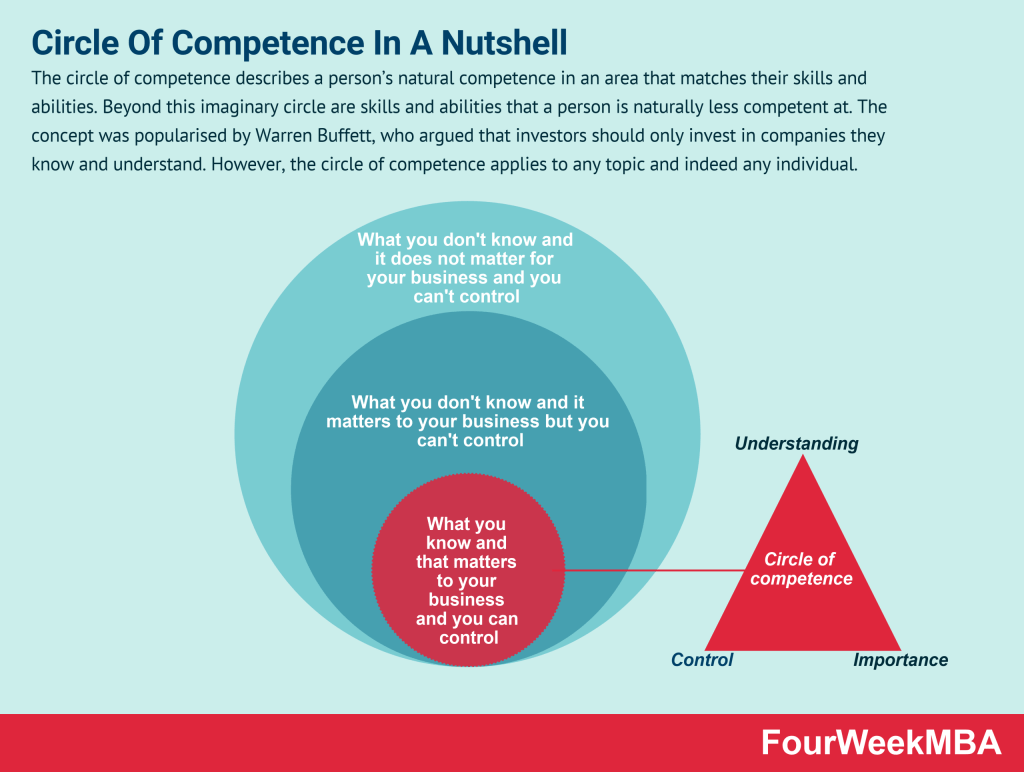
The circle of competence describes a person’s natural competence in an area that matches their skills and abilities. Beyond this imaginary circle are skills and abilities that a person is naturally less competent at. The concept was popularised by Warren Buffett, who argued that investors should only invest in companies they know and understand. However, the circle of competence applies to any topic and indeed any individual.
Economic or market moats represent the long-term business defensibility. Or how long a business can retain its competitive advantage in the marketplace over the years. Warren Buffet who popularized the term “moat” referred to it as a share of mind, opposite to market share, as such it is the characteristic that all valuable brands have.
The Buffet Indicator is a measure of the total value of all publicly-traded stocks in a country divided by that country’s GDP. It’s a measure and ratio to evaluate whether a market is undervalued or overvalued. It’s one of Warren Buffet’s favorite measures as a warning that financial markets might be overvalued and riskier.
Venture capital is a form of investing skewed toward high-risk bets, that are likely to fail. Therefore venture capitalists look for higher returns. Indeed, venture capital is based on the power law, or the law for which a small number of bets will pay off big time for the larger numbers of low-return or investments that will go to zero. That is the whole premise of venture capital.
Foreign direct investment occurs when an individual or business purchases an interest of 10% or more in a company that operates in a different country. According to the International Monetary Fund (IMF), this percentage implies that the investor can influence or participate in the management of an enterprise. When the interest is less than 10%, on the other hand, the IMF simply defines it as a security that is part of a stock portfolio. Foreign direct investment (FDI), therefore, involves the purchase of an interest in a company by an entity that is located in another country.
Micro-investing is the process of investing small amounts of money regularly. The process of micro-investing involves small and sometimes irregular investments where the individual can set up recurring payments or invest a lump sum as cash becomes available.
Meme stocks are securities that go viral online and attract the attention of the younger generation of retail investors. Meme investing, therefore, is a bottom-up, community-driven approach to investing that positions itself as the antonym to Wall Street investing. Also, meme investing often looks at attractive opportunities with lower liquidity that might be easier to overtake, thus enabling wide speculation, as “meme investors” often look for disproportionate short-term returns.
Retail investing is the act of non-professional investors buying and selling securities for their own purposes. Retail investing has become popular with the rise of zero commissions digital platforms enabling anyone with small portfolio to trade.
Accredited investors are individuals or entities deemed sophisticated enough to purchase securities that are not bound by the laws that protect normal investors. These may encompass venture capital, angel investments, private equity funds, hedge funds, real estate investment funds, and specialty investment funds such as those related to cryptocurrency. Accredited investors, therefore, are individuals or entities permitted to invest in securities that are complex, opaque, loosely regulated, or otherwise unregistered with a financial authority.
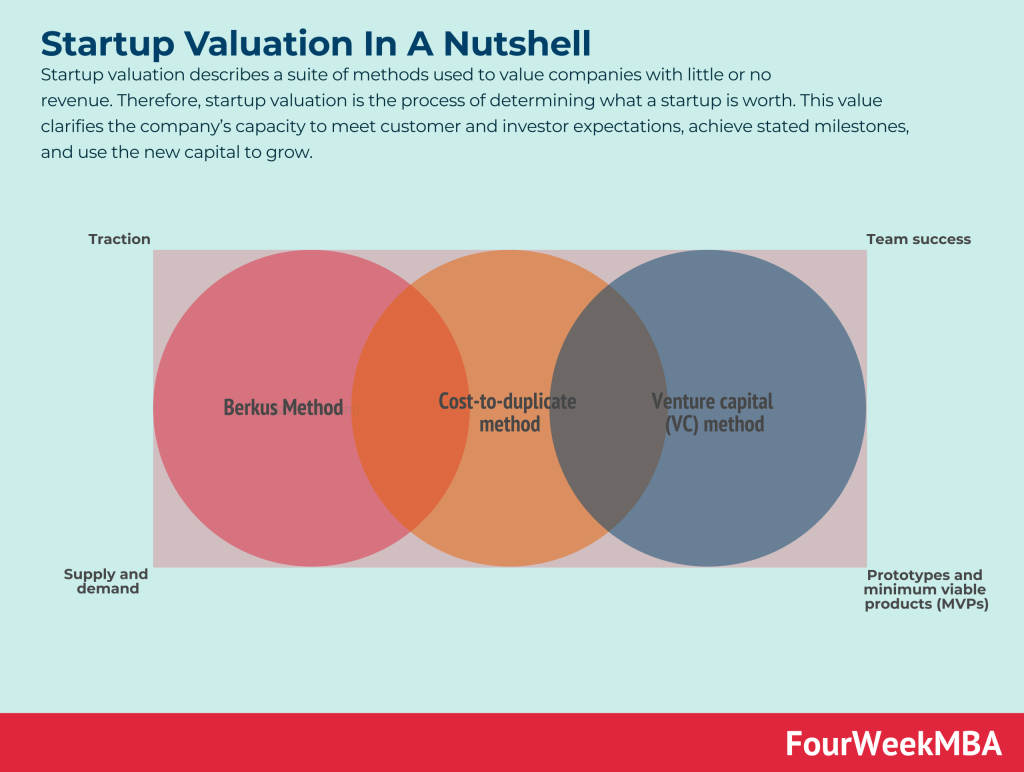
Startup valuation describes a suite of methods used to value companies with little or no revenue. Therefore, startup valuation is the process of determining what a startup is worth. This value clarifies the company’s capacity to meet customer and investor expectations, achieve stated milestones, and use the new capital to grow.
Profit is the total income that a company generates from its operations. This includes money from sales, investments, and other income sources. In contrast, cash flow is the money that flows in and out of a company. This distinction is critical to understand as a profitable company might be short of cash and have liquidity crises.
Double-entry accounting is the foundation of modern financial accounting. It’s based on the accounting equation, where assets equal liabilities plus equity. That is the fundamental unit to build financial statements (balance sheet, income statement, and cash flow statement). The basic concept of double-entry is that a single transaction, to be recorded, will hit two accounts.
The purpose of the balance sheet is to report how the resources to run the operations of the business were acquired. The Balance Sheet helps to assess the financial risk of a business and the simplest way to describe it is given by the accounting equation (assets = liability + equity).
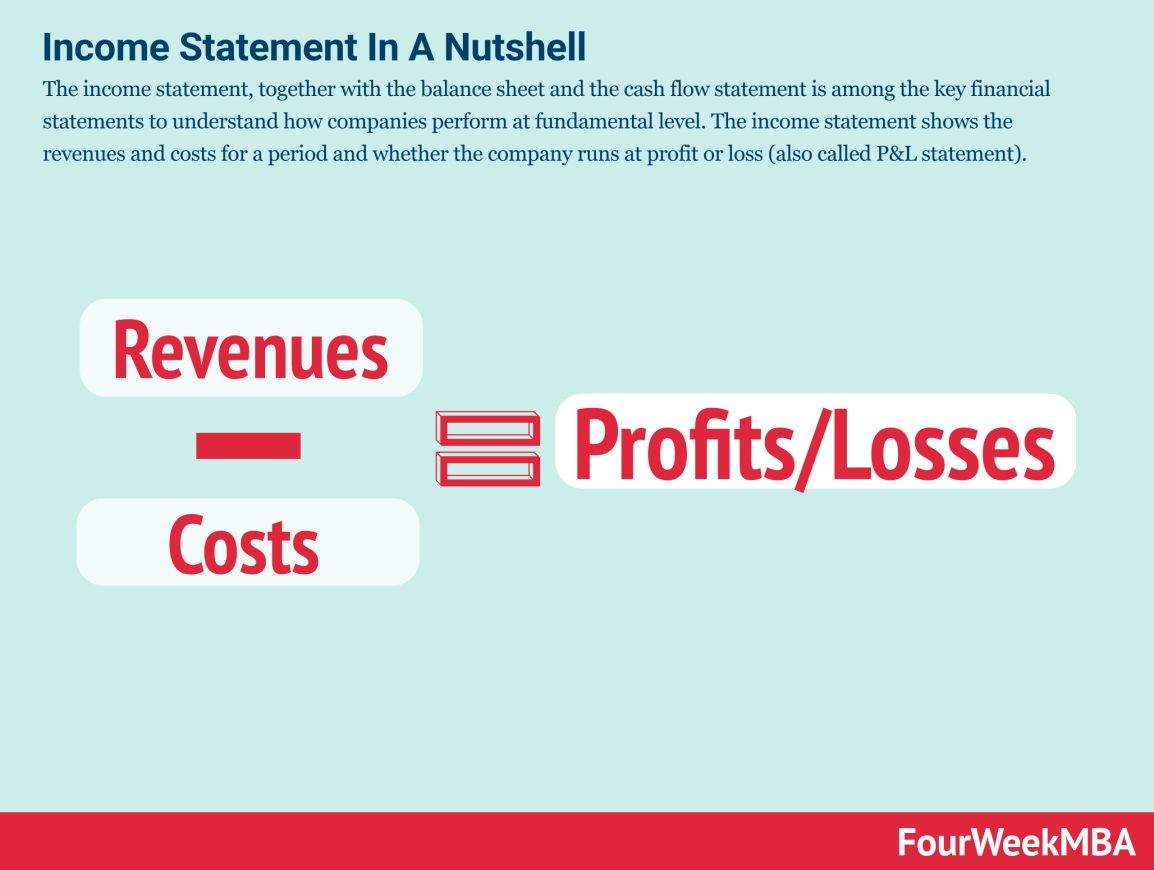
The income statement, together with the balance sheet and the cash flow statement is among the key financial statements to understand how companies perform at fundamental level. The income statement shows the revenues and costs for a period and whether the company runs at profit or loss (also called P&L statement).
The cash flow statement is the third main financial statement, together with income statement and the balance sheet. It helps to assess the liquidity of an organization by showing the cash balances coming from operations, investing and financing. The cash flow statement can be prepared with two separate methods: direct or indirect.
The capital structure shows how an organization financed its operations. Following the balance sheet structure, usually, assets of an organization can be built either by using equity or liability. Equity usually comprises endowment from shareholders and profit reserves. Where instead, liabilities can comprise either current (short-term debt) or non-current (long-term obligations).
Capital expenditure or capital expense represents the money spent toward things that can be classified as fixed asset, with a longer term value. As such they will be recorded under non-current assets, on the balance sheet, and they will be amortized over the years. The reduced value on the balance sheet is expensed through the profit and loss.
Financial statements help companies assess several aspects of the business, from profitability (income statement) to how assets are sourced (balance sheet), and cash inflows and outflows (cash flow statement). Financial statements are also mandatory to companies for tax purposes. They are also used by managers to assess the performance of the business.
Financial modeling involves the analysis of accounting, finance, and business data to predict future financial performance. Financial modeling is often used in valuation, which consists of estimating the value in dollar terms of a company based on several parameters. Some of the most common financial models comprise discounted cash flows, the M&A model, and the CCA model.
Business valuations involve a formal analysis of the key operational aspects of a business. A business valuation is an analysis used to determine the economic value of a business or company unit. It’s important to note that valuations are one part science and one part art. Analysts use professional judgment to consider the financial performance of a business with respect to local, national, or global economic conditions. They will also consider the total value of assets and liabilities, in addition to patented or proprietary technology.
The Weighted Average Cost of Capital can also be defined as the cost of capital. That’s a rate – net of the weight of the equity and debt the company holds – that assesses how much it cost to that firm to get capital in the form of equity, debt or both.
A financial option is a contract, defined as a derivative drawing its value on a set of underlying variables (perhaps the volatility of the stock underlying the option). It comprises two parties (option writer and option buyer). This contract offers the right of the option holder to purchase the underlying asset at an agreed price.
Gennaro is the creator of FourWeekMBA, which reached about four million business people, comprising C-level executives, investors, analysts, product managers, and aspiring digital entrepreneurs in 2022 alone | He is also Director of Sales for a high-tech scaleup in the AI Industry | In 2012, Gennaro earned an International MBA with emphasis on Corporate Finance and Business Strategy.