Outside sales occur when a salesperson meets with prospects or customers in the field. This sort of sales function is critical to acquire larger accounts, like enterprise customers, for which the acquisition process is usually longer, more complex and it requires the understanding of the target organization. Thus the outside sales will cut through the noise to acquire a large enterprise account for the organization.
Aspect
Explanation
Definition
Outside Sales, also known as field sales or external sales, is a sales approach where sales representatives or agents travel to meet clients and prospects in person to sell products or services, build relationships, and close deals. It contrasts with inside sales, which relies on remote communication methods like phone or email.
Key Concepts
– Face-to-Face Interaction: Sales representatives engage with clients and prospects in physical meetings. – Relationship Building: Emphasis on building trust and rapport through personal interactions. – Product Demonstrations: The ability to showcase and demonstrate products or services directly. – Targeted Prospecting: Identifying and visiting high-potential clients or leads. – On-Site Support: Providing on-site assistance and solutions.
Characteristics
– Personal Touch: Offers a personal and customized approach to sales. – High-Value Sales: Often used for complex or high-value products or services. – Travel: Requires extensive travel to meet clients at their locations. – Longer Sales Cycles: Typically involves longer sales cycles due to relationship-building aspects.
Examples
– A pharmaceutical sales representative meeting with doctors to promote and provide samples of medications. – An industrial equipment salesperson visiting manufacturing facilities to demonstrate machinery. – A real estate agent showing properties to potential buyers. – A business consultant meeting with clients to discuss tailored solutions.
Advantages
– Relationship Building: Allows for strong personal connections with clients. – Effective for Complex Sales: Suited for products or services that require in-depth explanation or customization. – Trust-Building: Face-to-face interactions can build trust more effectively. – Product Demonstrations: Enables hands-on product demonstrations.
Challenges
– High Costs: Involves significant expenses related to travel and logistics. – Time-Consuming: Requires substantial time investment for travel and in-person meetings. – Limited Reach: May not be suitable for reaching a large number of clients or prospects. – Geographic Limitations: Can be challenging in regions with vast territories or remote areas.
Adoption Trends
Outside Sales remains essential for industries where personal relationships and on-site demonstrations are critical, such as pharmaceuticals, real estate, and industrial equipment. Advances in technology have also enabled hybrid models that combine in-person and remote sales strategies.
Conclusion
Outside Sales is a sales approach that relies on in-person meetings and personal interactions with clients and prospects. While it offers the advantage of building strong relationships and demonstrating products effectively, it also involves substantial costs and time commitments. Choosing the right sales approach depends on the nature of the products or services and the target audience.
Outside sales representatives conduct sales in the field via face-to-face interactions in a location convenient to the prospect or customer.
The work environment of an outside sales professional tends to be less formal and more autonomous since it is outside the confines of an office setting. While the attractiveness of increased freedom cannot be denied, it is important to note that outside sales reps may be required to work on-demand according to the client’s schedule. This often means ensuring they are available outside of normal work hours.
Each outside sales representative may have a territory assigned to them and be responsible for educating the prospect about a product or service. What’s more, they must make their own travel arrangements and be flexible to scheduling changes or delays. Unlike inside sales professionals, those in outside sales place more emphasis on their physical appearance and need to be in the mood to entertain and network whenever the need arises.
Responsibilities associated with outside sales
Here is a more succinct look at the responsibilities associated with the outside sales profession:
Establish and nurture business relationships through regular meetings.
Demonstrate the suitability of a product or service vis-à-vis solving customer problems. This can be done with presentations, hands-on tutorials, and case studies.
Set and achieve monthly sales quotas.
Attend events, conferences, and conventions to present a product to service to interested parties.
Monitor the market for new entrants that could become competitors.
Map the various locations of clients using an app for territory and customer mapping.
Set up sales appointments using mobile CRM tools or by visiting prospects in person.
Research a prospect’s pain points in advance or be able to determine them from face-to-face interaction.
Utilize an outside sales app to keep a record of all customers, sales, hours worked, and generate reports based on tasks assigned and tasks completed.
Manage expenses associated with car rental, airline tickets, accommodation, and client entertainment such as restaurants and sporting events.
What traits does an outside sales rep need to possess?
At the very least, an outside sales rep needs to possess a Bachelor’s degree in communications, business, economics, or marketing. Similar qualifications that show experience in customer engagement may also be adequate.
They must also have a strong phone presence and be confident initiating conversations with prospects. Since no day in outside sales is the same as the last, the individual must also be adept at problem-solving in a diverse range of contexts.
Some of the more obvious traits include strong interpersonal skills, extraversion, detail-orientation, and the motivation and discipline necessary to work autonomously.
Examples of Outside Sales:
Pharmaceutical Sales Representative: These professionals visit healthcare providers in their offices or hospitals to promote and sell pharmaceutical products.
Real Estate Agent: Real estate agents meet with clients, show properties, and negotiate sales in person, often outside of a traditional office setting.
Insurance Sales Agent: Insurance agents meet with potential clients to discuss insurance needs, provide quotes, and sell insurance policies, often at the client’s location.
Software Sales Executive: These professionals visit businesses to demonstrate software solutions, provide personalized consultations, and close sales deals.
Advertising Sales Representative: Advertising sales reps meet with businesses to discuss advertising opportunities, present advertising packages, and secure contracts.
Medical Equipment Sales Representative: They visit healthcare facilities to showcase and sell medical equipment, ensuring it meets the needs of the institution.
Financial Advisor: Financial advisors meet with clients in person to discuss financial goals, recommend investment strategies, and manage financial portfolios.
Wholesale Account Manager: These individuals meet with wholesale customers to manage accounts, discuss product needs, and negotiate contracts.
Construction Sales Representative: They visit construction sites, meet with contractors, and provide construction materials or equipment solutions.
Automobile Salesperson: Car salespeople meet with customers at dealerships, offer test drives, and negotiate vehicle purchases.
Manufacturing Equipment Sales Representative: They visit manufacturing companies to sell machinery and equipment required for their production processes.
Industrial Supplies Sales Representative: Professionals in this role visit industrial businesses to sell supplies such as safety equipment, tools, or raw materials.
Wine Sales Representative: These reps visit restaurants, bars, and wine shops to promote and sell wines to establishments and distributors.
Educational Sales Representative: They meet with educational institutions to sell textbooks, educational software, or teaching materials.
Trade Show Exhibitor: Companies send representatives to trade shows and conventions to showcase products and services, engage with potential clients, and generate leads.
Farm Equipment Sales Representative: These reps visit farms to sell agricultural machinery, tractors, and farming equipment.
Telecommunications Sales Representative: They meet with businesses to discuss and sell phone systems, internet services, and communication solutions.
Catering Sales Manager: Catering sales managers meet with clients to plan and coordinate catering services for events and functions.
Energy Sales Representative: They visit residential or commercial clients to discuss energy solutions, such as solar panels or energy-efficient products.
Textile Sales Representative: Professionals in this role visit clothing manufacturers or retailers to sell fabrics, textiles, and fashion products.
Case Study: Outside Sales Strategy Implementation for Industrial Equipment Manufacturer
Overview: Implementing an outside sales strategy is essential for industrial equipment manufacturers to reach new customers, expand market share, and drive revenue growth. This case study examines how a manufacturer of industrial machinery successfully executed an outside sales strategy to increase sales in a competitive market environment.
Background: An industrial equipment manufacturer specializing in heavy machinery used in construction and manufacturing sectors aimed to boost sales and market penetration. With a focus on targeting large-scale projects and industrial clients, the company decided to deploy an outside sales strategy to engage customers directly in their operational environments.
Implementing Outside Sales Strategy:
1. Market Segmentation and Targeting: The company conducted thorough market research and segmentation analysis to identify high-potential customer segments and industries. Based on criteria such as project size, industry demand, and geographical location, the sales team prioritized target markets for outside sales efforts.
Case Example: The company identified construction companies, manufacturing plants, infrastructure projects, and government agencies as primary target segments. The sales team utilized market data, industry trends, and customer insights to tailor their outside sales approach and value propositions to each target segment’s specific needs and requirements.
2. Field Sales Team Deployment: To execute the outside sales strategy effectively, the company deployed a dedicated field sales team tasked with building relationships, generating leads, and closing deals with prospective customers. The field sales representatives were equipped with the necessary tools, resources, and support to engage customers on-site and in-person.
Case Example: The field sales team comprised experienced sales professionals with industry knowledge and technical expertise in industrial machinery. Equipped with mobile devices, product catalogs, and marketing materials, the sales representatives conducted regular site visits, client meetings, and product demonstrations to showcase the company’s offerings and value proposition.
3. Relationship Building and Consultative Selling: Outside sales efforts focused on building strong relationships with key decision-makers and influencers within target accounts. Sales representatives adopted a consultative selling approach, engaging prospects in meaningful conversations, understanding their pain points, and offering tailored solutions to address specific challenges.
Case Example: Sales representatives invested time in building rapport and trust with customers by demonstrating industry expertise, product knowledge, and a commitment to customer success. They conducted site assessments, equipment demonstrations, and feasibility studies to help customers make informed purchase decisions and overcome potential objections.
4. Sales Support and Follow-Up: To ensure the success of outside sales initiatives, the company provided comprehensive sales support and follow-up mechanisms to address customer inquiries, facilitate order processing, and provide ongoing assistance throughout the sales cycle. This included dedicated customer service teams, technical support resources, and post-sales service offerings.
Case Example: After conducting product demonstrations or submitting proposals, sales representatives followed up with customers to address any questions, concerns, or objections promptly. They collaborated with internal teams to provide timely responses, negotiate pricing, and finalize contracts, ensuring a seamless transition from prospecting to closing.
Results and Impact: By implementing an outside sales strategy, the industrial equipment manufacturer achieved significant results:
Increased Sales Revenue: The company experienced a notable increase in sales revenue attributed to successful outside sales efforts and customer acquisitions.
Market Expansion: The outside sales strategy enabled the company to expand its market presence, penetrate new territories, and secure contracts with key accounts.
Customer Satisfaction: By prioritizing relationship building and consultative selling, the company enhanced customer satisfaction levels, leading to repeat business and referrals.
Conclusion: Implementing an outside sales strategy proved effective for the industrial equipment manufacturer, allowing them to engage customers directly, build relationships, and drive revenue growth. By deploying a dedicated field sales team, focusing on relationship building, and providing comprehensive sales support, the company successfully expanded its market reach and established itself as a trusted partner in the competitive industrial machinery sector.
Key takeaways:
Outside sales occur when a salesperson meets with prospects or customers in the field.
Responsibilities associated with outside sales include the ability to build relationships, demonstrate products, attend events and conventions, monitor the market for new entrants, and map the location of customers in a sales territory.
Outside sales require the individual to possess a strong phone presence and be able to problem-solve in diverse contexts. A Bachelor’s degree in communications, business, economics, marketing, or similar is essential.
Key Highlights of Outside Sales:
Definition: Outside sales involve salespeople meeting prospects or customers in person, often in the field. This approach is crucial for acquiring larger accounts, especially enterprise customers, due to their longer and more complex acquisition process.
Face-to-Face Interactions: Outside sales representatives engage with prospects and customers through face-to-face interactions, usually in a location convenient for the client.
Work Environment: Outside sales roles are less formal and more autonomous, offering increased freedom. However, these professionals may need to work on-demand, including outside regular office hours.
Territory Management: Outside sales reps often have assigned territories and are responsible for educating prospects about products or services. They must handle their own travel arrangements and be flexible with scheduling changes.
Emphasis on Appearance and Networking: Physical appearance and the ability to entertain and network are more critical for outside sales compared to inside sales roles.
Responsibilities: Key responsibilities of outside sales reps include building and nurturing business relationships, demonstrating product suitability, meeting sales quotas, attending events and conferences, monitoring the market for competitors, and managing client locations using mapping tools.
Appointment Setting: They set up sales appointments using mobile CRM tools and research prospects’ pain points in advance or through face-to-face interactions.
Expense Management: Outside sales reps are responsible for managing expenses related to travel, accommodation, and client entertainment.
Required Traits: Traits for success in outside sales include a Bachelor’s degree in relevant fields, strong phone presence, problem-solving skills in diverse contexts, interpersonal skills, extraversion, attention to detail, and self-motivation for autonomous work.
Outside vs. Inside vs. Field Sales
Aspect
Outside Sales
Inside Sales
Field Sales
Primary Location
Conducts sales activities outside the office, meeting clients face-to-face in their own environment.
Conducts sales activities remotely from the office, typically via phone, email, or video conferencing.
Conducts sales activities primarily outside the office, meeting clients in their own environment or designated locations.
Customer Interaction
Emphasis on building relationships through in-person meetings, presentations, and product demonstrations.
Relies on virtual interactions such as phone calls, emails, and video conferences to engage with customers.
Prioritizes face-to-face interactions with customers, allowing for deeper relationship building and rapport.
Sales Process
Involves traveling to client locations, prospecting, cold calling, and conducting meetings to close deals.
Focuses on lead generation, qualification, and nurturing through remote communication channels and CRM tools.
Includes traveling to client sites, conducting product demonstrations, negotiating contracts, and closing deals in-person.
Territory Management
Manages a designated geographic territory, building relationships and conducting sales activities within that area.
May manage a specific market segment or vertical, utilizing technology and data to target and engage prospects remotely.
Manages a defined sales territory, often covering a larger geographic area, requiring extensive travel to reach clients.
Sales Cycle
Generally longer sales cycles due to the need for in-person meetings and relationship-building efforts.
Can have shorter sales cycles due to more frequent and efficient communication methods and technology tools.
Sales cycles may vary depending on the complexity of the sale and the nature of the industry, often involving multiple meetings and touchpoints.
Relationship Building
Prioritizes face-to-face interactions to establish trust, credibility, and rapport with clients.
Relies on building relationships through remote communication channels, requiring strong communication and listening skills.
Focuses on building strong relationships through in-person interactions, allowing for deeper connections and understanding.
Adaptability
Requires adaptability to various environments and situations, including travel and client-specific needs.
Requires adaptability to changing technologies and virtual communication methods to engage with clients effectively.
Requires adaptability to different client personalities and preferences, as well as varied travel conditions and schedules.
Time Management
Requires effective time management skills to balance travel, client meetings, and administrative tasks.
Requires strong time management skills to efficiently manage lead follow-ups, meetings, and CRM updates.
Requires efficient time management to balance travel, client meetings, and sales activities while on the road.
Networking
Offers ample opportunities for networking at industry events, trade shows, and client meetings.
May participate in virtual networking events, webinars, and online communities to connect with prospects and peers.
Involves networking at industry events, conferences, and client meetings, fostering relationships with key stakeholders.
Business development comprises a set of strategies and actions to grow a business via a mixture of sales, marketing, and distribution. While marketing usually relies on automation to reach a wider audience, and sales typically leverage a one-to-one approach. The business development’s role is that of generating distribution.
The more you move from consumers to enterprise clients, the more you’ll need a sales force able to manage complex sales. As a rule of thumb, a more expensive product, in B2B or Enterprise, will require an organizational structure around sales. An inexpensive product to be offered to consumers will leverage on marketing.
A sales cycle is the process that your company takes to sell your services and products. In simple words, it’s a series of steps that your sales reps need to go through with prospects that lead up to a closed sale.
RevOps – short for Revenue Operations – is a framework that aims to maximize the revenue potential of an organization. RevOps seeks to align these departments by giving them access to the same data and tools. With shared information, each then understands their role in the sales funnel and can work collaboratively to increase revenue.
In negotiation theory, BATNA stands for “Best Alternative To a Negotiated Agreement,” and it’s one of the key tenets of negotiation theory. Indeed, it describes the best course of action a party can take if negotiations fail to reach an agreement. This simple strategy can help improve the negotiation as each party is (in theory) willing to take the best course of action, as otherwise, an agreement won’t be reached.
In negotiation, WATNA stands for “worst alternative to a negotiated agreement,” representing one of several alternative options if a resolution cannot be reached. This is a useful technique to help understand what might be a negotiation outcome, that even if negative is still better than a WATNA, making the deal still feasible.
The ZOPA (zone of possible agreement) describes an area in which two negotiation parties may find common ground. Indeed, ZOPA is critical to explore the deals where the parties get a mutually beneficial outcome to prevent the risk of a win-lose, or lose-win scenario. And therefore get to the point of a win-win negotiation outcome.
Revenue modeling is a process of incorporating a sustainable financial model for revenue generation within a business model design. Revenue modeling can help to understand what options make more sense in creating a digital business from scratch; alternatively, it can help in analyzing existing digital businesses and reverse engineer them.
Customer experience maps are visual representations of every encounter a customer has with a brand. On a customer experience map, interactions called touchpoints visually denote each interaction that a business has with its consumers. Typically, these include every interaction from the first contact to marketing, branding, sales, and customer support.
AIDA stands for attention, interest, desire, and action. That is a model that is used in marketing to describe the potential journey a customer might go through before purchasing a product or service. The AIDA model helps organizations focus their efforts when optimizing their marketing activities based on the customers’ journeys.
Social selling is a process of developing trust, rapport, and a relationship with a prospect to enhance the sales cycle. It usually happens through tech platforms (like LinkedIn, Twitter, Facebook, and more), which enable salespeople to engage with potential prospects before closing the sale, thus becoming more effective.
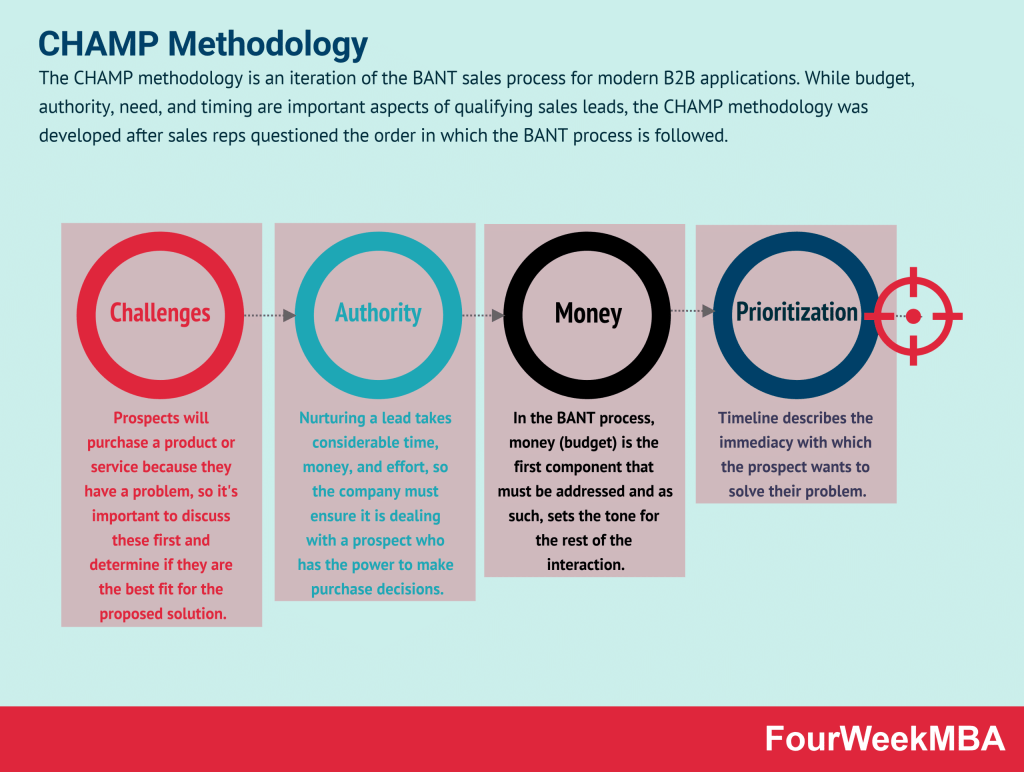
The CHAMP methodology is an iteration of the BANT sales process for modern B2B applications. While budget, authority, need, and timing are important aspects of qualifying sales leads, the CHAMP methodology was developed after sales reps questioned the order in which the BANT process is followed.
The BANT process was conceived at IBM in the 1950s as a way to quickly identify prospects most likely to make a purchase. Despite its introduction around 70 years ago, the BANT process remains relevant today and was formally adopted into IBM’s Business Agility Solution Identification Guide.
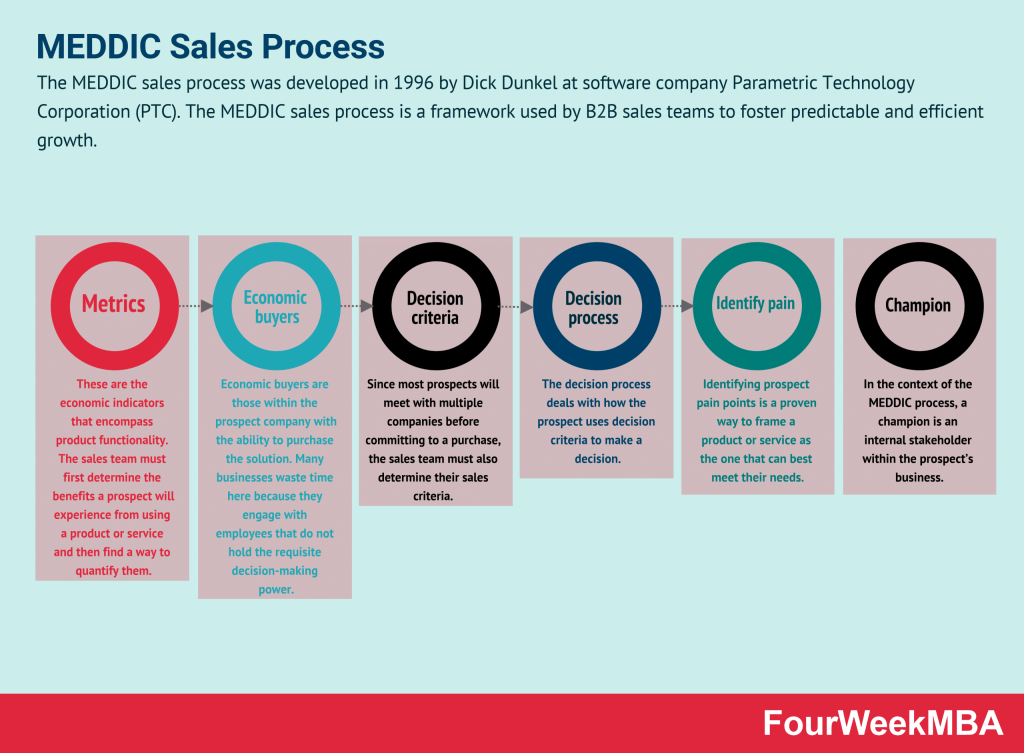
The MEDDIC sales process was developed in 1996 by Dick Dunkel at software company Parametric Technology Corporation (PTC). The MEDDIC sales process is a framework used by B2B sales teams to foster predictable and efficient growth.
STP marketing simplifies the market segmentation process and is one of the most commonly used approaches in modern marketing. The core focus of STP marketing is commercial effectiveness. Marketers use the approach to select the most valuable segments from a target audience and develop a product positioning strategy and marketing mix for each.
The sales funnel is a model used in marketing to represent an ideal, potential journey that potential customers go through before becoming actual customers. As a representation, it is also often an approximation, that helps marketing and sales teams structure their processes at scale, thus building repeatable sales and marketing tactics to convert customers.
Venture capitalist, Dave McClure, coined the acronym AARRR which is a simplified model that enables to understand what metrics and channels to look at, at each stage for the users’ path toward becoming customers and referrers of a brand.
The general concept of Bootstrapping connects to “a self-starting process that is supposed to proceed without external input.” In business, Bootstrapping means financing the growth of the company from the available cash flows produced by a viable business model. Bootstrapping requires the mastery of the key customers driving growth.
The virtuous cycle is a positive loop or a set of positive loops that trigger a non-linear growth. Indeed, in the context of digital platforms, virtuous cycles – also defined as flywheel models – help companies capture more market shares by accelerating growth. The classic example is Amazon’s lower prices driving more consumers, driving more sellers, thus improving variety and convenience, thus accelerating growth.
Business storytelling is a critical part of developing a business model. Indeed, the way you frame the story of your organization will influence its brand in the long-term. That’s because your brand story is tied to your brand identity, and it enables people to identify with a company.
Enterprise sales describes the procurement of large contracts that tend to be characterized by multiple decision-makers, complicated implementation, higher risk levels, or longer sales cycles.
Outside sales occur when a salesperson meets with prospects or customers in the field. This sort of sales function is critical to acquire larger accounts, like enterprise customers, for which the acquisition process is usually longer, more complex and it requires the understanding of the target organization. Thus the outside sales will cut through the noise to acquire a large enterprise account for the organization.
A freeterprise is a combination of free and enterprise where free professional accounts are driven into the funnel through the free product. As the opportunity is identified the company assigns the free account to a salesperson within the organization (inside sales or fields sales) to convert that into a B2B/enterprise account.
Zero to One is a book by Peter Thiel. But it also represents a business mindset, more typical of tech, where building something wholly new is the default mode, rather than building something incrementally better. The core premise of Zero to One then is that it’s much more valuable to create a whole new market/product rather than starting from existing markets.
Palantir is a software company offering intelligence services from governments and institutions to large commercial organizations. The company’s two main platforms Gotham and Foundry, are integrated at enterprise-level. Its business model follows three phases: Acquire, Expand, and Scale. The company bears the pilot costs in the acquire and expand phases, and it runs at a loss. Where in the scale phase, the customers’ contribution margins become positive.
Consultative selling is a sales approach favoring relationship building and open dialogue to adequately meet the needs of a prospective customer. By building trust quickly a consultative selling approach can help the customer better meet her/his expectations and the salesperson hit her/his targets more effectively.
A unique selling proposition (USP) enables a business to differentiate itself from its competitors. Importantly, a USP enables a business to stand for something that they, in turn, become known among consumers. A strong and recognizable USP is crucial to operating successfully in competitive markets.
Gennaro is the creator of FourWeekMBA, which reached about four million business people, comprising C-level executives, investors, analysts, product managers, and aspiring digital entrepreneurs in 2022 alone | He is also Director of Sales for a high-tech scaleup in the AI Industry | In 2012, Gennaro earned an International MBA with emphasis on Corporate Finance and Business Strategy.