The OODA loop was popularized by U.S. Air Force fighter pilot Colonel John Boyd to describe maneuver warfare during the Korean War. The OODA loop is a four-step approach to decision making where strategies must be adjusted quickly. Those four steps comprise observe, orient, decide, and act.
RATER Model
Key Elements
Analysis
Implications
Applications
Examples
Definition
The RATER Model is a framework used to evaluate and measure the quality of services based on five key dimensions: Reliability, Assurance, Tangibles, Empathy, and Responsiveness. It helps assess customers’ perceptions of service quality.
Analyzing the RATER Model involves understanding and evaluating each of its five dimensions to gauge the quality of a service. It requires collecting feedback from customers or users to assess how well a service meets their expectations in each dimension.
The RATER Model provides valuable insights into the strengths and weaknesses of a service, allowing organizations to identify areas for improvement. It helps in enhancing customer satisfaction, loyalty, and overall service performance.
The RATER Model is widely used in service industries such as hospitality, healthcare, banking, and customer support. Organizations use it to measure and improve the quality of their services and ensure they align with customer expectations.
– Conducting customer surveys to assess service quality and identify areas needing improvement. – Training and development programs for employees to enhance their ability to deliver high-quality service in all five dimensions. – Benchmarking against competitors and industry standards to maintain or achieve a competitive advantage.
Reliability
Reliability refers to the ability of a service provider to consistently deliver accurate, dependable, and error-free services. Customers expect services to be reliable and free from disruptions or inconsistencies.
Analyzing reliability involves assessing the consistency of service delivery, error rates, and the ability to meet commitments and promises. High reliability indicates that a service can be trusted and relied upon by customers.
Reliability is critical for building trust and confidence among customers. A lack of reliability can lead to customer dissatisfaction, lost business, and a damaged reputation. Organizations must prioritize reliability to meet customer expectations.
Reliability is essential in various service sectors, including transportation, healthcare, and technology support. It plays a significant role in retaining customers and earning their loyalty. Organizations focus on minimizing service interruptions and errors to enhance reliability.
– Ensuring that scheduled services are consistently provided on time and as promised. – Implementing quality control measures to reduce errors and defects in service delivery. – Monitoring and improving service performance to maintain a high level of reliability.
Assurance
Assurance pertains to the competence, courtesy, credibility, and professionalism exhibited by service providers. Customers seek assurance that service providers have the necessary skills and knowledge to meet their needs.
Analyzing assurance involves evaluating the qualifications, training, and behavior of service personnel. It also includes assessing the provider’s ability to convey trustworthiness and confidence to customers. Assurance helps build credibility and trust.
Assurance is crucial for instilling confidence in customers and ensuring they feel secure and valued during service interactions. Service providers should invest in employee training and professionalism to enhance assurance.
Assurance is especially significant in industries like healthcare, finance, and legal services, where customers rely on the expertise and trustworthiness of service providers. Organizations focus on training and developing employees to improve assurance.
– Providing employees with ongoing training and development opportunities to enhance their expertise and professionalism. – Implementing policies and practices that promote courtesy, respect, and effective communication with customers. – Building trust and credibility through transparent and ethical business practices.
Tangibles
Tangibles refer to the physical or tangible aspects of a service, such as facilities, equipment, appearance, and the overall presentation of service elements. Tangibles influence customers’ perceptions of service quality.
Analyzing tangibles involves assessing the physical environment, equipment quality, cleanliness, and the appearance of service facilities. High-quality tangibles contribute to positive perceptions of service quality and professionalism.
Tangibles play a role in creating a positive first impression and influencing overall customer satisfaction. Neglecting the physical aspects of service can lead to a negative perception of quality, even if the core service is excellent.
Tangibles are relevant in industries like hospitality, retail, and restaurants, where the physical environment and presentation significantly impact the customer experience. Organizations invest in improving tangibles to enhance customer perceptions.
– Regularly maintaining and upgrading facilities and equipment to ensure they are clean, modern, and in good working condition. – Training employees on maintaining a clean and organized environment. – Designing service facilities to be aesthetically pleasing and comfortable for customers.
Empathy
Empathy refers to the ability of service providers to understand, care for, and address customers’ individual needs and concerns. It involves showing genuine concern and interest in customers’ well-being.
Analyzing empathy involves evaluating how well service providers listen to customers, understand their unique needs, and provide personalized support. High empathy levels result in customers feeling valued and understood.
Empathy is essential for building strong customer relationships and loyalty. It helps create a customer-centric culture where customers believe their concerns and needs are genuinely cared for. Organizations must prioritize empathy in their service interactions.
Empathy is relevant in industries such as healthcare, customer service, and hospitality, where personalized care and attention to individual needs are critical. Organizations train employees to develop empathy and prioritize customer satisfaction.
– Providing training programs that emphasize active listening and the importance of addressing customer concerns empathetically. – Encouraging employees to establish rapport with customers and understand their unique preferences and requirements. – Implementing feedback mechanisms to gather customer input and improve empathy in service interactions.
Responsiveness
Responsiveness refers to the willingness and ability of service providers to promptly address customer inquiries, requests, and problems. It involves being accessible and proactive in assisting customers.
Analyzing responsiveness involves assessing the speed and effectiveness of service providers’ responses to customer inquiries, issues, or requests. Quick and helpful responses demonstrate a high level of responsiveness and customer focus.
Responsiveness is crucial for customer satisfaction, as customers expect timely assistance and solutions to their concerns. Service providers should prioritize prompt responses to enhance the customer experience and resolve issues efficiently.
Responsiveness is essential in various service sectors, including customer support, hospitality, and e-commerce, where timely assistance and problem resolution are critical for customer retention. Organizations implement efficient communication channels and response systems.
– Implementing multi-channel communication options for customers, such as phone, email, chat, and social media, to enhance accessibility. – Training employees to respond promptly and effectively to customer inquiries and concerns. – Establishing clear protocols for addressing and resolving customer issues in a timely manner.
OODA Loop
Key Elements
Analysis
Implications
Applications
Examples
Definition
The OODA Loop is a decision-making and action-oriented process consisting of four stages: Observe, Orient, Decide, and Act. It was developed by military strategist and Colonel John Boyd.
Analyzing the OODA Loop involves understanding each stage’s significance and their sequential nature. It emphasizes the importance of rapid decision-making and adaptability to changing situations.
The OODA Loop emphasizes the need for agility and quick responses in dynamic environments. Organizations that effectively apply the OODA Loop can gain a competitive edge by outmaneuvering competitors and responding effectively to changing conditions.
The OODA Loop is widely used in military operations, aviation, business strategy, and emergency response situations. Organizations implement it to improve decision-making, agility, and response capabilities.
– Military operations: Planning and executing missions while adapting to the enemy’s actions. – Business strategy: Responding to market changes, competition, and customer demands swiftly. – Emergency response: Managing crises and making decisions under pressure to save lives and resources.
Observe
The “Observe” stage involves collecting and gathering information about the environment, situation, or problem. It includes surveillance, data collection, and monitoring.
Analyzing the “Observe” stage entails assessing the sources of information, data accuracy, and the ability to detect relevant changes and patterns. Timely and accurate observation is crucial for making informed decisions.
Effective observation enables organizations to stay informed about changing conditions, threats, and opportunities. It provides the foundation for the subsequent stages of the OODA Loop and supports proactive decision-making.
The “Observe” stage is applicable in various contexts, such as competitive intelligence, threat detection, and market research. Organizations invest in data collection and analysis capabilities to enhance observation.
– Competitive intelligence: Monitoring competitors’ actions, market trends, and industry developments. – Security and surveillance: Detecting and responding to security threats and breaches. – Market research: Gathering data on customer preferences, buying behavior, and market dynamics.
Orient
The “Orient” stage involves analyzing and synthesizing the information collected during the “Observe” stage. It includes understanding the context, assessing potential impacts, and forming a mental model of the situation.
Analyzing the “Orient” stage requires evaluating how well organizations interpret data, adapt to changing circumstances, and develop a comprehensive understanding of the situation. Effective orientation supports accurate decision-making.
Effective orientation enables organizations to make sense of complex and dynamic situations. It helps decision-makers align their mental models with reality, enabling more informed and adaptive decisions.
The “Orient” stage is relevant in strategic planning, risk assessment, and crisis management. Organizations prioritize continuous learning and adaptability to enhance their orientation capabilities.
– Strategic planning: Assessing market conditions, competitive threats, and future trends to develop effective strategies. – Crisis management: Understanding the impact and implications of crisis situations and formulating response plans. – Risk assessment: Evaluating potential risks and vulnerabilities to make informed decisions.
Decide
The “Decide” stage involves choosing a course of action based on the information gathered and the mental model developed during the previous stages. It requires evaluating options and making a timely decision.
Analyzing the “Decide” stage includes assessing the decision-making process, considering alternatives, evaluating risks, and ensuring that decisions align with organizational goals and objectives. Timely and effective decisions are essential.
Effective decision-making in the “Decide” stage enables organizations to respond rapidly and proactively to changing conditions. It helps prevent indecision and ensures that actions align with organizational objectives and strategies.
The “Decide” stage is applicable in various contexts, including project management, crisis response, and business operations. Organizations prioritize decision-making processes that are efficient and well-informed.
– Project management: Selecting project strategies, allocating resources, and approving project plans. – Crisis response: Determining the appropriate actions to mitigate the impact of a crisis or emergency. – Business operations: Making operational decisions related to production, logistics, and resource allocation.
Act
The “Act” stage involves implementing the chosen course of action based on the decision made in the previous stage. It requires executing plans, deploying resources, and taking concrete steps to address the situation.
Analyzing the “Act” stage entails evaluating the execution of plans, resource allocation, and the effectiveness of actions taken. Effective action requires coordination, communication, and a commitment to achieving the desired outcomes.
Effective action ensures that decisions are translated into tangible results and outcomes. It is the stage where organizations demonstrate their ability to respond rapidly and effectively to changing conditions.
The “Act” stage is relevant in project execution, crisis response, and operational management. Organizations prioritize execution excellence and monitor progress to achieve desired results.
– Project execution: Implementing project plans, monitoring progress, and achieving project objectives. – Crisis response: Deploying resources and personnel to address emergencies and mitigate risks. – Operational management: Executing operational plans to meet production, quality, and customer service goals.
Boyd noted that USAF pilots flying F-86 fighter jets were able to consistently down the Korean Mig-15 by a factor of 10 to 1. This was even though the Mig-15 was a technically superior aircraft, with better acceleration and higher climb rates.
However, the F-86 had two distinct advantages. Thanks to a hydraulic control system, it could transition from one maneuver to another in rapid succession. The canopy of the F-86 was also more expansive, allowing pilots to better observe and react more quickly in combat. Ultimately, the F-86 was the more agile of the two jets.
In the context of the OODA loop, agility is represented as a series of decision-making cycles. Businesses can use these cycles to solve specific problems quickly, thereby remaining competitive.
In the next section, we will look at the cycle in more detail.
Decision-making cycles of the OODA loop
In its simplest form, the OODA loop has four stages.
Stage 1 – Observe
What are the internal and external drivers of change? Where are the inflection points in trends?
Decision-makers must observe changes at the micro or macro level to determine whether a response is required. Drivers might include ever-increasing internet speeds or the continued replacement of jobs with technology and automation.
Stage 2 – Orient
Is the business aligned with the observations made? Scenario planning is useful in ensuring that strategic plans are meeting expectations or challenging expectations.
This is the most important step because it determines how a business will position itself to take advantage of its observations. It’s also the step most vulnerable to bias, which has five main influences:
Cultural traditions.
An ability to analyze and synthesize.
Genetic heritage.
New information.
Previous experience.
As a rule, each decision made in the orienting process must be based on evidence. Businesses must also understand the perspective of a competitor by using the five influences above. This, to some extent, can predict how a competitor will behave.
Stage 3 – Decide
What is the most appropriate course of action?
Here, taking no action is sometimes the best choice. Indeed, businesses should avoid acting for the sake of it.
Since the OODA loop advocates quick decision making in fluid environments, businesses often cycle between Stage 1 and Stage 3 as more information becomes available.
Stage 4 – Act
Once a decision is made it is important to act quickly and implement it. The results of decision implementation are then fed back into the observation stage and their impact re-assessed.
Note also that the OODA loop is not a cyclical process but a series of iterative adjustments.
Businesses should also remember that it favors quick decision making to remain competitive. For some decisions where the cost of failure is high, a more considered approach is required.
For example, a relatively minor change in customer refund policy can be made quickly and adapted if required. But a significant product refresh has a higher cost of failure and as a result, would likely reduce competitiveness if not implemented properly.
Drawbacks of the OODA Loop
Complexity in Practical Application:
Can Be Overly Abstract: The OODA Loop is a conceptual framework, and its abstract nature can make practical application challenging for some individuals or organizations.
Difficulty in Fast-Paced Environments: Rapidly executing the loop in extremely fast-paced or complex environments can be challenging, potentially leading to decision-making delays.
Risk of Misinterpretation:
Potential for Oversimplification: Users might oversimplify the steps, especially ‘Orient,’ which is crucial but can be conceptually complex.
Misapplication: Without a clear understanding, there’s a risk of misapplying the OODA Loop principles, leading to ineffective decision-making.
Requires Continuous Feedback and Adaptation:
Need for Constant Adjustment: The effectiveness of the OODA Loop hinges on continuous feedback and adaptation, which can be resource-intensive.
Information Overload: Rapid cycling through the loop can result in information overload, making it difficult to make informed decisions.
Limited Focus on Collaborative Decision-Making:
Individual-Centric Model: Originally designed for fighter pilots, the OODA Loop is heavily individual-centric and may not fully account for the complexities of team-based decision-making.
When to Use the OODA Loop
Ideal Scenarios:
High-Stakes or Competitive Environments: Particularly useful in military, business, or sports scenarios where quick and effective decision-making under pressure is crucial.
Rapidly Changing Situations: Effective in environments where situations evolve rapidly and require quick adaptation.
Strategic Application:
As a Personal Decision-Making Tool: Can be employed as a personal strategy for improving situational awareness and decision-making speed.
In Crisis Management: Useful for navigating rapidly unfolding crisis situations where quick, adaptive responses are necessary.
How to Use the OODA Loop
Implementing the Four Stages:
Observe: Gather as much information as possible about the situation and environment.
Orient: Analyze and synthesize the information, taking into account personal experience, cultural background, and any new information.
Decide: Based on your orientation, make a decision on the best course of action.
Act: Implement the decision and observe the results.
Continuous Cycling:
Rapid Iteration: The OODA Loop is designed to be cycled through rapidly for continuous reassessment and adaptation.
Iterative Learning: Learn from each loop cycle to improve decision-making in future iterations.
Collaborative Application:
Team Implementation: Adapt the OODA Loop for team use by clearly defining roles and ensuring efficient communication.
Integration with Other Decision-Making Models: Combine with other frameworks for more comprehensive team-based decision-making strategies.
What to Expect from Implementing the OODA Loop
Enhanced Decision-Making:
Faster Responses: Aids in making faster decisions under pressure.
Improved Situational Awareness: Enhances the ability to understand and adapt to changing circumstances.
Challenges in Application:
Potential for Confusion: Rapid cycling through stages without thorough understanding can lead to confusion or ineffective decisions.
Risk of Hasty Decisions: The emphasis on speed can sometimes lead to premature or ill-considered decisions.
Organizational Impact:
Promotes Adaptability: Encourages a culture of flexibility and adaptability within the organization.
Enhances Strategic Thinking: Improves overall strategic thinking by fostering continuous assessment and adjustment.
Long-Term Benefits:
Sustained Competitive Advantage: In competitive environments, mastering the OODA Loop can provide a sustained advantage by staying ahead of opponents or competitors.
Continuous Improvement: Promotes an ongoing cycle of learning and improvement in decision-making processes.
OODA loop examples
So what are some examples of OODA loops outside military contexts? Let’s take a look at some scenarios used in everyday life to make better decisions.
Professional development
Imagine that you feel stuck in your current career and want to enhance your skill set and boost your career prospects in the process.
Observe – what are the specific skills you need to learn to reach your objectives? Observation can be used as a tool to ensure you are staying abreast of the latest trends and developments in your industry. Thus, it’s important to see the observation phase as a chance to asset your current skillset. Is it still relevant and valuable?
Orient – the most important phase of any OODA loop is the orientation phase. In this case, you’ll be required to be completely honest with yourself and spot errors or contradictions in your thinking. What is standing between you and career success? What is preventing you from operating outside your comfort zone? Is it based on rigid beliefs instead of logic and rationality? Maybe you were once fired in a similar role and falsely believe you would be unqualified for future roles.
Decide – in the third phase, take what you have learned from the previous two phases and come up with a concrete action plan. Choose one or two meaningful tasks to focus on instead of setting too many simultaneous goals. There have never been more opportunities for career advancement than there are today, but this can be a blessing and a curse since it leads to information overload. Think hard about the best course of action with respect to your unique situation.
Act – while you can theorize about the best course of action indefinitely, it is only action itself that can determine whether you are on the right path. Acting on our intentions also means we will inevitably make mistakes, but missteps should be seen as vehicles for learning, growth, and career development.
Blockbuster and Netflix
In the early 2000s, DVD rental services Blockbuster and Netflix were in direct competition with each other.
Observe – in 2002, Netflix co-founders Marc Randolph and Reed Hastings observe that the speed of consumer broadband is increasing rapidly. As a consequence, the internet starts to become intertwined with consumers’ lives. Blockbuster, of course, maintains its belief that consumers will want to rent DVDs from a store for the foreseeable future.
Orient – Netflix then orients itself toward a future where consumers stream their favorite films and television shows online. Since the market (and indeed technology) is not quite ready for the revolution that is to come, Netflix has time to analyze and evaluate information, leverage raw statistics to develop industry insights, and size up potential competitors, threats, partners, and opportunities.
Decide – at this point, Netflix had several options. The company could upload its entire DVD library onto servers, negotiate with producers to develop exclusive streaming content, or launch a scaled-back trial service. Netflix could also develop a box unit that downloaded movies while consumers slept so they’d be ready to view the next day. Ultimately, the co-founders belief in streaming was reinforced after witnessing the popularity of low-resolution video streaming on YouTube.
The OODA loop is a quick, effective, and proactive decision-making process that allows businesses to remain competitive.
The OODA loop is based on four stages that help decision-makers identify key drivers of change, identify unbiased solutions, and then implement the best course of action quickly.
Despite its name, the OODA loop decision-making process is less of a loop and more a series of iterative and interactive adjustments. Businesses should also be careful not to rush important decisions where the cost of failure is high.
Key Highlights
Origin and Purpose: The OODA Loop was formulated by Colonel John Boyd during the Korean War to describe maneuver warfare. It emphasizes rapid decision-making and adaptation. The loop consists of four stages: Observe, Orient, Decide, and Act.
Boyd’s Observation: During the Korean War, F-86 fighter jets consistently outperformed the technically superior MiG-15 jets. The F-86’s advantages lay in its ability to transition between maneuvers rapidly and its better observation capabilities.
Agility and Decision Cycles: The OODA Loop represents agility through decision-making cycles. It offers businesses a way to make quick decisions and remain competitive in dynamic environments.
Decision-Making Cycles:
Observe: Identify internal and external drivers of change, inflection points in trends, and the need for response.
Orient: Align the business with observations. Determine strategic positioning and consider biases that might influence decisions.
Decide: Choose the most appropriate course of action, including the possibility of taking no action.
Act: Implement the decision swiftly and assess the results.
Iterative Adjustments: The OODA Loop involves iterative and interactive adjustments rather than a strict cyclical process.
Applications in Business:
Leadership: Emphasizes rapid decision-making and adaptability in leadership roles.
Strategic Planning: Guides businesses in making quick decisions based on accurate observations.
Competitiveness: Encourages businesses to cycle between observation and decision stages to stay competitive.
Examples of OODA Loop in Business:
Professional Development: Applying the OODA Loop to career advancement by observing trends, aligning skills, making informed decisions, and taking action.
Blockbuster vs. Netflix: Netflix’s success is attributed to its OODA Loop-driven decision to embrace online streaming while Blockbuster adhered to traditional DVD rentals.
Key Takeaways:
The OODA Loop is a proactive decision-making process for remaining competitive.
The four stages of the loop guide businesses in identifying change, aligning strategies, making decisions, and implementing actions quickly.
The OODA Loop emphasizes agility and iterative adjustments rather than a strict loop.
It’s important to avoid rushing critical decisions with high failure costs.
AIOps is the application of artificial intelligence to IT operations. It has become particularly useful for modern IT management in hybridized, distributed, and dynamic environments. AIOps has become a key operational component of modern digital-based organizations, built around software and algorithms.
Agile started as a lightweight development method compared to heavyweight software development, which is the core paradigm of the previous decades of software development. By 2001 the Manifesto for Agile Software Development was born as a set of principles that defined the new paradigm for software development as a continuous iteration. This would also influence the way of doing business.
Agile Program Management is a means of managing, planning, and coordinating interrelated work in such a way that value delivery is emphasized for all key stakeholders. Agile Program Management (AgilePgM) is a disciplined yet flexible agile approach to managing transformational change within an organization.
Agile project management (APM) is a strategy that breaks large projects into smaller, more manageable tasks. In the APM methodology, each project is completed in small sections – often referred to as iterations. Each iteration is completed according to its project life cycle, beginning with the initial design and progressing to testing and then quality assurance.
Agile Modeling (AM) is a methodology for modeling and documenting software-based systems. Agile Modeling is critical to the rapid and continuous delivery of software. It is a collection of values, principles, and practices that guide effective, lightweight software modeling.
Agile Business Analysis (AgileBA) is certification in the form of guidance and training for business analysts seeking to work in agile environments. To support this shift, AgileBA also helps the business analyst relate Agile projects to a wider organizational mission or strategy. To ensure that analysts have the necessary skills and expertise, AgileBA certification was developed.
Agile leadership is the embodiment of agile manifesto principles by a manager or management team. Agile leadership impacts two important levels of a business. The structural level defines the roles, responsibilities, and key performance indicators. The behavioral level describes the actions leaders exhibit to others based on agile principles.
Bimodal Portfolio Management (BimodalPfM) helps an organization manage both agile and traditional portfolios concurrently. Bimodal Portfolio Management – sometimes referred to as bimodal development – was coined by research and advisory company Gartner. The firm argued that many agile organizations still needed to run some aspects of their operations using traditional delivery models.
Business innovation is about creating new opportunities for an organization to reinvent its core offerings, revenue streams, and enhance the value proposition for existing or new customers, thus renewing its whole business model. Business innovation springs by understanding the structure of the market, thus adapting or anticipating those changes.
Business modelinnovation is about increasing the success of an organization with existing products and technologies by crafting a compelling value proposition able to propel a new business model to scale up customers and create a lasting competitive advantage. And it all starts by mastering the key customers.
A consumer brand company like Procter & Gamble (P&G) defines “Constructive Disruption” as: a willingness to change, adapt, and create new trends and technologies that will shape our industry for the future. According to P&G, it moves around four pillars: lean innovation, brand building, supply chain, and digitalization & data analytics.
That is a process that requires a continuous feedback loop to develop a valuable product and build a viable business model. Continuous innovation is a mindset where products and services are designed and delivered to tune them around the customers’ problem and not the technical solution of its founders.
A design sprint is a proven five-day process where critical business questions are answered through speedy design and prototyping, focusing on the end-user. A design sprint starts with a weekly challenge that should finish with a prototype, test at the end, and therefore a lesson learned to be iterated.
Tim Brown, Executive Chair of IDEO, defined design thinking as “a human-centered approach to innovation that draws from the designer’s toolkit to integrate the needs of people, the possibilities of technology, and the requirements for business success.” Therefore, desirability, feasibility, and viability are balanced to solve critical problems.
DevOps refers to a series of practices performed to perform automated software development processes. It is a conjugation of the term “development” and “operations” to emphasize how functions integrate across IT teams. DevOps strategies promote seamless building, testing, and deployment of products. It aims to bridge a gap between development and operations teams to streamline the development altogether.
Product discovery is a critical part of agile methodologies, as its aim is to ensure that products customers love are built. Product discovery involves learning through a raft of methods, including design thinking, lean start-up, and A/B testing to name a few. Dual Track Agile is an agile methodology containing two separate tracks: the “discovery” track and the “delivery” track.
Feature-Driven Development is a pragmatic software process that is client and architecture-centric. Feature-Driven Development (FDD) is an agile software development model that organizes workflow according to which features need to be developed next.
eXtreme Programming was developed in the late 1990s by Ken Beck, Ron Jeffries, and Ward Cunningham. During this time, the trio was working on the Chrysler Comprehensive Compensation System (C3) to help manage the company payroll system. eXtreme Programming (XP) is a software development methodology. It is designed to improve software quality and the ability of software to adapt to changing customer needs.
The ICE Scoring Model is an agile methodology that prioritizes features using data according to three components: impact, confidence, and ease of implementation. The ICE Scoring Model was initially created by author and growth expert Sean Ellis to help companies expand. Today, the model is broadly used to prioritize projects, features, initiatives, and rollouts. It is ideally suited for early-stage product development where there is a continuous flow of ideas and momentum must be maintained.
An innovation funnel is a tool or process ensuring only the best ideas are executed. In a metaphorical sense, the funnel screens innovative ideas for viability so that only the best products, processes, or business models are launched to the market. An innovation funnel provides a framework for the screening and testing of innovative ideas for viability.
According to how well defined is the problem and how well defined the domain, we have four main types of innovations: basic research (problem and domain or not well defined); breakthrough innovation (domain is not well defined, the problem is well defined); sustaining innovation (both problem and domain are well defined); and disruptive innovation (domain is well defined, the problem is not well defined).
The innovation loop is a methodology/framework derived from the Bell Labs, which produced innovation at scale throughout the 20th century. They learned how to leverage a hybrid innovation management model based on science, invention, engineering, and manufacturing at scale. By leveraging individual genius, creativity, and small/large groups.
The Agile methodology has been primarily thought of for software development (and other business disciplines have also adopted it). Lean thinking is a process improvement technique where teams prioritize the value streams to improve it continuously. Both methodologies look at the customer as the key driver to improvement and waste reduction. Both methodologies look at improvement as something continuous.
A startup company is a high-tech business that tries to build a scalable business model in tech-driven industries. A startup company usually follows a lean methodology, where continuous innovation, driven by built-in viral loops is the rule. Thus, driving growth and building network effects as a consequence of this strategy.
Kanban is a lean manufacturing framework first developed by Toyota in the late 1940s. The Kanban framework is a means of visualizing work as it moves through identifying potential bottlenecks. It does that through a process called just-in-time (JIT) manufacturing to optimize engineering processes, speed up manufacturing products, and improve the go-to-market strategy.
RAD was first introduced by author and consultant James Martin in 1991. Martin recognized and then took advantage of the endless malleability of software in designing development models. Rapid Application Development (RAD) is a methodology focusing on delivering rapidly through continuous feedback and frequent iterations.
Scaled Agile Lean Development (ScALeD) helps businesses discover a balanced approach to agile transition and scaling questions. The ScALed approach helps businesses successfully respond to change. Inspired by a combination of lean and agile values, ScALed is practitioner-based and can be completed through various agile frameworks and practices.
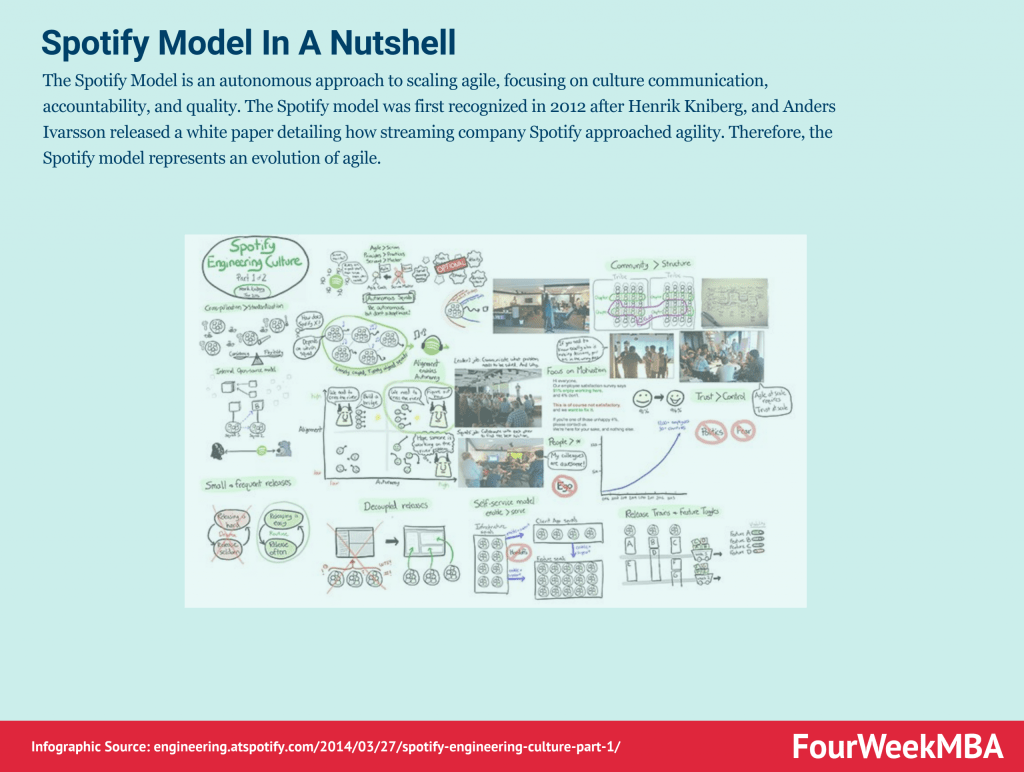
The Spotify Model is an autonomous approach to scaling agile, focusing on culture communication, accountability, and quality. The Spotify model was first recognized in 2012 after Henrik Kniberg, and Anders Ivarsson released a white paper detailing how streaming company Spotify approached agility. Therefore, the Spotify model represents an evolution of agile.
As the name suggests, TDD is a test-driven technique for delivering high-quality software rapidly and sustainably. It is an iterative approach based on the idea that a failing test should be written before any code for a feature or function is written. Test-Driven Development (TDD) is an approach to software development that relies on very short development cycles.
Timeboxing is a simple yet powerful time-management technique for improving productivity. Timeboxing describes the process of proactively scheduling a block of time to spend on a task in the future. It was first described by author James Martin in a book about agile software development.
Scrum is a methodology co-created by Ken Schwaber and Jeff Sutherland for effective team collaboration on complex products. Scrum was primarily thought for software development projects to deliver new software capability every 2-4 weeks. It is a sub-group of agile also used in project management to improve startups’ productivity.
Scrumban is a project management framework that is a hybrid of two popular agile methodologies: Scrum and Kanban. Scrumban is a popular approach to helping businesses focus on the right strategic tasks while simultaneously strengthening their processes.
Scrum anti-patterns describe any attractive, easy-to-implement solution that ultimately makes a problem worse. Therefore, these are the practice not to follow to prevent issues from emerging. Some classic examples of scrum anti-patterns comprise absent product owners, pre-assigned tickets (making individuals work in isolation), and discounting retrospectives (where review meetings are not useful to really make improvements).
Scrum at Scale (Scrum@Scale) is a framework that Scrum teams use to address complex problems and deliver high-value products. Scrum at Scale was created through a joint venture between the Scrum Alliance and Scrum Inc. The joint venture was overseen by Jeff Sutherland, a co-creator of Scrum and one of the principal authors of the Agile Manifesto.
Stretch objectives describe any task an agile team plans to complete without expressly committing to do so. Teams incorporate stretch objectives during a Sprint or Program Increment (PI) as part of Scaled Agile. They are used when the agile team is unsure of its capacity to attain an objective. Therefore, stretch objectives are instead outcomes that, while extremely desirable, are not the difference between the success or failure of each sprint.
The waterfall model was first described by Herbert D. Benington in 1956 during a presentation about the software used in radar imaging during the Cold War. Since there were no knowledge-based, creative software development strategies at the time, the waterfall method became standard practice. The waterfall model is a linear and sequential project management framework.
Gennaro is the creator of FourWeekMBA, which reached about four million business people, comprising C-level executives, investors, analysts, product managers, and aspiring digital entrepreneurs in 2022 alone | He is also Director of Sales for a high-tech scaleup in the AI Industry | In 2012, Gennaro earned an International MBA with emphasis on Corporate Finance and Business Strategy.