The minimum viable audience (MVA) represents the smallest possible audience that can sustain your business as you get it started from a microniche (the smallest subset of a market…
Key Components
Concept Overview
The concept of Minimum Viable Audience (MVA) is a strategic approach in marketing and business that focuses on identifying and targeting the smallest, most spec
Identification
Identifying the MVA involves researching and understanding customer segments deeply. Key considerations include: 1. Demographics: Defining the specific characte
Benefits and Impact
Embracing the concept of Minimum Viable Audience offers several benefits and impacts: 1. Focused Marketing: Allows businesses to create highly targeted marketin
Applications
MVA has applications in various industries and business models: 1. Content Creators: Bloggers, YouTubers, and podcasters often identify an MVA within a niche to
Challenges
While MVA offers benefits, it comes with challenges: 1. Market Size: Ensuring the MVA is large enough to support the business is a critical consideration. 2. Ad
Key Insight
If you could pick them and needed to delight them because you had no one else available, would your product or service improve? If you had no choice but to ignore the naysayers (they’re not in the group) or the people who don’t think they need you…
Exec Package + Claude OS Master Skill | Business Engineer Founding Plan
FourWeekMBA x Business Engineer | Updated 2026
The minimum viable audience (MVA) represents the smallest possible audience that can sustain your business as you get it started from a microniche (the smallest subset of a market). The main aspect of the MVA is to zoom into existing markets to find those people which needs are unmet by existing players.
Aspect
Explanation
Concept Overview
The concept of Minimum Viable Audience (MVA) is a strategic approach in marketing and business that focuses on identifying and targeting the smallest, most specific audience that can sustain a product or business. Inspired by the “Minimum Viable Product” (MVP) concept in product development, MVA recognizes that not all customers are equal and that it’s often more effective and efficient to serve a niche audience exceptionally well rather than trying to appeal to a broad and diverse market. By concentrating efforts on a specific, passionate group of customers, businesses can achieve greater engagement, loyalty, and growth.
Identification
Identifying the MVA involves researching and understanding customer segments deeply. Key considerations include: 1. Demographics: Defining the specific characteristics of the target audience, such as age, gender, location, and income. 2. Psychographics: Understanding their interests, values, attitudes, and behaviors. 3. Pain Points: Identifying the specific problems or needs that the MVA faces. 4. Passion and Enthusiasm: Assessing the level of passion and enthusiasm the audience has for a particular niche or topic. 5. Size: Evaluating whether the audience is large enough to sustain the business.
Benefits and Impact
Embracing the concept of Minimum Viable Audience offers several benefits and impacts: 1. Focused Marketing: Allows businesses to create highly targeted marketing campaigns that resonate deeply with the audience. 2. Engagement: Results in higher levels of engagement, as the audience feels a strong connection to the brand or product. 3. Loyalty: Nurtures brand loyalty, as the MVA perceives the business as a solution tailored specifically to their needs. 4. Reduced Competition: Reduces competition by targeting a unique niche that may be less crowded. 5. Efficient Resource Allocation: Optimizes resource allocation by directing marketing, product development, and customer service efforts where they matter most. 6. Scalability: Provides a foundation for scaling up the business once the MVA is well-served.
Applications
MVA has applications in various industries and business models: 1. Content Creators: Bloggers, YouTubers, and podcasters often identify an MVA within a niche topic or interest. 2. E-commerce: Online stores focus on specific product categories or customer personas. 3. Software Development: Software companies may target a specific industry or use case with their products. 4. Service Providers: Service-based businesses may specialize in serving a particular client type or industry. 5. Startups: Many startups adopt MVA strategies to gain a foothold before expanding.
Challenges
While MVA offers benefits, it comes with challenges: 1. Market Size: Ensuring the MVA is large enough to support the business is a critical consideration. 2. Adaptability: The chosen audience’s needs and preferences may evolve, requiring the business to adapt. 3. Risk: Focusing solely on the MVA may involve risk if the niche market faces economic or other challenges. 4. Expansion: Deciding when and how to expand beyond the MVA can be complex. 5. Competitive Pressure: As the MVA strategy gains traction, competitors may attempt to enter the same niche.
Inside the Minimum Viable Audience
The entrepreneur looking into the concept of Minimum Viable Audience, will be more like an artist. As Seth Godin defined it:
The smallest group that could possibly sustain you in your work…
Seth Godin also further explains:
If you could pick them and needed to delight them because you had no one else available, would your product or service improve? If you had no choice but to ignore the naysayers (they’re not in the group) or the people who don’t think they need you or your work, would that force you to stop compromising and start excelling?
A simple case study to find your Minimum Viable Audience
Let’s apply this concept back to the entrepreneurial world, and let’s search for our MVA.
As a simple example, imagine the case you’re staring a bookstore online. None would find that interesting. At least not today. This idea was already proved commercially viable by Amazon, at the and of the 1990s.
Therefore, you will need to zoom into the publishing industry and curve out your own niche first.
For that, the major gatekeeper in the publishing industry can help you out. You can use Amazon search engine to identify your own category. This is only the first step.
To make the exercise of finding your micro-category viable you need to drill down at least three times to what you might think is a viable audience.
Drilling down at least three times
Thus, if you start from fiction, this is the process:
Within the several possible categories, pick yours. What about starting from fiction?
Within fiction you will look for a specific sub-category, perhaps historic fiction.
Within historic fiction, you will look for another specific sub-category, what about historic fiction, focused on Renaissance?
Now you found your microniche. What about building up the best website/blog about Renaissance Historic Fiction?
How do you know there is a viable audience for that?
One simple way, perhaps, is to look at the volume of search in that category, especially for the most known authors (you might be surprised to find out there are micro-stars also within that microniche).
For instance, Johanna Lindsey is a great example of an author that has an incredible engaged following in a microniche. This is an example of how you kick things off and find your Minimum Viable Audience.
When and How to Use Minimum Viable Audience (MVA):
The MVA concept can be used in various business scenarios:
Product Development: When launching a new product or service, organizations can start by targeting a minimum viable audience to gather initial feedback and refine the offering.
Early-Stage Startups: Startups with limited resources can use MVA to focus their efforts on a niche audience before scaling.
Marketing Campaigns: MVA can inform marketing strategies by identifying the most receptive audience for a particular campaign or promotion.
Content Creation: Content creators can use MVA to tailor their content to a specific audience segment, building a loyal following.
To implement MVA effectively:
Identify the Core Audience: Analyze market research, user data, and feedback to identify the smallest, most engaged group of users or customers.
Deepen Understanding: Conduct in-depth research and surveys to gain a comprehensive understanding of the core audience’s needs and preferences.
Iterate and Refine: Continuously iterate on products, services, or content based on feedback from the core audience.
Gradual Expansion: As the core audience is satisfied and the offering matures, gradually expand to serve a broader customer base while maintaining focus on the core.
Expected Benefits of Minimum Viable Audience (MVA):
Implementing MVA can lead to several benefits:
Efficient Resource Allocation: By focusing on a smaller audience initially, organizations can allocate resources more efficiently.
Deeper Engagement: MVA enables organizations to build deeper relationships with their core audience, fostering loyalty and advocacy.
Product-Market Fit: Iterative development based on core audience feedback increases the likelihood of achieving product-market fit.
Reduced Risk: Starting with a small, engaged audience reduces the risk of launching a product or service that does not resonate with a broader market.
Sustainable Growth: Gradual expansion allows organizations to grow sustainably while maintaining a strong connection with their core audience.
Potential Drawbacks of Minimum Viable Audience (MVA):
While MVA offers numerous advantages, it also has potential drawbacks:
Limited Growth: Overemphasis on serving a small audience may limit long-term growth potential.
Market Saturation: In highly competitive markets, focusing solely on a niche audience may not be sufficient to achieve significant market share.
Resource Allocation: Organizations must strike a balance between serving the core audience and investing in broader market reach.
Case Studies
Company
Application of Minimum Viable Audience (MVA)
Case Study
Analysis
Airbnb
Targeting specific traveler segments
Airbnb’s “Business Travel Ready” listings
Airbnb identified business travelers as a Minimum Viable Audience (MVA) and tailored listings to their needs. Focusing on MVAs helps improve customer experience and drive revenue.
Spotify
Personalized music recommendations
Spotify’s algorithm-driven playlists
Spotify uses MVA by understanding individual user preferences to curate playlists, enhancing user engagement and retention.
Netflix
Content recommendation and personalization
Netflix’s recommendation engine
By analyzing viewing habits, Netflix delivers personalized content suggestions, improving user satisfaction and retention.
HubSpot
Inbound marketing software
HubSpot’s targeted content marketing
HubSpot’s MVA approach focuses on specific industries and provides tailored content, attracting niche audiences and converting them into customers.
Peloton
Home fitness equipment and content
Peloton’s interactive fitness classes
Peloton identified fitness enthusiasts as its MVA, offering interactive classes that cater to this audience’s specific needs, resulting in brand loyalty and growth.
Slack
Team communication and collaboration
Slack’s team-specific communication channels
Slack targets teams and organizations as its MVA, providing tailored solutions for efficient communication, which has fueled its growth.
Coursera
Online education and specialization
Coursera’s specialization programs
Coursera offers specialized courses to learners who are looking for expertise in a particular field, demonstrating the effectiveness of MVA in the online education industry.
Dollar Shave Club
Subscription-based grooming products
Dollar Shave Club’s affordable razors
Dollar Shave Club targeted individuals seeking cost-effective grooming solutions, quickly gaining a dedicated MVA and disrupting the industry.
Udemy
Online course marketplace
Udemy’s niche course offerings
Udemy allows instructors to create and sell niche courses, attracting learners with specific interests, a prime example of MVA-driven success.
Key takeaways
In today’s gatekeeping era, there are many approaches to enter the business world. One way is through the Minimum Viable Audience.
With the Minimum Viable Audience, rather than try to do something for everyone, we’ll try to build something exceptional for a small group of people, which needs are unmet by the current market.
Contrary to what happens in other markets, finding your Minimum Viable Audience means having a group of people that are willing to sustain and preserve your business as this adds so much value to them.
Key Highlights
Definition: The Minimum Viable Audience represents the smallest group of people that can sustain a business, especially when starting from a niche market (microniche). It involves zooming into existing markets to find individuals whose needs are not adequately met by existing players.
Entrepreneur as an Artist: Embracing the concept of MVA, an entrepreneur takes on a role similar to that of an artist. They focus on serving the smallest group that could potentially sustain their work.
Delighting the Audience: The idea is to create a product or service that would delight this small audience if they were the only ones available. Ignoring naysayers or people who don’t see the value in the offering can lead to excelling without compromises.
Case Study: Starting a Bookstore Online: If an entrepreneur wants to start an online bookstore, it is essential to find a niche within the vast publishing industry. They may drill down into specific sub-categories, such as historical fiction focused on the Renaissance, to find their microniche.
Identifying Viability: To ensure there is a viable audience for the microniche, entrepreneurs can analyze search volume and engagement for well-known authors within that specific category.
Building Something Exceptional: Instead of trying to cater to everyone, MVA focuses on building something exceptional for a small group of people with unmet needs. This can lead to loyal and engaged customers who sustain and support the business.
Value Creation: Finding the Minimum Viable Audience means creating significant value for a small group of individuals, which is essential for the success and sustainability of the business in today’s gatekeeping era.
Related Frameworks
Description
When to Apply
Minimum Viable Product (MVP)
– MVP is the smallest version of a product that allows a team to collect the maximum amount of validated learning about customers with the least effort. – It focuses on delivering essential features to early adopters to validate assumptions and gather feedback. – MVPs help minimize waste, reduce risk, and accelerate time to market for new products or features.
– When launching new products or features, to quickly validate assumptions, gather feedback from early adopters, and iterate based on validated learnings.
Lean Startup
– Lean Startup methodology emphasizes rapid experimentation, validated learning, and iteration in product development cycles. – It advocates for building minimum viable products (MVPs) to test assumptions and gather feedback from customers early. – Lean Startup principles include validated learning, innovation accounting, and build-measure-learn cycles.
– When launching new products or ventures, especially in uncertain environments, to quickly validate assumptions, learn from customer feedback, and iterate on product development based on validated learnings.
Agile Development
– Agile Development is an iterative and incremental approach to software development that emphasizes adaptive planning, collaboration, and continuous improvement. – It promotes early and frequent delivery of working software, allowing teams to respond to change and deliver value to customers quickly. – Agile methodologies include Scrum, Kanban, and XP.
– When developing software or digital products, to embrace change, deliver value incrementally, and collaborate closely with stakeholders to ensure the product meets customer needs.
Design Thinking
– Design Thinking is a human-centered approach to innovation that focuses on empathizing with users, defining problems, ideating solutions, prototyping ideas, and testing with users. – It encourages collaboration, creativity, and iteration to develop innovative solutions. – Design Thinking stages include empathize, define, ideate, prototype, and test.
– When seeking to understand user needs, generate innovative ideas, and prototype solutions iteratively to solve complex problems or develop user-centric products and services.
Customer Development
– Customer Development is a framework for discovering and validating market demand by interacting with potential customers early and often. – It emphasizes customer feedback, iteration, and continuous learning to reduce risk and maximize the chances of product-market fit. – Customer Development stages include customer discovery, customer validation, and customer creation.
– When launching new products or ventures, to validate assumptions, understand customer needs, and iterate on product development based on feedback and market demand.
Value Proposition Canvas
– Value Proposition Canvas is a tool for designing products and services that meet customer needs and solve their problems effectively. – It helps teams understand their customers and create value propositions that resonate with them. – The canvas consists of two sides: customer segments (jobs, pains, gains) and value propositions (products, services, gains).
– When defining or refining a product or service offering, to ensure alignment between customer needs and the value proposition, and identify areas for improvement or innovation.
Lean Canvas
– Lean Canvas is a one-page business plan template that helps startups capture and organize their business hypotheses quickly. – It focuses on key metrics, value propositions, customer segments, and solution hypotheses. – Lean Canvas enables rapid iteration and testing of business models to validate assumptions and identify viable paths to success.
– When developing or refining a business model, to succinctly capture key hypotheses, test assumptions, and iterate on the business model to increase the chances of success.
Business Model Canvas
– Business Model Canvas is a strategic management tool that allows businesses to visualize, design, and iterate their business models. – It consists of nine building blocks representing key aspects of a business, including customer segments, value propositions, channels, and revenue streams. – The canvas helps organizations understand their business model and identify opportunities for improvement.
– When analyzing or developing a business model, to gain a holistic view of the business and its components, identify areas for innovation or optimization, and communicate the business model effectively to stakeholders.
Blue Ocean Strategy
– Blue Ocean Strategy is a framework for creating uncontested market space and making competition irrelevant. – It encourages organizations to focus on innovation and value creation rather than competing in crowded markets. – Blue Ocean Strategy involves value innovation, market-creating, and strategic moves that differentiate the organization from competitors and attract new customers.
– When seeking to differentiate from competitors, innovate, and create new market opportunities by offering unique value propositions that resonate with customers.
Customer Journey Mapping
– Customer Journey Mapping is a tool for visualizing and understanding the customer experience across touchpoints and interactions with a product or service. – It helps teams empathize with customers, identify pain points, and improve the overall user experience. – Customer Journey Mapping involves mapping the customer journey, identifying touchpoints, and analyzing customer interactions.
– When analyzing or improving the customer experience, to gain insights into customer behavior, identify opportunities for improvement, and align product or service offerings with customer needs and expectations.
A total addressable market or TAM is the available market for a product or service. That is a metric usually leveraged by startups to understand the business potential of an industry. Typically, a large addressable market is appealing to venture capitalists willing to back startups with extensive growth potential.
A microniche is a subset of potential customers within a niche. In the era of dominating digital super-platforms, identifying a microniche can kick off the strategy of digital businesses to prevent competition against large platforms. As the microniche becomes a niche, then a market, scale becomes an option.
In simple terms, market validation is the process of showing a concept to a prospective buyer and collecting feedback to determine whether it is worth persisting with. To that end, market validation requires the business to conduct multiple customer interviews before it has made a significant investment of time or money. A transitional business model is an example of market validation that helps the company secure the needed capital while having a market reality check. It helps shape the long-term vision and a scalable businessmodel.
Market orientation is an approach to business where the company focuses more on the behaviors, wants, and needs of customers in its market. A company will first target a niche market to prove a commercial use case. And from there, it will create options to scale.
In a tech-driven business world, companies can move toward market expansion by creating options to scale via niches. Thus leveraging transitional business models to scale further and take advantage of non-linear competition, where today’s niches become tomorrow’s legacy players.
Digital and tech business models can be classified according to four levels of transformation into digitally-enabled, digitally-enhanced, tech or platform business models, and business platforms/ecosystems.
A platform business model generates value by enabling interactions between people, groups, and users by leveraging network effects. Platform business models usually comprise two sides: supply and demand. Kicking off the interactions between those two sides is one of the crucial elements for a platform business model success.
Business scaling is the process of transformation of a business as the product is validated by wider and wider market segments. Business scaling is about creating traction for a product that fits a small market segment. As the product is validated it becomes critical to build a viable businessmodel. And as the product is offered at wider and wider market segments, it’s important to align product, businessmodel, and organizational design, to enable wider and wider scale.
Developing a successful business strategy is about finding the proper niche, where to launch an initial version of your product to create a feedback loop and improve fast while making sure not to run out of money. And from there create options to scale to adjacent niches.
A Blockchain Business Model according to the FourWeekMBA framework is made of four main components: Value Model (Core Philosophy, Core Values and Value Propositions for the key stakeholders), Blockchain Model (Protocol Rules, Network Shape and Applications Layer/Ecosystem), Distribution Model (the key channels amplifying the protocol and its communities), and the Economic Model (the dynamics/incentives through which protocol players make money). Those elements coming together can serve as the basis to build and analyze a solid Blockchain Business Model.
In an asymmetric businessmodel, the organization doesn’t monetize the user directly, but it leverages the data users provide coupled with technology, thus have a key customer pay to sustain the core asset. For example, Google makes money by leveraging users’ data, combined with its algorithms sold to advertisers for visibility.
In a business world driven by technology and digitalization, competition is much more fluid, as innovation becomes a bottom-up approach that can come from anywhere. Thus, making it much harder to define the boundaries of existing markets. Therefore, a proper business competition analysis looks at customer, technology, distribution, and financial model overlaps. While at the same time looking at future potential intersections among industries that in the short-term seem unrelated.
Technological modeling is a discipline to provide the basis for companies to sustain innovation, thus developing incremental products. While also looking at breakthrough innovative products that can pave the way for long-term success. In a sort of Barbell Strategy, technological modeling suggests having a two-sided approach, on the one hand, to keep sustaining continuous innovation as a core part of the business model. On the other hand, it places bets on future developments that have the potential to break through and take a leap forward.
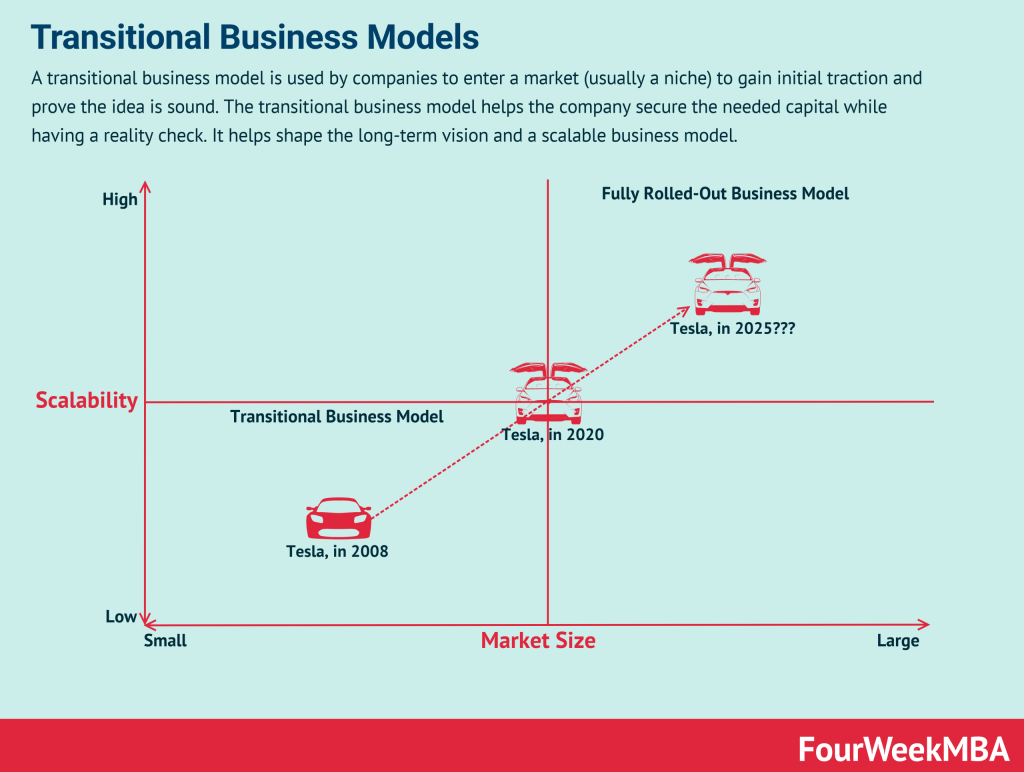
A transitional business model is used by companies to enter a market (usually a niche) to gain initial traction and prove the idea is sound. The transitional business model helps the company secure the needed capital while having a reality check. It helps shape the long-term vision and a scalable business model.
The minimum viable audience (MVA) represents the smallest possible audience that can sustain your business as you get it started from a microniche (the smallest subset of a market). The main aspect of the MVA is to zoom into existing markets to find those people which needs are unmet by existing players.
Business scaling is the process of transformation of a business as the product is validated by wider and wider market segments. Business scaling is about creating traction for a product that fits a small market segment. As the product is validated it becomes critical to build a viable business model. And as the product is offered at wider and wider market segments, it’s important to align product, business model, and organizational design, to enable wider and wider scale.
The market expansion consists in providing a product or service to a broader portion of an existing market or perhaps expanding that market. Or yet, market expansions can be about creating a whole new market. At each step, as a result, a company scales together with the market covered.
In the FourWeekMBA growth matrix, you can apply growth for existing customers by tackling the same problems (gain mode). Or by tackling existing problems, for new customers (expand mode). Or by tackling new problems for existing customers (extend mode). Or perhaps by tackling whole new problems for new customers (reinvent mode).
In the FourWeekMBA Revenue Streams Matrix, revenue streams are classified according to the kind of interactions the business has with its key customers. The first dimension is the “Frequency” of interaction with the key customer. As the second dimension, there is the “Ownership” of the interaction with the key customer.
Revenue model patterns are a way for companies to monetize their business models. A revenue model pattern is a crucial building block of a business model because it informs how the company will generate short-term financial resources to invest back into the business. Thus, the way a company makes money will also influence its overall business model.
A pricing strategy or model helps companies find the pricing formula in fit with their business models. Thus aligning the customer needs with the product type while trying to enable profitability for the company. A good pricing strategy aligns the customer with the company’s long term financial sustainability to build a solid business model.
The minimum viable audience (MVA) represents the smallest possible audience that can sustain your business as you get it started from a microniche (the smallest subset of a market ). The main aspect of the MVA is to zoom into existing markets to find those people which needs are unmet by existing players.
What are the key components of The Minimum Viable Audience?
The key components of The Minimum Viable Audience include Concept Overview, Identification, Benefits and Impact, Applications, Challenges. Concept Overview: The concept of Minimum Viable Audience (MVA) is a strategic approach in marketing and business that focuses on… Identification: Identifying the MVA involves researching and understanding customer segments deeply. Key considerations include: 1….
If you could pick them and needed to delight them because you had no one else available, would your product or service improve? If you had no choice but to ignore the naysayers (they’re not in the group) or the people who don’t think they need you or your work, would that force you to stop compromising and start excelling?
How do you apply The Minimum Viable Audience in practice?
Let’s apply this concept back to the entrepreneurial world, and let’s search for our MVA.
What are the advantages and limitations of The Minimum Viable Audience?
As a simple example, imagine the case you’re staring a bookstore online. None would find that interesting. At least not today. This idea was already proved commercially viable by Amazon, at the and of the 1990s.
Gennaro is the creator of FourWeekMBA, which reached about four million business people, comprising C-level executives, investors, analysts, product managers, and aspiring digital entrepreneurs in 2022 alone | He is also Director of Sales for a high-tech scaleup in the AI Industry | In 2012, Gennaro earned an International MBA with emphasis on Corporate Finance and Business Strategy.