The more you move from consumers to enterprise clients, the more you’ll need a sales force able to manage complex sales. As a rule of thumb, a more expensive product, in B2B or Enterprise, will require an organizational structure around sales. An inexpensive product to be offered to consumers will leverage marketing.
The more you move from consumers to enterprise clients, the more you’ll need a sales force able to manage complex sales. As a rule of thumb, a more expensive product, in B2B or Enterprise, will require an organizational structure around sales. An inexpensive product to be offered to consumers will leverage on marketing.
Beware, a good product doesn’t mean a successful company
As pointed out by Peter Levine, a general partner at the venture capital firm Andreessen Horowitz:
As a former software engineer and CEO, I used to hold the “engineer-centric” view that sales is not a critical function in an organization. I believed that product excellence and market fit obviated the need for a formal sales function: Build a great product, and customers will come.
That view was short-sighted, to say the least. The technology companies that are able to both build great products and integrate a strong sales function are the ones that succeed, whether consumer or enterprise — from Microsoft to Salesforce and yes, even Apple and Facebook. You may not hear about it, but all the world-class companies have a strong sales force.
This is critical to remember especially for founders that often have a technical background. As tech companies are gaining momentum, more and more often we see founders that are also engineers, developers or programmers. That technical background is critical as it allows them to develop applications that might improve 10x over competitors. Think of Brin and Page, Google’s founders. When they started to pitch their new search engine based on PageRank, they knew it was 10x better than any other search engine on the market.
However, it was when they started to think like businesspeople and stopped thinking as academics that the business took off. They understood the importance of distribution. And it is important to remark that even though Google initially was already used by millions of people, but very far from becoming the tech giant we know today.
In a story told by John Doerr, a venture capitalist and one of the first investors in Google, in his book “Measure What Matters.” When he met the young Larry Page, he knew that even though Google had entered the market pretty late (Google was the eighteenth search engine to enter the market), it was a product, 10x better than its competitors. Yet John Doerr’s future valuation of the company (the maximum growth it could achieve) was about a billion in market capitalization.
However, when he interviewed Page, that young entrepreneur surprised him by saying they would reach instead of a ten billion dollars revenue mark! Which according to Page made the company worth around a hundred billion dollars.
Several factors, comprising pure luck. But of course, an incredible execution is what mattered the most. When you have a company that is growing so fast the most challenging thing is to make sure it will not implode.
In short, putting together a sales process that works it means to keep well in mind the difference between marketing and sales.
At the same time, it is also critical to remind that sales are primarily about the bottom line, but it can also be used a propeller for a company’s brand. Google’s AOL deal is one of those cases.
Distribution can be a branding hack
You might think that Google was great at marketing itself, and in a way it was. Yet, what propelled its growth wasn’t just the marketing side, but rather the distribution side. Many associates sales and distribution as something purely connected to the bottom line.
While sales and distributions focus on the bottom line, they can also be leveraged to build up a strong brand. Think of when Google got the AOL deal, by taking it away from its main competitor at the time (Overture). Well, the distribution agreement with AOL, not only was a sales strategy that guaranteed an explosive growth.
It also represented a massive branding campaign. One that with marketing alone would have taken years to build. In other words, Google used an already established brand to grow its business, and it also worked as a propeller for its brand. As suggested by Google Ngram, by 2004 the term “Googled” had already become a cult!
Therefore, the primary role of sales and distribution should be to look at the bottom line. Yet, once that role is resolved, it can also be leveraged as a powerful branding tool.
You might think that for a consumer product company like Google, which offers a set of free tools to masses has been mainly driven by marketing. However, if we look at the business part of it, what brings revenues to the company is the advertising network where millions of small and medium businesses and enterprises spend their marketing budget. In this scenario, you can understand how sales and distribution become critical.
Some practical suggestions for your sales processes
Peter Levine, suggests a few practical ways to have a sales process within your company, as a CEO:
Have a weekly meeting with your sales VP where you review the pipeline and forecast, have the VP sales educate you on what he or she is doing, and ask questions
Ask what you can do to help your sales VP: Can I help with closing a deal, visiting a customer, or rallying the troops?
Spend time together! In fact, there’s no better way to build morale with your sales team than to do so with them and your customer
Hold your sales VP accountable by setting clear objectives with quantitative (not qualitative!) agreed-upon metrics; you should also know the quotas and productivity of each salesperson
Be sure to interview the first sales hires to ensure alignment with your head of sales as well as with organizational culture and values
Encourage engineers to spend time with sales, and sales to spend time with engineers; the more the two organizations interact solving real product and customer issues, the less foreign each will be to one another and the better your product will be
How much to spend on Marketing vs. Sales? It’s all about the product and the target customer
When it comes to marketing vs. sales, it is critical to start the assessment from your target customer. In general, we have three kinds of customers:
Consumer
Small and medium business
Enterprise
The idea is the more you move from consumers to enterprise clients, the more you’ll need a sales force able to manage complex sales. However, imagine the case you sell a simple product, which is worth $20, would it make sense to have a dedicated sales force? It might not. This would be too expensive and not scalable.
In other words, with a less expensive product that is targeting consumers, marketing will be a critical aspect. Where, instead of with an expensive product, which focuses more on small and medium businesses and enterprise clients, sales will become the most relevant aspect of your business.
Of course, this is a simplification. Yet it is a good starting point to understand and trace a line between marketing and sales. Take the case of a freemium business model. In that case, the investment in sales would be minimal if not none as you’ll be leveraging on free product features as marketing investment for the company.
While in a subscription business model that targets mainly enterprise clients, the sales force will solve a critical role.
Summary and conclusions
In this article, we’ve seen the main difference between sales and marketing. But also how sales and distribution can be used to hack the branding of an organization – where marketing would take years to build a strong brand.
A single distribution deal can generate revenues and visibility for the business. We’ve also seen how in some cases marketing might be easily confused with sales. Take the case of Google, where it has a free product targeting consumers. In that case, you might be fooled to think Google is all about branding.
Yet if we look at its beginning, Google’s main ability has been to create a powerful distribution strategy by closing the right deals. That distribution strategy turned into a branding hack, which turned the company into a cult, by 2004.
We’ve also seen how a few actions can have a large impact on a company’s future growth, by establishing some practical actions (like weekly sales meetings, accountability, and clear quotas).
A last critical aspect you can understand how to create the right sales and marketing mix by looking at two things, the kind of product you sell and what customers it targets. The more it will be an enterprise customer the more the sales processes will become important. The more we move toward an inexpensive product thought mainly for consumers, the more marketing will lead the game.
Enterprise Case Study: Zoom Complex Sales Organization
Zoom is a video communication platform, which mission is to “make video communications frictionless.” Leveraging on the viral growth from its freemium model, Zoom then uses its direct sales force to identify the opportunity and channel those in B2B and enterprise accounts.
While Zoom offers a free product available to anyone, it also has available packages which are enterprise. In this case, Zoom leverages a model that I defined freeterprise as it moves from a free product to a potential enterprise account, thanks to the ability of its salesforce.
A freeterprise is a combination of free and enterprise where free professional accounts are driven into the funnel through the free product. As the opportunity is identified the company assigns the free account to a salesperson within the organization (inside sales or fields sales) to convert that into a B2B/enterprise account.
Consumer Case Study: Apple’s Branding Power
In 2023, most of Apple’s sales (63%) came from indirect channels (comprising third-party cellular networks, wholesalers/retailers, and resellers). These channels are critical for sales amplification, scale, and subsidies (to enable the iPhone to be purchased by many people). In comparison, the direct channel represented 37% of the total revenues. Stores are critical for customer experience, enabling the service business and branding at scale.
Apple has been among these companies that figured an effective distribution strategy, that enables its products to be sold at scale.
Therefore, even if Apple’s products are usually sold at a premium price compared to other similar products.
Apple leverage a strong brand, and distribution capability without relying too much on a complex salesforce.
Although Apple does direct sales through its store. A lot of its distribution also happens via indirect channels, which enable a wider reach for its products.
Case Studies
Tesla’s Direct Sales Model:
Marketing: Tesla’s marketing efforts focus on brand building, highlighting the benefits of electric vehicles, and creating a narrative around sustainability and innovation. Their marketing campaigns generate brand awareness and educate consumers about the advantages of Tesla vehicles.
Sales: Tesla’s direct sales model eliminates the need for traditional dealerships, allowing them to control the sales process entirely. Their sales strategy involves engaging directly with customers through company-owned stores, online channels, and test drive events.
Impact: Tesla’s emphasis on marketing helps to create a strong brand identity and generate consumer interest. Meanwhile, their direct sales approach enables them to maintain control over pricing, customer experience, and product messaging, leading to higher conversion rates and customer satisfaction.
Nike’s Branding and Distribution:
Marketing: Nike invests heavily in marketing campaigns that emphasize athleticism, innovation, and empowerment. They sponsor high-profile athletes, launch impactful advertising campaigns, and leverage social media to engage with their audience. Nike’s marketing efforts create emotional connections with consumers and reinforce brand loyalty.
Sales: Nike’s extensive distribution network includes company-owned stores, authorized retailers, and e-commerce channels. Their sales strategy involves ensuring product availability, optimizing shelf placement, and providing training and support to retail partners.
Impact: Nike’s strong brand presence and marketing initiatives drive consumer demand and brand affinity. Their robust distribution network ensures widespread availability of products, enabling them to reach diverse customer segments and maintain market leadership.
Salesforce’s Enterprise Sales Strategy:
Marketing: Salesforce’s marketing efforts focus on thought leadership, content marketing, and lead generation. They produce educational resources, host industry events, and engage with potential customers through targeted digital campaigns. Salesforce’s marketing activities position them as experts in CRM solutions and generate leads for the sales team.
Sales: Salesforce employs a consultative sales approach, where sales representatives engage with enterprise clients to understand their needs, customize solutions, and drive adoption. Their sales strategy involves building long-term relationships, demonstrating product value, and providing ongoing support.
Impact: Salesforce’s marketing initiatives generate awareness and interest in their CRM platform, attracting qualified leads for the sales team. Their consultative sales approach enables them to close high-value deals, drive customer satisfaction, and foster loyalty among enterprise clients.
Amazon’s Marketplace Expansion:
Marketing: Amazon’s marketing efforts focus on enhancing the customer experience, promoting product discovery, and driving conversion. They leverage data analytics, personalized recommendations, and targeted advertising to engage shoppers and increase sales. Amazon’s marketing activities drive traffic to the Marketplace platform and stimulate purchase behavior.
Sales: Amazon’s Marketplace operates on a self-service model, where third-party sellers list their products directly on the platform. While Amazon provides tools and support to optimize listings and sales performance, the sales process is primarily driven by sellers themselves.
Impact: Amazon’s marketing initiatives create a dynamic and engaging shopping environment, encouraging customers to explore and purchase products from the Marketplace. By empowering third-party sellers to reach a vast audience and manage their sales, Amazon expands its product selection and revenue streams.
Netflix’s Subscription-Based Model:
Marketing: Netflix’s marketing efforts focus on content promotion, personalized recommendations, and user engagement. They invest in original content production, tailor recommendations based on viewing habits, and use targeted email campaigns and social media advertising to attract and retain subscribers. Netflix’s marketing activities drive awareness of new releases, encourage sign-ups, and encourage retention through personalized content suggestions.
Sales: Netflix operates on a subscription-based model, where customers sign up for access to the platform’s content library. While there isn’t a traditional sales team in the same sense as other industries, Netflix’s customer service plays a crucial role in retaining subscribers by addressing issues, resolving complaints, and providing assistance when needed.
Impact: Netflix’s marketing efforts create buzz around new releases, attract new subscribers, and drive engagement with the platform. By offering a compelling content library and personalized recommendations, Netflix retains subscribers over the long term, resulting in stable recurring revenue and growth.
McDonald’s Franchise Model:
Marketing: McDonald’s marketing efforts focus on brand awareness, product promotions, and customer engagement. They launch advertising campaigns to promote new menu items, offer limited-time promotions and discounts, and engage with customers through social media platforms and loyalty programs. McDonald’s marketing activities drive foot traffic to restaurants, increase sales, and reinforce brand loyalty.
Sales: McDonald’s operates on a franchise model, where individual franchisees own and operate restaurants under the McDonald’s brand. While the corporate team provides marketing support, training, and operational guidelines, the sales process primarily involves franchisees managing customer interactions, processing orders, and delivering service.
Impact: McDonald’s marketing initiatives drive customer demand for products and drive traffic to franchise locations. The franchise model enables McDonald’s to expand rapidly, penetrate new markets, and maintain consistency in product quality and customer experience across locations.
Patagonia’s Purpose-Driven Marketing:
Marketing: Patagonia’s marketing efforts focus on environmental activism, brand storytelling, and community engagement. They launch campaigns highlighting environmental issues, promote sustainable practices in manufacturing and supply chain, and engage with customers through educational events and advocacy initiatives. Patagonia’s marketing activities build brand authenticity, foster loyalty among environmentally-conscious consumers, and differentiate them from competitors.
Sales: Patagonia sells outdoor apparel and gear through company-owned stores, e-commerce platform, and authorized retailers. Their sales strategy emphasizes product quality, durability, and sustainability, aligning with their brand values and customer expectations. Patagonia’s sales team focuses on providing excellent customer service, product knowledge, and support.
Impact: Patagonia’s purpose-driven marketing resonates with environmentally-conscious consumers, driving brand affinity and loyalty. By integrating sustainability into their products and operations, Patagonia attracts customers who prioritize ethical and eco-friendly purchasing decisions, resulting in long-term customer relationships and market differentiation.
Key Highlights:
Sales Management for Complex Products: The complexity of a product often dictates the need for a structured sales organization. While consumer products rely heavily on marketing, B2B or enterprise products typically require a sales force to manage complex sales processes.
Product Excellence vs. Sales: Simply having a great product doesn’t guarantee business success. Companies like Google demonstrate that integrating a strong sales function alongside product excellence is crucial for sustained success.
Distribution as a Branding Tool: Effective distribution strategies can serve not only to drive sales but also to build a brand. Google’s distribution deals, such as the one with AOL, acted as significant branding campaigns, propelling its growth.
Sales Process Management: Practical suggestions include regular meetings with the sales VP, alignment between sales and engineering teams, setting clear objectives, and fostering a culture of collaboration.
Marketing vs. Sales Investment: The investment in marketing vs. sales depends on the nature of the product and the target customer. Consumer-focused products lean more towards marketing, while enterprise products require a robust sales force.
Case Studies: Zoom demonstrates a freeterprise model, combining a free product with a direct sales force targeting enterprise clients. Apple showcases the power of distribution and branding, leveraging both direct and indirect sales channels to reach consumers.
A Blockchain Business Model according to the FourWeekMBA framework is made of four main components: Value Model (Core Philosophy, Core Values and Value Propositions for the key stakeholders), Blockchain Model (Protocol Rules, Network Shape and Applications Layer/Ecosystem), Distribution Model (the key channels amplifying the protocol and its communities), and the Economic Model (the dynamics/incentives through which protocol players make money). Those elements coming together can serve as the basis to build and analyze a solid Blockchain Business Model.
In an asymmetric business model, the organization doesn’t monetize the user directly, but it leverages the data users provide coupled with technology, thus have a key customer pay to sustain the core asset. For example, Google makes money by leveraging users’ data, combined with its algorithms sold to advertisers for visibility.
In a business world driven by technology and digitalization, competition is much more fluid, as innovation becomes a bottom-up approach that can come from anywhere. Thus, making it much harder to define the boundaries of existing markets. Therefore, a proper business competition analysis looks at customer, technology, distribution, and financial model overlaps. While at the same time looking at future potential intersections among industries that in the short-term seem unrelated.
Technological modeling is a discipline to provide the basis for companies to sustain innovation, thus developing incremental products. While also looking at breakthrough innovative products that can pave the way for long-term success. In a sort of Barbell Strategy, technological modeling suggests having a two-sided approach, on the one hand, to keep sustaining continuous innovation as a core part of the business model. On the other hand, it places bets on future developments that have the potential to break through and take a leap forward.
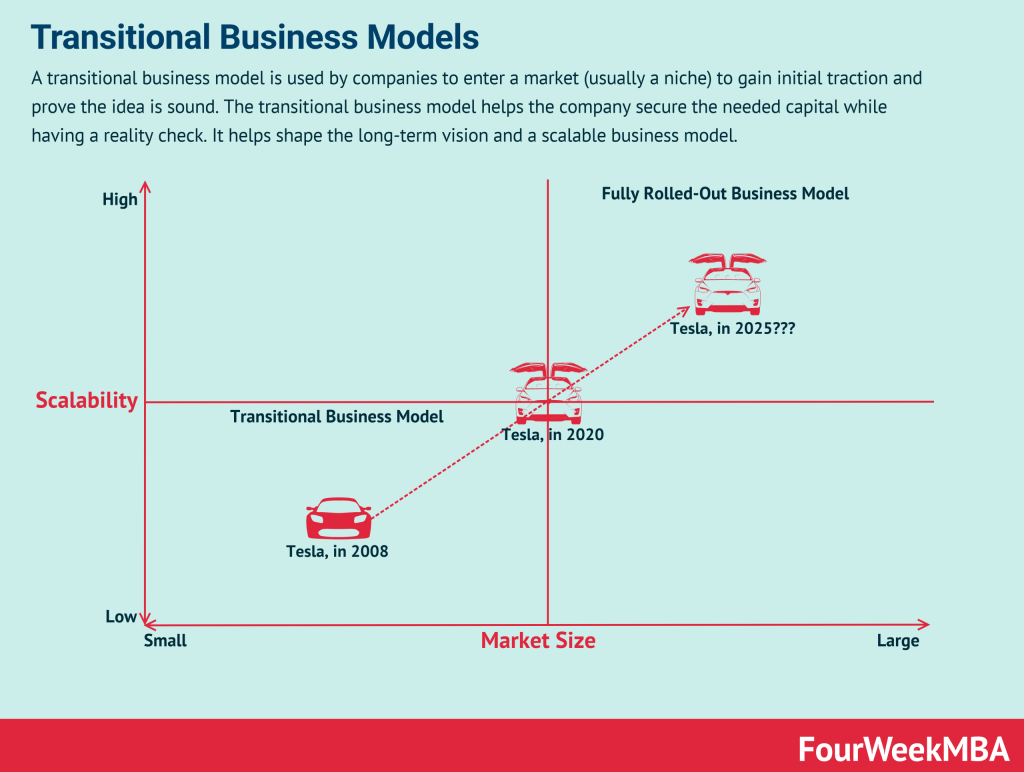
A transitional business model is used by companies to enter a market (usually a niche) to gain initial traction and prove the idea is sound. The transitional business model helps the company secure the needed capital while having a reality check. It helps shape the long-term vision and a scalable business model.
The minimum viable audience (MVA) represents the smallest possible audience that can sustain your business as you get it started from a microniche (the smallest subset of a market). The main aspect of the MVA is to zoom into existing markets to find those people which needs are unmet by existing players.
Business scaling is the process of transformation of a business as the product is validated by wider and wider market segments. Business scaling is about creating traction for a product that fits a small market segment. As the product is validated it becomes critical to build a viable business model. And as the product is offered at wider and wider market segments, it’s important to align product, business model, and organizational design, to enable wider and wider scale.
The market expansion consists in providing a product or service to a broader portion of an existing market or perhaps expanding that market. Or yet, market expansions can be about creating a whole new market. At each step, as a result, a company scales together with the market covered.
In the FourWeekMBA growth matrix, you can apply growth for existing customers by tackling the same problems (gain mode). Or by tackling existing problems, for new customers (expand mode). Or by tackling new problems for existing customers (extend mode). Or perhaps by tackling whole new problems for new customers (reinvent mode).
In the FourWeekMBA Revenue Streams Matrix, revenue streams are classified according to the kind of interactions the business has with its key customers. The first dimension is the “Frequency” of interaction with the key customer. As the second dimension, there is the “Ownership” of the interaction with the key customer.
Revenue model patterns are a way for companies to monetize their business models. A revenue model pattern is a crucial building block of a business model because it informs how the company will generate short-term financial resources to invest back into the business. Thus, the way a company makes money will also influence its overall business model.
A pricing strategy or model helps companies find the pricing formula in fit with their business models. Thus aligning the customer needs with the product type while trying to enable profitability for the company. A good pricing strategy aligns the customer with the company’s long term financial sustainability to build a solid business model.
Gennaro is the creator of FourWeekMBA, which reached about four million business people, comprising C-level executives, investors, analysts, product managers, and aspiring digital entrepreneurs in 2022 alone | He is also Director of Sales for a high-tech scaleup in the AI Industry | In 2012, Gennaro earned an International MBA with emphasis on Corporate Finance and Business Strategy.
2 thoughts on “Marketing vs. Sales: How to Use Sales Processes to Grow Your Business”
Garvit
Thankyou Sir for clarification between sales & marketing your Article is Awesome.







Thankyou Sir for clarification between sales & marketing your Article is Awesome.
Thank you Garvit!