

The market expansion consists in providing a product or service to a broader portion of an existing market or perhaps expanding that market. Or yet, market expansions can be about creating a whole new market. At each step, as a result, a company scales together with the market covered.
The mother of the modern market expansion
One of the most successful market expansion of modern business history was achieved by Apple. As the company moved from niche PC maker; it jumped to new markets, until it created a whole new market with its iPhone (what is known as a blue ocean, or at least it used to be so).

As Apple created new products, those new products also comprised new technologies, and they were coupled with a different distribution model.
Platforms dominate distribution platforms
When Apple jumped from computers to the iPod, it started to understand that to create a whole new market, a product alone wasn’t enough.
It needed a new way to distribute it and a new platform for enabling a different level of content consumption for consumers.
From there, the iPod, iTunes, and a new distribution model (single songs could be consumed in place of buying entire CDs), a whole new distribution platform was born.
TDM: Technology + Distribution + Monetization
Netflix started as a DVD-rental company. That was the most viable way to start a business that could compete with existing players like Blockbuster. Netflix could have tried to play it bigger.
Netflix had known for years that being a competitive player in the DVD-rental space, was “just the beginning of something else:”
In a Wired article, entitled “The Netflix Effect” from 2002, Reed Hastings, still current Netflix’s CEO, highlighted:
The dream 20 years from now, is to have a global entertainment distribution company that provides a unique channel for film producers and studios.
Thus, Reed Hastings was well aware of the potential of building a platform, yet it knew it took time to achieve the viability of that business model. Netflix could have burned all its capital to enter that market early on.
Yet the first time “streaming” was announced on a Netflix financial statement was in the 2007 annual report, presented in 2008, and by 2009 annual report streaming would be mentioned 88 times (FourWeekMBA analysis). That is when things started to pick up!

And suddenly Netflix jumped from a limited market to an unlimited, digital market, without physical constraints, besides servers’ costs, of course. In 2019 server expenses increased by $18 million as more streaming was served on the platform (FourWeekMBA Analysis). And yet, this model was way more scalable.

Other examples that we’re looking at currently, are all around us. Another interesting one is Uber and how – as the company scales – it explores new ways it can achieve its mission, and yet be careful not to take this step too fast, as a false step might certain business death.
Technological platforms mature with the birth of an economic ecosystem around them. Conversely, “business platforms” require technological, distribution, and monetization changes, that combined provide a new way of doing business, and the basis for new business models to emerge.
Logical only in hindsight
While it all makes sense to look at market expansion in this way, it’s important to understand that this is logical only in hindsight. In reality, as companies go through those periods of market changes, they need to adjust.
For instance, as Netflix survived two eras of changed content distribution formats, the survival is all but granted.
And in the next era, where augmented reality might become the next available consumer-platform, the whole TDM framework might change again!
Key takeaways
- Market expansion can happen in several formats. It can start by gaining more market shares in an existing market. Or perhaps by expanding the existing market.
- Or it can happen by taking advantage of a whole new market. As those new markets become available the whole TDM framework (technology, distribution, monetization) makes available new “business platforms” which enable new business models.
Key Insights
- Market Expansion: Market expansion can take different forms, such as gaining more market share in an existing market, expanding an existing market, or creating a whole new market. As companies progress through these stages, they scale together with the market covered.
- Apple’s Success in Market Expansion: Apple’s success story demonstrates how it moved from being a niche PC maker to creating a whole new market with the iPhone. This exemplifies the concept of a “blue ocean” strategy, where new products, technologies, and distribution models are combined to create a unique market space.
- Platforms and Distribution: To create a whole new market, companies must go beyond offering a product alone. They need to develop new distribution platforms that enable different levels of content consumption for consumers. Examples like Netflix transitioning from DVD-rental to streaming show how this shift can lead to more scalable and less constrained business models.
- The TDM Framework: Technology, Distribution, Monetization: The TDM framework emphasizes the importance of technological advancements, distribution channels, and monetization strategies in building new business platforms. These elements collectively provide a new way of doing business and serve as the basis for emerging business models.
- Adjusting and Surviving in Changing Markets: While market expansion and the TDM framework make sense in hindsight, companies often face uncertainties and challenges during periods of market changes. Survival and success in evolving markets require continuous adjustments and adaptability.
- Future of Market Expansion: As technology continues to advance, new opportunities for market expansion might arise. For instance, the emergence of augmented reality could lead to new consumer-platforms and necessitate a change in the TDM framework.
Case Studies
| Company | Market Expansion Strategy | Description | Example |
|---|---|---|---|
| Amazon | Gaining More Market Share | Amazon initially expanded its online bookstore into a diverse e-commerce platform, gradually dominating various retail categories. | Amazon’s relentless expansion strategy allowed it to gain a significant share in the online retail market. |
| Creating a Whole New Market | Google pioneered the search engine industry and later ventured into various sectors like advertising, cloud services, and autonomous vehicles. | Google’s search engine created a new market, while diversification led to a broader market presence. | |
| Expanding the Existing Market | Facebook expanded its user base by acquiring Instagram and WhatsApp, increasing its presence in the social media and messaging markets. | Facebook’s acquisitions helped it expand within the existing social media market, targeting diverse user segments. | |
| Microsoft | Shifting to New Technologies and Markets | Microsoft transitioned from a software-focused company to a cloud and services provider, addressing changing market demands. | Microsoft’s shift to cloud services and diversification reflects its adaptation to evolving technology trends. |
| Uber | Exploring New Ways to Achieve Its Mission | Uber began as a ride-hailing service and has since explored new avenues, such as Uber Eats and Uber Freight, to broaden its market presence. | Uber’s diversification efforts align with its mission to provide transportation and logistics solutions. |
| Airbnb | Creating a Unique Market Space | Airbnb disrupted the hospitality industry by offering unique accommodations, appealing to travelers seeking distinctive lodging experiences. | Airbnb’s approach created a new market space focused on individualized travel experiences. |
| Zoom Video Communications | Scaling with Changing Demand | Zoom responded to the growing need for remote communication by offering a reliable video conferencing platform for businesses and individuals. | Zoom’s rapid expansion aligned with changing market demands for remote work and collaboration solutions. |
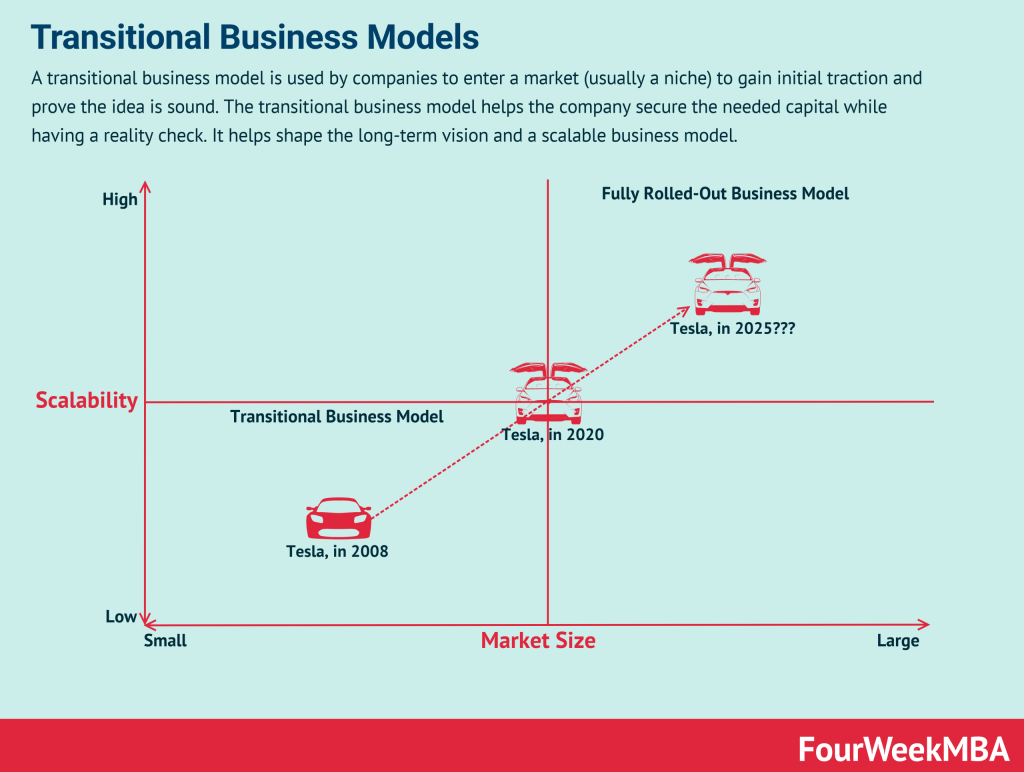
| Tesla | Transitioning into Electric Vehicles | Tesla shifted from niche electric sports cars to mass-market electric vehicles, contributing to the growth of the electric vehicle market. | Tesla’s expansion strategy played a pivotal role in shaping the electric vehicle market and increasing its share. |
| Apple | Expanding Beyond Niche PC Market | Apple evolved from a niche PC maker to create a whole new market with the iPhone, introducing new technologies and distribution models. | Apple’s market expansion journey exemplifies a “blue ocean” strategy that redefined consumer technology markets. |
| Netflix | Shifting from DVD-Rental to Streaming | Netflix transformed its business from DVD-rental to streaming, tapping into a broader, digital market with less physical constraints. | Netflix’s shift expanded its market coverage and offered a more scalable business model for content delivery. |
| Amazon Web Services (AWS) | Pioneering Cloud Computing | AWS pioneered cloud computing services, enabling businesses to access scalable and cost-effective cloud infrastructure solutions. | AWS’s early entry and comprehensive cloud services created a new market, driving widespread adoption of cloud technology. |
| Airbnb | Expanding into Airbnb Experiences | Airbnb extended its offerings to include Airbnb Experiences, providing travelers with unique activities and cultural immersion opportunities. | Airbnb expanded its market presence by diversifying into personalized and immersive travel experiences. |
| SpaceX | Targeting Government Contracts and Beyond | SpaceX focuses on space exploration, government contracts, commercial launches, and space enthusiasts, broadening its presence in space-related markets. | SpaceX’s diverse services cater to various sectors within the space industry, contributing to market expansion. |
| Adobe | Transitioning to Subscription-Based Model | Adobe shifted from traditional software sales to a Creative Cloud subscription model, offering software tools and services to a broader audience. | Adobe’s subscription-based approach expanded its market reach, making creative software more accessible. |
| Slack | Adapting to Evolving Communication Needs | Slack entered the team collaboration market later but provided an integrative platform for efficient and flexible communication, meeting evolving demands. | Slack’s adaptability and user-centric approach allowed it to expand in a competitive communication technology market. |
Related Market Development Frameworks


Stages of Digital Transformation

Platform Business Model Strategy


FourWeekMBA Business Toolbox




Asymmetric Betting


Your handcrafted selection:


