The intrapreneur is an employee which is usually assigned to innovative projects that can impact the company’s future success. As such, the intrapreneur is an employee that acts like an entrepreneur within the organisation. While the intrapreneur has access to the resources of the organisation she does not bear the risks connected to it.
Aspect
Explanation
Intrapreneur
An intrapreneur is an employee within a large organization who exhibits entrepreneurial traits and behaviors while working within the confines of the organization. Intrapreneurs are often driven to innovate, take risks, and create new opportunities within the company. They act as “internal entrepreneurs.”
Characteristics
– Innovation: Intrapreneurs are known for their innovative mindset and willingness to challenge the status quo. – Risk-Taking: They are not averse to taking calculated risks in pursuit of new ideas. – Initiative: Intrapreneurs proactively identify opportunities and act on them. – Autonomy: They may seek autonomy and independence to develop and implement their ideas. – Passion: Intrapreneurs are passionate about their projects and vision. – Resilience: They are resilient and persistent in the face of challenges.
Role in Organizations
– Driving Innovation: Intrapreneurs play a key role in driving innovation within the organization by introducing new products, services, or processes. – Solving Problems: They often identify and solve complex problems that the organization faces. – Competitive Advantage: Intrapreneurs can give the company a competitive advantage by staying ahead in the market. – Creating Value: They create value by exploring new markets and revenue streams.
Examples
– Google’s “20% Time”: Google encourages employees to spend 20% of their work hours on personal projects, fostering intrapreneurship. This led to the development of products like Gmail. – 3M’s Post-It Notes: 3M’s intrapreneurial culture led to the creation of the iconic Post-It Notes by an employee pursuing an innovative idea. – Amazon Web Services (AWS): Amazon’s AWS division emerged from an intrapreneurial initiative to sell the company’s excess server capacity.
Challenges
– Resistance to Change: Some organizations may resist intrapreneurial activities due to concerns about disruptions or risks. – Resource Constraints: Intrapreneurs may face challenges in securing resources, budgets, or support for their projects. – Organizational Culture: The existing culture may not always support intrapreneurship, hindering initiatives. – Failure Acceptance: Not all intrapreneurial efforts succeed, and organizations need to accept and learn from failures.
Benefits for Organizations
– Innovation: Intrapreneurs drive innovation, which is essential for staying competitive. – Talent Retention: Encouraging intrapreneurship can attract and retain top talent. – Adaptability: It allows organizations to adapt to changing market conditions and customer needs. – Diversification: Intrapreneurial projects can diversify revenue streams.
Conclusion
Intrapreneurs are entrepreneurial-minded employees who bring innovation, creativity, and a willingness to take calculated risks to their organizations. Encouraging intrapreneurship can lead to valuable innovations, a competitive edge, and a dynamic workplace culture within large organizations.
What is the difference between entrepreneurs and intrapreneurs?
Entrepreneurship is the process of designing, launching, and managing a new business. The individual, or entrepreneur, assumes most of the associated risks but will also reap the most rewards if the business is successful.
Intrapreneurship involves an employee developing new ideas or products within an existing company. Intrapreneurs can formulate new ideas or products without the associated risks of entrepreneurship.
The role of both entrepreneurs and intrapreneurs is to uncover new opportunities and then devise a strategy to profit from them. Both roles also require that individuals be adaptable, innovative, persistent, resilient, and effective leaders.
The primary difference is in risk-taking and ownership. Where the Intrapreneur does not own the company and does not take the financial risks associated with the project. The entrepreneur does.
That makes the entrepreneur more conservative and risk-avoidant.
And the intrapreneur is more risk-prone and, in theory, willing to take bolder steps that can make processes within organizations obsolete. Thus, looking at innovations that can impact the whole organization.
As we saw, the main difference between entrepreneurs and intrapreneurs is the level of risk that each assumes. Entrepreneurs start companies from scratch and take on extreme levels of risk to increase their individual wealth.
Since intrapreneurs operate within existing organizations, they can leverage their resources, networks, and expertise to take more calculated risks.
These individuals may pursue the same transformative ideas as entrepreneurs, but they may also be involved in incremental innovation projects and not be rewarded as handsomely if the idea pays off.
Other key differences between entrepreneur sand intrapreneurs
Goal-setting
Entrepreneurs have the freedom to set their own vision for the company, while the objectives of an intrapreneur are influenced by their employer and its senior leaders. That is, they are less autonomous.
Safety net
When an entrepreneur has a few months of lackluster sales, it may mean financial disaster. The potential ramifications for an intrapreneur as never as severe – particularly in mature organizations that can absorb failures and the associated negative financial impact.
Access to perks
While intrapreneurs may not enjoy the same freedoms or financial compensation as entrepreneurs, they are nevertheless valuable to their respective companies. Based on this, intrapreneurs can command attractive salaries and perks.
Time constraints
In theory, an entrepreneur can operate as long as funds allow. Intrapreneurs often work under time and resource constraints stipulated by the employer.
How does Intrapreneurship work?
Intrapreneurs get assigned to special projects that are extremely innovative.
That is also why they are usually given the freedom to pursue them, which means the intrapreneur is extremely independent within the organization.
Therefore, intrapreneurs can access resources from the organization, thus organizing and working with those resources on innovative projects.
At the same time, the financial risks associated with the project stay with the organization.
Good, in theory, what in practice?
While the concept of intrapreneurship is compelling, and perhaps many companies have leveraged it to keep innovating.
Google is one of the companies that took advantage of intrapreneurs to build wildly successful products. As Brin and Page highlighted back in 2004:
“We encourage our employees, in addition to their regular projects, to spend 20% of their time working on what they think will most benefit Google…This empowers them to be more creative and innovative. Many of our significant advances have happened in this manner.”
From this 20% project allocation, where employees could pursue the projects they felt compelled about, products like Google News, Gmail, and AdSense were built.
Other intrapreneurship examples
Here are just a few examples of intrapreneurship in modern companies.
Google’s Gmail
The development of Gmail is one of the finest examples of intrapreneurship at work. The service was created by Paul Buchheit who joined Google as its twenty-third employee in 1999.
Buchheit had previously worked on a web-based email platform and search engine, but the idea of replicating this combination within Google’s email service was met with internal resistance.
Indeed, some executives were worried that the company was extending itself too far beyond its core search product.
However, co-founders Sergey Brin and Larry Page ultimately supported the project, with Buchheit using Google’s 20% time policy for personal projects to develop the Gmail platform.
History will show that when Gmail was released in April 2004, it grew rapidly to displace Hotmail and Yahoo Mail as the provider of choice. Gmail would also influence the development of Google AdSense in later years.
McDonald’s
It may surprise some to learn that the famous Happy Meal started as somewhat of a gimmick when it was first slated in 1977.
The idea for the meal is credited to Dick Brams, former regional ad manager for the St. Louis, Missouri area.
Brams pitched the idea to senior management after witnessing that competitor Burger Chef was selling children’s meal boxes that also came with a toy.
While many believed it would never catch on, the Happy Meal became popular with McDonald’s franchise owners who desired a product that would streamline the chaotic process of ordering food for kids.
Brams is often credited as the “Father of the Happy Meal” in official McDonald’s communications, but depending on who you ask, the idea for the meal is also attributed to fellow employee Yolanda Fernandez.
She founded the first McDonald’s restaurant in Guatemala in 1974 and would add toys purchased from a local market to children’s meals.
In the late 1980s, however, a forward-thinking Sony engineer known as Ken Kutaragi was watching his daughter play with a Nintendo gaming console and was amazed at its potential.
Kutaragi invited his superiors to seriously consider developing a gaming console but was ultimately rebuffed.
Undeterred, the engineer surreptitiously took on a role with Nintendo to help them develop the Nintendo Entertainment System (NES).
When Sony found out, executives at the company were infuriated and their instinct was to fire Kutaragi on the spot.
In the end, Kutaragi was saved by CEO Norio Ohga who believed his idea had merit and funded a partnership with Nintendo to develop the Super Famicom (known in the West as the Super Nintendo).
Sony would eventually develop the PlayStation and, after its release in December 1994, became the first computer entertainment platform to sell over 100 million units.
Kutaragi was promoted to CEO of a new division called Sony Interactive Entertainment where he oversaw the development of the PlayStation 2 and PlayStation 3.
Successful intrapreneurs
Successful entrepreneurs and indeed entrepreneurship culture is widely celebrated in the media and elsewhere. Successful intrapreneurs and their contributions to business, by comparison, are much less well known.
Here are some that stand out:
Ken Kutaragi
Whilst an employee of Sony, Kutaragi envisioned a future where electronic games were commonplace.
He ultimately convinced company leaders to create a new division where he lead the development of the Sony PlayStation.
Paul Buchheit
The 23rd employee of Google was responsible for developing Gmail in 2001 and also prompted the product that would later become AdSense.
John Lasseter
This animator was sacked from Disney because of his belief that the company should enter computer animation.
Lasseter then joined Lucasfilm where he was part of a team that pioneered CGI animation.
Once the graphics arm of Lucasfilm was sold to Apple, he oversaw the development of Pixar’s most successful films.
Additional Case Studies
Dropbox:
Scenario: Drew Houston, the founder of Dropbox, was frustrated when he repeatedly forgot his USB flash drive while he was a student at MIT. He created Dropbox as a solution to his problem. Today, Dropbox is one of the leading cloud storage companies globally.
Spanx:
Scenario: Sara Blakely cut the feet off her pantyhose one day when she couldn’t find the right undergarment to wear under her white pants. This idea later evolved into Spanx, a multi-billion-dollar hosiery company.
Slack:
Scenario: Stewart Butterfield originally developed a gaming company called Tiny Speck. The gaming venture didn’t take off, but they had developed an internal communication tool for their team which became highly popular. They pivoted and turned that tool into what is now known as Slack.
Airbnb:
Scenario: Brian Chesky and Joe Gebbia couldn’t afford their rent, so they decided to put an air mattress in their living room and turn it into a bed and breakfast. This concept eventually grew into Airbnb, one of the world’s largest peer-to-peer service for people to list, discover, and book accommodations.
WhatsApp:
Scenario: Brian Acton and Jan Koum, former employees of Yahoo, created WhatsApp, a simple, real-time messaging app. The app became massively popular worldwide and was eventually acquired by Facebook for $19 billion.
Rovio Entertainment:
Scenario: Rovio Entertainment had been developing games for years with little success. They were on the brink of bankruptcy when they decided to make one last game: Angry Birds. The game became a huge success, saving the company and turning it into a major entertainment company.
Groupon:
Scenario: Andrew Mason initially started a platform called The Point, designed for collective action and fundraising. The platform didn’t gain much traction, but Mason realized that it could be adapted for group buying. This led to the formation of Groupon.
Under Armour:
Scenario: Kevin Plank, a former football player, was frustrated with his sweat-soaked shirts. He developed a moisture-wicking fabric that became the foundation for Under Armour.
Chobani:
Scenario: Hamdi Ulukaya, an immigrant from Turkey, bought a closed-down yogurt plant and started producing Greek yogurt. Chobani became a billion-dollar business and revolutionized the yogurt industry in the U.S.
Square:
Scenario: Jack Dorsey and Jim McKelvey developed a simple device to accept card payments on a mobile phone, turning it into a point-of-sale system. This idea became Square, a significant player in the financial services industry.
Key takeaways
Entrepreneurship is the process of designing, launching, and managing a new business from scratch. Intrapreneurship involves an employee developing new ideas or products within an existing company.
The qualities and indeed roles of entrepreneurs and intrapreneurs are rather similar, but one of the primary differences is the level of associated risks and the extent to which each can access resources, networks, and expertise.
The other key differences between entrepreneurship and intrapreneurship are the level of autonomy of control, the presence of safety nets and time constraints, and access to perks.
Key Highlights
Entrepreneurs vs. Intrapreneurs: Entrepreneurship involves designing, launching, and managing a new business with associated risks and potential rewards. Intrapreneurship, on the other hand, involves employees developing new ideas or products within an existing company without bearing the financial risks.
Differences in Risk and Ownership: Entrepreneurs take on extreme levels of risk and ownership in their ventures, while intrapreneurs operate within existing organizations and leverage their resources without bearing the same financial risks.
Goal-Setting and Autonomy: Entrepreneurs have the freedom to set their own vision for the company, while intrapreneurs’ objectives are influenced by their employer and senior leaders, making them less autonomous.
Safety Net and Time Constraints: Entrepreneurs face severe financial consequences if their venture fails, while intrapreneurs often work under safety nets provided by mature organizations. Additionally, intrapreneurs may face time constraints set by their employers.
Access to Perks: While entrepreneurs have the potential for significant individual wealth, intrapreneurs may receive attractive salaries and perks within their respective companies.
Intrapreneurship Examples: Companies like Google, McDonald’s, and Sony have benefited from successful intrapreneurship projects. Examples include the creation of Gmail at Google, the development of the Happy Meal at McDonald’s, and the launch of the PlayStation at Sony.
Successful Intrapreneurs: Intrapreneurs like Ken Kutaragi, Paul Buchheit, and John Lasseter have made significant contributions within their respective companies by driving innovative projects and creating successful products.
Related Concepts
Description
When to Apply
Intrapreneurship
Intrapreneurship refers to the practice of entrepreneurial behavior and mindset within an established organization. Intrapreneurs are employees who exhibit innovation, creativity, and risk-taking characteristics to develop new products, services, or processes within their organization. They often operate with autonomy and drive, seeking to solve problems, seize opportunities, and drive positive change from within. Intrapreneurship is essential for fostering innovation, agility, and competitiveness within organizations, allowing them to adapt to market dynamics and stay ahead of the curve.
– Organizational Innovation: Apply the concept of intrapreneurship to foster a culture of innovation and creativity within the organization. Encourage employees to explore new ideas, experiment with solutions, and take calculated risks to drive growth and competitiveness. Provide resources, support, and recognition for intrapreneurial initiatives that have the potential to create value and propel the organization forward.
Corporate Entrepreneurship
Corporate Entrepreneurship encompasses activities and initiatives aimed at fostering entrepreneurial behavior and ventures within a corporate setting. It involves creating an environment where employees are empowered to think and act like entrepreneurs, driving innovation and growth from within the organization. Corporate entrepreneurship may involve establishing dedicated innovation labs, incubators, or accelerators to support intrapreneurial initiatives and ventures. By embracing corporate entrepreneurship, organizations can tap into the creative talents and potential of their employees, driving continuous innovation and competitive advantage.
– Strategic Renewal: Implement corporate entrepreneurship initiatives as part of strategic renewal efforts to revitalize the organization and drive sustainable growth. Encourage employees to challenge the status quo, explore new markets, and develop innovative products or services that align with the organization’s long-term goals and vision. Foster collaboration between intrapreneurs and other stakeholders to leverage diverse expertise and resources in pursuit of strategic objectives.
Innovation Management
In the context of Innovation Management, intrapreneurship plays a crucial role in driving organizational innovation and competitiveness. Innovation management involves systematically nurturing and harnessing creative ideas and solutions to address market challenges and opportunities. Intrapreneurs serve as key drivers of innovation, leveraging their entrepreneurial mindset to identify unmet needs, disrupt existing markets, and create value for customers and stakeholders. By integrating intrapreneurial practices into innovation management processes, organizations can enhance their capacity for innovation and adaptability in a rapidly changing business landscape.
– Product Development: Incorporate intrapreneurship into innovation management processes to accelerate product development and launch innovative solutions to market. Empower cross-functional teams of intrapreneurs to collaborate on ideation, prototyping, and validation of new products or services, ensuring alignment with market needs and strategic objectives. Provide dedicated resources and support for intrapreneurial projects to facilitate rapid experimentation and iteration in pursuit of breakthrough innovations.
Leadership Development
Within the realm of Leadership Development, intrapreneurship fosters the growth and development of future leaders who are adept at driving change and innovation. Leadership development programs may incorporate intrapreneurial training and experiences to cultivate entrepreneurial skills and mindset among aspiring leaders. By nurturing intrapreneurial leadership capabilities, organizations can build a pipeline of dynamic and visionary leaders capable of navigating uncertainty, driving transformation, and seizing opportunities in the ever-evolving business landscape.
– Talent Development: Integrate intrapreneurship into leadership development programs to groom future leaders with the skills and mindset needed to lead innovation and change. Provide aspiring leaders with opportunities to engage in intrapreneurial projects, mentorship, and cross-functional collaboration to develop their entrepreneurial capabilities and leadership potential. Encourage a culture of continuous learning and experimentation that empowers leaders to embrace uncertainty, challenge conventions, and drive organizational growth.
Organizational Culture
In Organizational Culture, intrapreneurship contributes to the creation of a dynamic and innovative workplace culture where experimentation and creativity are valued and rewarded. Organizational culture encompasses the shared values, beliefs, and norms that shape behavior and decision-making within an organization. By fostering a culture of intrapreneurship, organizations can inspire employees to think innovatively, take ownership of their ideas, and pursue entrepreneurial opportunities that drive business success and growth.
– Culture Transformation: Embrace intrapreneurship as a catalyst for culture transformation within the organization. Cultivate a culture of trust, empowerment, and experimentation that encourages employees to challenge the status quo, embrace ambiguity, and pursue innovative solutions to business challenges. Recognize and celebrate intrapreneurial achievements and contributions, reinforcing the organization’s commitment to fostering a culture of innovation and entrepreneurship at all levels.
Strategic Management
Within Strategic Management, intrapreneurship plays a strategic role in driving organizational agility, resilience, and long-term competitiveness. Strategic management involves setting goals, allocating resources, and making decisions that shape the future direction of the organization. By embracing intrapreneurial practices, organizations can respond more effectively to market disruptions, capitalize on emerging opportunities, and sustain growth in the face of uncertainty and change.
– Strategic Alignment: Integrate intrapreneurship into strategic management processes to align organizational goals and initiatives with market dynamics and emerging trends. Foster a strategic mindset among intrapreneurs, empowering them to identify strategic opportunities, assess risks, and execute initiatives that contribute to the organization’s long-term success. Ensure alignment between intrapreneurial ventures and strategic priorities, allocating resources strategically to maximize impact and value creation.
Entrepreneurial Ecosystems
In Entrepreneurial Ecosystems, intrapreneurship contributes to the vibrancy and innovation capacity of local and regional economies. Entrepreneurial ecosystems encompass the networks, resources, and support structures that facilitate entrepreneurship and innovation within a geographic region. By promoting intrapreneurial activities and partnerships, organizations can enhance the resilience and competitiveness of the broader entrepreneurial ecosystem, driving economic growth, job creation, and societal impact.
– Ecosystem Collaboration: Engage with entrepreneurial ecosystems to foster collaboration and knowledge sharing around intrapreneurship and innovation. Participate in industry clusters, innovation hubs, and entrepreneurship networks to exchange best practices, access talent and resources, and explore partnership opportunities that accelerate intrapreneurial ventures and contribute to ecosystem development. Contribute to ecosystem-building initiatives and policy advocacy efforts that support intrapreneurship and entrepreneurship as drivers of economic and social progress.
Technology Adoption
In the context of Technology Adoption, intrapreneurship enables organizations to embrace technological innovation and leverage emerging tools and platforms to drive business transformation. Technology adoption involves the integration and utilization of new technologies to enhance operations, improve efficiency, and create value for customers and stakeholders. Intrapreneurs play a pivotal role in championing technology adoption initiatives, exploring new technologies, and driving organizational change through innovation and experimentation.
– Digital Transformation: Harness intrapreneurship to drive digital transformation initiatives within the organization. Empower employees to explore and experiment with emerging technologies such as artificial intelligence, blockchain, and Internet of Things to identify opportunities for process optimization, product innovation, and customer engagement. Foster a culture of digital innovation and agility that enables the organization to adapt and thrive in an increasingly digital business environment.
Corporate Social Responsibility
Within the domain of Corporate Social Responsibility (CSR), intrapreneurship contributes to the development and implementation of socially impactful initiatives that address environmental, social, and governance (ESG) issues. CSR involves integrating sustainability and ethical considerations into business operations and decision-making processes. Intrapreneurs leverage their entrepreneurial mindset to design and execute CSR projects that create positive social and environmental outcomes while generating value for the organization and its stakeholders.
– Social Innovation: Leverage intrapreneurship to drive social innovation and sustainability initiatives within the organization. Encourage employees to develop intrapreneurial ventures that address pressing societal challenges such as climate change, poverty alleviation, and access to education and healthcare. Collaborate with external partners, NGOs, and community organizations to amplify the impact of intrapreneurial CSR initiatives and contribute to positive social change at local, national, and global levels.
Entrepreneurship is a continuous quest for real-world problem-solving. The success of a business is measured by how well you helped people solve those problems. While entrepreneurs can rely on methodologies, systems, and processes, they also need to know when to revert to instinct and leverage on their experience.
Acquisition Entrepreneurship (AE) starts by buying an existing business instead of starting one from scratch. Therefore, an acquisition entrepreneur masters the process of acquiring existing businesses to shorten the path to success. In short, the acquisition entrepreneur thinks like an investor in the process of buying an existing business and acts as a CEO once the deal has been closed and he needs to run the company to bring it to the next level.
A business designer is a person that helps organizations to find and test a business model that can be tested and iterated so that value can be captured by the organization in the long run. Business design is the discipline, set of tools and processes that help entrepreneurs prototype business models and test them in the marketplace.
Serial entrepreneur and venture capitalist Paul Graham popularized the term “Ramen Profitability.” As he pointed out “Ramen profitable means a startup makes just enough to pay the founders’ living expenses.”
Business experiments help entrepreneurs test their hypotheses. Rather than define the problem by making too many hypotheses, a digital entrepreneur can formulate a few assumptions, design experiments, and check them against the actions of potential customers. Once measured, the impact, the entrepreneur, will be closer to define the problem.
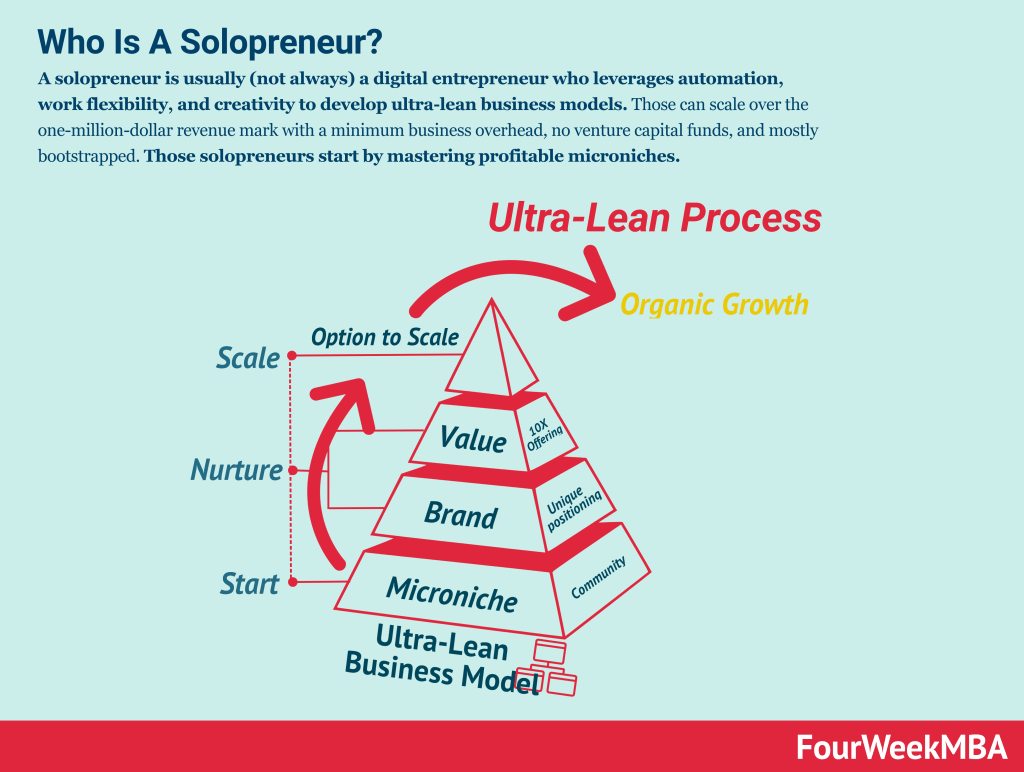
A solopreneur is usually (not always) a digital entrepreneur who leverages automation, work flexibility, and creativity to develop ultra-lean business models. Those can scale over the one-million-dollar revenue mark with a minimum business overhead, no venture capital funds, and mostly bootstrapped. Those solopreneurs start by mastering profitable microniches.
A value proposition is about how you create value for customers. While many entrepreneurial theories draw from customers’ problems and pain points, value can also be created via demand generation, which is about enabling people to identify with your brand, thus generating demand for your products and services.
Business modelinnovation is about increasing the success of an organization with existing products and technologies by crafting a compelling value proposition able to propel a new business model to scale up customers and create a lasting competitive advantage. And it all starts by mastering the key customers.
The innovation loop is a methodology/framework derived from the Bell Labs, which produced innovation at scale throughout the 20th century. They learned how to leverage a hybrid innovation management model based on science, invention, engineering, and manufacturing at scale. By leveraging individual genius, creativity, and small/large groups.
Disruptive innovation as a term was first described by Clayton M. Christensen, an American academic and business consultant whom The Economist called “the most influential management thinker of his time.” Disruptive innovation describes the process by which a product or service takes hold at the bottom of a market and eventually displaces established competitors, products, firms, or alliances.
In a business world driven by technology and digitalization, competition is much more fluid, as innovation becomes a bottom-up approach that can come from anywhere. Thus, making it much harder to define the boundaries of existing markets. Therefore, a proper business competition analysis looks at customer, technology, distribution, and financial model overlaps. While at the same time looking at future potential intersections among industries that in the short-term seem unrelated.
Technological modeling is a discipline to provide the basis for companies to sustain innovation, thus developing incremental products. While also looking at breakthrough innovative products that can pave the way for long-term success. In a sort of Barbell Strategy, technological modeling suggests having a two-sided approach, on the one hand, to keep sustaining continuous innovation as a core part of the business model. On the other hand, it places bets on future developments that have the potential to break through and take a leap forward.
Sociologist E.M Rogers developed the Diffusion of Innovation Theory in 1962 with the premise that with enough time, tech products are adopted by wider society as a whole. People adopting those technologies are divided according to their psychologic profiles in five groups: innovators, early adopters, early majority, late majority, and laggards.
Gennaro is the creator of FourWeekMBA, which reached about four million business people, comprising C-level executives, investors, analysts, product managers, and aspiring digital entrepreneurs in 2022 alone | He is also Director of Sales for a high-tech scaleup in the AI Industry | In 2012, Gennaro earned an International MBA with emphasis on Corporate Finance and Business Strategy.