Zubie is a connected-car app and service for business and rental vehicle fleets. The app was founded in 2012 as a joint venture between retailer Best Buy and mobile-centric venture firm OpenAir Equity Partners.
Zubie makes money via Zubie Asset Trak, a fleet and equipment managementplatform for almost any type of vehicle that is connected to a locational device smaller than a pack of playing cards.
Zubie makes money by selling various plans under the Zubie Rental Connect and Zubie Fleet Connect products, where the customer can receive a discount on a monthly subscription by committing to a two or three-year payment schedule. It is likely the company also makes money in a partnership with insurance companies to roll out usage-based insurance programs.
Business Model Element
Analysis
Implications
Examples
Value Proposition
Zubie’s value proposition includes: – Vehicle Tracking: Offering real-time GPS tracking and location services for vehicles, helping businesses and individuals monitor their fleets or personal vehicles. – Diagnostics: Providing insights into vehicle health and maintenance needs, helping users identify and address potential issues. – Driver Scoring: Evaluating driving behavior and safety, facilitating better driver performance. – Connectivity: Enabling connectivity for older vehicles through a plug-and-play device. Zubie appeals to businesses and individuals seeking improved vehicle management, safety, and maintenance through technology.
Enhances vehicle management by providing real-time tracking and diagnostic information. Promotes safer driving habits through driver scoring. Extends connectivity features to older vehicles, increasing their lifespan. Addresses the needs of businesses with fleets and individual vehicle owners.
– Businesses tracking their fleets in real-time for improved efficiency. – Individuals monitoring their personal vehicles’ health and location. – Drivers receiving feedback and scoring on their driving habits. – Older vehicle owners adding connectivity features to their cars.
Customer Segments
Zubie primarily serves the following customer segments: 1. Fleet Management: Businesses with vehicle fleets looking to optimize operations, improve safety, and reduce maintenance costs. 2. Individual Vehicle Owners: Consumers interested in monitoring their personal vehicles’ health, location, and driving behavior. 3. Insurance Companies: Partnerships with insurers to offer usage-based insurance programs. Zubie caters to the needs of businesses, individuals, and insurance providers in the vehicle management and safety industry.
Targets businesses seeking fleet optimization and cost reduction. Addresses the needs of individual vehicle owners for convenience and safety. Collaborates with insurance companies to offer usage-based insurance solutions. Serves a diverse range of customers in the automotive and insurance sectors.
– Fleet managers using Zubie to track and manage their vehicle fleets. – Individual vehicle owners monitoring their cars’ health and safety. – Insurance companies offering usage-based insurance programs with Zubie’s data.
Distribution Strategy
Zubie’s distribution strategy includes: – Direct Sales: Selling its connected-car solutions directly to businesses and consumers through its website and sales teams. – Partnerships: Collaborating with insurance companies, telematics providers, and automotive industry players to expand its reach. – Mobile App: Offering a mobile app for users to access their vehicle data and insights conveniently. Zubie relies on direct sales, partnerships, and its mobile app to distribute its services.
Provides direct sales channels for businesses and consumers on its website. Forms strategic partnerships with key players in the automotive and insurance industries. Offers a user-friendly mobile app for easy access to vehicle data and insights. Utilizes multiple distribution channels to reach a wider audience.
– Businesses purchasing Zubie’s solutions through its website or sales teams. – Partnerships with insurance companies and telematics providers. – Users accessing vehicle data and insights through Zubie’s mobile app.
Revenue Streams
Zubie generates revenue through the following channels: 1. Subscription Plans: Offering tiered subscription plans for businesses and individuals, providing access to advanced features and analytics. 2. Partnership Fees: Earning fees and revenue-sharing from collaborations with insurance companies and industry partners. 3. Device Sales: Selling Zubie’s plug-and-play devices for vehicle connectivity. Zubie primarily relies on subscription plans and partnership fees as its revenue streams.
Generates revenue through subscription plans for advanced features and analytics. Earns fees and revenue-sharing from partnerships with insurers and industry players. Sells plug-and-play devices to enable vehicle connectivity. Diversifies revenue sources through subscriptions, partnerships, and hardware sales.
– Businesses and individuals subscribing to Zubie’s tiered plans for vehicle insights. – Earnings from partnerships with insurance companies and industry partners. – Sales of Zubie’s plug-and-play devices for vehicle connectivity.
Marketing Strategy
Zubie’s marketing strategy involves: – Digital Marketing: Engaging in digital advertising campaigns to promote its connected-car solutions to businesses and consumers. – Content Marketing: Creating and sharing educational content about vehicle tracking, diagnostics, and safety. – Industry Partnerships: Collaborating with insurance companies and automotive industry players to reach new customers. Zubie combines digital marketing, content creation, and industry partnerships to market its services effectively.
Increases brand visibility and user acquisition through digital advertising. Educates users with informative content about vehicle tracking and diagnostics. Expands its reach by forming strategic partnerships within the automotive and insurance sectors. Implements a comprehensive marketing strategy in the connected-car industry.
– Encountering Zubie’s digital ads promoting its connected-car solutions. – Accessing informative content on vehicle tracking and diagnostics. – Learning about Zubie’s services through partnerships with insurers and industry players.
Organization Structure
Zubie’s organizational structure includes: – Executive Leadership: Comprising executives responsible for strategic direction, decision-making, and overall company management. – Technology and Development Teams: Managing app and software development, data analytics, and platform stability. – Sales and Partnerships: Focusing on direct sales, partnerships, and collaborations with insurance companies. – Customer Support: Providing customer support and assistance to businesses and consumers. Zubie maintains a structured organization aligned with its mission in the connected-car industry.
Led by executive leadership for strategic guidance and decision-making. Manages technology and development to ensure the app’s functionality and data analytics. Drives direct sales, partnerships, and collaborations with insurers. Offers customer support for businesses and consumers using Zubie’s services. Maintains a structured organization to support its role in the connected-car ecosystem.
– Executive leadership responsible for strategic direction. – Technology and development teams working on app and software development. – Sales and partnerships teams facilitating collaborations and partnerships. – Customer support teams assisting businesses and consumers.
Zubie is a connected-car app and service for business and rental vehicle fleets.
The app was founded in 2012 as a joint venture between retailer Best Buy and mobile-centric venture firm OpenAir Equity Partners.
Zubie is ostensibly the brainchild of Best Buy, who believed in the idea of a connected car at a time when the internet was transitioning from desktop to mobile and it seemed that almost every other device had internet connectivity as standard.
The company tried to develop the technology and IP behind Zubie but failed for various reasons, with a lack of funding cited as one reason.
Venture capitalist Tim Kelly then got involved in the project through his connection with OpenAir Equity Partners, with both companies pitching the thesis of a connected car to the investor in the hopes that he would develop the technology and take the company forward. Sold on the idea, Kelly was ultimately appointed CEO.
Zubie had to raise a substantial sum of money in developing a prototype. This process was difficult to initially, but after 20 or 30 meetings with venture capital firms, the company secured a large commitment from BP Ventures and home cable provider Comporium.
BP was particularly interested in how automotive data could be used to time engine oil changes and better understand customer demographics across its numerous gas stations.
Zubie manufactures a hardware dongle that allows customers and businesses to add their vehicles to the Internet of Things (IoT). The dongle can provide basic information detailing how long a trip took or the amount of fuel used.
However, it can also track driving habits, mapping areas where the driver engaged in rapid acceleration, hard braking, and speeding.
If that wasn’t enough, Zubie also analyses important vehicle diagnostics and can identify potential engine problems ahead of time.
In more recent years, the Zubie product has expanded into providing custom telematics and data services for insurance carriers, vehicle rental fleets and automotive dealerships, service centers, and manufacturers.
Zubie makes money by selling three core products: Zubie Asset Trak, Zubie Rental Connect, and Zubie Fleet Connect.
The company also likely makes money from partnerships with insurance companies.
Let’s take a look at these in more detail.
Zubie Asset Trak
Zubie Asset Trak is a fleet and equipment managementplatform for a range of vehicles, including fork trucks, generators, packers, skid steers, and even cleaning equipment.
Asset Trak can recover lost or stolen assets, provide device tamper alerts, and send notifications when a vehicle moves with motion monitoring and custom geofences.
The device itself, which costs $99, is a rechargeable battery-powered device smaller than a deck of playing cards.
There are three funding options here based on the length of annual commitment:
Zubie Rental Connect is a car rental fleet managementplatform helping companies manage their inventory intelligently and efficiently.
Here, there are two plans:
Standard – with features such as live map, geofence alerts, trip history, real-time fuel and odometer readings, inventory insight reports, and engine and battery alerts.
Premium – with all Standard features plus device tampering alerts, automated check-in, hazardous driving alerts, and a dashcam for shuttle buses.
Prices for both plans are available on request. It can be assumed prices depend on the number of vehicles in a customer’s rental fleet.
Zubie Fleet Connect
Zubie Fleet Connect helps a business protect and optimize its vehicle fleet with a single device connected to the company’s software platform. The solution is ideal for vehicles in the construction, home services, and transportation industries.
There are three plans available here, with businesses able to receive a discount on their monthly bill if they commit to two or three years:
Light ($18/month) – for easy GPS tracking with real-time location updates provided every 5 minutes and trip history logs retained for 6 months.
Standard ($22/month) – a driver and vehicle performanceproduct with location updates every 3 minutes and trip history logs retained for 13 months. Standard users can also purchase a dashcam for $399 plus $10/month.
Premium ($27/month) – a comprehensive fleet management system with locational updates provided in less than 60-second intervals and trip history logs retained for 2 years. Premium users have access to the Zubie API which allows them to synchronize fleet assets or incorporate trip or event data into their business workflows.
Insurance company partnerships
Zubie also helps insurance companies roll out usage-based insurance (UBI) programs through simple and efficient telematics deployment. These programs feature high-quality data, reliable cell coverage, and scalable cloud analytics.
Businesses can also acquire or retain customers via branded devices and a fully customizable user experience across mobile, web, and email. Perhaps most importantly, Zubie UBI programs help a business engage with its clients to make driving easier and safer.
Though not officially disclosed, it can be assumed Zubie charges for this deployment service.
Key Takeaways
Zubie Overview: Zubie is a connected-car app and service for business and rental vehicle fleets, founded in 2012 as a joint venture between Best Buy and OpenAir Equity Partners.
Product Offerings: Zubie offers three core products: Zubie Asset Trak, Zubie Rental Connect, and Zubie Fleet Connect.
Zubie Asset Trak: A fleet and equipment managementplatform for various vehicles, offering three subscription options with different commitments and features.
Zubie Rental Connect: A car rental fleet managementplatform with Standard and Premium plans, providing various features tailored to the rental industry.
Zubie Fleet Connect: A fleet management system for businesses with three plans, offering different levels of GPS tracking and trip history retention based on commitment lengths.
Partnerships with Insurance Companies: Zubie partners with insurance companies to roll out usage-based insurance programs, offering telematics deployment services and customer engagement solutions.
Revenue Generation: Zubie generates revenue through subscriptions to its various plans and services, as well as from partnerships with insurance companies.
Major Clients: Zubie’s major clients include Hertz, Budget, Toyota, Nissan, and Avis.
Uber is a two-sided marketplace, a platform business model that connects drivers and riders, with an interface with gamification elements that make it easy for two sides to connect and transact. Uber makes money by collecting fees from the platform’s gross bookings.
Uber Eats is a three-sided marketplace connecting a driver, a restaurant owner, and a customer with the Uber Eats platform at the center. The three-sided marketplace moves around three players: Restaurants pay commission on the orders to Uber Eats; Customers pay small delivery charges, and at times, cancellation fees; Drivers earn through making reliable deliveries on time.
DoorDash is a platform business model that enables restaurants to set up no-cost delivery operations. At the same time, customers get their food at home, and dashers (delivery people) earn some extra money. DoorDash makes money by markup prices through delivery fees, memberships, and advertising for restaurants on the marketplace.
Glovo is a Spanish on-demand courier service that purchases and delivers products ordered through a mobile app. Founded in 2015 by Oscar Pierre and Sacha Michaud as a way to “uberize” local services. Glovo makes money via delivery fees, mini-supermarkets (fulfillment centers that Glovo operates in partnership with grocery store chains), and dark kitchens (enabling restaurants to increase their capacity).
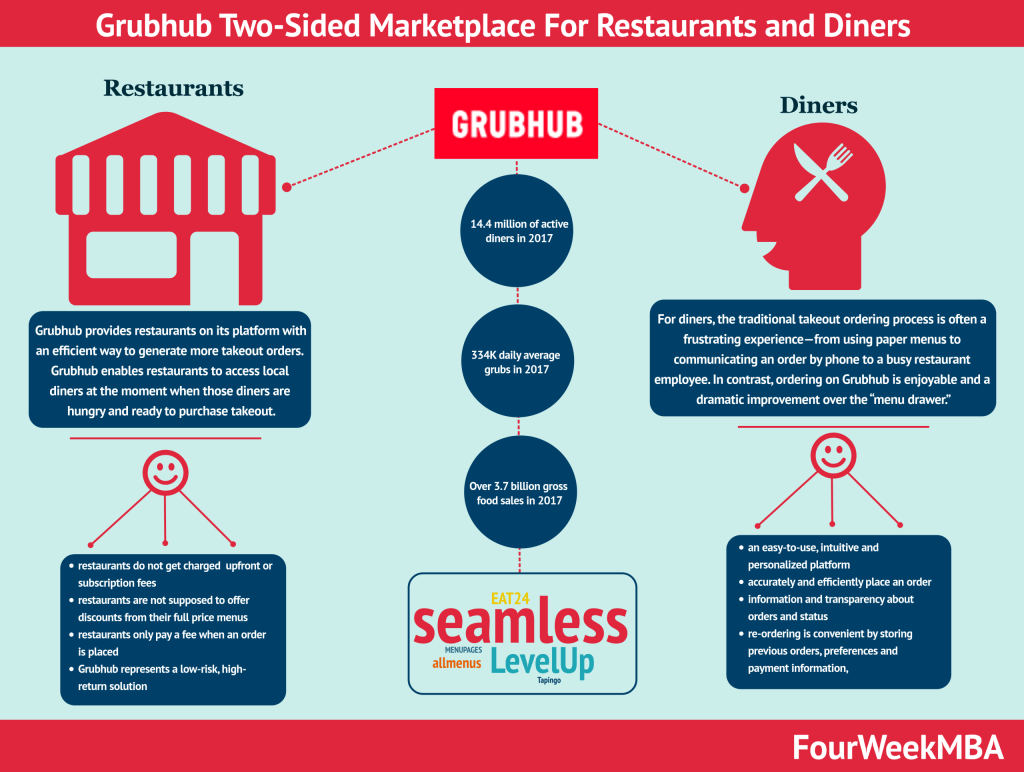
Grubhub is an online and mobile platform for restaurant pick-up and delivery orders. In 2018 the company connected 95,000 takeout restaurants in over 1,700 U.S. cities and London. The Grubhub portfolio of brands like Seamless, LevelUp, Eat24, AllMenus, MenuPages, and Tapingo. The company makes money primarily by charging restaurants a pre-order commission, and it generates revenues when diners place an order on its platform. Also, it charges restaurants that use Grubhub delivery services and when diners pay for those services.
Instacart’s business model enables an easy setup for grocery stores, the comfort for customers to get their shopping delivered at home, and an additional income stream for personal shoppers. Instacart makes money by charging service fees via memberships and running performance advertising on its platform.
Lyft is a transportation-as-a-service marketplace allowing riders to find a driver for a ride. Lyft has also expanded with a multimodal platform that gives more options like bike-sharing or electric scooters. Lyft primarily makes money by collecting fees from drivers who complete rides on the platform.
Postmates is a food delivery service built as a last-mile platform connecting locals with shops. Postmates collects fees (commission, delivery, service, cart, and cancellation fees). It also makes money via its subscription service (called Unlimted – $9.99/month or $99.99 annually), giving free delivery on orders of more than $12.
Netflix is a profitable company, which net profits were $5.1 billion in 2021. Growing from $2.7 billion in 2020. The company runs a negative cash flow businessmodel, where it anticipates the costs of content development and licensing through the platform. Those costs get amortized over the years, as subscribers stick to the platform.
Amazon was profitable in 2021. The company generated over $33 billion in net income, primarily driven by the Amazon AWS business, which contributed to over 55% of its operating margins and other profitable parts like Amazon Prime and Ads. The Amazon e-commerce platform runs at tight operating margins since it’s built for scale.
Uber made over $17.45 billion in revenues in 2021, and its losses were $496 million, thus in 2021, Uber was not profitable. In 2021, Uber generated over $17.4 billion in revenues, mostly coming from mobility ($6.95B or 39.8% of its total revenues) and delivery with Uber Eats ($8.36B or 47.9% of its total revenues).
Microsoft is the most profitable tech giant, with 41.6% operating margins, in 2021. Followed by Facebook (Meta) with 39.6% operating margins. Apple, with 29.6% operating margins. Google, with 22.6% operating margins. And Amazon’s 5.2% operating margins.
Gennaro is the creator of FourWeekMBA, which reached about four million business people, comprising C-level executives, investors, analysts, product managers, and aspiring digital entrepreneurs in 2022 alone | He is also Director of Sales for a high-tech scaleup in the AI Industry | In 2012, Gennaro earned an International MBA with emphasis on Corporate Finance and Business Strategy.