The Heckscher-Ohlin model is named after Swedish economists Bertil Ohlin and Eli Filip Heckscher. Ohlin, who developed the model while a student of Heckscher, won the Nobel Prize for Economics in 1977. The Heckscher-Ohlin model is an economic theory suggesting countries only export what they can produce efficiently and in sufficient quantity.
Aspect
Explanation
Definition
The Heckscher-Ohlin Model, also known as the Heckscher-Ohlin-Samuelson (HOS) Model, is a fundamental theory in international trade economics. Named after its creators, Eli Heckscher and Bertil Ohlin, this model seeks to explain patterns of international trade based on differences in relative factor endowments among countries. It posits that countries will export goods that intensively use factors of production they possess in abundance and import goods that require factors they lack. In essence, the model highlights the role of factor endowments (such as labor, capital, and natural resources) in determining a country’s comparative advantage in trade. The Heckscher-Ohlin Model has been influential in understanding global trade patterns and has implications for trade policy and economic development.
Key Concepts
– Factor Endowments: The model revolves around the concept of factor endowments, which refer to a country’s relative abundance of factors of production like labor, capital, and land. – Comparative Advantage: It emphasizes the idea of comparative advantage, where countries specialize in producing goods that use their abundant factors more efficiently. – Factor Intensity: Factor intensity measures how much a good relies on a particular factor. – Trade Patterns: The model predicts trade patterns based on factor endowments and factor intensities. – Resource Mobility: It assumes that factors of production cannot move between countries in the short run.
Characteristics
– Relative Abundance: The model compares the relative abundance of factors across countries. – Trade Equilibrium: It seeks to find the equilibrium point at which supply equals demand for goods in different countries. – Two-Factor Model: Initially, the model focused on two factors of production, usually labor and capital. – Factor Price Equalization: It predicts that trade will lead to equalization of factor prices across countries for factors that are internationally mobile. – Long-Run Perspective: The model primarily provides insights into long-term trade patterns.
Implications
– Trade Patterns: It helps explain why countries trade certain goods and how their trade patterns change over time. – Factor Movements: The model suggests that trade can lead to shifts in factor prices and factor mobility in the long run. – Resource Allocation: It informs policymakers and businesses about efficient resource allocation based on factor endowments. – Policy Implications: The model has implications for trade policy, such as tariffs and subsidies. – Economic Development: It relates to a country’s economic development trajectory based on its factor endowments.
Advantages
– Theoretical Foundation: It provides a strong theoretical foundation for understanding international trade. – Simplicity: The model’s simplicity makes it accessible for analysis and teaching. – Intuitive: The concept of comparative advantage is intuitive and aligns with real-world observations. – Useful Predictions: It generates predictions about trade patterns that align with empirical data. – Policy Guidance: It guides policymakers in formulating trade policies that consider factor endowments.
Drawbacks
– Assumptions: The model relies on assumptions that may not always hold in the real world, such as immobility of factors in the short run. – Limited Factors: It often simplifies the factors of production to just labor and capital. – Dynamic Factors: The model doesn’t account for changes in factor endowments over time. – Ignoring Non-Factor Influences: It focuses solely on factor endowments, ignoring other factors that influence trade. – Doesn’t Explain All Trade: The model doesn’t explain trade in all types of goods, particularly those with differentiated characteristics.
Applications
– Trade Policy: Governments use insights from the Heckscher-Ohlin Model to formulate trade policies, such as import tariffs or export incentives. – Business Strategy: Companies consider factor endowments when making decisions about global supply chains and market entry. – Academic Research: Researchers use the model as a basis for studying international trade and its implications. – Resource Allocation: It helps businesses allocate resources efficiently based on international factor endowments. – Economic Diplomacy: Countries use the model in international negotiations to argue for favorable trade terms based on their comparative advantage.
Use Cases
– Agricultural Exports: A country with abundant fertile land and labor may export agricultural products like grains and produce. – High-Tech Goods: A technologically advanced nation with a skilled workforce may export high-tech goods and services. – Resource-Rich Countries: Nations with vast natural resources may export raw materials and minerals. – Labor-Intensive Goods: Countries with large, low-skilled labor forces may export labor-intensive goods like textiles and apparel. – Capital-Intensive Industries: Nations with significant capital investments may export capital-intensive products like machinery and equipment.
In general terms, the Heckscher-Ohlin model is a theory of international trade suggesting nations with relatively plentiful capital and relatively scarce labor will tend to export capital-intensive products and import labor-intensive products.
Conversely, a nation where labor is relatively plentiful and capital relatively scarce will tend to export labor-intensive products and import capital-intensive products.
Wealthy nations have access to more capital, which means workers are assisted by equipment and technology.
As a result, the cost of producing labor-intensive goods tends to be higher than in poorer, less advanced countries with plentiful labor and lower wages.
By the same token, goods requiring more capital and less labor tend to be cheaper in wealthy countries because the cost of paying employees is reduced.
This leads to a situation where a wealthy nation can produce capital-intensive goods more cheaply than a poorer country.
These goods are then exported to the poorer nation to pay for the import of labor-intensive goods in return. In theory, this should be a mutually beneficial arrangement for both parties.
The two assumptions of the Heckscher-Ohlin model
The model makes two major assumptions that are worth mentioning.
Firstly, it assumes each country in a trade arrangement will differ according to the factors of production it has available.
For example, one country may have a large and uneducated population with an abundance of labor and land but relatively less access to capital.
The other country may have access to capital and be technologically advanced, but have less access to land and a smaller workforce.
Secondly, Heckscher and Ohlin assumed that different countries have the same preferences for one good over another.
With preferences being equal, it is the relative cost of production (and not the relative demand) that drives how much of a good is produced and consumed before being traded.
Using these assumptions, model posits that countries with an abundance of land, labor, or capital will have a comparative market advantage for the goods produced over other countries.
The country is the largest exporter in the world because petroleum is a capital-intensive resource that is easy to extract – which reduces labor costs.
In other words, Saudi Arabia has an advantage over competing nations because it can export petroleum more efficiently and in greater quantities.
Criticisms of the Heckscher-Ohlin model
Despite the model appearing plausible on paper, it frequently differs from actual patterns of dynamic international trade.
This occurs when a government is lobbied by a group or body to protect its interests through tax breaks, extra duties, or bans on imported products.
This may result in a wealthy nation exporting labor-intensive products and importing capital-intensive products, instead of the more economically viable reverse.
Assumes all workers are employed
In other words, the model does not account for the prevalence of unpaid work in poorer countries which reduces labor costs.
Assumes that production is equal
Rather unrealistically, Heckscher and Ohlin suggest every nation has the same level of production technology.
This ignores the major discrepancies in technological innovation and design between some countries.
Ignores trade between two wealthy countries
The model implies that trade will not occur between two capital-intensive nations, despite obvious evidence to the contrary.
Indeed, a significant proportion of world trade occurs between the United States and the countries of Western Europe.
In this case, comparative advantage is driven by transport costs, economies of scale, and cost or price differences.
Ignores factor mobility
Both capital and labor can move between countries, which the model does not consider.
Capital moves from advanced countries to those with petroleum, mineral, or plantation resources, among other things.
Similarly, the large-scale movement of labor from third-world countries to much richer countries is well documented.
In the resource-rich nation of the United Arab Emirates, there are thought to be 8 million foreign temporary contract workers from poor nations such as India, Bangladesh, Nepal, Sri Lanka, and Pakistan.
Case Studies
1. Agricultural Exports:
Consider a country like Argentina, which has vast expanses of fertile land and a relatively large agricultural labor force.
Due to its abundant land and labor resources, Argentina specializes in agricultural production, including grains like soybeans and wheat, as well as beef.
The country exports these agricultural products to other nations, leveraging its comparative advantage in producing labor-intensive agricultural goods.
This specialization and export pattern align with the predictions of the Heckscher-Ohlin model, which suggests that countries with abundant land and labor will export labor-intensive products.
2. High-Tech Goods:
Take the example of Japan, a technologically advanced nation with a highly skilled workforce and significant investments in research and development.
Japan specializes in the production of high-tech goods such as automobiles, electronics, and robotics.
These sophisticated products require substantial capital investment and skilled labor, both of which Japan possesses in abundance.
As a result, Japan exports these high-tech goods to countries around the world, benefiting from its comparative advantage in capital-intensive industries.
This case illustrates how countries with abundant capital and skilled labor tend to excel in the production and export of capital-intensive goods, as predicted by the Heckscher-Ohlin model.
3. Resource-Rich Countries:
Consider Saudi Arabia, a nation endowed with vast reserves of oil and other natural resources.
Saudi Arabia specializes in the extraction and export of petroleum products, leveraging its abundant natural resource endowments.
The country’s economy is heavily reliant on oil exports, which contribute significantly to its GDP and government revenue.
Saudi Arabia’s comparative advantage lies in its abundant natural resources, allowing it to dominate global oil markets and export petroleum products to countries worldwide.
This case exemplifies how resource-rich countries tend to specialize in and export goods intensive in their abundant natural resources, consistent with the predictions of the Heckscher-Ohlin model.
4. Labor-Intensive Goods:
Consider Bangladesh, a country with a large population and abundant low-skilled labor.
Bangladesh specializes in labor-intensive industries such as textiles and garment manufacturing.
The country’s textile and apparel industry is a major contributor to its economy, employing millions of workers and generating significant export revenue.
Bangladesh’s comparative advantage lies in its abundant supply of low-cost labor, allowing it to produce textiles and garments at competitive prices for export to global markets.
This case illustrates how countries with abundant low-skilled labor tend to specialize in and export labor-intensive goods, consistent with the predictions of the Heckscher-Ohlin model.
5. Capital-Intensive Industries:
Consider Germany, a country known for its advanced manufacturing sector and heavy investment in capital-intensive industries.
Germany specializes in the production of capital goods such as machinery, automobiles, and industrial equipment.
The country’s economy is driven by its strong manufacturing base, which relies on advanced technology and skilled labor.
Germany exports these capital-intensive products to countries worldwide, benefiting from its comparative advantage in producing high-quality capital goods.
This case demonstrates how countries with abundant capital and advanced technology tend to specialize in and export capital-intensive products, as predicted by the Heckscher-Ohlin model.
Key takeaways
The Heckscher-Ohlin model is an economic theory suggesting countries only export what they can produce efficiently and in sufficient quantity. It was developed by Swedish economists Bertil Ohlin and Eli Filip Heckscher
The Heckscher-Ohlin model assumes international trade is mutually beneficial to both parties. It also assumes that the relative cost of production is the key driver of how much of a good is produced and consumed.
The Heckscher-Ohlin model has several limitations. It does not account for workers in poor nations who are not employed, which reduces total labor costs. Nor does it account for trade between two wealthy nations or the high mobility of capital and labor across international borders.
Key Highlights
Heckscher-Ohlin Model:
Named after economists Bertil Ohlin and Eli Filip Heckscher.
Suggests countries export goods they can produce efficiently and in abundance.
Highlights the importance of factor endowments (capital and labor) in determining trade patterns.
Factor Abundance and Trade:
Nations with abundant capital and scarce labor export capital-intensive products.
Nations with abundant labor and scarce capital export labor-intensive products.
Effect of Capital and Technology:
Wealthy countries have more capital and advanced technology.
Labor-intensive goods are costlier to produce in advanced countries due to higher wages.
Mutually Beneficial Trade:
Wealthy nations export capital-intensive goods and import labor-intensive goods.
Poorer nations export labor-intensive goods and import capital-intensive goods.
Should result in mutual benefits due to efficiency gains.
Two Major Assumptions:
Differences in factor endowments among countries.
Equal preferences for goods, focusing on relative production costs.
Rent-Seeking and Trade Distortion:
Model doesn’t account for lobbying efforts causing trade distortions.
Governments may protect specific interests through policies affecting trade.
Unemployment and Labor Costs:
Model doesn’t consider unemployment or unpaid labor in poorer nations.
Neglects the effect of unpaid work on labor costs.
Production Technology Assumption:
Assumes all countries have the same production technology.
Ignores technological disparities among nations.
Trade Between Wealthy Countries:
Model implies no trade between two capital-intensive nations.
Reality shows trade occurs due to transport costs, economies of scale, and price differences.
Factor Mobility Ignored:
Model overlooks mobility of capital and labor between countries.
Capital moves from advanced to resource-rich nations; labor migrates from poor to rich countries.
Real-World Example: UAE Labor Migration:
United Arab Emirates hosts millions of foreign temporary contract workers from poorer nations.
Capital and labor mobility contradicts the model’s assumption.
Aspect
Heckscher-Ohlin Model
Ricardian Model
Specific Factors Model
New Trade Theory
Main Concept
Comparative Advantage based on factor endowments.
Comparative Advantage based on technology differences.
Comparative Advantage based on factor mobility.
Comparative Advantage based on economies of scale.
Key Components
– Factors of production: Land, labor, and capital. – Factor endowments determine comparative advantage.
– Labor productivity differences between countries. – Comparative advantage arises from differences in technology.
– Mobility of certain factors (e.g., labor) across sectors. – Specific factors are immobile between sectors.
– Economies of scale in production. – New industries can arise based on demand conditions and economies of scale.
In Economics, Economies of Scale is a theory for which, as companies grow, they gain cost advantages. More precisely, companies manage to benefit from these cost advantages as they grow, due to increased efficiency in production. Thus, as companies scale and increase production, a subsequent decrease in the costs associated with it will help the organizationscale further.
In Economics, a Diseconomy of Scale happens when a company has grown so large that its costs per unit will start to increase. Thus, losing the benefits of scale. That can happen due to several factors arising as a company scales. From coordination issues to management inefficiencies and lack of proper communication flows.
Creative destruction was first described by Austrian economist Joseph Schumpeter in 1942, who suggested that capital was never stationary and constantly evolving. To describe this process, Schumpeter defined creative destruction as the “process of industrial mutation that incessantly revolutionizes the economic structure from within, incessantly destroying the old one, incessantly creating a new one.” Therefore, creative destruction is the replacing of long-standing practices or procedures with more innovative, disruptive practices in capitalist markets.
Happiness economics seeks to relate economic decisions to wider measures of individual welfare than traditional measures which focus on income and wealth. Happiness economics, therefore, is the formal study of the relationship between individual satisfaction, employment, and wealth.
In a command economy, the government controls the economy through various commands, laws, and national goals which are used to coordinate complex social and economic systems. In other words, a social or political hierarchy determines what is produced, how it is produced, and how it is distributed. Therefore, the command economy is one in which the government controls all major aspects of the economy and economic production.
The term “animal spirits” is derived from the Latin spiritus animalis, loosely translated as “the breath that awakens the human mind”. As far back as 300 B.C., animal spirits were used to explain psychological phenomena such as hysterias and manias. Animal spirits also appeared in literature where they exemplified qualities such as exuberance, gaiety, and courage. Thus, the term “animal spirits” is used to describe how people arrive at financial decisions during periods of economic stress or uncertainty.
State capitalism is an economic system where business and commercial activity is controlled by the state through state-owned enterprises. In a state capitalist environment, the government is the principal actor. It takes an active role in the formation, regulation, and subsidization of businesses to divert capital to state-appointed bureaucrats. In effect, the government uses capital to further its political ambitions or strengthen its leverage on the international stage.
The boom and bust cycle describes the alternating periods of economic growth and decline common in many capitalist economies. The boom and bust cycle is a phrase used to describe the fluctuations in an economy in which there is persistent expansion and contraction. Expansion is associated with prosperity, while the contraction is associated with either a recession or a depression.
Double-entry accounting is the foundation of modern financial accounting. It’s based on the accounting equation, where assets equal liabilities plus equity. That is the fundamental unit to build financial statements (balance sheet, income statement, and cash flow statement). The basic concept of double-entry is that a single transaction, to be recorded, will hit two accounts.
The purpose of the balance sheet is to report how the resources to run the operations of the business were acquired. The Balance Sheet helps to assess the financial risk of a business and the simplest way to describe it is given by the accounting equation (assets = liability + equity).
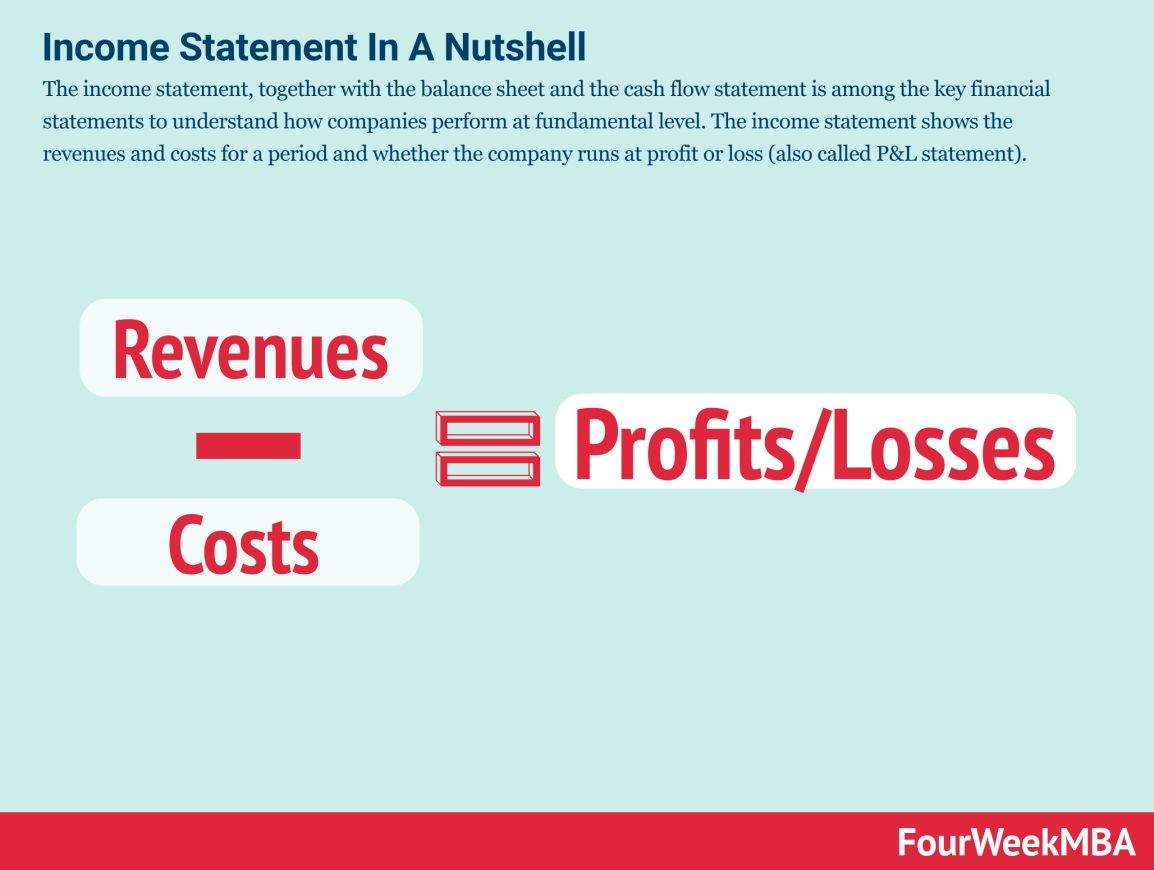
The income statement, together with the balance sheet and the cash flow statement is among the key financial statements to understand how companies perform at fundamental level. The income statement shows the revenues and costs for a period and whether the company runs at profit or loss (also called P&L statement).
The cash flow statement is the third main financial statement, together with income statement and the balance sheet. It helps to assess the liquidity of an organization by showing the cash balances coming from operations, investing and financing. The cash flow statement can be prepared with two separate methods: direct or indirect.
The capital structure shows how an organization financed its operations. Following the balance sheet structure, usually, assets of an organization can be built either by using equity or liability. Equity usually comprises endowment from shareholders and profit reserves. Where instead, liabilities can comprise either current (short-term debt) or non-current (long-term obligations).
Capital expenditure or capital expense represents the money spent toward things that can be classified as fixed asset, with a longer term value. As such they will be recorded under non-current assets, on the balance sheet, and they will be amortized over the years. The reduced value on the balance sheet is expensed through the profit and loss.
Financial statements help companies assess several aspects of the business, from profitability (income statement) to how assets are sourced (balance sheet), and cash inflows and outflows (cash flow statement). Financial statements are also mandatory to companies for tax purposes. They are also used by managers to assess the performance of the business.
Gennaro is the creator of FourWeekMBA, which reached about four million business people, comprising C-level executives, investors, analysts, product managers, and aspiring digital entrepreneurs in 2022 alone | He is also Director of Sales for a high-tech scaleup in the AI Industry | In 2012, Gennaro earned an International MBA with emphasis on Corporate Finance and Business Strategy.