Glovo is a Spanish on-demand courier service that purchases and delivers products ordered through a mobile app. Founded in 2015 by Oscar Pierre and Sacha Michaud as a way to “uberize” local services. Glovo makes money via delivery fees, mini-supermarkets (fulfillment centers that Glovo operates in partnership with grocery store chains), and dark kitchens (enabling restaurants to increase their capacity).
Glovo is a Spanish on-demand courier service that purchases and delivers products ordered through a mobile app.
The company was founded in 2015 by Oscar Pierre and Sacha Michaud, primary in response to the uberization of local services.
It is perhaps most well-known for its food delivery service, but the company has a mission to develop an urban lifestyle product.
This encompasses the delivery of pharmacy goods, groceries, jewelry, flowers, courier parcels, and desserts among other options.
Indeed, Glovo markets itself as able to deliver anything. It will for example buy a customer a size 10 dress from Zara and deliver it to their doorstep.
Such is Glovo’s success that it has expanded globally with operations focused on Europe, Africa, and South America.
Securing the funding that enabled the company to attain a significant market share in the very competitive delivery industry.
Glovo’s Value Proposition:
Convenience: Glovo provides a convenient and efficient way for customers to order and receive a wide range of products, from food to groceries, pharmacy items, and more, all through a single mobile app.
Versatility: The platform offers versatility in delivery options, allowing users to order from restaurants, local stores, supermarkets, and even dark kitchens. This versatility caters to a broad spectrum of customer needs.
Urban Lifestyle Enhancement: Glovo aims to enhance the urban lifestyle by offering a diverse selection of goods and services that can be delivered directly to customers’ doorsteps, simplifying daily tasks and saving time.
Global Reach: Glovo’s global presence across Europe, Africa, and South America makes it accessible to customers in multiple regions, providing an international solution for on-demand deliveries.
Customer Segments:
Consumers: Individuals and households seeking convenient and quick delivery of various products, including meals, groceries, pharmacy items, electronics, and more.
Restaurants: Restaurants looking to expand their delivery services and reach a broader customer base through Glovo’s platform.
Local Stores: Retail businesses, including grocery stores, electronics shops, and pharmacies, partnering with Glovo to offer delivery services to their customers.
Couriers: Independent couriers or delivery drivers who collaborate with Glovo to earn income by fulfilling delivery orders.
Distribution Strategy:
Mobile App: Glovo’s mobile application serves as the primary distributionchannel, allowing users to browse products, place orders, and track deliveries. It also provides a platform for partner businesses to manage orders and for couriers to accept and complete delivery assignments.
Website: Glovo’s website complements its mobile app by offering users an alternative platform for accessing the service and placing orders.
Marketing Strategy:
User Acquisition: Glovo invests in user acquisition strategies, including digital advertising, social media marketing, and search engine optimization (SEO), to attract new customers to its platform.
Partnership Marketing: The company collaborates with restaurants, local stores, and supermarket chains to encourage them to join its platform, expanding the range of products available for delivery.
Promotions and Discounts: Glovo runs promotional campaigns and offers discounts to incentivize users to place orders and engage with the platform regularly.
Geographic Expansion: To grow its market reach, Glovo strategically enters new cities and regions, expanding its presence and user base.
User Engagement: Glovo engages with its users through email marketing, personalized recommendations, and push notifications to keep them informed about promotions, new features, and order updates.
Glovo revenue generation
Glovo drives revenue by charging its partners a fee. This fee is typically 22-30% of the total value of the food or product being delivered. The exact fee is agreed upon between Glovo and each business.
A portion of this fee is given to Glovo couriers based on the distance they cover while delivering.
Delivery fee
The user also pays a delivery fee to ensure their order reaches them. Deliveries fees are dependent on location, distance, and how quickly the customer wants to receive their order.
An average delivery fee in Europe is around 1.90€.
SuperGlovo mini-supermarkets
SuperGlovo supermarkets are essentially fulfillment centers that Glovo operates in collaboration with grocery store chains.
These stores are not open to the public. Instead, they are staffed with employees who pick, purchase, and deliver customer grocery orders 24/7. This gives Glovo total control over the goods that are available to its customers.
These stores are still a relatively new concept and as such, are only offered in Madrid and Barcelona. However, the company hopes to expand its rapid delivery service by using the efficiency of a McDonald’s drive-through as inspiration. Pickers are being trained to select an entire customer order before the courier arrives to collect it.
Glovo is also targeting every day, household items to drive revenue in a relatively underserved segment. This includes items such as bread, milk, cereal, and water.
Dark kitchens
Glovo also works with local restaurants that have reached peak capacity in their kitchens. These restaurants can rent one of seven dark kitchens scattered across Europe, allowing them to increase productivity and sell more food.
Again, the intent here is for Glovo to control more of the food delivery process and charge accordingly.
Key takeaways
Glovo is a Spanish on-demand courier service. Although most well-known for delivering restaurant food, the company will deliver almost anything including clothes, pharmacy goods, and jewelry.
Glovo charges its customers a delivery fee and also takes a 22-30% commission from each participating business. The company gives a portion of this commission to the courier, depending on the distance covered.
Glovo is also in the process of creating supermarket fulfillment stores. These stores are attended by pickers who collect orders for common household purchases and deliver them 24/7. The company also makes money by offering kitchen space to restaurants that require extra space.
Element
Description
Value Proposition
Glovo offers a compelling value proposition for its users, including: – Convenience: On-demand delivery of a wide range of products and services. – Variety: Access to food, groceries, pharmacy items, and more. – Quick Delivery: Fast and reliable delivery services. – Accessibility: Ordering through a user-friendly mobile app. – Affordability: Competitive pricing and delivery fees. – Wide Coverage: Extensive availability in multiple cities and countries. – Customization: Personalized order options and preferences. – Tracking: Real-time order tracking and status updates. – Multiple Payment Options: Various payment methods, including cash and digital payments. – Safety Measures: Ensuring safety and hygiene in deliveries.
Core Products/Services
Glovo’s core products and services encompass: – Glovo App: A mobile application for iOS and Android devices, enabling users to order and track deliveries. – Food Delivery: Delivering meals from restaurants and food outlets. – Grocery Delivery: Providing groceries and essential items from stores and supermarkets. – Pharmacy Delivery: Offering prescription and over-the-counter medication delivery. – Courier Services: Enabling users to send packages and documents. – Retail Delivery: Delivering various retail products, including electronics, clothing, and more. – Alcohol and Convenience: Delivering alcoholic beverages and convenience store items. – Beauty and Cosmetics: Delivering beauty products and cosmetics. – Payment Services: Integrating digital payment options within the app. – Partnership Programs: Collaborating with restaurants, supermarkets, and businesses for delivery services.
Customer Segments
Glovo serves a range of customer segments, including: – Consumers: Individuals seeking on-demand delivery services for food, groceries, and various products. – Restaurants: Partnering with restaurants and eateries to expand their delivery reach. – Retailers: Collaborating with retail businesses to offer delivery services for their products. – Pharmacies: Partnering with pharmacies to provide prescription and OTC medication delivery. – Couriers: Engaging couriers and delivery personnel for order fulfillment. – Small Businesses: Assisting small businesses in expanding their delivery capabilities. – Corporate Clients: Offering corporate meal delivery and business solutions. – Event Organizers: Providing event delivery services for food and supplies. – Local Partners: Building partnerships with local stores and supermarkets. – Alcohol Suppliers: Partnering with liquor stores and beverage providers.
Revenue Streams
Glovo generates revenue through various revenue streams: – Delivery Fees: Charging users a fee for each delivery made through the platform. – Restaurant Commissions: Earning a commission from partner restaurants for each order placed. – Grocery and Retail Commissions: Receiving a percentage of sales for grocery and retail deliveries. – Pharmacy Commissions: Earning commissions on pharmacy orders. – Courier Fees: Charging couriers a fee for orders they fulfill. – Glovo Business: Offering premium corporate delivery services to businesses for a fee. – Advertising and Promotions: Partnering with businesses for advertising and promotional opportunities within the app. – Glovo Plus: Subscription service providing users with free deliveries for a monthly fee. – Data Insights: Offering data and insights to partner businesses for a fee. – Convenience Fees: Charging users additional fees for specific services or features.
Distribution Strategy
Glovo employs a strategic distribution strategy to connect users and businesses: – Mobile App: Providing a user-friendly mobile app as the primary platform for ordering and tracking deliveries. – Website: Offering a web interface for browsing and placing orders. – Local Partnerships: Collaborating with local restaurants, stores, and pharmacies to expand its delivery network. – Couriers: Engaging a network of couriers and delivery personnel for order fulfillment. – Corporate Sales Teams: Offering corporate solutions and engaging with businesses for partnerships. – Marketing and Promotions: Running marketing campaigns and promotions to attract users and businesses. – Referral Programs: Encouraging users to refer friends and family for incentives. – Dynamic Pricing: Adjusting delivery fees based on demand and distance. – Payment Integration: Supporting various payment methods, including cash, credit cards, and digital wallets. – Customer Support: Providing assistance to users, restaurants, and couriers.
Deliveroo is a British online food delivery company founded by Greg Orlowski and Will Shu in 2013. Shu developed the platform in response to a lack of high-quality food delivery in London.
Deliveroo makes money by collecting 25-45% of every order it facilitates. It also charges delivery fees and onboarding fees for restaurants that wish to be featured on the platform.
Deliveroo for Business is a service designed for corporate clients needing to order food in bulk. The company also charges a higher commission to businesses that utilize a network of digital kitchens to process orders.
DoorDash is a platform business model that enables restaurants to set up at-no-cost delivery operations. At the same time, customers get their food at home, and dashers (delivery people) earn some extra money. DoorDash makes money by markup prices through delivery fees, memberships, and advertising for restaurants on the marketplace.
Glovo is a Spanish on-demand courier service that purchases and delivers products ordered through a mobile app. Founded in 2015 by Oscar Pierre and Sacha Michaud as a way to “uberize” local services. Glovo makes money via delivery fees, mini-supermarkets (fulfillment centers that Glovo operates in partnership with grocery store chains), and dark kitchens (enabling restaurants to increase their capacity).
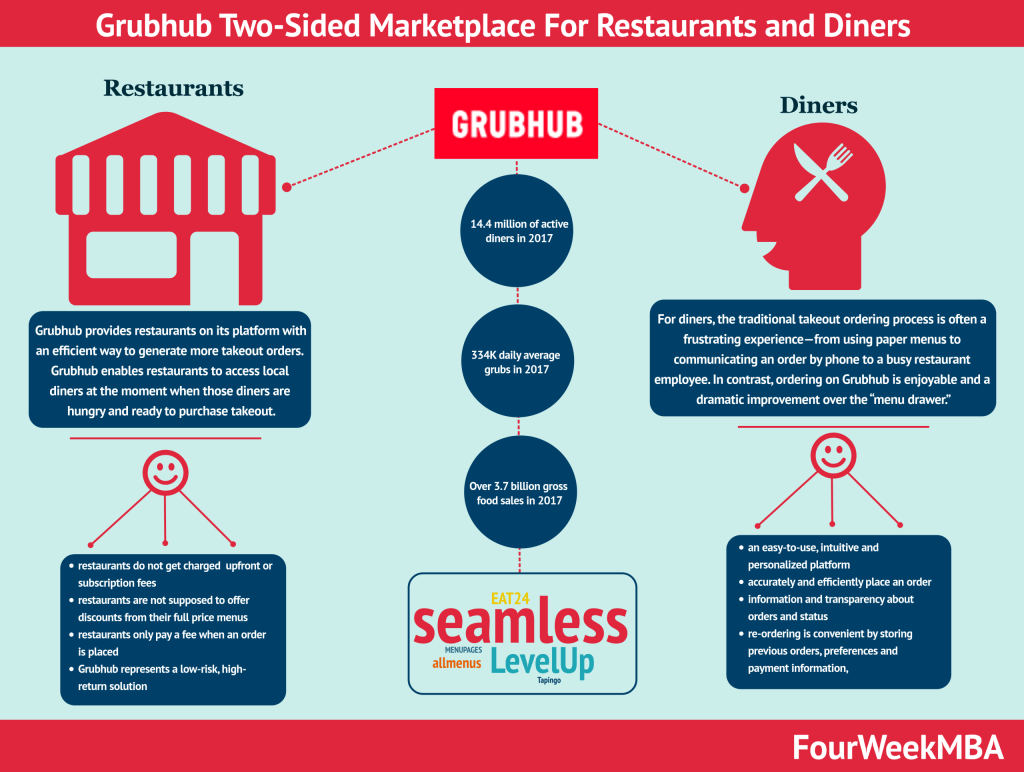
Grubhub is an online and mobile platform for restaurant pick-up and delivery orders. In 2018 the company connected 95,000 takeout restaurants in over 1,700 U.S. cities and London. The Grubhub portfolio of brands like Seamless, LevelUp, Eat24, AllMenus, MenuPages, and Tapingo. The company makes money primarily by charging restaurants a pre-order commission, and it generates revenues when diners place an order on its platform. Also, it charges restaurants that use Grubhub delivery services when diners pay for them.
Lyft is a transportation-as-a-service marketplace allowing riders to find a driver for a ride. Lyft has also expanded with a multimodal platform that gives more options like bike-sharing or electric scooters. Lyft primarily makes money by collecting fees from drivers that complete rides on the platform.
OpenTable is an American online restaurant reservation system founded by Chuck Templeton. During the late 90s, it provided one of the first automated, real-time reservation systems. The company was acquired by Booking Holding back in 2014 for $2.6 billion. Today OpenTable makes money via subscription plans, referral fees, and in-dining with its first restaurant, as an experiment in Miami, Florida.
Postmates is a food delivery service built as a last-mile delivery service platform connecting locals with shops. Postmates makes money by collecting fees (commission, delivery, service, cart, and cancellation fees). It also makes money via its subscription service (called Unlimted – $9.99/month or $99.99 annually), giving free delivery on orders of more than $12.
Uber Eats is a three-sided marketplace connecting a driver, a restaurant owner, and a customer with Uber Eats platform at the center. The three-sided marketplace moves around three players: Restaurants pay commission on the orders to Uber Eats; Customers pay small delivery charges and, at times, cancellation fees; Drivers earn through making reliable deliveries on time.
Gennaro is the creator of FourWeekMBA, which reached about four million business people, comprising C-level executives, investors, analysts, product managers, and aspiring digital entrepreneurs in 2022 alone | He is also Director of Sales for a high-tech scaleup in the AI Industry | In 2012, Gennaro earned an International MBA with emphasis on Corporate Finance and Business Strategy.