Growth marketing is a process of rapid experimentation, which in a way has to be “scientific” by keeping in mind that it is used by startups to grow, quickly. Thus, the “scientific” here is not meant in the academic sense. Growth marketing is expected to unlock growth, quickly and with an often limited budget.
Scrum is a methodology co-created by Ken Schwaber and Jeff Sutherland for effective team collaboration on complex products. Scrum was primarily thought for software development projects to deliver new software capability every 2-4 weeks. It is a sub-group of agile also used in project management to improve startups’ productivity.
As pointed out by Eric Ries, a minimum viable product is that version of a new product that allows a team to collect the maximum amount of validated learning about customers with the least effort through a cycle of build, measure, learn; that is the foundation of the lean startup methodology.
In the Lean Startup, Eric Ries defined the engine of growth as “the mechanism that startups use to achieve sustainable growth.” He described sustainable growth as following a simple rule, “new customers come from the actions of past customers.” The three engines of growth are the sticky engine, the viral engine, and the paid engine. Each of those can be measured and tracked by a few key metrics.
The lean startup canvas is an adaptation by Ash Maurya of the business model canvas by Alexander Osterwalder, which adds a layer that focuses on problems, solutions, key metrics, unfair advantage based, and a unique value proposition. Thus, starting from mastering the problem rather than the solution.
The lean methodology is a continuous process of product development to meet customers’ needs. It was in part borrowed by the auto industry and its roots are found in the Toyota Production System, which was heavily influenced by Henry Ford’s assembly line system. The lean methodology is, therefore, an evolution from lean manufacturing, based on continuous improvement.
Kanban is a lean manufacturing framework first developed by Toyota in the late 1940s. The Kanban framework is a means of visualizing work as it moves through identifying potential bottlenecks. It does that through a process called just-in-time (JIT) manufacturing to optimize engineering processes, speed up manufacturing products, and improve the go-to-market strategy.
A Blockchain Business Model according to the FourWeekMBA framework is made of four main components: Value Model (Core Philosophy, Core Values and Value Propositions for the key stakeholders), Blockchain Model (Protocol Rules, Network Shape and Applications Layer/Ecosystem), Distribution Model (the key channels amplifying the protocol and its communities), and the Economic Model (the dynamics/incentives through which protocol players make money). Those elements coming together can serve as the basis to build and analyze a solid Blockchain Business Model.
In an asymmetric businessmodel, the organization doesn’t monetize the user directly, but it leverages the data users provide coupled with technology, thus have a key customer pay to sustain the core asset. For example, Google makes money by leveraging users’ data, combined with its algorithms sold to advertisers for visibility.
In a business world driven by technology and digitalization, competition is much more fluid, as innovation becomes a bottom-up approach that can come from anywhere. Thus, making it much harder to define the boundaries of existing markets. Therefore, a proper business competition analysis looks at customer, technology, distribution, and financial model overlaps. While at the same time looking at future potential intersections among industries that in the short-term seem unrelated.
Technological modeling is a discipline to provide the basis for companies to sustain innovation, thus developing incremental products. While also looking at breakthrough innovative products that can pave the way for long-term success. In a sort of Barbell Strategy, technological modeling suggests having a two-sided approach, on the one hand, to keep sustaining continuous innovation as a core part of the businessmodel. On the other hand, it places bets on future developments that have the potential to break through and take a leap forward.
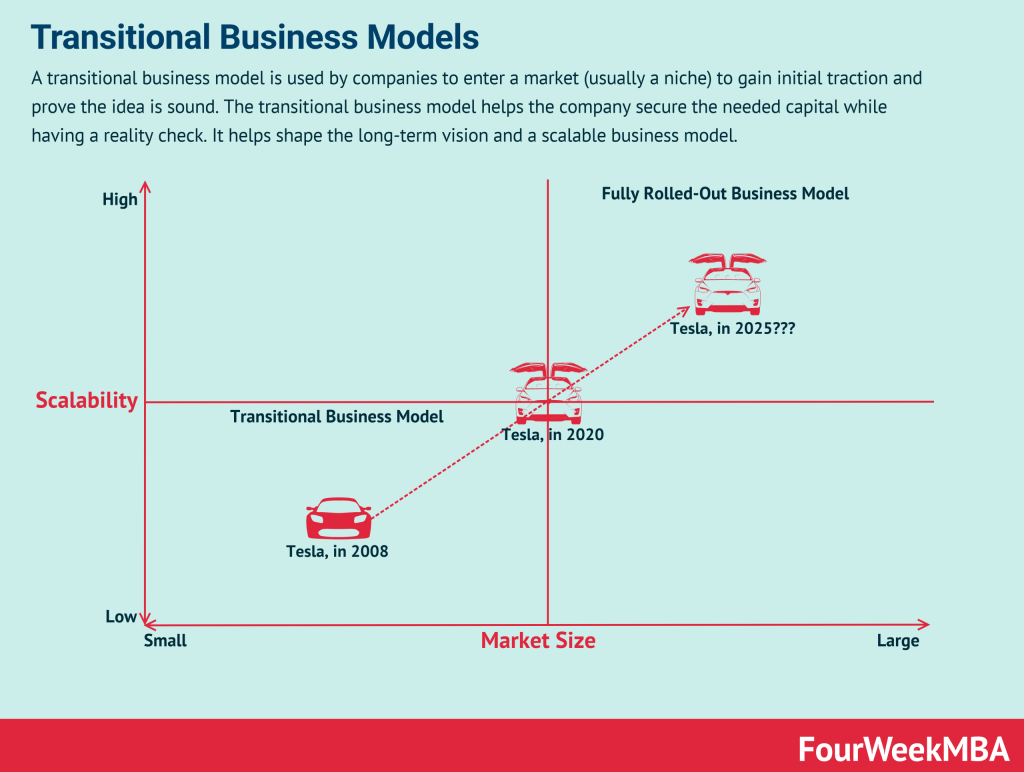
A transitional business model is used by companies to enter a market (usually a niche) to gain initial traction and prove the idea is sound. The transitional business model helps the company secure the needed capital while having a reality check. It helps shape the long-term vision and a scalable businessmodel.
The minimum viable audience (MVA) represents the smallest possible audience that can sustain your business as you get it started from a microniche (the smallest subset of a market). The main aspect of the MVA is to zoom into existing markets to find those people which needs are unmet by existing players.
Business scaling is the process of transformation of a business as the product is validated by wider and wider market segments. Business scaling is about creating traction for a product that fits a small market segment. As the product is validated it becomes critical to build a viable businessmodel. And as the product is offered at wider and wider market segments, it’s important to align product, businessmodel, and organizational design, to enable wider and wider scale.
The market expansion consists in providing a product or service to a broader portion of an existing market or perhaps expanding that market. Or yet, market expansions can be about creating a whole new market. At each step, as a result, a company scales together with the market covered.
In the FourWeekMBA growth matrix, you can apply growth for existing customers by tackling the same problems (gain mode). Or by tackling existing problems, for new customers (expand mode). Or by tackling new problems for existing customers (extend mode). Or perhaps by tackling whole new problems for new customers (reinvent mode).
In the FourWeekMBA Revenue Streams Matrix, revenue streams are classified according to the kind of interactions the business has with its key customers. The first dimension is the “Frequency” of interaction with the key customer. As the second dimension, there is the “Ownership” of the interaction with the key customer.
Revenue model patterns are a way for companies to monetize their business models. A revenue model pattern is a crucial building block of a business model because it informs how the company will generate short-term financial resources to invest back into the business. Thus, the way a company makes money will also influence its overall businessmodel.
A pricingstrategy or model helps companies find the pricing formula in fit with their business models. Thus aligning the customer needs with the product type while trying to enable profitability for the company. A good pricingstrategy aligns the customer with the company’s long term financial sustainability to build a solid businessmodel.
The bullseye framework is a simple method that enables you to prioritize the marketing channels that will make your company gain traction. The main logic of the bullseye framework is to find the marketing channels that work and prioritize them.
STP marketing simplifies the market segmentation process and is one of the most commonly used approaches in modern marketing. The core focus of STP marketing is commercial effectiveness. Marketers use the approach to select the most valuable segments from a target audience and develop a product positioning strategy and marketing mix for each.
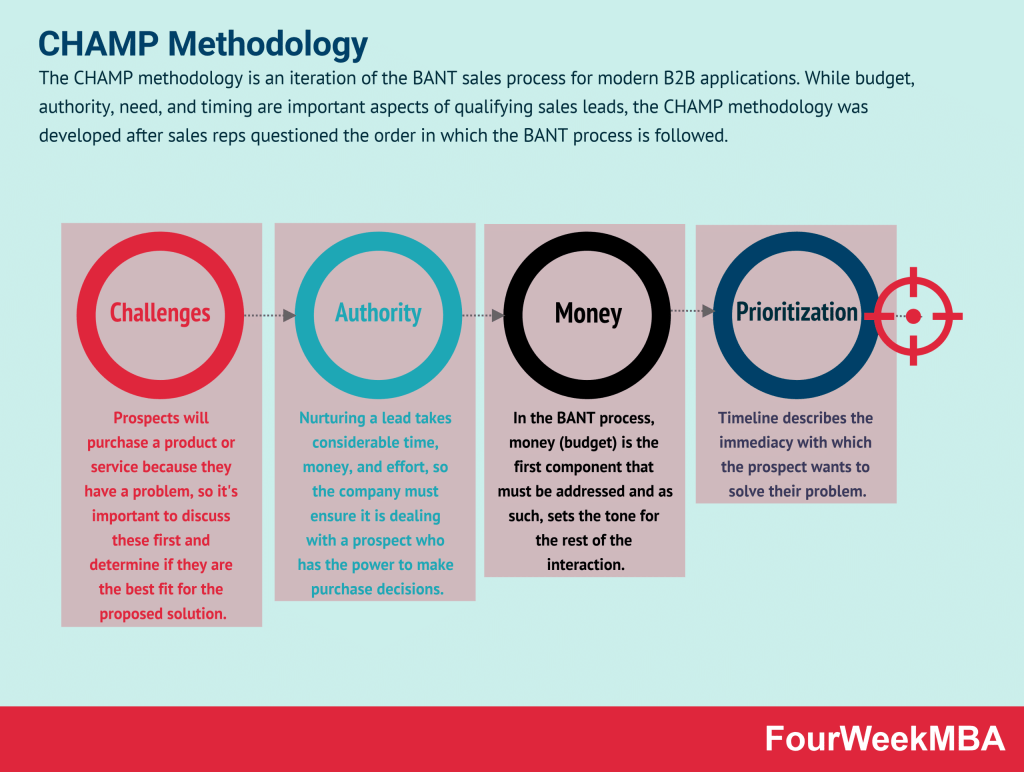
The CHAMP methodology is an iteration of the BANT sales process for modern B2B applications. While budget, authority, need, and timing are important aspects of qualifying sales leads, the CHAMP methodology was developed after sales reps questioned the order in which the BANT process is followed.
The BANT process was conceived at IBM in the 1950s as a way to quickly identify prospects most likely to make a purchase. Despite its introduction around 70 years ago, the BANT process remains relevant today and was formally adopted into IBM’s Business Agility Solution Identification Guide.
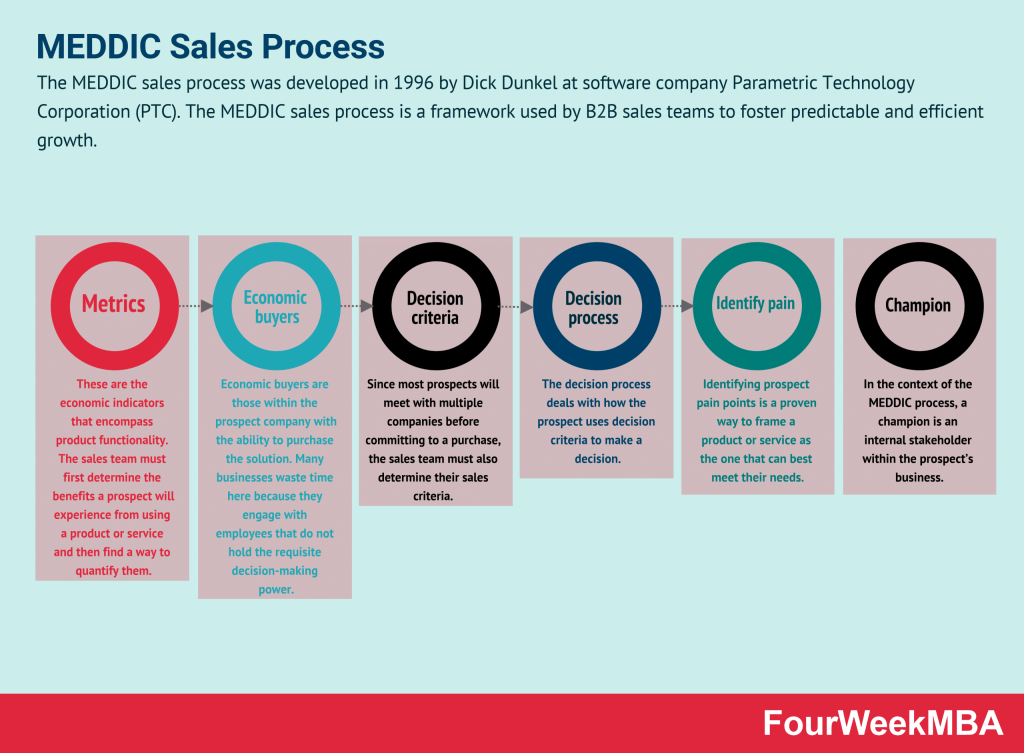
The MEDDIC sales process was developed in 1996 by Dick Dunkel at software company Parametric Technology Corporation (PTC). The MEDDIC sales process is a framework used by B2B sales teams to foster predictable and efficient growth.
Highlights
Concept
Description
When to Use
Advantages
Drawbacks
Growth Hacking
Rapid experimentation for startups to achieve quick growth with a limited budget.
When aiming for rapid growth on a tight budget, typically in startup environments.
Speedy growth with resource constraints.
Requires continuous experimentation and testing.
Scrum
A methodology for effective team collaboration, primarily used in software development for frequent product delivery.
In complex product development projects, particularly in software development.
Enhances team collaboration and productivity.
May not be suitable for all project types.
Minimum Viable Product
A version of a new product that collects customer feedback with minimal effort, aligned with lean startup principles.
When developing a product to validate customer needs efficiently.
Reduces development time and risk.
May lack advanced features initially.
Continuous Innovation
The ongoing process of innovating products and processes to meet evolving customer needs.
When striving to stay competitive by adapting to changing market conditions.
Ensures adaptability and competitiveness.
Requires a culture of innovation and adaptability.
Leaner MVP
An evolution of the MVP approach that validates market risk before proceeding with development.
When seeking to further reduce risks and costs before building a minimum viable product.
Minimizes development investment early on.
May delay product development.
Engines of Growth
Three mechanisms (sticky, viral, paid) startups use to achieve sustainable growth by leveraging past customer actions.
When analyzing and strategizing growth for startups, focusing on user behavior.
Provides clear growth strategies.
Success depends on effective implementation.
Lean Startup Canvas
An adaptation of the business model canvas that emphasizes understanding problems before solutions.
When developing startups with a customer-centric approach, emphasizing problem-solving.
Focuses on customer needs and value.
May require iteration and refinement.
Lean Methodology
A continuous process of product development that aims to meet customer needs efficiently, rooted in lean manufacturing.
In industries where efficiency and customer-centricity are essential.
Streamlines product development.
Requires a shift in mindset and practices.
Kanban
A lean manufacturing framework for visualizing work, optimizing processes, and improving efficiency.
When managing work processes, particularly in manufacturing or service industries.
Enhances workflow visibility and efficiency.
May not address broader strategic concerns.
Business Engineering
A discipline that combines entrepreneurship, strategy, and scaling concepts for effective business innovation.
When seeking to innovate and scale business models effectively and systematically.
Integrates various aspects of business.
Requires a deep understanding of the framework.
Tech Business Model Template
Defines the components of a tech business model, including value, technology, distribution, and financial models.
When designing or analyzing tech-focused business models.
Offers a structured approach to tech business modeling.
Requires adaptation to specific tech contexts.
Web3 Business Model Template
Defines the components of a blockchain-based business model, encompassing value, blockchain, distribution, and economic models.
When analyzing or designing business models for blockchain or Web3 applications.
Offers a framework for understanding Web3 business models.
Requires expertise in blockchain and Web3 concepts.
Asymmetric Business Models
Monetization models that leverage data and technology platforms with key customers paying to sustain the core asset.
When exploring business models that leverage data and technology assets.
Enables new revenue streams and models.
Requires careful management of data and technology assets.
Business Competition
Analyzes competition in a technology-driven world, considering customer, technology, distribution, and financial model overlaps.
When assessing competitive forces and strategic positioning in evolving markets.
Offers a comprehensive view of competitive dynamics.
Requires continuous monitoring and adaptation.
Technological Modeling
A discipline to sustain innovation by developing both incremental and breakthrough products through technological strategies.
When aiming to innovate continuously while exploring transformative opportunities.
Balances short-term and long-term innovation.
Requires a clear understanding of technological trends.
Transitional Business Models
Used by companies to gain initial traction and validate ideas in a market, helping shape long-term scalable business models.
When entering new markets or niches to test concepts and secure needed capital.
Supports idea validation and adaptation.
Requires a transition to long-term models.
Minimum Viable Audience
Represents the smallest audience that can sustain a business and focuses on unmet needs within existing markets.
When identifying niche markets and microniche segments with unmet needs.
Targets specific unmet customer needs.
May limit growth potential beyond the minimum audience.
Business Scaling
Transformation of a business as the product is validated by wider market segments, aligning product, model, and organization.
When expanding from a niche product to broader market segments and achieving growth.
Enables growth and market penetration.
Requires alignment of product, model, and organization.
Market Expansion Theory
Involves providing products or services to a broader portion of an existing market or creating entirely new markets.
When considering strategies for expanding market reach and opportunities.
Supports scaling and market coverage.
May require adapting to changing market conditions.
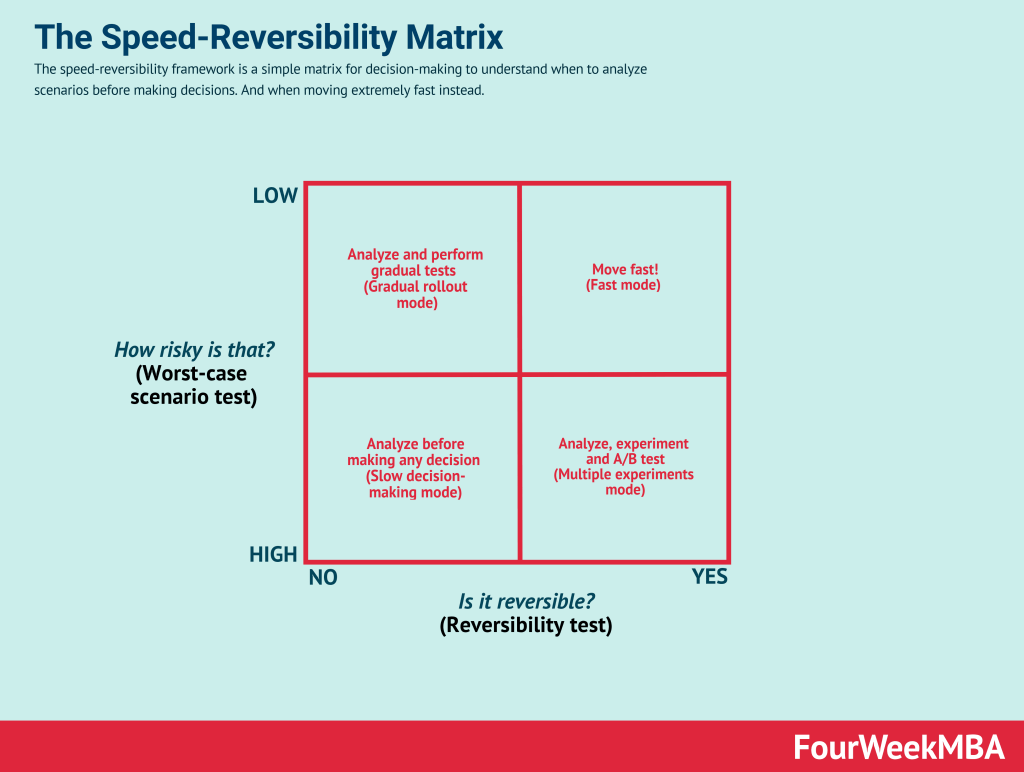
Speed-Reversibility
Evaluates business decisions based on their speed of implementation and ease of reversal.
When assessing and prioritizing business decisions based on impact and reversibility.
Helps make informed decisions.
May not address all decision factors comprehensively.
Asymmetric Betting
Focuses on high-impact opportunities where market risk is validated before other investments.
When evaluating and prioritizing business ideas based on impact and risk.
Helps identify high-impact opportunities.
Not a standalone decision-making tool.
Growth Matrix
Categorizes growth strategies based on addressing existing or new problems for existing or new customers.
When planning growth strategies for a business or product.
Provides a framework for strategic growth planning.
May not cover all strategic growth scenarios.
Revenue Streams Matrix
Classifies revenue streams based on the frequency and ownership of interactions with key customers.
When analyzing and optimizing revenue generation strategies.
Offers insights into revenue sources and customer relationships.
Requires alignment with business strategy and goals.
Revenue Modeling
Examines revenue patterns to monetize business models effectively, considering short-term financial sustainability.
When designing revenue generation strategies and models.
Provides guidance for revenue planning and optimization.
Requires adaptation to fit specific business contexts.
Pricing Strategies
Establishing pricing formulas that align customer needs with profitability, enabling sustainable business models.
When setting prices for products or services to achieve profitability.
Aligns customer needs with business sustainability.
Considers market dynamics and competition.
Bullseye Framework
A method to prioritize marketing channels that will drive traction for a company effectively.
When planning marketing strategies to gain traction and optimize resources.
Focuses marketing efforts on high-impact channels.
Requires ongoing testing and adjustment.
Speed vs. Reversibility Matrix
Evaluates business decisions based on their speed of implementation and ease of reversal.
When assessing and prioritizing business decisions based on impact and reversibility.
Helps make informed decisions.
May not address all decision factors comprehensively.
STP Marketing
Simplifies market segmentation to select valuable segments, develop product positioning, and optimize marketing strategies.
In marketing, when identifying and targeting valuable customer segments efficiently.
Enhances commercial effectiveness.
May require comprehensive market research.
CHAMP Methodology
An iteration of the BANT sales process for B2B sales teams, focusing on customer challenges, authority, money, and prioritization.
In B2B sales, when qualifying leads and identifying prospects likely to make a purchase.
Addresses critical aspects of lead qualification.
May not fully align with certain sales processes.
BANT Sales Process
A sales process for identifying prospects based on budget, authority, need, and timing criteria.
In sales, when qualifying leads to prioritize those most likely to convert.
Simplifies lead qualification.
May not cover all aspects of lead qualification.
MEDDIC Sales Process
A framework for B2B sales teams to foster predictable and efficient growth by focusing on Metrics, Economic buyer, Decision criteria, Decision process, Identify pain, and Champion.
In B2B sales, when qualifying leads and ensuring efficient sales processes.
Provides a comprehensive approach to lead qualification.
May require significant training and implementation effort.
Gennaro is the creator of FourWeekMBA, which reached about four million business people, comprising C-level executives, investors, analysts, product managers, and aspiring digital entrepreneurs in 2022 alone | He is also Director of Sales for a high-tech scaleup in the AI Industry | In 2012, Gennaro earned an International MBA with emphasis on Corporate Finance and Business Strategy.