The STAR method is an interview technique that is used to answer behavioral interview questions. The STAR method is a technique that an interviewee can use to help prepare for behavioral or situational interview questions that assess important skills. STAR is an acronym comprised of four factors that make the question answering framework: situation, task, action, and result.
The Vroom-Yetton decision model is a decision-making process based on situational leadership. According to this model, there are five decision-making styles guides group-based decision-making according to the situation at hand and the level of involvement of subordinates: Autocratic Type 1 (AI), Autocratic Type 2 (AII), Consultative Type 1 (CI), Consultative Type 2 (CII), Group-based Type 2 (GII).
The TDODAR decision model helps an individual make good decisions in emergencies or any scenario with a high degree of uncertainty. TDODAR is an acronym of the six sequential steps that every practitioner must follow, comprising: time, diagnosis, options, decide, act/assign, review.
A Blindspot Analysis is a means of unearthing incorrect or outdated assumptions that can harm decision making in an organization. The term “blindspot analysis” was first coined by American economist Michael Porter. Porter argued that in business, outdated ideas or strategies had the potential to stifle modern ideas and prevent them from succeeding. Furthermore, decisions a business thought were made with care caused projects to fail because major factors had not been duly considered.
The Foursquare Protocol is an ethical decision-making model. The Foursquare Protocol helps businesses respond to challenging situations by making decisions according to a code of ethics. It can also be used to help individuals make decisions in the context of their own moral principles. It consists of four steps: gather the facts, understand previous decisions, assess the degree of similarity to past events, and assess yourself.
The Amazon Working Backwards Method is a product development methodology that advocates building a product based on customer needs. The Amazon Working Backwards Method gained traction after notable Amazon employee Ian McAllister shared the company’s product development approach on Quora. McAllister noted that the method seeks “to work backwards from the customer, rather than starting with an idea for a product and trying to bolt customers onto it.”
Eighteen years later, it was adapted by psychologist Bob Eberle in his book SCAMPER: Games for Imagination Development. The SCAMPER method was first described by advertising executive Alex Osborne in 1953. The SCAMPER method is a form of creative thinking or problem solving based on evaluating ideas or groups of ideas.
A decision matrix is a decision-making tool that evaluates and prioritizes a list of options. Decision matrices are useful when: A list of options must be trimmed to a single choice. A decision must be made based on several criteria. A list of criteria has been made manageable through the process of elimination.
A cost-benefit analysis is a process a business can use to analyze decisions according to the costs associated with making that decision. For a costanalysis to be effective it’s important to articulate the project in the simplest terms possible, identify the costs, determine the benefits of project implementation, assess the alternatives.
In general, terms, go/no-go decision making is a process of passing or failing a proposition. Each proposition is assessed according to criteria that determine whether a project advances to the next stage. The outcome of the go/no-go decision making is to assess whether to go or not to go with a project, or perhaps proceed with caveats.
In the FourWeekMBA growth matrix, you can apply growth for existing customers by tackling the same problems (gain mode). Or by tackling existing problems, for new customers (expand mode). Or by tackling new problems for existing customers (extend mode). Or perhaps by tackling whole new problems for new customers (reinvent mode).
In the FourWeekMBA Revenue Streams Matrix, revenue streams are classified according to the kind of interactions the business has with its key customers. The first dimension is the “Frequency” of interaction with the key customer. As the second dimension, there is the “Ownership” of the interaction with the key customer.
The Mendelow stakeholder matrix is a framework used to analyze stakeholder attitudes and expectations and their potential impact on business decisions.
Nudge theory argues positive reinforcement and indirect suggestion is an effective way to influence the behavior and decision making of individuals or groups. Nudge theory was an idea first popularized by behavioral economist Richard Thaler and political scientist Cass Sunstein. However, the pair based much of their theory on heuristic research conducted by psychologists Daniel Kahneman and Amos Tversky in the 1970s.
Stanford University Professor Ronald A. Howard first defined decision analysis as a profession in 1964. Over the ensuing decades, Howard has supervised many doctoral theses on the subject across topics including nuclear waste disposal, investment planning, hurricane seeding, and research strategy. Decision analysis (DA) is a systematic, visual, and quantitative decision-making approach where all aspects of a decision are evaluated before making an optimal choice.
A regret minimization framework is a business heuristic that enables you to make a decision, by projecting yourself in the future, at an old age, and visualize whether the regrets of missing an opportunity would hunt you down, vs. having taken the opportunity and failed. In short, if taking action and failing feels much better than regretting it, in the long run, that is when you’re ready to go!
Single-attribute choices – such as choosing the apartment with the lowest rent – are relatively simple. However, most of the decisions consumers make are based on multiple attributes which complicate the decision-making process. The compromise effect states that a consumer is more likely to choose the middle option of a set of products over more extreme options.
The Pareto Analysis is a statistical analysis used in business decision making that identifies a certain number of input factors that have the greatest impact on income. It is based on the similarly named Pareto Principle, which states that 80% of the effect of something can be attributed to just 20% of the drivers.
Decision-Making Techniques and Frameworks
STAR Method: An interview technique to answer behavioral questions, focusing on Situation, Task, Action, and Result.
Vroom-Yetton Decision Model: A decision-making process based on situational leadership and five decision-making styles.
TDODAR Decision Model: A sequential decision-making model for emergencies and high-uncertainty scenarios.
Blindspot Analysis: Identifying incorrect or outdated assumptions that can harm decision-making.
Foursquare Protocol: An ethical decision-making model with four steps: gather facts, understand previous decisions, assess similarity, and assess yourself.
Working Backwards: A product development methodology that starts with customer needs.
SCAMPER Method: A creative thinking technique for evaluating and generating ideas.
Decision Matrix: A tool to evaluate and prioritize a list of options based on criteria.
Cost-Benefit Analysis: Analyzing decisions based on costs and benefits.
Go/No-Go Decision: Assessing whether to proceed with a project based on criteria.
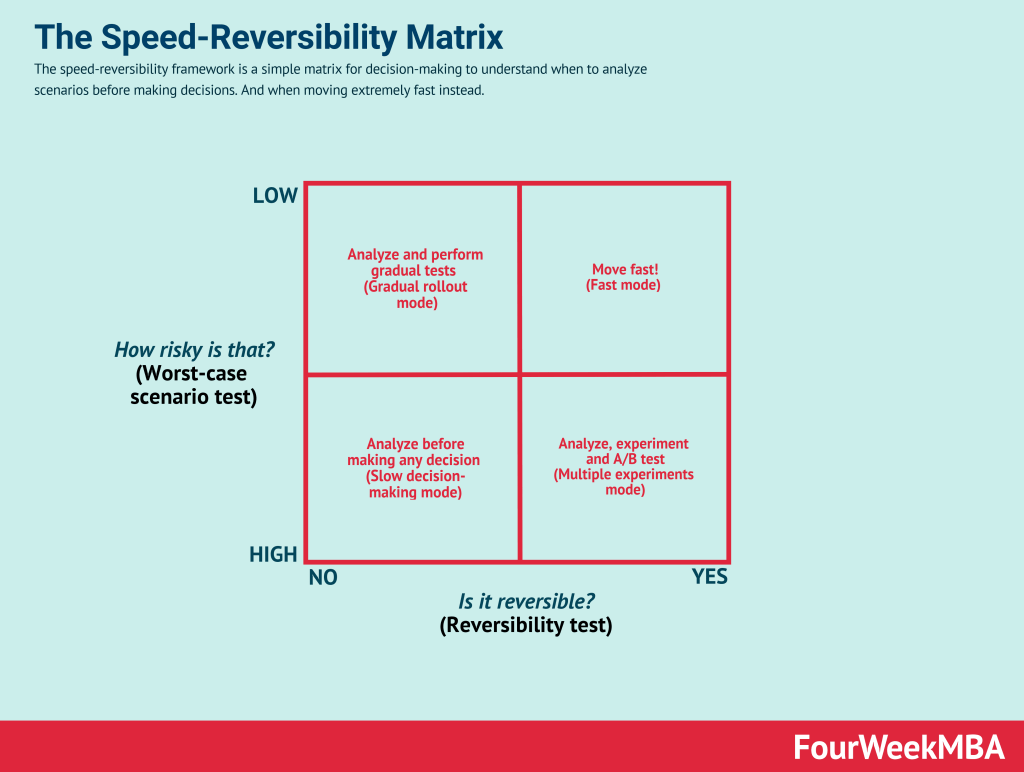
Speed-Reversibility: A decision-making approach considering the speed and ease of reversibility.
Asymmetric Betting: Making decisions with a favorable risk-reward ratio.
Growth Matrix: Classifying growth strategies based on existing and new customers and problems.
Revenue Streams Matrix: Classifying revenue streams based on interactions with key customers.
Mendelow Stakeholder Matrix: Analyzing stakeholder attitudes and impact on business decisions.
Nudge Theory: Using positive reinforcement and indirect suggestion to influence behavior.
Decision Analysis: A systematic and quantitative approach to decision-making.
Regret Minimization Framework: Making decisions by visualizing future regrets.
Compromise Effect: Choosing the middle option of a set of products over extreme options.
Pareto Analysis: Identifying the key input factors that have the greatest impact on outcomes.
User Manual
Strategy/Concept
Description
When to Use
Advantages
Drawbacks
STAR Method
Interview technique for answering behavioral questions.
During job interviews or when preparing for behavioral interviews.
Provides a structured approach to answering interview questions.
May feel formulaic if not adapted to specific situations.
Vroom-Yetton Decision Model
Decision-making model based on situational leadership.
When making group-based decisions with varying levels of involvement from subordinates.
Offers different decision styles to fit different situations and team dynamics.
Complexity in choosing the most appropriate style.
TDODAR Decision Model
Decision-making framework for emergencies or high uncertainty.
In situations with a high degree of uncertainty and the need for quick, effective decisions.
Provides a systematic approach to decision-making in high-pressure scenarios.
May require practice to implement effectively.
Blindspot Analysis
Identifying incorrect or outdated assumptions in decision-making.
When organizational decisions seem to be hindered by outdated ideas or assumptions.
Helps uncover hidden biases and improves decision quality.
May require thorough examination and introspection.
Foursquare Protocol
Ethical decision-making model for businesses and individuals.
When facing challenging ethical decisions or dilemmas.
Provides a structured process for ethical decision-making.
Requires careful consideration of each step in the protocol.
Working Backwards
Product development methodology focused on customer needs.
When developing new products or services with a customer-centric approach.
Ensures alignment with customer needs and market demand.
May require a shift in mindset and traditional development processes.
SCAMPER Method
Creative thinking and problem-solving approach.
When seeking to generate innovative ideas or evaluate existing ones.
Encourages thinking from different angles and prompts creativity.
May not be suitable for all types of problems or decision contexts.
Decision Matrix
Decision-making tool for evaluating and prioritizing options.
When facing choices that involve multiple criteria and options.
Provides a structured way to compare and assess different choices.
Requires careful consideration and weighting of criteria.
Cost-Benefit Analysis
Process for analyzing decisions based on costs and benefits.
When evaluating the financial implications of a specific decision or project.
Helps quantify the pros and cons of a decision in monetary terms.
May not capture all intangible or non-monetary factors.
Go/No-Go Decision
Assessing propositions and determining project advancement.
When evaluating whether to proceed with a project or proposition based on predefined criteria.
Provides clarity on whether to move forward or reconsider a project.
Requires well-defined criteria and objective evaluation.
Speed-Reversibility
Decision-making based on the speed of implementation.
In situations where the speed of decision implementation is critical to success.
Prioritizes quick decision-making and adaptability.
May not apply to all types of decisions or industries.
Asymmetric Betting
Making decisions by assessing potential future regrets.
When facing significant decisions and evaluating the potential consequences of taking action or not.
Encourages a forward-looking perspective on decision-making.
May require introspection and long-term thinking.
Growth Matrix
Framework for growth strategies based on customer problems.
When planning business growth strategies and market expansion.
Helps align growth efforts with customer needs and segments.
Requires a deep understanding of customer problems and market dynamics.
Revenue Streams Matrix
Classifying revenue streams based on customer interactions.
When analyzing and optimizing revenue generation strategies.
Provides insights into revenue sources and customer engagement.
May require data collection and analysis to implement effectively.
Mendelow Stakeholder Matrix
Analyzing stakeholder attitudes and impact on decisions.
When assessing stakeholder relationships and their influence on business choices.
Helps prioritize stakeholder engagement and decision alignment.
May oversimplify stakeholder complexity in some cases.
Nudge Theory
Influencing behavior and decisions through positive reinforcement.
When designing policies or strategies to encourage specific behaviors or choices.
Offers a non-coercive approach to decision influence and behavior change.
Effectiveness may vary depending on individual responses.
Decision Analysis
Systematic approach to evaluate all aspects of a decision.
When facing complex decisions that involve multiple variables and uncertainties.
Provides a structured way to assess the full impact of a decision.
May require specialized knowledge and modeling expertise.
Regret Minimization Framework
Making decisions by considering potential future regrets.
When deciding between significant actions and assessing the long-term impact on personal satisfaction.
Encourages a forward-looking perspective and minimizes future regrets.
Requires introspection and subjective assessment of regrets.
Compromise Effect
Tendency to choose middle options when faced with multiple attributes.
When analyzing consumer choices and preferences in product offerings.
Offers insights into consumer decision patterns and pricing strategies.
May not apply to all decision contexts or industries.
Pareto Analysis
Identifying input factors with the greatest impact on income.
When analyzing factors that significantly influence business income or outcomes.
Focuses resources on the most influential factors for decision-making.
Assumes that a small portion of factors drives the majority of outcomes.
This table provides information on various strategies and concepts related to d
Gennaro is the creator of FourWeekMBA, which reached about four million business people, comprising C-level executives, investors, analysts, product managers, and aspiring digital entrepreneurs in 2022 alone | He is also Director of Sales for a high-tech scaleup in the AI Industry | In 2012, Gennaro earned an International MBA with emphasis on Corporate Finance and Business Strategy.