A business incubator is an organization that helps start-up companies or entrepreneurs develop their businesses. Assistance usually takes the form of dedicated office space, management training, and venture capital funding. According to the National Business Incubation Association, there are more than 1,400 incubators in the United States.
Aspect
Explanation
Definition
A Business Incubator is a program or organization that supports the development and growth of early-stage startups and small businesses. It provides a supportive ecosystem that typically includes physical workspace, mentorship, access to resources, and networking opportunities. The primary goal is to help startups overcome common challenges, such as lack of funding, limited business experience, and market entry barriers. Business incubators aim to accelerate the growth of these ventures, increase their chances of success, and contribute to economic development by fostering entrepreneurship. Incubators can be operated by universities, governments, private organizations, or a combination of these entities.
Key Concepts
– Support Ecosystem: Business incubators offer a comprehensive support ecosystem that includes physical infrastructure, mentorship, education, and access to networks. – Early-Stage Focus: They primarily target early-stage startups, helping them navigate the challenging initial phases of business development. – Resource Access: Incubated businesses gain access to resources such as funding, facilities, and expert advice. – Networking: Incubators facilitate networking with other entrepreneurs, investors, and industry experts. – Graduation: Successful startups eventually graduate from the incubator and continue operating independently.
Characteristics
– Physical Space: Incubators often provide co-working spaces or dedicated offices for startups, reducing overhead costs. – Mentorship: Experienced mentors or advisors guide entrepreneurs, offering insights and helping them make informed decisions. – Programs: Structured programs and workshops cover various aspects of business development, from strategy to marketing. – Investment Opportunities: Some incubators offer investment opportunities through direct funding or connections to investors. – Community: The incubator fosters a sense of community among entrepreneurs, promoting collaboration and idea sharing.
Implications
– Accelerated Growth: Incubators can significantly accelerate a startup’s growth trajectory by providing critical resources and guidance. – Risk Reduction: By addressing common startup challenges, they help reduce the risk of failure. – Innovation: Incubators contribute to innovation by nurturing new ideas and technologies. – Economic Impact: They can have a positive economic impact by creating jobs and fostering local entrepreneurship. – Market Entry: Incubators assist startups in entering markets more effectively and competitively.
Advantages
– Resource Access: Startups benefit from access to resources that would otherwise be costly or challenging to obtain. – Mentorship: Guidance from experienced mentors helps entrepreneurs make informed decisions. – Networking: Networking opportunities can lead to partnerships, collaborations, and investment. – Skill Development: Entrepreneurs can acquire valuable skills and knowledge through incubator programs. – Validation: Being part of an incubator can validate a startup’s credibility and potential.
Drawbacks
– Competitive Selection: Not all startups are accepted into incubator programs, leading to competition for limited spots. – Equity Exchange: Some incubators take equity in startups in exchange for their services, impacting ownership. – Resource Dependence: Startups may become overly reliant on the incubator’s resources, which can pose challenges post-graduation. – Mismatch: A misalignment between a startup’s goals and the incubator’s focus can lead to inefficiencies. – Graduation Challenges: Preparing for independence after incubation can be challenging for some startups.
Applications
– Technology Startups: Business incubators are prevalent in the technology sector, supporting software, hardware, and biotech startups. – Social Enterprises: Incubators also assist social enterprises and nonprofits in developing sustainable models. – Creative Industries: Incubators serve creative industries like design, fashion, and entertainment by offering resources and exposure. – Agriculture and Food: Some incubators focus on supporting innovations in agriculture and food production. – Healthcare and Biotechnology: Incubators play a crucial role in nurturing healthcare and biotechnology innovations.
Use Cases
– Y Combinator: Y Combinator is a renowned startup accelerator that has nurtured companies like Airbnb, Dropbox, and Reddit. – TechStars: TechStars provides mentorship and resources to startups and has a track record of successful alumni. – 500 Startups: Known for its global reach, 500 Startups has supported numerous startups in various industries. – MassChallenge: MassChallenge focuses on high-impact startups and has contributed to economic development in multiple cities. – BioLabs: BioLabs specializes in life sciences incubation, supporting companies in biotech and healthcare.
Business incubators provide specially designed programs to help young companies innovate, grow, and realize their vision. These programs provide access to financial and technical services that result in numerous benefits to the owners of such a company.
For one, office space may be offered at below-market rates. Experts can also provide advice on business or marketing plans and give entrepreneurs access to a network of investors and other professional services such as accountants and lawyers.
Most companies utilize the services of a business incubator for around two years. During this time, multiple start-ups with a similar focus work in a shared area to reduce operating costs.
It’s important to note that not all business incubators are created equal. Many specialize in a particular industry and some have a more rigorous application process than others. In most cases, however, the start-up will be required to submit a detailed business plan and disclose all business-related activities. Once accepted, it must commit to undertaking the necessary training and be prepared to report to the business incubator’s management.
What does the business incubator expect in return?
Business incubators do not accept every application – no matter how detailed a business plan may be.
Ultimately, they seek a return on investment and will take an equity stake in the business in exchange for services rendered. The shareholding is typically in the region of 2% to 10%. Alternatively, some may choose to charge a flat fee. Some incubators – including research organizations and educational institutions – may take a percentage of earnings from any resultant innovations.
While capital is useful to any start-up company, the amount of capital it receives from a business incubator may pale in comparison to how much that equity is worth over the long term. Entrepreneurs should note that while the incubator is invested in their success to some extent, they are nonetheless paying to be part of an incubator program where the incubator may take profits at the earliest opportunity.
Four types of business incubator
Though every business incubator shares the common goal of facilitating growth, they can nevertheless be broadly categorized into four types:
Non-profit development incubators
These are non-profit or government agencies designed to stimulate economic development. Many of these business incubators work with companies with a focus on public welfare or the improvement of society.
Corporate incubators
Whose primary objective is to enhance the entrepreneurial skillset of a start-up and help it remain competitive relative to its peers. Corporate incubators focus on internal and external company projects.
Private investor incubators
These incubators assist high-potential businesses by taking a stake in the company and selling at some point in the future. Many tech start-ups enter into this sort of arrangement.
Academic incubators
In response to increasingly dynamic and competitive markets, universities foster strategic partnerships between academia and industry to help graduates develop relevant, long-term skills.
Key takeaways:
A business incubator is an organization that helps start-up companies or entrepreneurs develop their businesses. Assistance usually takes the form of dedicated office space, management training, and venture capital funding.
In exchange for providing assistance, the business incubator takes an equity stake in the start-up of between 2% and 10%. Research and educational incubators may opt to take a percentage of the earnings resulting from any innovative products.
There are four broad types of business incubators: non-profit development, corporate, private investor, and academic. All share the common goal of facilitating growth.
Key Highlights
Definition: A business incubator is an organization that supports start-up companies and entrepreneurs in developing their businesses. It provides resources such as office space, management training, and venture capital funding.
How Business Incubators Work:
Incubators offer specialized programs to help young companies innovate, grow, and achieve their goals.
Benefits include access to financial and technical services, below-market office space, expert advice on business plans, and connections to investors and professional services.
Start-ups typically utilize the incubator’s services for around two years, sharing space to reduce costs.
Variations in Incubators:
Business incubators vary in focus and application processes.
Start-ups usually need to submit a detailed business plan and commit to necessary training and reporting.
Expectations from Start-ups:
Business incubators seek a return on investment and often take an equity stake in the start-up (2% to 10%) in exchange for services.
Some incubators might charge a flat fee or take a percentage of earnings from innovative products.
Types of Business Incubators:
Non-profit Development Incubators: Focus on economic development, often working with companies contributing to public welfare.
Corporate Incubators: Enhance entrepreneurial skills and competitiveness, both internally and externally.
Private Investor Incubators: Assist high-potential businesses by taking a stake and selling it in the future, commonly found in the tech sector.
Academic Incubators: Foster partnerships between academia and industry to develop graduates’ relevant skills.
Related Frameworks, Models, or Concepts
Description
When to Apply
Lean Startup Methodology
Lean Startup Methodology is an approach to launching and growing startups that emphasizes rapid experimentation, iterative product development, and validated learning. The Lean Startup Methodology advocates for building a minimum viable product (MVP) to test hypotheses and gather feedback from customers early and often. By adopting a lean startup approach, entrepreneurs and business incubators can reduce the time and resources needed to bring a product to market, mitigate risks, and increase the likelihood of success.
Apply the Lean Startup Methodology to guide the development and growth of startups within business incubators. Use it to encourage entrepreneurs to test their business ideas quickly and cheaply, iterate based on customer feedback, and pivot or persevere based on validated learning. Implement the Lean Startup Methodology as a framework for business model validation, product-market fit, and iterative innovation to accelerate startup growth and increase the chances of sustainable success.
Business Model Canvas
Business Model Canvas is a strategic management tool that allows entrepreneurs to visualize, design, and iterate on their business models. The Business Model Canvas consists of nine building blocks, including key elements such as customer segments, value propositions, channels, revenue streams, and cost structure. By using the Business Model Canvas, entrepreneurs and business incubators can systematically explore and refine their business models, identify opportunities for innovation, and align their resources and activities to create and capture value.
Apply the Business Model Canvas to facilitate the development and refinement of startup business models within business incubators. Use it to brainstorm and visualize key components of the business model, assess the viability and scalability of different value propositions and revenue streams, and iteratively refine the business model based on customer feedback and market validation. Implement the Business Model Canvas as a framework for strategic planning, business model innovation, and resource allocation to support startup growth and sustainability in dynamic and competitive markets.
Design Thinking
Design Thinking is a human-centered approach to innovation that emphasizes empathy, creativity, and iterative problem-solving. Design Thinking involves understanding the needs and motivations of users, generating diverse ideas, prototyping solutions, and testing and refining them based on user feedback. By applying Design Thinking principles, entrepreneurs and business incubators can uncover unmet customer needs, develop innovative solutions, and create products and services that resonate with users.
Apply Design Thinking to foster a culture of innovation and creativity within business incubators. Use it to encourage entrepreneurs to empathize with their target customers, define user-centric problem statements, ideate and prototype solutions, and validate concepts through iterative testing and refinement. Implement Design Thinking as a framework for user-centered design, product development, and innovation strategy to empower startups to create meaningful and impactful solutions that address real-world challenges and opportunities.
Agile Methodology
Agile Methodology is an iterative and incremental approach to software development that prioritizes flexibility, collaboration, and responsiveness to change. Agile development teams work in short iterations, delivering working software incrementally and adapting to evolving requirements and feedback. By embracing Agile principles such as customer collaboration, adaptive planning, and continuous improvement, entrepreneurs and business incubators can accelerate product development, reduce time to market, and increase customer satisfaction.
Apply Agile Methodology to streamline product development processes and workflows within business incubators. Use it to organize cross-functional teams, prioritize features and tasks, and deliver value to customers in short development cycles. Implement Agile Methodology as a framework for adaptive project management, customer-centric development, and rapid iteration to support startup agility and innovation and drive faster time to market and customer feedback.
Business Ecosystem Model
Business Ecosystem Model is a framework that describes the interconnected relationships between organizations, stakeholders, and resources within a business ecosystem. Business ecosystems consist of diverse actors such as customers, suppliers, partners, competitors, and regulators, and encompass both tangible and intangible assets such as technology, knowledge, and relationships. By analyzing and mapping the business ecosystem, entrepreneurs and business incubators can identify opportunities for collaboration, resource sharing, and value creation, and navigate competitive dynamics and market uncertainties.
Apply the Business Ecosystem Model to analyze and understand the dynamics and relationships within startup ecosystems and industries. Use it to identify key players and stakeholders, assess their roles and interactions, and uncover opportunities for partnership, collaboration, and co-creation. Implement the Business Ecosystem Model as a framework for ecosystem mapping, network analysis, and ecosystem development to support startup growth and ecosystem resilience and foster innovation and value creation within business incubators.
Open Innovation
Open Innovation is a collaborative approach to innovation that involves leveraging external ideas, technologies, and resources to accelerate internal innovation and create value. Open Innovation emphasizes collaboration with external partners such as customers, suppliers, universities, and startups to access new knowledge, insights, and capabilities and co-create innovative solutions. By embracing Open Innovation principles, entrepreneurs and business incubators can tap into external expertise and networks, drive technology transfer and commercialization, and enhance the competitiveness and sustainability of startups.
Apply Open Innovation to foster collaboration and knowledge exchange within and beyond business incubators. Use it to connect startups with external partners and resources, such as industry experts, academic institutions, research organizations, and funding agencies, to access new ideas, technologies, and markets. Implement Open Innovation as a framework for ecosystem collaboration, technology scouting, and co-innovation to support startup growth and competitiveness and accelerate the pace of innovation within business incubators.
Customer Development
Customer Development is a methodology developed by Steve Blank that focuses on validating startup hypotheses through direct engagement with customers. Customer Development involves a structured process of customer discovery, validation, creation, and building, aimed at understanding customer needs, testing product-market fit, and refining the startup’s value proposition. By applying Customer Development principles, entrepreneurs and business incubators can gather actionable insights, iterate on their business models, and increase the likelihood of success in competitive markets.
Apply Customer Development to validate startup ideas and assumptions through direct interaction with customers. Use it to conduct interviews, surveys, and experiments to gather feedback, validate hypotheses, and refine the startup’s value proposition and business model. Implement Customer Development as a framework for customer-centric innovation, market validation, and product-market fit to support startup growth and resilience and minimize the risks of failure within business incubators.
Business Acceleration
Business Acceleration is a process that helps startups rapidly scale their businesses and achieve sustainable growth. Business accelerators provide startups with resources, mentorship, and networking opportunities to accelerate their development, access markets, and attract investment. By participating in business acceleration programs, entrepreneurs can gain valuable support, guidance, and exposure to help them navigate the challenges of scaling a startup and increase their chances of success.
Apply Business Acceleration to support startup growth and scalability within business incubators. Use it to provide startups with access to mentorship, coaching, and networking opportunities, as well as resources such as funding, office space, and market access. Implement Business Acceleration as a framework for intensive support, guidance, and investment readiness to help startups accelerate their growth trajectories and achieve market traction and investor interest within business incubators.
Technology Transfer Model
Technology Transfer Model is a process that facilitates the transfer of technology and knowledge from research institutions, universities, and government agencies to the commercial sector for practical applications and commercialization. Technology transfer involves licensing intellectual property, establishing spin-off companies, and fostering collaborations between academia and industry to leverage research and innovation for economic and societal impact. By adopting technology transfer models, entrepreneurs and business incubators can access cutting-edge research and technologies, build competitive advantages, and drive innovation and economic growth.
Apply the Technology Transfer Model to facilitate the commercialization of research and technology within business incubators. Use it to establish partnerships with research institutions, universities, and government agencies to access intellectual property, expertise, and facilities, and support startups in licensing technologies, developing prototypes, and bringing innovations to market. Implement the Technology Transfer Model as a framework for technology commercialization, knowledge transfer, and industry-academia collaboration to foster innovation and entrepreneurship and create economic value within business incubators.
Startup Ecosystem Development
Startup Ecosystem Development involves creating an enabling environment and support infrastructure for startups to thrive and succeed. Startup ecosystems consist of diverse stakeholders such as entrepreneurs, investors, mentors, accelerators, government agencies, and support organizations, and encompass resources such as funding, talent, infrastructure, and networks. By fostering collaboration, connectivity, and innovation within startup ecosystems, entrepreneurs and business incubators can create vibrant entrepreneurial communities, attract investment, and catalyze economic growth and innovation.
Apply Startup Ecosystem Development to cultivate a supportive and vibrant startup ecosystem within business incubators. Use it to engage stakeholders, foster collaboration, and build connections between startups, investors, mentors, and support organizations, and create a conducive environment for entrepreneurship, innovation, and investment. Implement Startup Ecosystem Development as a framework for ecosystem building, community development, and policy advocacy to stimulate entrepreneurship, attract talent and capital, and drive economic development and prosperity within business incubators.
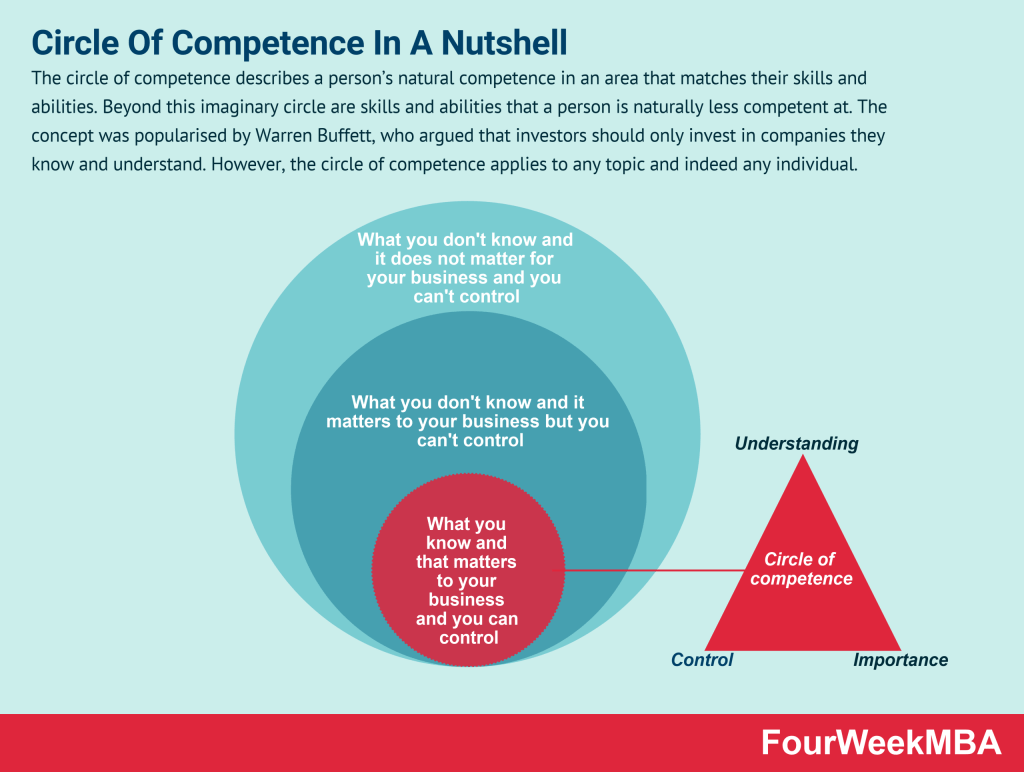
The circle of competence describes a person’s natural competence in an area that matches their skills and abilities. Beyond this imaginary circle are skills and abilities that a person is naturally less competent at. The concept was popularised by Warren Buffett, who argued that investors should only invest in companies they know and understand. However, the circle of competence applies to any topic and indeed any individual.
Economic or market moats represent the long-term business defensibility. Or how long a business can retain its competitive advantage in the marketplace over the years. Warren Buffet who popularized the term “moat” referred to it as a share of mind, opposite to market share, as such it is the characteristic that all valuable brands have.
The Buffet Indicator is a measure of the total value of all publicly-traded stocks in a country divided by that country’s GDP. It’s a measure and ratio to evaluate whether a market is undervalued or overvalued. It’s one of Warren Buffet’s favorite measures as a warning that financial markets might be overvalued and riskier.
Venture capital is a form of investing skewed toward high-risk bets, that are likely to fail. Therefore venture capitalists look for higher returns. Indeed, venture capital is based on the power law, or the law for which a small number of bets will pay off big time for the larger numbers of low-return or investments that will go to zero. That is the whole premise of venture capital.
Foreign direct investment occurs when an individual or business purchases an interest of 10% or more in a company that operates in a different country. According to the International Monetary Fund (IMF), this percentage implies that the investor can influence or participate in the management of an enterprise. When the interest is less than 10%, on the other hand, the IMF simply defines it as a security that is part of a stock portfolio. Foreign direct investment (FDI), therefore, involves the purchase of an interest in a company by an entity that is located in another country.
Micro-investing is the process of investing small amounts of money regularly. The process of micro-investing involves small and sometimes irregular investments where the individual can set up recurring payments or invest a lump sum as cash becomes available.
Meme stocks are securities that go viral online and attract the attention of the younger generation of retail investors. Meme investing, therefore, is a bottom-up, community-driven approach to investing that positions itself as the antonym to Wall Street investing. Also, meme investing often looks at attractive opportunities with lower liquidity that might be easier to overtake, thus enabling wide speculation, as “meme investors” often look for disproportionate short-term returns.
Retail investing is the act of non-professional investors buying and selling securities for their own purposes. Retail investing has become popular with the rise of zero commissions digital platforms enabling anyone with small portfolio to trade.
Accredited investors are individuals or entities deemed sophisticated enough to purchase securities that are not bound by the laws that protect normal investors. These may encompass venture capital, angel investments, private equity funds, hedge funds, real estate investment funds, and specialty investment funds such as those related to cryptocurrency. Accredited investors, therefore, are individuals or entities permitted to invest in securities that are complex, opaque, loosely regulated, or otherwise unregistered with a financial authority.
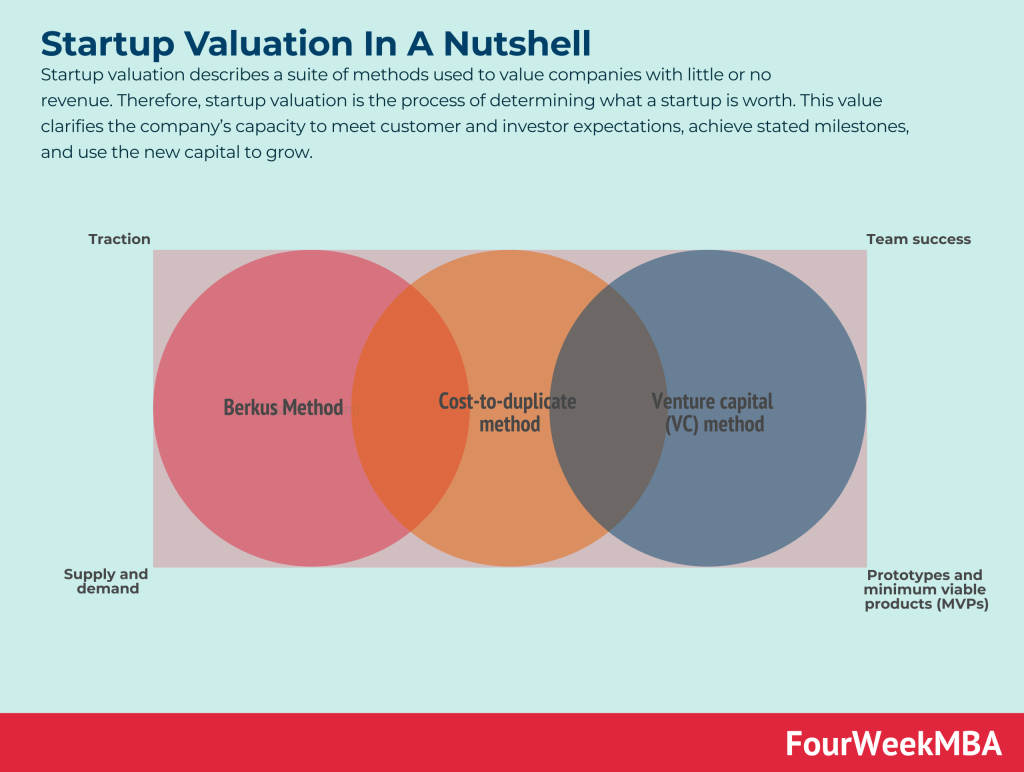
Startup valuation describes a suite of methods used to value companies with little or no revenue. Therefore, startup valuation is the process of determining what a startup is worth. This value clarifies the company’s capacity to meet customer and investor expectations, achieve stated milestones, and use the new capital to grow.
Profit is the total income that a company generates from its operations. This includes money from sales, investments, and other income sources. In contrast, cash flow is the money that flows in and out of a company. This distinction is critical to understand as a profitable company might be short of cash and have liquidity crises.
Double-entry accounting is the foundation of modern financial accounting. It’s based on the accounting equation, where assets equal liabilities plus equity. That is the fundamental unit to build financial statements (balance sheet, income statement, and cash flow statement). The basic concept of double-entry is that a single transaction, to be recorded, will hit two accounts.
The purpose of the balance sheet is to report how the resources to run the operations of the business were acquired. The Balance Sheet helps to assess the financial risk of a business and the simplest way to describe it is given by the accounting equation (assets = liability + equity).
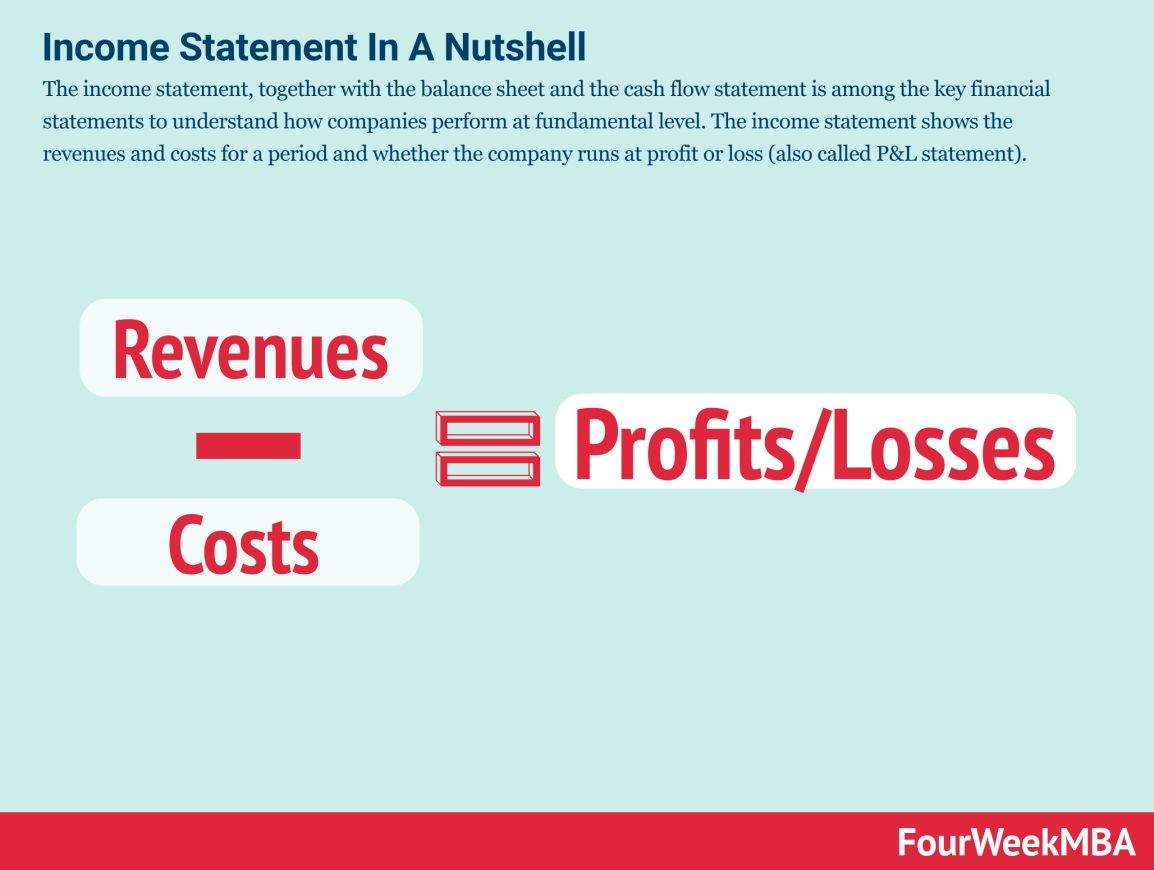
The income statement, together with the balance sheet and the cash flow statement is among the key financial statements to understand how companies perform at fundamental level. The income statement shows the revenues and costs for a period and whether the company runs at profit or loss (also called P&L statement).
The cash flow statement is the third main financial statement, together with income statement and the balance sheet. It helps to assess the liquidity of an organization by showing the cash balances coming from operations, investing and financing. The cash flow statement can be prepared with two separate methods: direct or indirect.
The capital structure shows how an organization financed its operations. Following the balance sheet structure, usually, assets of an organization can be built either by using equity or liability. Equity usually comprises endowment from shareholders and profit reserves. Where instead, liabilities can comprise either current (short-term debt) or non-current (long-term obligations).
Capital expenditure or capital expense represents the money spent toward things that can be classified as fixed asset, with a longer term value. As such they will be recorded under non-current assets, on the balance sheet, and they will be amortized over the years. The reduced value on the balance sheet is expensed through the profit and loss.
Financial statements help companies assess several aspects of the business, from profitability (income statement) to how assets are sourced (balance sheet), and cash inflows and outflows (cash flow statement). Financial statements are also mandatory to companies for tax purposes. They are also used by managers to assess the performance of the business.
Financial modeling involves the analysis of accounting, finance, and business data to predict future financial performance. Financial modeling is often used in valuation, which consists of estimating the value in dollar terms of a company based on several parameters. Some of the most common financial models comprise discounted cash flows, the M&A model, and the CCA model.
Business valuations involve a formal analysis of the key operational aspects of a business. A business valuation is an analysis used to determine the economic value of a business or company unit. It’s important to note that valuations are one part science and one part art. Analysts use professional judgment to consider the financial performance of a business with respect to local, national, or global economic conditions. They will also consider the total value of assets and liabilities, in addition to patented or proprietary technology.
A financial option is a contract, defined as a derivative drawing its value on a set of underlying variables (perhaps the volatility of the stock underlying the option). It comprises two parties (option writer and option buyer). This contract offers the right of the option holder to purchase the underlying asset at an agreed price.
Gennaro is the creator of FourWeekMBA, which reached about four million business people, comprising C-level executives, investors, analysts, product managers, and aspiring digital entrepreneurs in 2022 alone | He is also Director of Sales for a high-tech scaleup in the AI Industry | In 2012, Gennaro earned an International MBA with emphasis on Corporate Finance and Business Strategy.