– Value Proposition is one of the key components of the Business Model Canvas, which is a strategic tool used for designing, describing, and analyzing business
Importance
– Defining a clear and compelling value proposition is essential for attracting and retaining customers. It answers the critical question: "Why should customers
Customer Segment
– The Value Proposition is intimately connected to the Customer Segment. A business must understand its target customers' needs, pain points, and preferences to
Customer Jobs
– In the Value Proposition Canvas, you identify the Customer Jobs, which are the tasks or problems your customers are trying to solve. Understanding these jobs
Pains and Gains
– The canvas also involves capturing the Pains (customer frustrations and challenges) and Gains (desired outcomes and benefits) experienced by your customers. T
Fit and Alignment
– A successful value proposition aligns with the specific jobs, pains, and gains of your target customer segment. Achieving this fit ensures that your product o
Unique Differentiators
– The value proposition should highlight what sets your offering apart from competitors. Unique Differentiators are elements that make your product or service d
Features and Benefits
– The canvas helps in mapping out the key Features of your offering and the corresponding Benefits they provide to customers. Clear communication of these featu
The Value Proposition Canvas, part of the Business Model Canvas, is a tool used to ensure a product or service is positioned around customer values and needs.
Aspect
Explanation
Value Proposition
– Value Proposition is one of the key components of the Business Model Canvas, which is a strategic tool used for designing, describing, and analyzing business models. It focuses on defining the unique value a product or service offers to its customers.
Importance
– Defining a clear and compelling value proposition is essential for attracting and retaining customers. It answers the critical question: “Why should customers choose your product or service over alternatives?”
Customer Segment
– The Value Proposition is intimately connected to the Customer Segment. A business must understand its target customers’ needs, pain points, and preferences to create a value proposition that resonates with them.
Customer Jobs
– In the Value Proposition Canvas, you identify the Customer Jobs, which are the tasks or problems your customers are trying to solve. Understanding these jobs is key to crafting a value proposition that addresses their needs.
Pains and Gains
– The canvas also involves capturing the Pains (customer frustrations and challenges) and Gains (desired outcomes and benefits) experienced by your customers. These insights help tailor the value proposition effectively.
Fit and Alignment
– A successful value proposition aligns with the specific jobs, pains, and gains of your target customer segment. Achieving this fit ensures that your product or service addresses real customer needs, creating value.
Unique Differentiators
– The value proposition should highlight what sets your offering apart from competitors. Unique Differentiators are elements that make your product or service distinctive and appealing to customers.
Features and Benefits
– The canvas helps in mapping out the key Features of your offering and the corresponding Benefits they provide to customers. Clear communication of these features and benefits is crucial for customer understanding.
Testing and Iteration
– Value propositions are not set in stone. Businesses should be open to Testing their value propositions with real customers and be willing to Iterate based on feedback and changing market dynamics.
Cost vs. Value
– Balancing the Costs of delivering the value proposition with the perceived Value it provides to customers is critical. Businesses must ensure that the cost-to-value ratio remains attractive to customers.
Segment Fit
– A business may have multiple customer segments, each with its unique value proposition. Ensuring that the value proposition fits each segment’s needs and preferences is important for market relevance.
Clear Communication
– Effectively communicating the value proposition through marketing and messaging is vital. Customers should quickly grasp why your product or service is the best solution to their problems or needs.
Conclusion
– The Value Proposition Canvas helps businesses articulate the value they offer to customers and tailor it to specific segments. Achieving a strong fit between the value proposition and customer needs is key to success.
Understanding the Value Proposition Canvas
The Value Proposition Canvas enables businesses to list products or services that create value for a particular customer segment. In exchange for solving a problem or addressing a core need, the customer pays the business money.
The value proposition is fundamental to the success of any company since it is the main determinant of a customer choosing one product over a competing product. It encourages businesses to ask themselves:
What is the problem I am solving?
What is the underlying motivator?
Why would the consumer want this problem solved?
In clarifying the answers to these questions, it can be helpful to look at customer problems in the context of Maslow’s Hierarchy of Needs. That is, are the problems related to safety, status, belonging, or self-esteem?
Product development with a focus on value proposition and tangible customer needs helps the organization avoid launching products based on intangible ideas or innovation for the sake of innovation.
The two building blocks of the Value Proposition Canvas
Central to the Value Proposition Canvas is two foundational concepts. Each concept in turn comprises three parts.
1 – Customer profile
The customer profile consists of:
Jobs – these are the tasks and goals the customer tries to satisfy. They may be emotional, social, or functional.
Gains – or the benefits the consumer expects, wants, or needs, or would be delighted with receiving after completing a job. Gains may be related to status, wealth, efficiency, societal contributions, functionality, or quality, among other things.
Pains – these are emotions, risks, and other negative experiences associated with carrying out the job. These pains can be functional and prevent the consumer from accomplishing the task, such as a lack of time or money. They can also be emotional and social, resulting in feelings of shame or foolishness.
2 – Value map
The value map consists of:
Products and services – simply, the products and services being offered or under development.
Pain relievers – or how those products and services alleviate pain, eliminate frustrations or avoid risk. Common pain relievers include saving time and money, making consumers feel better, eliminating negative social consequences, and limiting or eradicating mistakes associated with product usage.
Gain creators – how can the organization make life easier for its customers? Gains may be related to quality, performance, features, usability, accessibility, social consequences, guarantees, and lower cost.
Value proposition types
Value may be qualitative (design, brand) or quantitative (price) with some businesses using a combination of both to target customer segments.
With that said, here is a non-exhaustive list of some common value proposition types:
Novelty – a form of value proposition commonly seen in tech products. Novelty was (and continues to be) a key ingredient in mass smartphone uptake around the world.
Customization – value proposition built around customization takes advantage of Maslow’s individual needs around self-esteem and self-actualization. With many buying products as extensions of themselves, value is created by allowing the customer to tailor the product to their individual needs. For example, Nike fans can design a completely original pair of shoes online by altering the color palette and even the size and placement of the swoosh.
Design – companies like Apple and Prada create value amongst consumers because they are perceived to add value through superior design.
Brand – value is also created via the status some people achieve by wearing a particular brand. Consumers who buy and wear Rolex watches want others to know they are wealthy enough to afford them. Brand value can also be explained by Maslow since status and belonging are higher-level consumer needs.
Price – a common way to create value in price-sensitive customer segments. Budget airlines have business models devoted entirely to low-cost air travel. Indian vehicle manufacturer Tata also released the Nano, which was so cheap that it became accessible to a vast and untapped segment of the national car market.
Examples Using the Value Proposition Canvas Framework:
Dropbox:
Customer Profile:
Jobs: Users need to access files across multiple devices.
Gains: Seamless access, ease of file sharing, no need for physical storage.
Pains: Loss of physical storage, inability to share large files.
Value Map:
Products and Services: Cloud storage.
Pain Relievers: Easy sharing, data backup.
Gain Creators: File sync across devices, collaboration tools.
Airbnb:
Customer Profile:
Jobs: Find affordable, unique accommodations.
Gains: Experience local culture, cost savings.
Pains: Expensive hotels, lack of local experiences.
Pains: Buying individual albums, lack of music discovery.
Value Map:
Products and Services: Music streaming platform.
Pain Relievers: Unlimited music access, curated playlists.
Gain Creators: Music recommendations, offline listening.
Rolex:
Customer Profile:
Jobs: Want a luxury accessory.
Gains: Status symbol, luxury feel.
Pains: Cheap watches, lack of durability.
Value Map:
Products and Services: Luxury watches.
Pain Relievers: Durability, time accuracy.
Gain Creators: Brand status, investment.
Ryanair (Budget Airlines):
Customer Profile:
Jobs: Travel at an affordable price.
Gains: Save money, more frequent travels.
Pains: Expensive flights, less frequent vacations.
Value Map:
Products and Services: Low-cost flights.
Pain Relievers: Affordable fares, frequent deals.
Gain Creators: More travel opportunities, no-frills service.
Key takeaways:
The Value Proposition Canvas is a tool used to ensure a product or service is positioned around customer values and needs.
The Value Proposition Canvas is based on two foundational concepts: the customer profile and the value map. Each consists of three parts that help businesses clarify how their products and services address consumer pains and add value to their lives.
Value proposition may be qualitative, quantitative, or a mixture of both. Common value types include novelty, customization, design, brand, and price.
Key Highlights
Importance of the Value Proposition: The Value Proposition Canvas is a crucial tool within the Business Model Canvas framework. It ensures that a product or service aligns with customer values and needs, ultimately driving customer choice and revenue generation.
Problem-Solution Alignment: A central focus of the value proposition is aligning the solution (product or service) with the customer’s problem or need. It prompts businesses to ask questions like, “What problem am I solving?” and “Why would the customer want this problem solved?” This problem-solution fit is vital for success.
Maslow’s Hierarchy of Needs: Understanding customer problems in the context of Maslow’s Hierarchy of Needs can be beneficial. It helps identify whether the problems relate to safety, status, belonging, self-esteem, or other levels of need. This understanding guides product development toward addressing tangible customer needs rather than vague ideas.
Two Building Blocks: The Value Proposition Canvas comprises two foundational building blocks:
Customer Profile: This block delves into the customer’s perspective and includes three key elements:
Jobs: The tasks and goals the customer seeks to accomplish, which can be emotional, social, or functional in nature.
Gains: The benefits the customer expects or desires after completing a job. These gains may pertain to status, wealth, efficiency, functionality, or other factors.
Pains: The negative emotions, risks, or experiences associated with performing a job, which can be functional (e.g., lack of time or money) or emotional/social (e.g., feelings of shame).
Value Map: This block explores how the organization’s products and services provide value to the customer. It includes:
Products and Services: A description of what the business offers or is developing.
Pain Relievers: How the products and services alleviate pain, frustration, or risk for the customer. Common pain relievers include time and cost savings, enhanced well-being, and error reduction.
Gain Creators: How the organization makes the customer’s life easier or better. This can relate to quality, performance, features, usability, accessibility, social impact, guarantees, and cost-effectiveness.
Value Proposition Types: Value propositions can take various forms, catering to different customer segments and preferences. Some common types include:
Novelty: Often found in tech products, novelty creates value by offering something new and exciting. For example, the mass adoption of smartphones was driven by their novelty.
Customization: Customization adds value by allowing customers to tailor products to their individual needs, fulfilling higher-level needs such as self-esteem and self-actualization.
Design: Superior design, as seen in companies like Apple and Prada, creates value by enhancing the product’s aesthetics and functionality.
Brand: Value is derived from the status associated with wearing or using a particular brand, aligning with consumers’ higher-level needs for status and belonging.
Price: Low-cost offerings, as seen in budget airlines and products like Tata Nano, create value in price-sensitive customer segments.
Qualitative and Quantitative Value: Value propositions can be qualitative (emphasizing design, brand, etc.) or quantitative (focused on price). Many businesses use a combination of both to target different customer segments effectively.
Related Frameworks, Models, or Concepts
Description
When to Apply
Business Model Canvas
The Business Model Canvas is a strategic management tool that allows organizations to describe, design, challenge, invent, and pivot their business model. It consists of nine building blocks, including key partners, key activities, value propositions, customer segments, customer relationships, channels, revenue streams, key resources, and cost structure. By using the Business Model Canvas, organizations can map out their business model and identify opportunities for innovation and growth.
Consider the Business Model Canvas when developing or refining your organization’s business model. Use it to visualize and analyze key components of your business model, identify strengths, weaknesses, and areas for improvement, and explore new opportunities for innovation and growth. Implement the Business Model Canvas as a framework for strategic planning, business model innovation, and alignment across your organization.
Customer Development Process
The Customer Development Process is a methodology for discovering and validating market opportunities by engaging directly with customers. It consists of four steps: customer discovery, customer validation, customer creation, and company building. By following the Customer Development Process, organizations can gain insights into customer needs, preferences, and pain points, validate their value proposition, and iteratively refine their product or service offerings to better fit market demand.
Consider the Customer Development Process when launching a new product or entering a new market. Use it to validate your value proposition, understand customer needs, and refine your product or service offerings based on customer feedback. Implement the Customer Development Process as a framework for customer-centric innovation, market validation, and iterative product development within your organization.
Jobs To Be Done (JTBD) Framework
The Jobs To Be Done (JTBD) Framework is a theory that suggests customers “hire” products or services to get a job done in their lives. It focuses on understanding the underlying motivations and goals that drive customer behavior. By identifying the “jobs” that customers are trying to accomplish, organizations can design value propositions that address specific customer needs and deliver superior outcomes.
Consider the Jobs To Be Done (JTBD) Framework when designing or refining your value proposition. Use it to uncover the underlying motivations and goals that drive customer behavior, identify unmet customer needs, and develop solutions that address specific job-related challenges effectively. Implement the JTBD Framework as a framework for customer-centric product development, innovation, and marketing strategy within your organization.
Lean Startup Methodology
The Lean Startup Methodology is an approach to building and managing startups that emphasizes rapid iteration, experimentation, and validated learning. It consists of three core principles: build-measure-learn, validated learning, and the minimum viable product (MVP). By adopting the Lean Startup Methodology, organizations can test their value propositions, iterate on product features, and pivot based on customer feedback to achieve product-market fit efficiently.
Consider the Lean Startup Methodology when developing new products or services. Use it to build prototypes quickly, test hypotheses, and gather feedback from early adopters to validate your value proposition and refine your product offering iteratively. Implement the Lean Startup Methodology as a framework for lean and agile product development, minimizing waste, and maximizing learning within your organization.
Design Thinking
Design Thinking is a human-centered approach to innovation that focuses on understanding user needs, ideating creative solutions, and prototyping and testing iteratively. It consists of five stages: empathize, define, ideate, prototype, and test. By applying Design Thinking principles, organizations can gain deep insights into customer needs, generate innovative ideas, and develop value propositions that resonate with users.
Consider Design Thinking when seeking to develop customer-centric solutions and value propositions. Use it to empathize with users, define their needs, brainstorm creative solutions, and prototype and test ideas iteratively to uncover valuable insights and drive innovation. Implement Design Thinking as a framework for fostering a culture of empathy, creativity, and experimentation within your organization to develop compelling value propositions and customer experiences.
Lean Canvas
The Lean Canvas is a one-page business plan template that helps entrepreneurs validate their startup ideas and communicate their business model succinctly. It consists of nine building blocks, including problem, solution, key metrics, unique value proposition, unfair advantage, customer segments, channels, cost structure, and revenue streams. By using the Lean Canvas, entrepreneurs can articulate their value proposition, identify key assumptions, and test hypotheses effectively.
Consider the Lean Canvas when developing a new business idea or startup venture. Use it to articulate your value proposition, identify key customer segments, and map out your business model in a concise and visual format. Implement the Lean Canvas as a framework for validating your startup concept, refining your value proposition, and aligning your business strategy with market needs and opportunities.
Customer Value Proposition
The Customer Value Proposition (CVP) articulates the unique benefits and value that a product or service delivers to its target customers. It answers the question: “Why should customers choose us over competitors?” By developing a compelling CVP, organizations can differentiate themselves in the market, attract customers, and drive revenue growth.
Consider the Customer Value Proposition when developing marketing strategies and messaging for your products or services. Use it to identify the unique benefits and value that your offerings provide to customers and communicate them effectively to target audiences. Implement the Customer Value Proposition as a framework for aligning your marketing efforts with customer needs, building brand awareness, and driving customer acquisition and retention within your organization.
Value Chain Analysis
Value Chain Analysis is a strategic tool that helps organizations identify activities that create value for customers and differentiate their offerings from competitors. It involves analyzing a firm’s internal operations and external relationships to understand how value is created and delivered throughout the supply chain. By conducting Value Chain Analysis, organizations can optimize processes, reduce costs, and enhance the overall value proposition for customers.
Consider Value Chain Analysis when seeking to understand your organization’s competitive advantage and value creation opportunities. Use it to identify key activities that contribute to your value proposition, assess their efficiency and effectiveness, and optimize processes to deliver superior value to customers. Implement Value Chain Analysis as a framework for strategic planning, process improvement, and competitive positioning within your organization.
Blue Ocean Strategy
Blue Ocean Strategy is a strategic framework that focuses on creating uncontested market space and making competition irrelevant. It encourages organizations to shift their focus from competing in existing markets (red oceans) to creating new market spaces (blue oceans) by offering unique value propositions. By pursuing Blue Ocean Strategy, organizations can unlock new growth opportunities, differentiate themselves from competitors, and capture untapped market demand.
Consider Blue Ocean Strategy when seeking to develop innovative value propositions and new market opportunities. Use it to identify unmet customer needs, challenge industry assumptions, and create new market spaces where competition is irrelevant. Implement Blue Ocean Strategy as a framework for driving innovation, differentiation, and growth within your organization by offering compelling value propositions that resonate with customers.
Customer Segmentation
Customer Segmentation involves dividing a market into distinct groups of customers with similar needs, characteristics, or behaviors. By segmenting customers, organizations can tailor their value propositions and marketing strategies to different target audiences effectively. Customer segmentation allows organizations to better understand customer needs, improve product-market fit, and enhance customer satisfaction and loyalty.
Consider Customer Segmentation when developing marketing strategies and value propositions for your products or services. Use it to identify distinct customer segments with unique needs and preferences, tailor your value proposition and messaging to each segment, and personalize customer experiences to drive engagement and loyalty. Implement Customer Segmentation as a framework for targeting specific customer groups, optimizing marketing effectiveness, and maximizing customer lifetime value within your organization.
This framework has been thought for any type of business model, be it digital or not. It’s a framework to start mind mapping the key components of your business or how it might look as it grows. Here, as usual, what matters is not the framework itself (let’s prevent to fall trap of the Maslow’s Hammer), what matters is to have a framework that enables you to hold the key components of your business in your mind, and execute fast to prevent running the business on too many untested assumptions, especially about what customers really want. Any framework that helps us test fast, it’s welcomed in our business strategy.
An effective business model has to focus on two dimensions: the people dimension and the financial dimension. The people dimension will allow you to build a product or service that is 10X better than existing ones and a solid brand. The financial dimension will help you develop proper distribution channels by identifying the people that are willing to pay for your product or service and make it financially sustainable in the long run.
This framework is well suited for all these cases where technology plays a key role in enhancing the value proposition for the users and customers. In short, when the company you’re building, analyzing, or looking at is a tech or platform business model, the template below is perfect for the job.
A tech business model is made of four main components: value model (value propositions, mission, vision), technological model (R&D management), distribution model (sales and marketingorganizational structure), and financial model (revenue modeling, cost structure, profitability and cash generation/management). Those elements coming together can serve as the basis to build a solid tech business model.
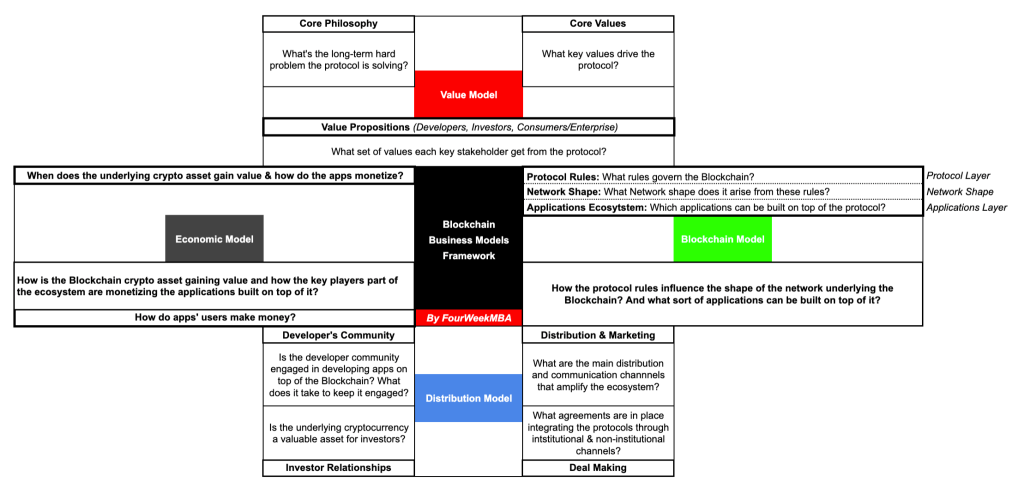
This framework is well suited to analyze and understand blockchain-based business models. Here, the underlying blockchain protocol, and the token economics behind it play a key role in aligning incentives and also in creating disincentives for the community of developers, individual contributors, entrepreneurs, and investors that enable the whole business model. The blockchain-based model is similar to a platform-based business model, but with an important twist, decentralization should be the key element enabling both decision-making and how incentives are distributed across the network.
A Blockchain Business Model according to the FourWeekMBA framework is made of four main components: Value Model (Core Philosophy, Core Values and Value Propositions for the key stakeholders), Blockchain Model (Protocol Rules, Network Shape and Applications Layer/Ecosystem), Distribution Model (the key channels amplifying the protocol and its communities), and the Economic Model (the dynamics/incentives through which protocol players make money). Those elements coming together can serve as the basis to build and analyze a solid Blockchain Business Model.
The ADKAR model is a management tool designed to assist employees and businesses in transitioning through organizational change. To maximize the chances of employees embracing change, the ADKAR model was developed by author and engineer Jeff Hiatt in 2003. The model seeks to guide people through the change process and importantly, ensure that people do not revert to habitual ways of operating after some time has passed.
You can use the Ansoff Matrix as a strategic framework to understand what growthstrategy is more suited based on the market context. Developed by mathematician and business manager Igor Ansoff, it assumes a growthstrategy can be derived from whether the market is new or existing, and whether the product is new or existing.
The business model canvas is a framework proposed by Alexander Osterwalder and Yves Pigneur in Busines Model Generation enabling the design of business models through nine building blocks comprising: key partners, key activities, value propositions, customer relationships, customer segments, critical resources, channels, cost structure, and revenue streams.
The lean startup canvas is an adaptation by Ash Maurya of the business model canvas by Alexander Osterwalder, which adds a layer that focuses on problems, solutions, key metrics, unfair advantage based, and a unique value proposition. Thus, starting from mastering the problem rather than the solution.
The Blitzscaling business model canvas is a model based on the concept of Blitzscaling, which is a particular process of massive growth under uncertainty, and that prioritizes speed over efficiency and focuses on market domination to create a first-scaler advantage in a scenario of uncertainty.
A blue ocean is a strategy where the boundaries of existing markets are redefined, and new uncontested markets are created. At its core, there is valueinnovation, for which uncontested markets are created, where competition is made irrelevant. And the cost-value trade-off is broken. Thus, companies following a blue ocean strategy offer much more value at a lower cost for the end customers.
Business analysis is a research discipline that helps driving change within an organization by identifying the key elements and processes that drive value. Business analysis can also be used in Identifying new business opportunities or how to take advantage of existing business opportunities to grow your business in the marketplace.
In the 1970s, Bruce D. Henderson, founder of the Boston Consulting Group, came up with The Product Portfolio (aka BCG Matrix, or Growth-share Matrix), which would look at a successful business product portfolio based on potential growth and market shares. It divided products into four main categories: cash cows, pets (dogs), question marks, and stars.
First proposed by accounting academic Robert Kaplan, the balanced scorecard is a management system that allows an organization to focus on big-picture strategic goals. The four perspectives of the balanced scorecard include financial, customer, business process, and organizational capacity. From there, according to the balanced scorecard, it’s possible to have a holistic view of the business.
A blue ocean is a strategy where the boundaries of existing markets are redefined, and new uncontested markets are created. At its core, there is valueinnovation, for which uncontested markets are created, where competition is made irrelevant. And the cost-value trade-off is broken. Thus, companies following a blue ocean strategy offer much more value at a lower cost for the end customers.
A gap analysis helps an organization assess its alignment with strategic objectives to determine whether the current execution is in line with the company’s mission and long-term vision. Gap analyses then help reach a target performance by assisting organizations to use their resources better. A good gap analysis is a powerful tool to improve execution.
The GE McKinsey Matrix was developed in the 1970s after General Electric asked its consultant McKinsey to develop a portfolio management model. This matrix is a strategy tool that provides guidance on how a corporation should prioritize its investments among its business units, leading to three possible scenarios: invest, protect, harvest, and divest.
The McKinsey 7-S Model was developed in the late 1970s by Robert Waterman and Thomas Peters, who were consultants at McKinsey & Company. Waterman and Peters created seven key internal elements that inform a business of how well positioned it is to achieve its goals, based on three hard elements and four soft elements.
McKinsey’s Seven Degrees of Freedom for Growth is a strategy tool. Developed by partners at McKinsey and Company, the tool helps businesses understand which opportunities will contribute to expansion, and therefore it helps to prioritize those initiatives.
The McKinsey Horizon Model helps a business focus on innovation and growth. The model is a strategy framework divided into three broad categories, otherwise known as horizons. Thus, the framework is sometimes referred to as McKinsey’s Three Horizons of Growth.
Porter’s Five Forces is a model that helps organizations to gain a better understanding of their industries and competition. Published for the first time by Professor Michael Porter in his book “Competitive Strategy” in the 1980s. The model breaks down industries and markets by analyzing them through five forces.
According to Michael Porter, a competitive advantage, in a given industry could be pursued in two key ways: low cost (cost leadership), or differentiation. A third generic strategy is focus. According to Porter a failure to do so would end up stuck in the middle scenario, where the company will not retain a long-term competitive advantage.
In his 1985 book Competitive Advantage, Porter explains that a value chain is a collection of processes that a company performs to create value for its consumers. As a result, he asserts that value chain analysis is directly linked to competitive advantage. Porter’s Value Chain Model is a strategic management tool developed by Harvard Business School professor Michael Porter. The tool analyses a company’s value chain – defined as the combination of processes that the company uses to make money.
Porter’s Diamond Model is a diamond-shaped framework that explains why specific industries in a nation become internationally competitive while those in other nations do not. The model was first published in Michael Porter’s 1990 book The Competitive Advantage of Nations. This framework looks at the firm strategy, structure/rivalry, factor conditions, demand conditions, related and supporting industries.
A SWOT Analysis is a framework used for evaluating the business‘s Strengths, Weaknesses, Opportunities, and Threats. It can aid in identifying the problematic areas of your business so that you can maximize your opportunities. It will also alert you to the challenges your organization might face in the future.
Businesses use scenario planning to make assumptions on future events and how their respective business environments may change in response to those future events. Therefore, scenario planning identifies specific uncertainties – or different realities and how they might affect future business operations. Scenario planning attempts at better strategic decision making by avoiding two pitfalls: underprediction, and overprediction.
The STEEPLE analysis is a variation of the STEEP analysis. Where the step analysis comprises socio-cultural, technological, economic, environmental/ecological, and political factors as the base of the analysis. The STEEPLE analysis adds other two factors such as Legal and Ethical.
A SWOT Analysis is a framework used for evaluating the business’s Strengths, Weaknesses, Opportunities, and Threats. It can aid in identifying the problematic areas of your business so that you can maximize your opportunities. It will also alert you to the challenges your organization might face in the future.
Gennaro is the creator of FourWeekMBA, which reached about four million business people, comprising C-level executives, investors, analysts, product managers, and aspiring digital entrepreneurs in 2022 alone | He is also Director of Sales for a high-tech scaleup in the AI Industry | In 2012, Gennaro earned an International MBA with emphasis on Corporate Finance and Business Strategy.