uber-values

Uber Values

Understanding a company’s values helps assess how the company makes decisions at scale. In Uber’s case, the company is defined by 7 core values:

  • Do the right thing.
  • Go get it.
  • Trip obsessed.
  • Build with heart.
  • Stand for safety.
  • See the forest and the trees.
  • One Uber.
  • Great minds don’t think alike.

Do the right thing

Period.

Go get it: Bring the mindset of a champion.

Our ambition is what drives us to achieve our mission. How we define a champion mindset isn’t based on how we perform on our best days, it’s how we respond on our worst days. We hustle, embrace the grind, overcome adversity, and play to win for the people we serve. Because it matters.

Uber has been following a blitzscaling strategy, since the onset.

In part, this has been due to the fact the company has been trying to open up a new industry, within a highly regulated and lobbied environment.

This pushed the company to move at the edge of regulation, and push on growth, as a priority, since its inception.

Trip obsessed: Make magic in the marketplace.

The trip is where the marketplace comes to life. The earner, rider, eater, carrier, and merchant are the people who connect in our marketplace – and we see every side. This requires judgment to make difficult trade-offs, blending algorithms with human ingenuity, and the ability to create simplicity from complexity. When we get the balance right for everyone, Uber magic happens.

Uber’s marketplace is central to its mission.

In fact, the marketplace is where network effects are built and how the service becomes valuable and stays valuable over time.

uber-mission-statement
Uber’s mission statement is to ignite opportunity by setting the world in motion.

When Uber kicks off network effects, those are usually local networks, where liquidity needs to be created, almost from scratch.

Build with heart: We care.

We work at Uber because our products profoundly affect lives and we care deeply about our impact. Putting ourselves in the shoes of people who connect in our marketplace helps us build better products that positively impact our communities and partners. Our care drives us to perfect our craft.

Uber has been pushing on a market expansion strategy, where it tried to build upon the existing mobility market, by enlarging it and redefining it.

uber-market-expansion

Stand for safety: Safety never stops.

We embed safety into everything we do. Our relentless pursuit to make Uber safer for everyone using our platform will continue to make us the industry leader for safety. We know the work of safety never stops, yet we can and will challenge ourselves to always be better for the communities we serve.

Safety is a core component of the service.

Just like for software companies like Google, or for media platforms like Twitter, the amount of spam on the platform as it scales, can stall the network and reduce its value drastically.

When it comes to Uber, safety is the spam equivalent.

In short, safety can actually reduce the value of the network, and it can do it quickly.

That is why this must be one of the core company’s values.

See the forest and the trees: Know the details that matter.

Building for the intersection of the physical and digital worlds at global scale requires seeing the big picture and the details. Knowing the important details can change the approach, and small improvements can compound into enormous impact over time.

This value is critical because Uber is a company operating at the intersection of digital and physical.

It has some advantages of being a digital player, but also many disadvantages of operating in a highly regulated, and local environment.

This enabled the company to create a built-in playbook that is at the intersection of digital and physical, with a focus on local and understanding of complex regulations.

One Uber: Bet on something bigger.

It’s powerful to be a part of something bigger than any one of us, or any one team. That’s why we work together to do what’s best for Uber, not the individual or team. We actively support our teammates, and they support us – especially when we hit the inevitable bumps in the road. We say what we mean, disagree and commit, and celebrate our progress, together.

Uber has created one of the most interesting companies of the last decade.

uber-business-model
Uber is a two-sided marketplace, a platform business model that connects drivers and riders, with an interface that has elements of gamification, that makes it easy for two sides to connect and transact. Uber makes money by collecting fees from the platform’s gross bookings.

And as its network has become valuable, it expanded in other areas, like delivery, with Uber Eats, which now, has become a huge company, within Uber.

uber-eats-business-model
Uber Eats is a three-sided marketplace connecting a driver, a restaurant owner, and a customer with the Uber Eats platform at the center. The three-sided marketplace moves around three players: Restaurants pay commission on the orders to Uber Eats; Customers pay the small delivery charges, and at times, cancellation fees; Drivers earn through making reliable deliveries on time.

Great minds don’t think alike: Diversity makes us stronger.

We seek out diversity. Diversity of ideas. Identity. Ethnicity. Experience. Education. The more diverse we become, the more we can adapt and ultimately achieve our mission. When we reflect the incredible diversity of the people who connect on our platform, we make better decisions that benefit the world.

In this case, diversity helps have a strong mindset, able to navigate complex situations and make decisions in a fast and ambiguous context.

Key Highlights

Do the right thing:

This value emphasizes ethical decision-making and integrity. It’s about making choices that align with ethical standards and doing what’s right, even when faced with challenges.

Go get it:

This value reflects a champion mindset and ambition. It’s about striving to achieve the company’s mission even in the face of adversity, hustling, embracing challenges, and playing to win.

Trip obsessed:

This value highlights the significance of the marketplace and customer experience. It involves making trade-offs, blending algorithms and human judgment, and creating balance to create the “magic” in the marketplace.

Build with heart:

This value focuses on caring about the impact of the company’s products on people’s lives. It’s about understanding the users, partners, and communities and using that empathy to build better products.

Stand for safety:

Safety is a paramount value for Uber. It emphasizes embedding safety into all aspects of the business to ensure the platform’s reliability and industry leadership in safety.

See the forest and the trees:

This value pertains to a balanced perspective that considers both the big picture and the crucial details. It’s essential in the context of operating at the intersection of the physical and digital worlds and understanding the complexities of local regulations.

One Uber:

This value promotes teamwork and collaboration, focusing on the collective success of the company rather than individual achievements. It encourages support, communication, and celebrating progress together.

Great minds don’t think alike:

Diversity is celebrated as a strength in this value. It highlights the importance of diverse perspectives, experiences, and backgrounds in decision-making, which leads to better outcomes for the company and its mission.


Read Next:

Visual Stories Related To Uber Business Model

Who Owns Uber

who-owns-uber
Uber’s principal individual shareholders comprise Yasir Al-Rumayyan (3.64%), the Governor of the Public Investment Fund, the sovereign wealth fund of the Kingdom of Saudi Arabia, and Dara Khosrowshahi, CEO of Uber. Institutional investors comprise Morgan Stanley, with 7.32% ownership, Fidelity, with 6.34%, and The Vanguard Group, with 5.85% ownership.

Uber Business Model

uber-business-model
Uber is a two-sided marketplace, a platform business model that connects drivers and riders, with an interface with gamification elements that make it easy for two sides to connect and transact. Uber makes money by collecting fees from the platform’s gross bookings.

Uber Revenue

uber-revenue

Is Uber Profitable?

is-uber-profitable
For the first time in its history, in 2023, Uber became profitable, with nearly $1.9 billion in net profits. Indeed on net revenues of over $37 billion, Uber posted a net profit of $1.88 billion, compared with a net loss of $9.14 billion in 2022. In 2021, Uber posted a lower net loss ($496 million), primarily thanks to the business divestitures of various assets. Throughout its history, on an annual basis, Uber has never made a profit except for 2023, when it finally reached profitability, thanks to a shifted focus toward operational efficiency.

Uber Take Rates

uber-vs-uber-eats-take-rate
Uber Mobility, which is the core platform of Uber, had a 28.8% take rate in 2023, and a 19.15% take rate for the delivery platform (Uber Eats) in the same period.
In 2022, Uber mobility took 27% of each booking on the platform. At the same time, Uber Eats took 20% of each booking on the delivery platform. The take rate varies according to demand and supply but also market dynamics. In short, in periods of increased competition, the service might charge lower take rates to keep up with it. In 2022, Uber pushed on efficiency, thus raising its take rates, to move toward profitability.

Uber Platform Users
uber-users
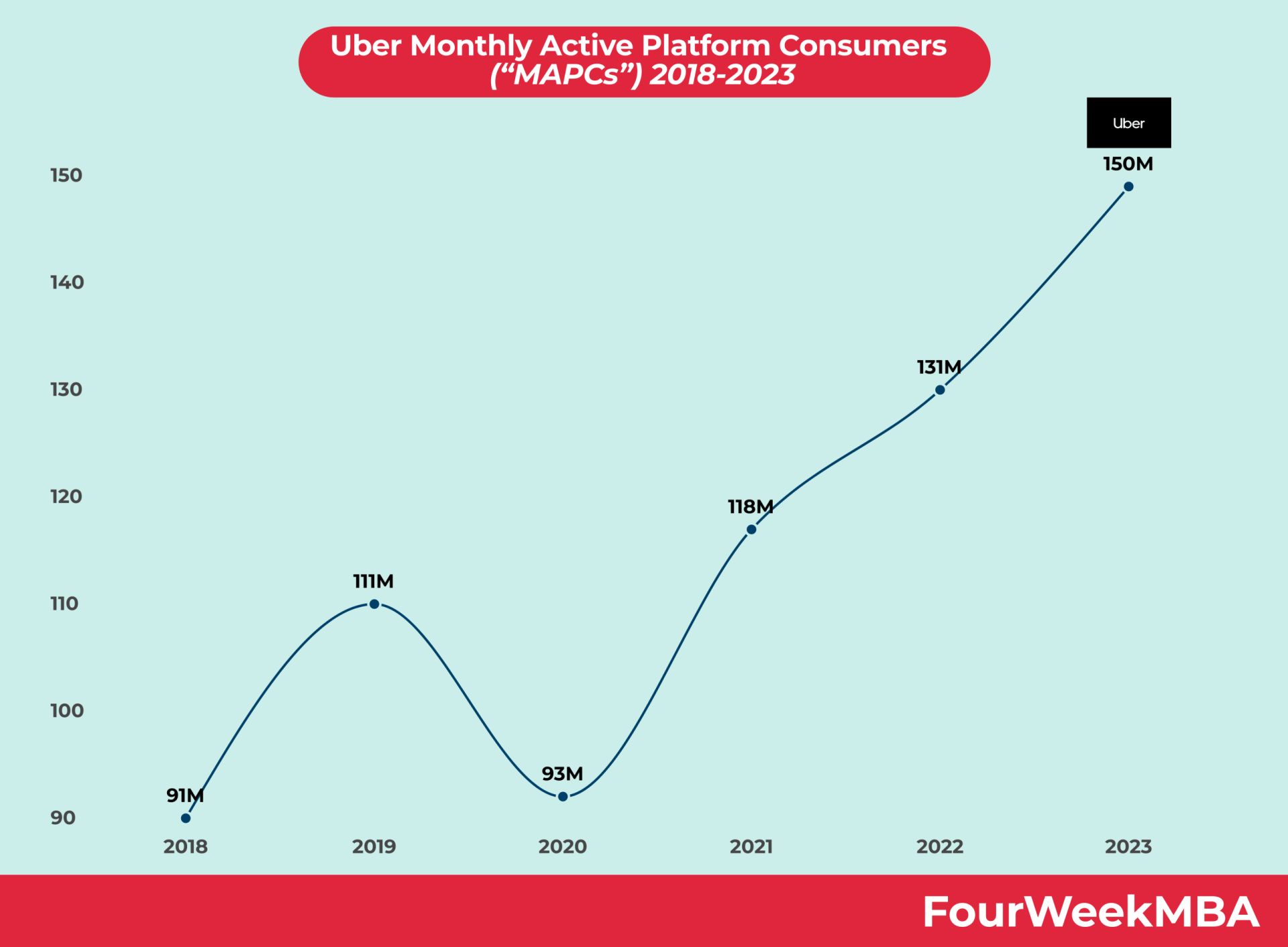
Uber had 150 million Monthly Active Platform Consumers in 2023. In 2022, Uber had 131 million Monthly Active Platform Consumers, compared to 118 million in 2021, and 93 million in 2020.

Uber Eats

uber-eats-business-model
Uber Eats is a three-sided marketplace connecting a driver, a restaurant owner, and a customer with the Uber Eats platform at the center. The three-sided marketplace moves around three players: Restaurants pay commission on the orders to Uber Eats; Customers pay small delivery charges, and at times, cancellation fees; Drivers earn through making reliable deliveries on time.

Uber Eats Revenue

uber-eats-revenue
In 2023 Uber Eats generated $12.2 billion in revenue, compared to nearly $11 billion in 2022, $8.3 billion in revenue in 2021, and $3.9 billion in revenue in 2020.

Is Uber Eats Profitable?

is-uber-eats-profitable
If we look at EBITDA, Uber Eats was a profitable segment, generating $1.5 billion in EBITDA in 2023. For the first time since its inception, Uber Eats’ EBITDA (Earnings Before Interest, Taxes, Depreciation, and Amortization) – which measures a company’s operational efficiency – turned positive for $551 million in 2022, compared to negative $348 million in 2021; negative $870 million in negative EBIDTA in 2020; and over $1.3 billion negative EBIDTA in 2019.

Uber Freight

uber-freight-business-model
Uber Freight is a platform that connects carriers with shippers, which generated $5.24 billion in revenue in 2023, slowing down from $6.95 billion in revenue in 2022, and it’s now one of the three core segments (Mobility, Delivery, and Freight) within the Uber Business Model.

Uber Revenue Breakdown

uber-revenues-breakdown
In 2023, Uber generated nearly $20 billion from its core platform (mobility), followed by delivery (Uber Eats) with $12.2 billion and freight, with $5.24 billion in revenue.

Uber Advertising

uber-advertising
In 2022 Uber launched its advertising segment, which comprises revenue from sponsored listing fees paid by merchants and brands in exchange for advertising on the platform. By the end of the year, Uber advertising had generated $500 million in revenue from 315K merchants. By 2023, the advertising business of Uber generated a billion dollars in revenue!

Uber vs. Lyft

uber-vs-lyft
Uber and Lyft are both mobility ride-sharing apps. Uber generated $37.28 billion in revenue in 2023, compared with Lyft, which generated $4.4B billion in the same year. A key difference is that while Lyft has primarily stayed in the mobility industry, Uber’s business model today spans various categories beyond mobility, such as delivery (Uber Eats) and freight. 

Food Delivery Business Models

food-delivery-business-model
In the food delivery business model companies leverage technology to build platforms that enable users to have the food delivered at home. This business model usually is set up as a platform and multi-sided marketplace, where the food delivery company makes money by charging commissions to the restaurant and to the customer.

DoorDash

how-does-doordash-make-money
DoorDash is a platform business model that enables restaurants to set up no-cost delivery operations. At the same time, customers get their food at home, and dashers (delivery people) earn some extra money. DoorDash makes money by markup prices through delivery fees, memberships, and advertising for restaurants on the marketplace.

Glovo

glovo-business-model
Glovo is a Spanish on-demand courier service that purchases and delivers products ordered through a mobile app. Founded in 2015 by Oscar Pierre and Sacha Michaud as a way to “uberize” local services. Glovo makes money via delivery fees, mini-supermarkets (fulfillment centers that Glovo operates in partnership with grocery store chains), and dark kitchens (enabling restaurants to increase their capacity).

Instacart Business Model

how-does-instacart-make-money
Instacart’s business model relies on enabling an easy set up for grocery stores, the comfort for customers to get their shopping delivered at home, and an additional income stream for personal shoppers. Instacart makes money by charging service fees, via memberships, and by running performance advertising on its platform.

Grubhub Business Model

grubhub-business-model
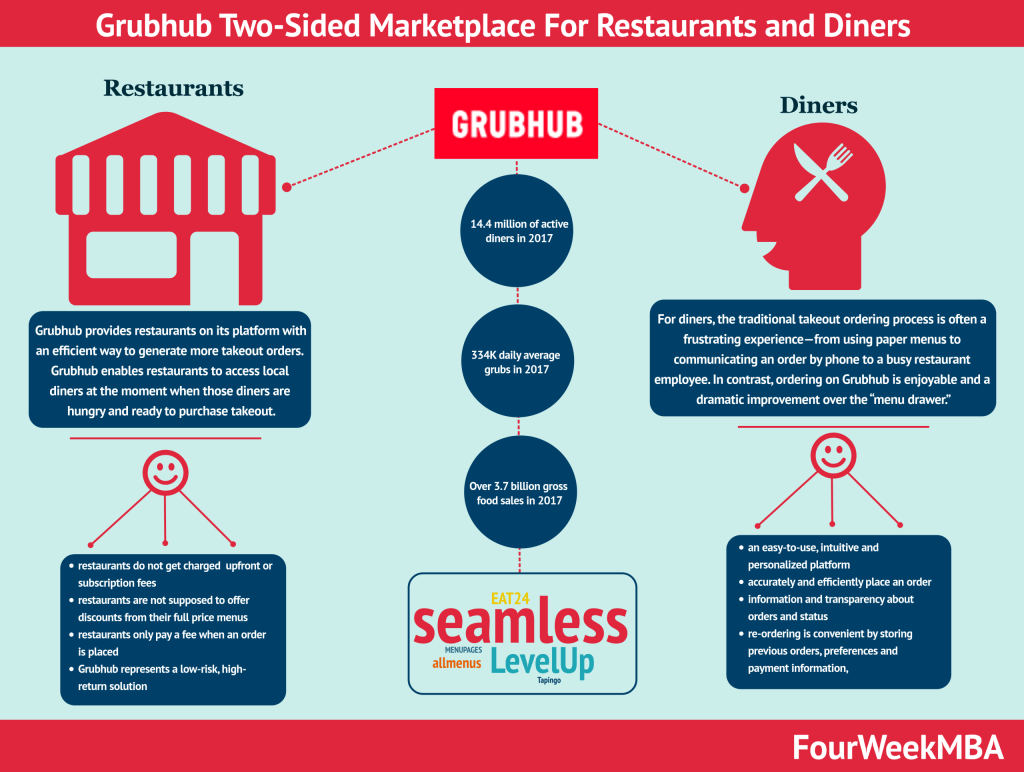
Grubhub is an online and mobile platform for restaurant pick-up and delivery orders. In 2018 the company connected 95,000 takeout restaurants in over 1,700 U.S. cities and London. The Grubhub portfolio of brands like Seamless, LevelUp, Eat24, AllMenus, MenuPages, andTapingo. The company makes money primarily by charging restaurants a pre-order commission and it generates revenues when diners place an order on its platform. Also, it charges restaurants that use Grubhub delivery services and when diners pay for those services. 

Shipt Business Model

how-does-shipt-make-money
Shipt is a North American integrated delivery service for groceries, home products, and electronics initially funded by Bill Smith, a highly experienced entrepreneur with a history of creating successful start-ups; in 2014, Smith used $3 million of his own money to create the first iteration of Shipt, the company was acquired by Target in 2017 in a cash deal worth $550 million. Membership fees predominantly drive Shipt revenue generation.
Scroll to Top

Discover more from FourWeekMBA

Subscribe now to keep reading and get access to the full archive.

Continue reading

FourWeekMBA