Marc Andreessen defined Product/market fit as “being in a good market with a product that can satisfy that market.” According to Andreessen, that is a moment when a product or service has its place in the market, thus enabling traction for the company offering that product or service.
The lean methodology is a continuous process of product development to meet customers’ needs. It was in part borrowed by the auto industry and its roots are found in the Toyota Production System, which was heavily influenced by Henry Ford’s assembly line system. The lean methodology is, therefore, an evolution from lean manufacturing, based on continuous improvement.
Kanban is a lean manufacturing framework first developed by Toyota in the late 1940s. The Kanban framework is a means of visualizing work as it moves through identifying potential bottlenecks. It does that through a process called just-in-time (JIT) manufacturing to optimize engineering processes, speed up manufacturing products, and improve the go-to-market strategy.
A blue ocean is a strategy where the boundaries of existing markets are redefined, and new uncontested markets are created. At its core, there is valueinnovation, for which uncontested markets are created, where competition is made irrelevant. And the cost-value trade-off is broken. Thus, companies following a blue ocean strategy offer much more value at a lower cost for the end customers.
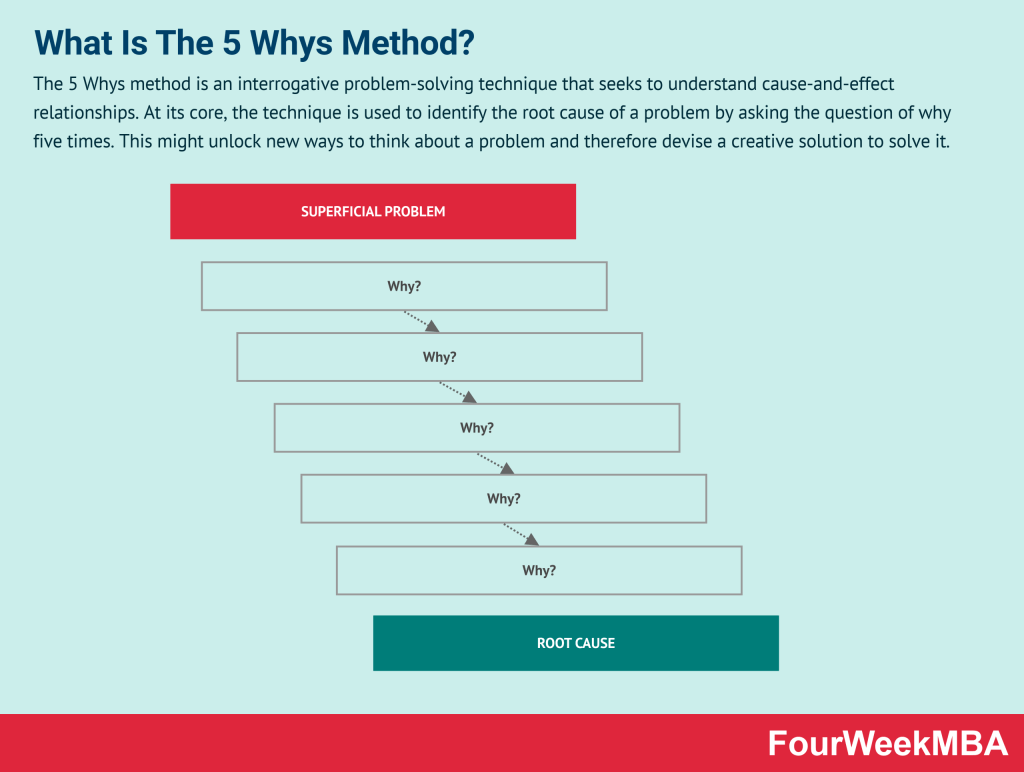
The 5 Whys method is an interrogative problem-solving technique that seeks to understand cause-and-effect relationships. At its core, the technique is used to identify the root cause of a problem by asking the question of why five times. This might unlock new ways to think about a problem and therefore devise a creative solution to solve it.
Venture capitalist, Dave McClure, coined the acronym AARRR which is a simplified model that enables to understand what metrics and channels to look at, at each stage for the users’ path toward becoming customers and referrers of a brand.
A north star metric (NSM) is any metric a company focuses on to achieve growth. A north star metric is usually a key component of an effective growth hackingstrategy, as it simplifies the whole strategy, making it simpler to execute at high speed. Usually, when picking up a North Start Metric, it’s critical to avoid vanity metrics (those who do not really impact the business) and instead find a metric that really matters for the businessgrowth.
Key Highlights
Product-Market Fit:
Coined by Marc Andreessen, product-market fit is when a product or service satisfies a specific market’s needs, leading to traction and success for the company.
Minimal Viable Product (MVP):
The MVP approach involves creating a basic version of a product to validate market demand and reduce risk before investing further resources.
Lean Methodology:
The lean methodology originates from lean manufacturing and aims for continuous product development to meet customer needs efficiently.
Kanban:
Kanban, a framework developed by Toyota, visualizes work in progress and helps optimize processes using just-in-time manufacturing.
Blue Ocean Strategy:
Blue ocean strategy involves creating new markets and valueinnovation, offering customers more value at lower costs while breaking the cost-value trade-off.
5 Whys:
The 5 Whys method is a problem-solving technique that seeks to identify the root cause of a problem by asking “why” multiple times.
Pirate Funnel (AARRR):
Coined by Dave McClure, the Pirate Funnel (AARRR) is a model that helps businesses understand metrics and channels at each stage of a user’s journey to becoming a customer and referrer.
Growth Hacking:
Growth hacking focuses on rapid experimentation across marketing channels to achieve scalable and sustainable businessgrowth.
North Star Metric (NSM):
The North Star Metric is a key metric a company focuses on to drive growth and guide its strategy, emphasizing meaningful impact over vanity metrics.
A Blockchain Business Model according to the FourWeekMBA framework is made of four main components: Value Model (Core Philosophy, Core Values and Value Propositions for the key stakeholders), Blockchain Model (Protocol Rules, Network Shape and Applications Layer/Ecosystem), Distribution Model (the key channels amplifying the protocol and its communities), and the Economic Model (the dynamics/incentives through which protocol players make money). Those elements coming together can serve as the basis to build and analyze a solid Blockchain Business Model.
In an asymmetric businessmodel, the organization doesn’t monetize the user directly, but it leverages the data users provide coupled with technology, thus have a key customer pay to sustain the core asset. For example, Google makes money by leveraging users’ data, combined with its algorithms sold to advertisers for visibility.
In a business world driven by technology and digitalization, competition is much more fluid, as innovation becomes a bottom-up approach that can come from anywhere. Thus, making it much harder to define the boundaries of existing markets. Therefore, a proper business competition analysis looks at customer, technology, distribution, and financial model overlaps. While at the same time looking at future potential intersections among industries that in the short-term seem unrelated.
Technological modeling is a discipline to provide the basis for companies to sustain innovation, thus developing incremental products. While also looking at breakthrough innovative products that can pave the way for long-term success. In a sort of Barbell Strategy, technological modeling suggests having a two-sided approach, on the one hand, to keep sustaining continuous innovation as a core part of the businessmodel. On the other hand, it places bets on future developments that have the potential to break through and take a leap forward.
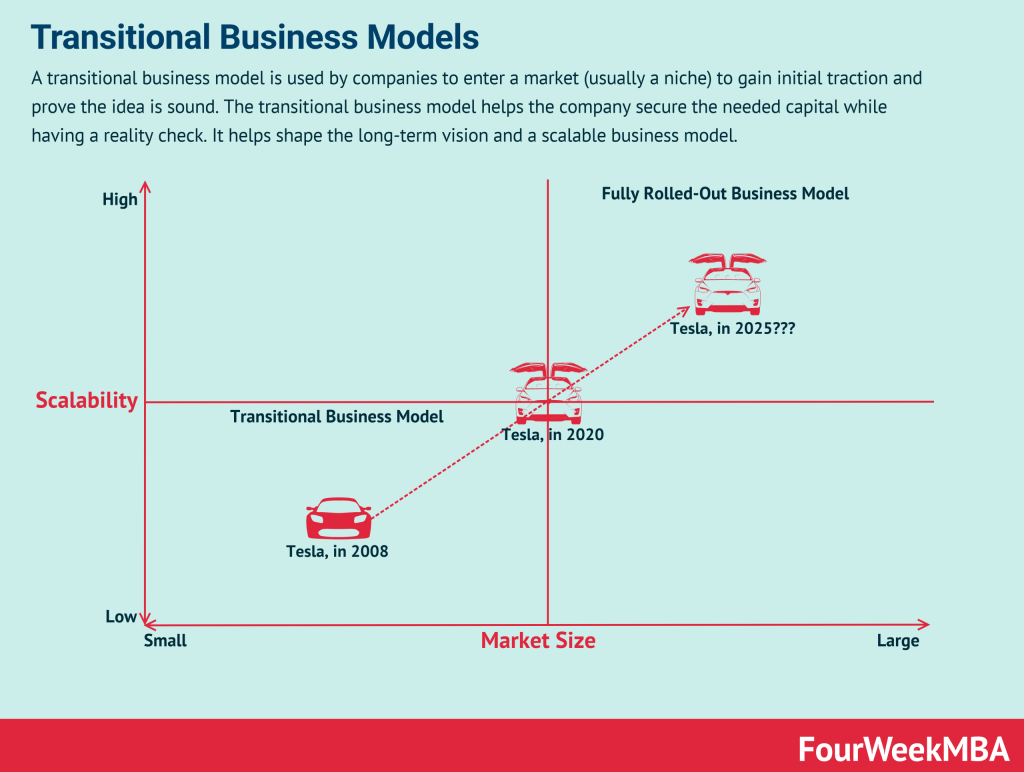
A transitional business model is used by companies to enter a market (usually a niche) to gain initial traction and prove the idea is sound. The transitional business model helps the company secure the needed capital while having a reality check. It helps shape the long-term vision and a scalable businessmodel.
The minimum viable audience (MVA) represents the smallest possible audience that can sustain your business as you get it started from a microniche (the smallest subset of a market). The main aspect of the MVA is to zoom into existing markets to find those people which needs are unmet by existing players.
Business scaling is the process of transformation of a business as the product is validated by wider and wider market segments. Business scaling is about creating traction for a product that fits a small market segment. As the product is validated it becomes critical to build a viable businessmodel. And as the product is offered at wider and wider market segments, it’s important to align product, businessmodel, and organizational design, to enable wider and wider scale.
The market expansion consists in providing a product or service to a broader portion of an existing market or perhaps expanding that market. Or yet, market expansions can be about creating a whole new market. At each step, as a result, a company scales together with the market covered.
In the FourWeekMBA growth matrix, you can apply growth for existing customers by tackling the same problems (gain mode). Or by tackling existing problems, for new customers (expand mode). Or by tackling new problems for existing customers (extend mode). Or perhaps by tackling whole new problems for new customers (reinvent mode).
In the FourWeekMBA Revenue Streams Matrix, revenue streams are classified according to the kind of interactions the business has with its key customers. The first dimension is the “Frequency” of interaction with the key customer. As the second dimension, there is the “Ownership” of the interaction with the key customer.
Revenue model patterns are a way for companies to monetize their business models. A revenue model pattern is a crucial building block of a business model because it informs how the company will generate short-term financial resources to invest back into the business. Thus, the way a company makes money will also influence its overall businessmodel.
A pricingstrategy or model helps companies find the pricing formula in fit with their business models. Thus aligning the customer needs with the product type while trying to enable profitability for the company. A good pricingstrategy aligns the customer with the company’s long term financial sustainability to build a solid businessmodel.
Gennaro is the creator of FourWeekMBA, which reached about four million business people, comprising C-level executives, investors, analysts, product managers, and aspiring digital entrepreneurs in 2022 alone | He is also Director of Sales for a high-tech scaleup in the AI Industry | In 2012, Gennaro earned an International MBA with emphasis on Corporate Finance and Business Strategy.