Social battery is an informal metaphor for the energy a person has for social interaction: it runs down with socialising and recharges with rest or time alone. It is not a clinical or scientific term, but it lines up with research on extraversion and fatigue, which finds that sociable behaviour lifts mood in the moment and can leave people more tired a few hours later.
The social battery cycle
Charged
Energy and patience for people
↻
Drain
Meetings, calls, crowds, small talk
↻
Low
Irritable, distracted, wants to withdraw
↻
Recharge
Rest, quiet, time alone or with close people
Everyone runs the cycle; the speed differs from person to person.
The battery refills with low-demand time, not with more of the same interaction.
Where you see it today
Happy now, tired later
In a 12-day experience-sampling study, people’s extraverted behaviour went with better mood at the time but more fatigue three hours later, regardless of their personality type; the effect was linked to the number of people they had met (Leikas and Ilmarinen, 2016). That is close to what people mean by a drained social battery.
Video-call fatigue
Communication researcher Jeremy Bailenson argued that the design of video-call interfaces creates nonverbal overload, which may explain why a day of calls feels so tiring (Bailenson, 2021). He presented these as arguments still to be tested and pointed to design changes that could help.
AI companions
In a series of studies (De Freitas et al., 2024), conversations with an AI companion reduced reported loneliness on a par with talking to another person, especially when users felt heard. The work is a preprint, and the longer-term effects on human relationships are not settled.
Agents that take the routine load
AI assistants now draft replies, schedule meetings and summarise threads. Handing over that routine layer can save social energy for the conversations that need a person.
Social battery and related ideas
Social battery
What it describesEnergy for interaction that drains and recharges
StatusInformal metaphor
Extraversion
What it describesA trait linked to seeking social stimulation
StatusBig Five research trait
Decision fatigue
What it describesWorse choices after many decisions
StatusResearch concept, findings debated
Ego depletion
What it describesSelf-control as a limited resource
StatusResearch concept, replication contested
Video-call fatigue
What it describesTiredness specific to video meetings
StatusEmerging research area
How to use it
Track which interactions drain you most, and plan your week around them.
Leave short gaps after long meetings instead of booking them back to back.
Turn off self-view and use audio-only calls where video adds little.
Hand routine messages and scheduling to an AI assistant, and keep your energy for conversations that matter.
Tell colleagues when you need quiet time; it is a normal need, not a mood.
The Business Engineer lens
When AI agents absorb more routine coordination, the human interactions left in a working day become the scarce and valuable part. The Business Engineer looks at how AI companionship and personal agents are reshaping where people spend their social energy.
It is an informal way of describing the energy someone has for social interaction, which drains with socialising and recharges with rest.
Is social battery a scientific term?
No. It is a popular metaphor, though research on extraversion and fatigue describes a similar pattern of mood gains followed by later tiredness.
Do only introverts have a social battery?
No. A study found that extraverted behaviour predicted later fatigue regardless of personality traits, although people differ in how fast they drain.
Why are video calls so tiring?
One argument is nonverbal overload: video-call interfaces demand more effort to send and read nonverbal cues than meeting in person. These explanations are still being tested.
Our earlier explainer follows below, cleaned up and reformatted for mobile.
BUSINESS CONCEPT
What Is A Social Battery
The social battery is a metaphor for the amount of energy someone has for socializing. The term “social battery” is used to describe the sometimes finite amount of energy one has for socializing with others. Individuals with a full social battery have energy to spare in social interactions and it will take some time before they are tired and need to rest. Extraverted individuals may even derive energy from others when they socialize.
Visual Overview
Key Components
Understanding a social battery
Individuals with a full social battery have energy to spare in social interactions and it will take some time before they are tired and need to rest.
What depletes someone’s social battery?
The amount of energy someone has for socializing with others and how quickly it is depleted depends on:
Social battery in the context of introversion and extroversion
Most people relate the concept of a social battery to extraversion and introversion, and for good reason.
How to charge the social battery
While introverted individuals need to spend time away from others to charge their social battery, this is often easier said than done.
Real-World Examples
Oracle
Quick Answers
What is a social battery?
Individuals with a full social battery have energy to spare in social interactions and it will take some time before they are tired and need to rest.
What depletes someone’s social battery?
The amount of energy someone has for socializing with others and how quickly it is depleted depends on:
What is Social battery in the context of introversion and extroversion?
Most people relate the concept of a social battery to extraversion and introversion, and for good reason.
Key Insight
The social battery is a metaphor for the amount of energy someone has for socializing. The term “social battery” is used to describe the sometimes finite amount of energy one has for socializing with others.
Exec Package + Claude OS Master Skill | Business Engineer Founding Plan
FourWeekMBA x Business Engineer | Updated 2026
The social battery is a metaphor for the amount of energy someone has for socializing. The term “social battery” is used to describe the sometimes finite amount of energy one has for socializing with others.
Definition
Explanation“Social Battery” is an informal term used to describe a person’s energy levels, mood, and capacity for social interaction, particularly in the context of social gatherings, events, or interactions. It refers to the amount of socializing or interpersonal engagement a person can handle before feeling mentally or emotionally drained. Similar to the concept of an “emotional battery,” social battery represents an individual’s capacity for socializing, and it can vary from person to person. When someone mentions that their “social battery is running low,” it means they are feeling fatigued or overwhelmed by social interactions and may need some alone time or solitude to recharge.
Key Concepts
Explanation– Energy Reserves: Social battery implies that individuals have limited reserves of social energy that can be depleted through social interactions. – Introversion vs. Extroversion: It is often associated with the introversion-extroversion spectrum, where introverts may have a smaller social battery and require more alone time, while extroverts may thrive on social interactions and have a larger social battery. – Stress and Overload: Extended or high-intensity social interactions can deplete one’s social battery, leading to feelings of stress or overwhelm. – Recharge: Just as a physical battery needs recharging, a social battery can be replenished by spending time alone or engaging in activities that provide relaxation and mental rest.
Characteristics
Explanation– Variability: Social battery varies among individuals, and even the same person may have different levels of social energy on different days. – Signals: People may exhibit signs of low social battery, such as withdrawing from conversations, becoming quieter, or expressing a desire to leave social settings. – Restorative Activities: Engaging in solitary or calming activities, such as reading, listening to music, or spending time in nature, can help recharge one’s social battery. – Introversion-Extroversion Balance: An individual’s position on the introversion-extroversion spectrum can influence their social battery capacity. – Emotional Impact: Depletion of the social battery can lead to feelings of exhaustion, irritability, or stress.
Implications
Explanation– Social Interactions: Social battery impacts how individuals navigate and participate in social interactions, gatherings, and events. – Self-Care: Recognizing one’s social battery level is important for self-care and maintaining mental well-being. – Relationships: It can affect relationships, as individuals with different social battery levels may need to find a balance that works for both partners. – Work and Social Life: Balancing work-related social interactions with personal socializing is influenced by one’s social battery. – Event Participation: Deciding whether to attend social events or gatherings is often influenced by one’s current social battery status.
Advantages
Explanation– Self-Awareness: Being aware of one’s social battery level allows individuals to make informed decisions about social engagements. – Mental Well-Being: Managing social interactions based on social battery can contribute to better mental and emotional well-being. – Respect Boundaries: Understanding social battery helps people respect their own boundaries and those of others. – Enhanced Communication: Openly discussing social battery can improve communication in relationships and friendships. – Balanced Lifestyle: It supports the creation of a balanced lifestyle that includes both social engagement and personal time for recharge.
Drawbacks
Explanation– Misunderstanding: People who are not familiar with the concept of social battery may misunderstand or misinterpret someone’s need for solitude or limited social interaction. – Social Pressure: Social expectations and pressure to conform to social norms can sometimes conflict with an individual’s social battery needs. – Isolation: An excessive focus on social battery can lead to isolation if individuals avoid social interactions altogether. – Relationship Challenges: Differing social battery levels between partners or friends may require negotiation and understanding to maintain healthy relationships. – Stigmatization: Some individuals may face stigmatization or judgment if they openly discuss their social battery needs.
Applications
Explanation– Personal Time Management: Understanding social battery can help individuals manage their time effectively by allocating periods of solitude for recharge. – Event Planning: Event organizers and hosts may consider the concept of social battery when planning the duration and intensity of gatherings. – Relationship Dynamics: Partners and friends can use knowledge of social battery to navigate their relationships and find mutually satisfying ways to spend time together. – Mental Health: Mental health professionals may address social battery as part of self-care strategies for clients. – Workplace Considerations: Employers may consider social battery when designing workspaces and schedules to support employees’ well-being.
Use Cases
Explanation– Introvert’s Retreat: An introverted individual may leave a social event early, explaining that their social battery is running low and they need some quiet time to recharge. – Meeting Preparation: Before an important meeting or presentation, someone may limit their social interactions to conserve social battery and focus on the task at hand. – Social Event Planning: Event planners may schedule breaks or provide quiet spaces for attendees to recharge their social batteries during long conferences or conventions. – Date Night Balance: Couples may plan date nights that consider each partner’s social battery level, ensuring a balanced mix of socializing and relaxation. – Work-Life Balance: Balancing a demanding job with personal socializing and downtime is influenced by one’s social battery status.
Understanding a social battery
Individuals with a full social battery have energy to spare in social interactions and it will take some time before they are tired and need to rest.
Extraverted individuals may even derive energy from others when they socialize.
Individuals with a low social battery, on the other hand, find that a smaller level of social interaction makes them tired, stressed, or overstimulated.
Since their batteries drain more quickly, they need to retreat and recharge often.
What depletes someone’s social battery?
The amount of energy someone has for socializing with others and how quickly it is depleted depends on:
The people one socializes with. Spending time with friends and family is generally less tiring compared to a high-stakes professional context.
The type or ease of the social interaction. Insensitive or unfriendly people are more draining than those that are easy to get along with.
The size of the group. Larger groups create noise and more complex social dynamics that can be difficult to navigate.
Internal stressors such as anxiety or depression.
External stressors such as environments that are unpredictable or noisy.
Power imbalances. This is particularly true for individuals in an underrepresented or marginalized demographic.
Social inertia – one’s social battery is drained more quickly if one tends to spend more time away from crowds or other social situations for extended periods.
Social battery in the context of introversion and extroversion
Most people relate the concept of a social battery to extraversion and introversion, and for good reason.
Extraverts, as we noted earlier, are energized by social situations and the external world so it is obvious that their batteries drain more slowly.
Introverts have shorter social batteries and instead find solitary activities more energizing.
While many introverts enjoy socializing, they derive less energy from the activity and their preference for spending time alone should never be construed as an indicator of poor social skills or shyness.
How to charge the social battery
While introverted individuals need to spend time away from others to charge their social battery, this is often easier said than done.
Some may have trouble leaving a social engagement first while others find it impossible to decline an invitation.
Nevertheless, introverts and anyone else with a shorter social battery should consider the following tips:
Observe your tendencies
It is important to understand how long you can socialize for in a typical setting and how much time you need to recover.
When scheduling social activities, this helps you block off sufficient time to recharge before you attend to necessary commitments such as work.
Set boundaries
Everyone has the right to protect their social battery without having to feel guilty about doing so.
If you start to feel overwhelmed by a hectic social calendar, it is perfectly acceptable to decline an invitation or call and say you won’t be able to attend.
When you make time to refuel, you’ll find yourself present and engaged in the next social interaction and not counting down the minutes until you can leave.
Communicate
Where possible, communicate to others that socializing makes you tired and that retreating earlier is not a sign of rejection or that you found them boring company.
Friends or co-workers will appreciate your honesty and are more likely to react positively to your social boundaries.
Key takeaways:
The term “social battery” is used to describe the sometimes finite amount of energy one has for socializing with others.
How quickly someone’s social battery depletes depends on numerous factors such as personality, group size, social inertia, and any power imbalances. The nature, type, and ease of social interaction are also major influences.
Introverts and those with a smaller social battery should observe their tendencies around socializing to block off sufficient time in their calendar to recharge. By extension they should set clear boundaries with others and communicate their needs where appropriate.
Key Highlights
Definition of Social Battery: The term “social battery” metaphorically represents the amount of energy an individual has for social interactions. It refers to the finite energy reserve that can be depleted by engaging in social activities.
Energy Levels and Socializing: People with a full social battery have surplus energy for social interactions and take longer before feeling tired. Extraverts might even gain energy from socializing. In contrast, those with a low social battery feel fatigued, stressed, or overstimulated with even minimal social interaction, requiring frequent retreats to recharge.
Factors Influencing Depletion: The speed at which someone’s social battery depletes depends on factors like the nature of social interactions (friendly or tense), the people involved (friends or high-stakes professionals), group size (small or large), internal stressors (anxiety or depression), external stressors (noisy environments), power imbalances, and one’s social inertia.
Introversion and Extroversion: The concept of social battery is often associated with introversion and extraversion. Extraverts draw energy from social situations and their batteries drain more slowly, whereas introverts have shorter social batteries and find solitary activities more energizing.
Recharging Strategies: Introverts and individuals with a smaller social battery can benefit from the following strategies:
Observation: Recognize personal socializing limits and recovery time, and plan social activities accordingly.
Setting Boundaries: Protect one’s social battery by declining invitations or leaving social events when necessary, without feeling guilty.
Communication: Openly communicate to others that socializing can be draining and early retreats are not a sign of rejection.
Positive Communication: Expressing one’s need to recharge to friends and co-workers helps establish understanding, avoids misconceptions about disinterest, and fosters supportive reactions.
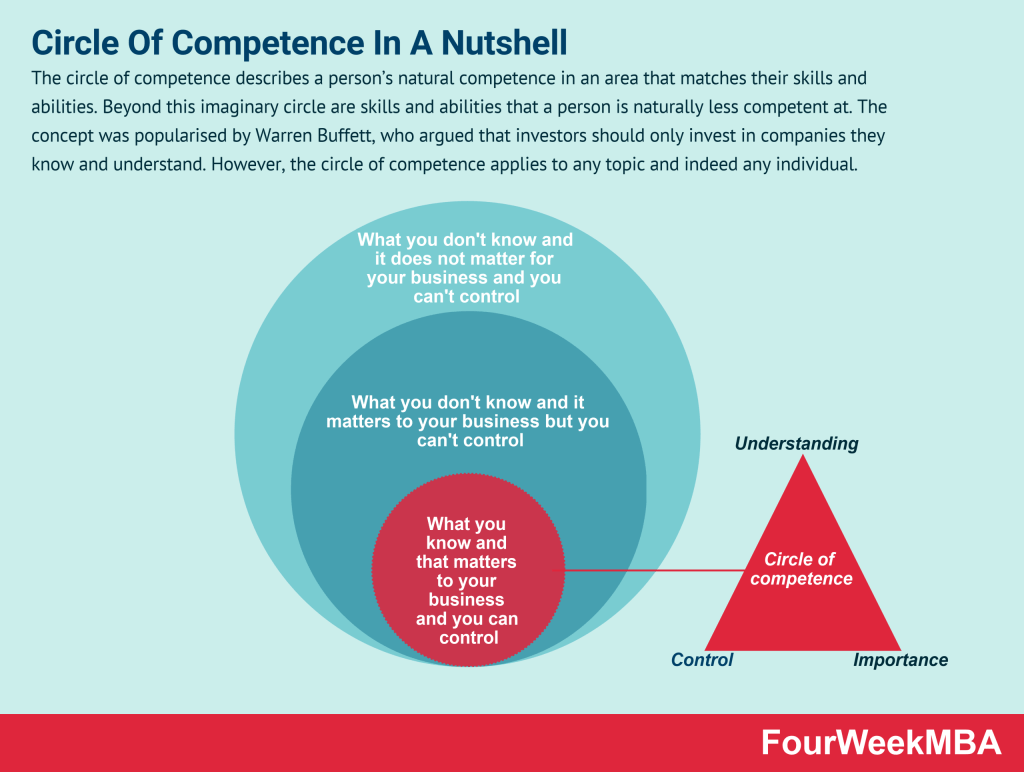
The circle of competence describes a person’s natural competence in an area that matches their skills and abilities. Beyond this imaginary circle are skills and abilities that a person is naturally less competent at. The concept was popularised by Warren Buffett, who argued that investors should only invest in companies they know and understand. However, the circle of competence applies to any topic and indeed any individual.
Economic or market moats represent the long-term business defensibility. Or how long a business can retain its competitive advantage in the marketplace over the years. Warren Buffet who popularized the term “moat” referred to it as a share of mind, opposite to market share, as such it is the characteristic that all valuable brands have.
The Buffet Indicator is a measure of the total value of all publicly-traded stocks in a country divided by that country’s GDP. It’s a measure and ratio to evaluate whether a market is undervalued or overvalued. It’s one of Warren Buffet’s favorite measures as a warning that financial markets might be overvalued and riskier.
Warren Buffett is an American investor, business tycoon, and philanthropist. Known as the “Oracle of Omaha”, Buffett is best known for his strict adherence to value investing and frugality despite his immense wealth. He is among the wealthiest people in the world. Most of his wealth is tied up in Berkshire-Hathaway and its 65 subsidiaries.
Price sensitivity can be explained using the price elasticity of demand, a concept in economics that measures the variation in product demand as the price of the product itself varies. In consumer behavior, price sensitivity describes and measures fluctuations in product demand as the price of that product changes.
A price ceiling is a price control or limit on how high a price can be charged for a product, service, or commodity. Price ceilings are limits imposed on the price of a product, service, or commodity to protect consumers from prohibitively expensive items. These limits are usually imposed by the government but can also be set in the resale price maintenance (RPM) agreement between a product manufacturer and its distributors.
Price elasticity measures the responsiveness of the quantity demanded or supplied of a good to a change in its price. It can be described as elastic, where consumers are responsive to price changes, or inelastic, where consumers are less responsive to price changes. Price elasticity, therefore, is a measure of how consumers react to the price of products and services.
In Economics, Economies of Scale is a theory for which, as companies grow, they gain cost advantages. More precisely, companies manage to benefit from these cost advantages as they grow, due to increased efficiency in production. Thus, as companies scale and increase production, a subsequent decrease in the costs associated with it will help the organizationscale further.
In Economics, a Diseconomy of Scale happens when a company has grown so large that its costs per unit will start to increase. Thus, losing the benefits of scale. That can happen due to several factors arising as a company scales. From coordination issues to management inefficiencies and lack of proper communication flows.
A network effect is a phenomenon in which as more people or users join a platform, the more the value of the service offered by the platform improves for those joining afterward.What depletes someone’s social battery?
The amount of energy someone has for socializing with others and how quickly it is depleted depends on:
What is Social battery in the context of introversion and extroversion?
Most people relate the concept of a social battery to extraversion and introversion, and for good reason.
How to charge the social battery?
While introverted individuals need to spend time away from others to charge their social battery, this is often easier said than done.
What depletes someone’s social battery?
The amount of energy someone has for socializing with others and how quickly it is depleted depends on:
What is Social battery in the context of introversion and extroversion?
Most people relate the concept of a social battery to extraversion and introversion, and for good reason.
How to charge the social battery?
While introverted individuals need to spend time away from others to charge their social battery, this is often easier said than done.
What depletes someone’s social battery?
The amount of energy someone has for socializing with others and how quickly it is depleted depends on:
What is Social battery in the context of introversion and extroversion?
Most people relate the concept of a social battery to extraversion and introversion, and for good reason.
How to charge the social battery?
While introverted individuals need to spend time away from others to charge their social battery, this is often easier said than done.
Frequently Asked Questions
What Is A Social Battery?
The social battery is a metaphor for the amount of energy someone has for socializing. The term “social battery” is used to describe the sometimes finite amount of energy one has for socializing with others. Individuals with a full social battery have energy to spare in social interactions and it will take some time before they are tired and need to rest. Extraverted individuals may even derive energy from others when they socialize.
What depletes someone’s social battery?
The amount of energy someone has for socializing with others and how quickly it is depleted depends on:
What is Social battery in the context of introversion and extroversion?
Most people relate the concept of a social battery to extraversion and introversion, and for good reason.
How to charge the social battery?
While introverted individuals need to spend time away from others to charge their social battery, this is often easier said than done.
Gennaro Cuofano is a CRO and tech executive who has worked in AI since late 2015, starting with bringing NLP, natural-language generation, voice and chatbot products to the marketing industry. His background is in law and finance: he holds a Master's degree in Law and an International MBA with an emphasis on corporate finance (LUISS Business School and the University of San Diego, 2012), and worked as a financial analyst at a real-estate investment firm in San Diego and as an assistant controller. His work focuses on business model strategy, business engineering and, more broadly, structural analysis: how companies make money, read from their own filings. He created FourWeekMBA and leads research there and at The Business Engineer, his newsletter on AI and business strategy, with over 95,000 subscribers and more than 1,000 published analyses. His writing has also appeared on Entrepreneur, HackerNoon and Search Engine People. Find him on LinkedIn and Substack. See how we source.
Scroll to Top
Discover more from FourWeekMBA
Subscribe now to keep reading and get access to the full archive.