An RFQ is a document companies use to gather the pricing information of goods from a potential vendor. Conversely, an RFP is a document companies use to gather information about services from potential contractors. Though they are similar documents with similar names, the RFQ and RFP documents have distinct characteristics making them suitable for different applications.
Aspect
RFQ (Request for Quotation)
RFP (Request for Proposal)
Purpose
Procurement of well-defined products/services
Procurement of complex projects or services that require detailed solutions and approaches.
Focus
Primarily on price and technical specifications. It is often used for standardized products or services.
Comprehensive focus that includes not only pricing but also detailed proposals, solutions, methodologies, and vendor qualifications. Typically used for complex and customized projects.
Information Requested
Requested information is specific and limited to product/service details and pricing.
Seeks comprehensive responses, including detailed explanations of proposed solutions, methodologies, project plans, timelines, and cost breakdowns.
Vendor Selection Criteria
Primarily based on pricing and compliance with technical specifications.
Criteria extend beyond pricing and compliance to include vendor qualifications, relevant experience, proposed approach, and alignment with project goals.
Scope of Work
Typically involves predefined scope with limited room for customization.
Offers flexibility in defining the scope, allowing for greater customization based on project requirements.
Response Format
Typically, responses are price quotes or bids with minimal additional information.
Requires vendors to provide comprehensive responses that outline their proposed solutions, methodologies, and approach, along with pricing details.
Complexity
Generally simpler and quicker to process due to the limited scope of information requested.
Often more complex and time-consuming due to the comprehensive nature of the proposals and the need for in-depth evaluations.
Procurement Process Stage
Typically used in the early stages of procurement when specific product/service needs are well-defined.
Often employed in later stages of procurement when more detailed information and decisions are required.
Customization and Relationship
Allows limited room for customization since the focus is primarily on standard products or services.
Offers room for customization, encourages collaboration between the client and vendors, and can lead to more tailored solutions.
Vendor Relationship
Tends to result in transactional relationships with vendors.
Can foster more collaborative and long-term partnerships between clients and vendors, as the process involves deeper engagement.
Decision Criteria
Decision-making heavily relies on price comparison and technical compliance with specifications.
Decision criteria extend beyond pricing and compliance, considering vendor qualifications, relevant experience, proposed approach, and alignment with project goals.
Typical Usage
Commonly used for procuring standardized products or services that have clear specifications.
Applied when procuring complex projects, technology solutions, consulting services, or any scenario where customized solutions are required.
Negotiation Phase
Typically involves minimal negotiation, as the focus is primarily on price and compliance.
Often includes negotiation for further refinement of proposals, pricing adjustments, and contract terms.
Timeframe
Generally features a shorter response time, as it involves straightforward price quoting and basic information.
Tends to require a longer response time, given the need for comprehensive proposals and in-depth evaluations.
Post-Selection
Typically results in straightforward vendor selection based on price and compliance.
May involve additional negotiations, discussions, and collaborations with the selected vendor to finalize project details and contract terms.
Business to business (B2B) operations are often difficult as key personnel struggle with the clientele attainment process. With hundreds of potential companies to do business with, how can an organization receive the best price for its goods and services?
When a business needs to procure goods or services from a prospective vendor, Request for Proposal (RFP) and Request for Quote (RFQ) documents are used. However, understanding which document is most suitable is vital.
Though they are similar documents with similar names, the RFQ and RFP documents have distinct characteristics making them suitable for different applications.
Selecting one document over another is an important skill in successfully negotiating corporate sales.
The difference between RFQ and RFP documents
With the above in mind, here are the key differences between each.
Request for Quote (RFQ)
A Request for Quote document is used to gather information about goods or services from the vendor. Before the procurement process, the RFQ stipulates the type and quantity of the product the business wishes to purchase.
Then, potential vendors send a quote in reply and the business chooses a vendor based on price. This makes them ideally suited to large-scale purchases where minimizing costs is a priority.
Request for Proposal (RFP)
A Request for Proposal document is used by companies to gather information about services from a potential contractor or supplier. Note that RFP documents are more complex than RFQ documents because they are asking for more than a simple price estimate.
Thus, the information contained in an RFP might detail:
The nature of the project the buyer needs to complete, including project goals.
The number of pages or illustrations the proposal should contain.
Laws the project is potentially subject to.
Qualifications that a vendor or contractor must possess.
Using the stipulations outlined above, the contractor submits a proposal estimating the costs of labor, management, and other relevant fees to give a total cost. Where relevant, the contractor will also detail a list of needs that must be met to complete the project successfully.
Then, the company assesses each proposal and selects a contractor based on price and their ability to detail the project scope.
So, what are the main differences?
The first and most obvious difference is the level of detail each document offers. An RFQ is well-suited to an itemized list of materials with known specifications. However, an RFP is more suited to large-scale projects where construction, maintenance, or legal advice is required.
It’s also important to note that RFP documents are part of a formal procurement process. The request leaves no room for interpretation or last-minute changes and edits can only be made with an official addendum. The RFQ request, on the other hand, has a more casual structure that can be adapted to suit. This is particularly true when a buyer accepts a quote it is happy with before the assigned due date.
Examples of Scenarios Using RFQ and RFP:
Software Development:
RFQ: A company needs 100 licenses of a specific software version. They send an RFQ to various suppliers to get the best price.
RFP: A corporation is looking to develop a custom software solution. They send out an RFP detailing their requirements, expecting potential developers to submit comprehensive proposals, including methodologies, timelines, and costs.
Construction Projects:
RFQ: A school needs 500 chairs for their new auditorium. They send out an RFQ to furniture suppliers for a price quote.
RFP: A city council plans to build a new community center. They send out an RFP to construction firms, detailing the project and expecting proposals on construction methodologies, materials, timelines, and costs.
Marketing Campaigns:
RFQ: A startup wants to buy promotional merchandise (like t-shirts and mugs) in bulk. They use an RFQ to get pricing from various vendors.
RFP: A multinational company is launching a new product and needs a comprehensive marketing campaign. They send out an RFP to advertising agencies detailing their requirements, target audience, and goals, expecting detailed campaign strategies in return.
IT Infrastructure:
RFQ: An office requires 50 new computers. They send out an RFQ to various suppliers to get the best pricing.
RFP: A corporation is planning to upgrade its entire IT infrastructure, including servers, networking, and security systems. They send out an RFP detailing their requirements and expecting proposals that cover solutions, implementation plans, and costs.
Event Management:
RFQ: An organization is hosting a seminar and needs catering for 200 people. They send out an RFQ to local caterers to get a price quote.
RFP: A company is planning its annual conference for shareholders and employees. They send out an RFP to event management companies detailing the event’s scale, expecting proposals that cover venue options, catering, entertainment, logistics, and costs.
Training and Development:
RFQ: A business needs to purchase an off-the-shelf online course on digital marketing for their sales team. They use an RFQ to get the best price from course providers.
RFP: An enterprise wants to develop a custom training program for its leadership team. They send out an RFP to training providers, detailing their specific needs, objectives, and expectations.
Key takeaways:
A Request for Proposal (RFP) document is used by companies wishing to gather information about large-scale services from potential contractors. A Request for Quote (RFQ) document is used when a company wants a simple, itemized quote for goods or services.
Although similar in name and appearance, successful corporate sales managers understand that each document is effective for different reasons and in different scenarios.
There are many differences between the RFP and RFQ documents. Perhaps the most pertinent is that an RFP forms part of a formal procurement process, whereas an RFQ is less formal and more flexible.
Key Highlights
Distinct Purpose: RFQ (Request for Quote) is used to gather pricing information about goods or services from a potential vendor, while RFP (Request for Proposal) is used to gather information about large-scale services from potential contractors.
RFQ Focus: RFQ documents specify the type and quantity of products a business wishes to purchase, and vendors respond with quotes, making them ideal for large-scale purchases where cost minimization is a priority.
RFP Complexity: RFP documents are more complex as they ask for more than a simple price estimate. They detail the nature of the project, project goals, potential laws, qualifications required from contractors, and other relevant information.
Contractor Selection: In the RFQ process, the company chooses a vendor based on price, while in the RFP process, the company assesses proposals and selects a contractor based on price and their ability to detail the project scope.
Level of Detail: RFQs are suited to itemized lists with known specifications, while RFPs are more suited to large-scale projects with various requirements like construction, maintenance, or legal advice.
Formality and Flexibility: RFPs are part of a formal procurement process with little room for interpretation or last-minute changes, while RFQs have a more casual structure and can be adapted to suit the buyer’s needs.
Understanding the Distinction: Successful corporate sales managers understand that each document serves different purposes and is effective in different scenarios.
Procurement Process: RFPs are a formal part of the procurement process, while RFQs offer more flexibility and adaptability before the due date for quotes.
Related Frameworks, Models, Concepts
Description
When to Apply
RFQ (Request for Quotation)
– A document that an organization submits to potential suppliers asking for a quote for the cost of specific products or services. It typically includes detailed specifications of the goods or services required.
– Used when the requirements are well-defined and the main interest is in comparing pricing between potential suppliers.
RFP (Request for Proposal)
– A document that an organization posts to elicit bids from potential vendors for a product or service. It is more detailed than an RFQ and asks vendors to propose how they will solve a problem or meet the need, including their methodology, timeline, and pricing.
– Appropriate when the project is complex or when the buyer needs more than just pricing information, such as approach and project management capabilities.
RFT (Request for Tender)
– An invitation sent to suppliers to submit a bid to supply goods or services. In RFTs, the focus is often on adhering to strict procurement standards and the process is highly structured.
– Suitable for public sector contracts or large private projects where legal and regulatory requirements dictate formal bidding.
RFI (Request for Information)
– A preliminary document to gather general supplier capabilities, products, and services before issuing more detailed RFQs or RFPs.
– Used early in the procurement process to identify potential vendors who can meet the organization’s requirements.
Reverse Auction
– An auction where the roles of buyer and seller are reversed. Instead of sellers bidding prices upwards, suppliers bid the price down competitively to win the buyer’s business.
– Effective in situations where price is the dominant factor, particularly for commoditized goods.
Vendor Analysis
– The process of evaluating potential suppliers based on factors such as price, quality, reputation, service, and reliability.
– Conducted to ensure that a company selects the right suppliers for goods and services, crucial for maintaining quality and reliability in the supply chain.
Total Cost of Ownership (TCO)
– A financial estimate intended to help buyers and owners determine the direct and indirect costs of a product or system.
– Important when purchasing decisions must consider not just the initial costs but also the lifetime costs associated with a product or service.
Purchase Order (PO)
– A commercial document issued by a buyer to a seller, indicating types, quantities, and agreed prices for products or services.
– Utilized after the supplier selection process is complete and terms have been agreed upon, formally initiating the purchasing transaction.
Contract Management
– The management of contracts made with customers, vendors, partners, or employees. It involves negotiating the terms and conditions in contracts and ensuring compliance with the terms and conditions, as well as documenting and agreeing on any changes.
– Necessary throughout the lifecycle of a procurement to ensure both parties meet their contractual obligations and to manage any changes or disputes.
Supplier Relationship Management (SRM)
– A systematic approach for developing and managing partnerships with vendors that supply goods and services to an organization to maximize the value of those interactions.
– Applied in managing ongoing vendor relationships, aiming to enhance the outcomes of long-term contracts and improve negotiations and collaboration.
A Blockchain Business Model according to the FourWeekMBA framework is made of four main components: Value Model (Core Philosophy, Core Values and Value Propositions for the key stakeholders), Blockchain Model (Protocol Rules, Network Shape and Applications Layer/Ecosystem), Distribution Model (the key channels amplifying the protocol and its communities), and the Economic Model (the dynamics/incentives through which protocol players make money). Those elements coming together can serve as the basis to build and analyze a solid Blockchain Business Model.
In an asymmetric businessmodel, the organization doesn’t monetize the user directly, but it leverages the data users provide coupled with technology, thus have a key customer pay to sustain the core asset. For example, Google makes money by leveraging users’ data, combined with its algorithms sold to advertisers for visibility.
In a business world driven by technology and digitalization, competition is much more fluid, as innovation becomes a bottom-up approach that can come from anywhere. Thus, making it much harder to define the boundaries of existing markets. Therefore, a proper business competition analysis looks at customer, technology, distribution, and financial model overlaps. While at the same time looking at future potential intersections among industries that in the short-term seem unrelated.
Technological modeling is a discipline to provide the basis for companies to sustain innovation, thus developing incremental products. While also looking at breakthrough innovative products that can pave the way for long-term success. In a sort of Barbell Strategy, technological modeling suggests having a two-sided approach, on the one hand, to keep sustaining continuous innovation as a core part of the businessmodel. On the other hand, it places bets on future developments that have the potential to break through and take a leap forward.
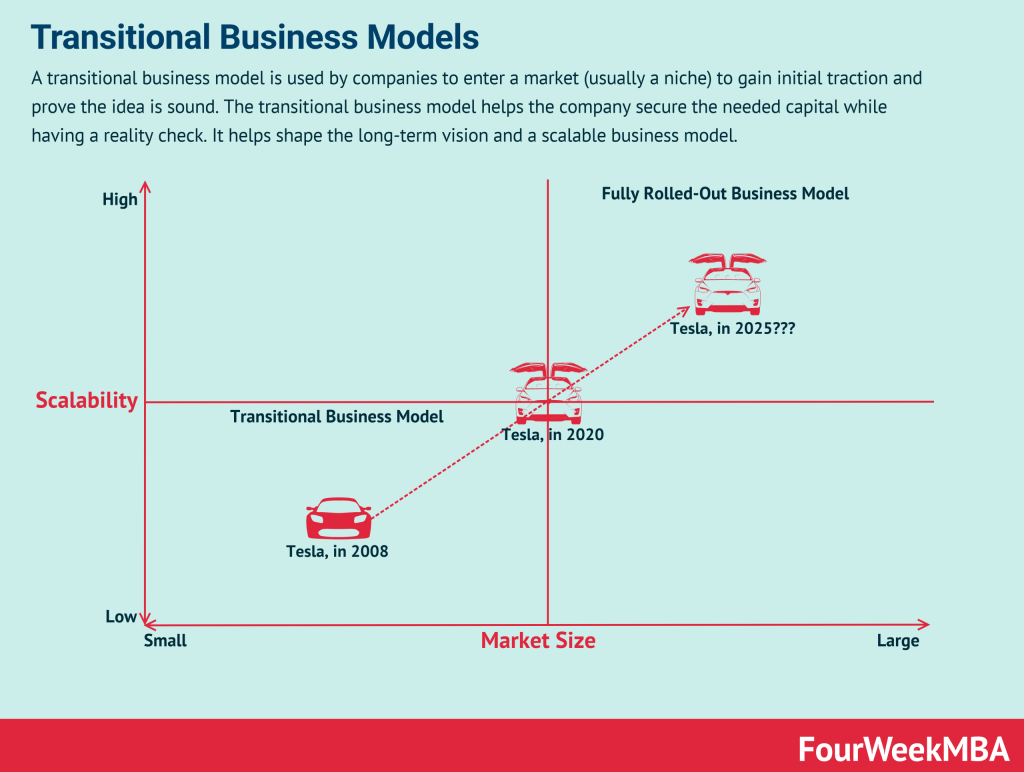
A transitional business model is used by companies to enter a market (usually a niche) to gain initial traction and prove the idea is sound. The transitional business model helps the company secure the needed capital while having a reality check. It helps shape the long-term vision and a scalable businessmodel.
The minimum viable audience (MVA) represents the smallest possible audience that can sustain your business as you get it started from a microniche (the smallest subset of a market). The main aspect of the MVA is to zoom into existing markets to find those people which needs are unmet by existing players.
Business scaling is the process of transformation of a business as the product is validated by wider and wider market segments. Business scaling is about creating traction for a product that fits a small market segment. As the product is validated it becomes critical to build a viable businessmodel. And as the product is offered at wider and wider market segments, it’s important to align product, businessmodel, and organizational design, to enable wider and wider scale.
The market expansion consists in providing a product or service to a broader portion of an existing market or perhaps expanding that market. Or yet, market expansions can be about creating a whole new market. At each step, as a result, a company scales together with the market covered.
In the FourWeekMBA growth matrix, you can apply growth for existing customers by tackling the same problems (gain mode). Or by tackling existing problems, for new customers (expand mode). Or by tackling new problems for existing customers (extend mode). Or perhaps by tackling whole new problems for new customers (reinvent mode).
In the FourWeekMBA Revenue Streams Matrix, revenue streams are classified according to the kind of interactions the business has with its key customers. The first dimension is the “Frequency” of interaction with the key customer. As the second dimension, there is the “Ownership” of the interaction with the key customer.
Revenue model patterns are a way for companies to monetize their business models. A revenue model pattern is a crucial building block of a business model because it informs how the company will generate short-term financial resources to invest back into the business. Thus, the way a company makes money will also influence its overall businessmodel.
A pricingstrategy or model helps companies find the pricing formula in fit with their business models. Thus aligning the customer needs with the product type while trying to enable profitability for the company. A good pricingstrategy aligns the customer with the company’s long term financial sustainability to build a solid businessmodel.
Gennaro is the creator of FourWeekMBA, which reached about four million business people, comprising C-level executives, investors, analysts, product managers, and aspiring digital entrepreneurs in 2022 alone | He is also Director of Sales for a high-tech scaleup in the AI Industry | In 2012, Gennaro earned an International MBA with emphasis on Corporate Finance and Business Strategy.