Objection Handling is a crucial skill in sales that involves actively listening to customer concerns, empathizing with their perspective, and persuasively addressing objections. By mastering this process, sales professionals can enhance their credibility, boost sales conversion rates, and build stronger relationships with customers. Challenges include overcoming resistance and addressing objections within limited time frames.
Objections are reservations, concerns, or questions raised by potential customers during the sales conversation.
They can take various forms, such as price concerns, product suitability questions, or objections related to timing.
Successful objection handling involves addressing these objections in a way that satisfies the customer’s concerns and keeps the sales process moving forward.
Key Concepts in Objection Handling:
Active Listening: Effective objection handling starts with active listening. Sales professionals should listen carefully to the customer’s objection without interruption, allowing the customer to express their concerns fully.
Empathy: Demonstrating empathy and understanding is crucial. Customers want to feel heard and valued, and acknowledging their concerns is a critical part of objection handling.
Clarification: After listening, it’s essential to clarify the objection to ensure a complete understanding. Restate the objection in your words to confirm that you’ve captured the customer’s concern accurately.
Positive Framing: Objection handling should focus on the positive aspects of the product or service. Highlight the benefits and value that address the objection rather than dwelling on the negative.
Customization: Tailor your objection-handling approach to the specific objection and customer. Not all objections are the same, and solutions should be customized accordingly.
Objection Handling Strategies
Effective objection handling requires a strategic approach. Here are some key strategies to keep in mind:
Anticipate Objections: Familiarize yourself with common objections in your industry and prepare responses in advance. This proactive approach allows you to be more confident and responsive during sales conversations.
Ask Probing Questions: To fully understand the objection, ask open-ended questions. This encourages the customer to provide more context and helps you tailor your response effectively.
Educate and Inform: Sometimes, objections arise from misunderstandings or misinformation. Take the opportunity to educate the customer about your product or service, addressing any misconceptions.
Use Social Proof: Share success stories, case studies, or testimonials that demonstrate how others have overcome similar objections and benefited from your product or service.
Provide Options: Offer alternative solutions or options that address the objection. Providing choices can empower the customer and increase their comfort with the decision.
Close the Loop: Once you’ve addressed the objection, seek confirmation from the customer that their concern has been resolved. This helps ensure that there are no lingering doubts.
Practice Empathy: Show empathy by acknowledging the customer’s perspective and validating their concerns. Let them know you understand their point of view.
Objection Handling Techniques
Sales professionals can employ various objection-handling techniques to navigate objections effectively:
Feel-Felt-Found: This technique acknowledges the customer’s feelings, relates to them by sharing that others have felt the same way, and then explains what those others have ultimately found or experienced, often a positive outcome.
Boomerang Technique: Instead of directly addressing the objection, agree with the customer and then redirect the conversation by turning the objection into a benefit or opportunity.
Questioning Technique: Ask clarifying questions to gain a deeper understanding of the objection. This not only helps you address the concern effectively but also demonstrates your commitment to solving the customer’s problem.
Assumptive Close: Assume the sale by expressing confidence that the objection can be resolved and moving forward with the next steps of the sales process. This approach can be particularly effective when the objection is a minor one.
Acknowledgment and Pivot: Begin by acknowledging the customer’s objection and then pivot the conversation to a different aspect of the product or service that aligns with the customer’s needs.
Best Practices in Objection Handling
To excel in objection handling, consider the following best practices:
Continuous Training: Regularly invest in training and development to improve your objection-handling skills. Sales techniques evolve, and staying up-to-date is essential.
Role Play: Practice objection handling through role-play scenarios with colleagues or mentors. This allows you to refine your skills in a low-stakes environment.
Feedback and Learning: Seek feedback from customers and colleagues after sales interactions. Analyze objections that arise and learn from each objection-handling experience.
Stay Calm and Professional: Objections can sometimes be challenging, but it’s crucial to remain calm, professional, and respectful throughout the conversation. Maintain a positive attitude.
Empower Customers: Encourage customers to ask questions and voice concerns. Creating an open and supportive dialogue helps build trust and rapport.
Record and Analyze: Keep records of objections and their resolutions. Analyze these records to identify patterns and develop strategies for addressing common objections.
Key Highlights
Objection Handling Overview:
Objection Handling is a vital sales skill involving active listening, empathy, and persuasive communication to address customer concerns.
It enhances credibility, improves conversion rates, and fosters strong customer relationships.
Characteristics:
Active Listening: Attentively understanding customer concerns.
Empathy: Acknowledging the customer’s perspective.
Persuasion: Communicating convincingly to address objections.
Use Cases:
Product Sales: Overcoming objections before finalizing a purchase.
Service Offerings: Addressing concerns about service packages.
Price Negotiation: Handling objections related to pricing.
Examples of Objection Handling:
Software Sales: Addressing compatibility and feature concerns.
Consulting Services: Overcoming objections to project scope.
Insurance Sales: Handling objections about policy coverage.
Benefits of Objection Handling:
Improved Credibility: Demonstrating expertise and credibility.
Increased Conversion: Convincing customers to make a purchase.
Stronger Relationships: Building trust by addressing concerns professionally.
Challenges in Objection Handling:
Resistance: Dealing with customers resistant to objections.
Lack of Information: Addressing objections with limited data.
Time Constraints: Effectively handling objections within limited interactions.
Business development comprises a set of strategies and actions to grow a business via a mixture of sales, marketing, and distribution. While marketing usually relies on automation to reach a wider audience, and sales typically leverage a one-to-one approach. The business development’s role is that of generating distribution.
The more you move from consumers to enterprise clients, the more you’ll need a sales force able to manage complex sales. As a rule of thumb, a more expensive product, in B2B or Enterprise, will require an organizational structure around sales. An inexpensive product to be offered to consumers will leverage on marketing.
A sales cycle is the process that your company takes to sell your services and products. In simple words, it’s a series of steps that your sales reps need to go through with prospects that lead up to a closed sale.
RevOps – short for Revenue Operations – is a framework that aims to maximize the revenue potential of an organization. RevOps seeks to align these departments by giving them access to the same data and tools. With shared information, each then understands their role in the sales funnel and can work collaboratively to increase revenue.
In negotiation theory, BATNA stands for “Best Alternative To a Negotiated Agreement,” and it’s one of the key tenets of negotiation theory. Indeed, it describes the best course of action a party can take if negotiations fail to reach an agreement. This simple strategy can help improve the negotiation as each party is (in theory) willing to take the best course of action, as otherwise, an agreement won’t be reached.
In negotiation, WATNA stands for “worst alternative to a negotiated agreement,” representing one of several alternative options if a resolution cannot be reached. This is a useful technique to help understand what might be a negotiation outcome, that even if negative is still better than a WATNA, making the deal still feasible.
The ZOPA (zone of possible agreement) describes an area in which two negotiation parties may find common ground. Indeed, ZOPA is critical to explore the deals where the parties get a mutually beneficial outcome to prevent the risk of a win-lose, or lose-win scenario. And therefore get to the point of a win-win negotiation outcome.
Revenue modeling is a process of incorporating a sustainable financial model for revenue generation within a business model design. Revenue modeling can help to understand what options make more sense in creating a digital business from scratch; alternatively, it can help in analyzing existing digital businesses and reverse engineer them.
Customer experience maps are visual representations of every encounter a customer has with a brand. On a customer experience map, interactions called touchpoints visually denote each interaction that a business has with its consumers. Typically, these include every interaction from the first contact to marketing, branding, sales, and customer support.
AIDA stands for attention, interest, desire, and action. That is a model that is used in marketing to describe the potential journey a customer might go through before purchasing a product or service. The AIDA model helps organizations focus their efforts when optimizing their marketing activities based on the customers’ journeys.
Social selling is a process of developing trust, rapport, and a relationship with a prospect to enhance the sales cycle. It usually happens through tech platforms (like LinkedIn, Twitter, Facebook, and more), which enable salespeople to engage with potential prospects before closing the sale, thus becoming more effective.
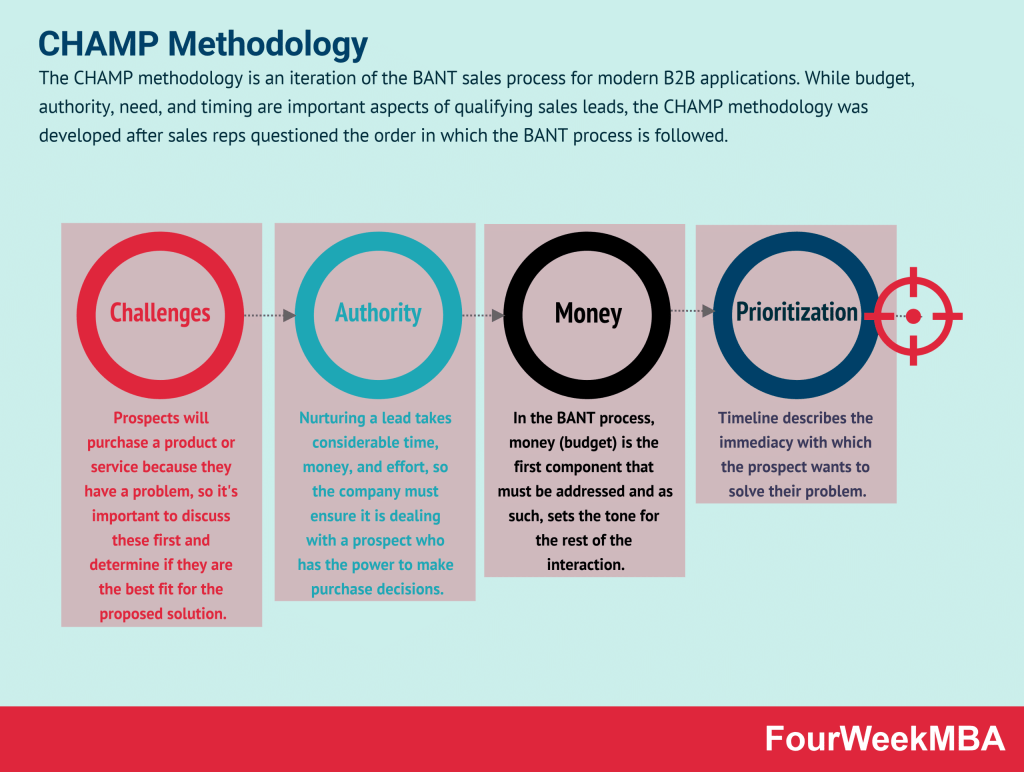
The CHAMP methodology is an iteration of the BANT sales process for modern B2B applications. While budget, authority, need, and timing are important aspects of qualifying sales leads, the CHAMP methodology was developed after sales reps questioned the order in which the BANT process is followed.
The BANT process was conceived at IBM in the 1950s as a way to quickly identify prospects most likely to make a purchase. Despite its introduction around 70 years ago, the BANT process remains relevant today and was formally adopted into IBM’s Business Agility Solution Identification Guide.
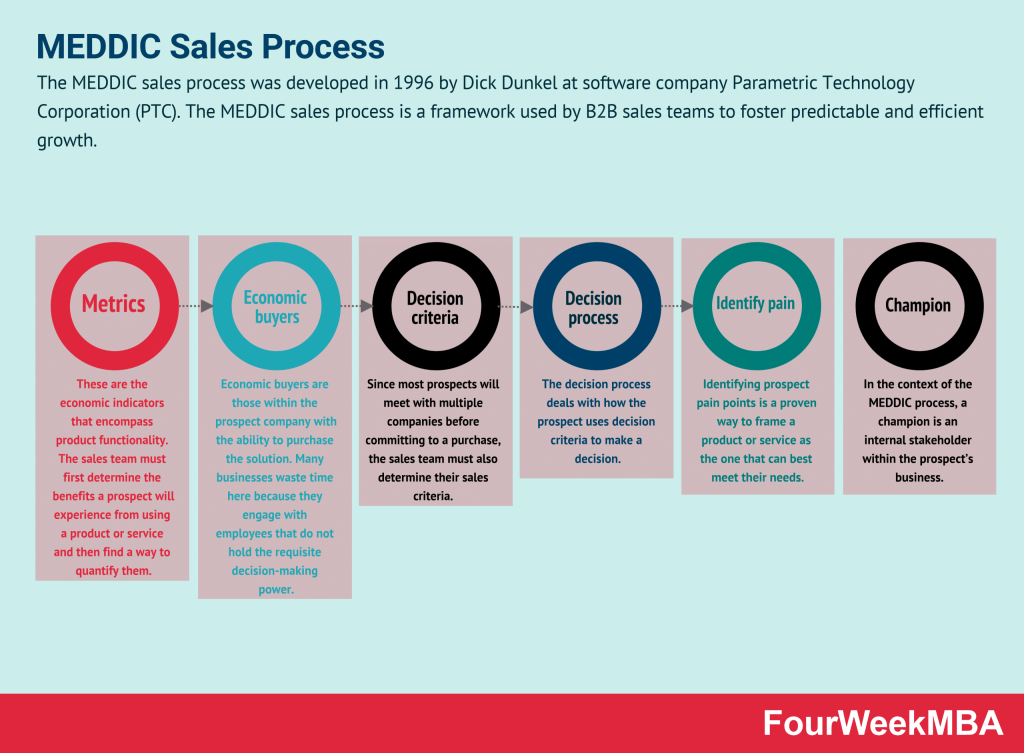
The MEDDIC sales process was developed in 1996 by Dick Dunkel at software company Parametric Technology Corporation (PTC). The MEDDIC sales process is a framework used by B2B sales teams to foster predictable and efficient growth.
STP marketing simplifies the market segmentation process and is one of the most commonly used approaches in modern marketing. The core focus of STP marketing is commercial effectiveness. Marketers use the approach to select the most valuable segments from a target audience and develop a product positioning strategy and marketing mix for each.
The sales funnel is a model used in marketing to represent an ideal, potential journey that potential customers go through before becoming actual customers. As a representation, it is also often an approximation, that helps marketing and sales teams structure their processes at scale, thus building repeatable sales and marketing tactics to convert customers.
Venture capitalist, Dave McClure, coined the acronym AARRR which is a simplified model that enables to understand what metrics and channels to look at, at each stage for the users’ path toward becoming customers and referrers of a brand.
The general concept of Bootstrapping connects to “a self-starting process that is supposed to proceed without external input.” In business, Bootstrapping means financing the growth of the company from the available cash flows produced by a viable businessmodel. Bootstrapping requires the mastery of the key customers driving growth.
The virtuous cycle is a positive loop or a set of positive loops that trigger a non-linear growth. Indeed, in the context of digital platforms, virtuous cycles – also defined as flywheel models – help companies capture more market shares by accelerating growth. The classic example is Amazon’s lower prices driving more consumers, driving more sellers, thus improving variety and convenience, thus accelerating growth.
Business storytelling is a critical part of developing a businessmodel. Indeed, the way you frame the story of your organization will influence its brand in the long-term. That’s because your brand story is tied to your brand identity, and it enables people to identify with a company.
Enterprise sales describes the procurement of large contracts that tend to be characterized by multiple decision-makers, complicated implementation, higher risk levels, or longer sales cycles.
Outside sales occur when a salesperson meets with prospects or customers in the field. This sort of sales function is critical to acquire larger accounts, like enterprise customers, for which the acquisition process is usually longer, more complex and it requires the understanding of the target organization. Thus the outside sales will cut through the noise to acquire a large enterprise account for the organization.
A freeterprise is a combination of free and enterprise where free professional accounts are driven into the funnel through the free product. As the opportunity is identified the company assigns the free account to a salesperson within the organization (inside sales or fields sales) to convert that into a B2B/enterprise account.
Zero to One is a book by Peter Thiel. But it also represents a business mindset, more typical of tech, where building something wholly new is the default mode, rather than building something incrementally better. The core premise of Zero to One then is that it’s much more valuable to create a whole new market/product rather than starting from existing markets.
Palantir is a software company offering intelligence services from governments and institutions to large commercial organizations. The company’s two main platforms Gotham and Foundry, are integrated at enterprise-level. Its business model follows three phases: Acquire, Expand, and Scale. The company bears the pilot costs in the acquire and expand phases, and it runs at a loss. Where in the scale phase, the customers’ contribution margins become positive.
Consultative selling is a sales approach favoring relationship building and open dialogue to adequately meet the needs of a prospective customer. By building trust quickly a consultative selling approach can help the customer better meet her/his expectations and the salesperson hit her/his targets more effectively.
A unique selling proposition (USP) enables a business to differentiate itself from its competitors. Importantly, a USP enables a business to stand for something that they, in turn, become known among consumers. A strong and recognizable USP is crucial to operating successfully in competitive markets.
Gennaro is the creator of FourWeekMBA, which reached about four million business people, comprising C-level executives, investors, analysts, product managers, and aspiring digital entrepreneurs in 2022 alone | He is also Director of Sales for a high-tech scaleup in the AI Industry | In 2012, Gennaro earned an International MBA with emphasis on Corporate Finance and Business Strategy.
Scroll to Top
Discover more from FourWeekMBA
Subscribe now to keep reading and get access to the full archive.