Martin Lorentzon co-founded Spotify with Daniel Ek in 2006 and has served as a quieter co-founder and board member. Before Spotify, he co-founded Tradedoubler, a digitalmarketing company. His wealth has grown alongside Spotify’s stock appreciation in 2024-2025.
Martin Lorentzon is the co-founder and one of Spotify’s principal shareholders. Indeed, in 2024, with 10.9% of Spotify’s shares, he was worth over $12 billion, thanks to the spike-up of Spotify’s stocks and market capitalization.
Master of Science in Engineering from Chalmers University of Technology
Early Career
Worked at Telia, Cell Ventures, and Altavista
Major Companies Founded
Tradedoubler, Spotify
Positions
Co-founder of Tradedoubler, Co-founder and former Chairman of Spotify
Net Worth
Estimated over $12 billion (July 2024)
Business Milestones
– 1999: Co-founded Tradedoubler, an online marketing and affiliate network, which became highly successful in Europe. – 2006: Co-founded Spotify with Daniel Ek, aiming to combat music piracy by offering a legal and superior music streaming service. – 2008: Launched Spotify in Europe, gaining rapid popularity for its freemium model and extensive music library. – 2011: Secured major licensing deals, enabling Spotify to launch in the United States, marking a significant expansion. – 2015: Spotify reached over 75 million active users, including 20 million paying subscribers, solidifying its position as a leader in music streaming. – 2018: Took Spotify public with a direct listing on the New York Stock Exchange, with a valuation of nearly $30 billion at the end of its first trading day. – 2019: Stepped down as Chairman of Spotify but remained on the board of directors, continuing to influence the company’s strategic direction. – 2020: Spotify continued to grow, reaching over 320 million monthly active users and 144 million premium subscribers globally. – 2021: Spotify expanded its offerings with a focus on podcasts, including exclusive deals with major creators and acquiring podcast-related companies. – 2022: Spotify reported strong financial performance and further growth in user numbers, maintaining its leadership in the global music streaming industry.
Spotify is a two-sided marketplace, running a free ad-supported service and a paid membership. Founded in 2008 with the belief that music should be universally accessible, it generated €13.25 billion in 2023. Of these revenues, 87.3%, or €11.56 billion, came from premium memberships, while over 12.6%, or €1.68 billion, came from ad-supported members. By 2023, Spotify had over 600 million users, of which 236 million were premium members and 379 million weread-supported users.
The interesting part is that the ad-supported side of the platform is self-sustaining, and it works as an excellent funnel for Spotify to attract as many premium members as possible.
In fact, over time, free users likely convert into premium members, and they are retained for a long time.
Spotify generated €11.56 billion from premium members and €1.68 billion from ad-supported members. The premium membership revenue cost was €8.23 billion and €1.62B billion for the ad-supported segment. Thus, premium members generated a profit of €3.33B billion for Spotify in 2023. Meanwhile, the ad-supported segment generated a €62 million gross profit in 2023. The ad-supported segment, which is run almost at a loss, is critical for Spotify as it enables it to build a sustainable self-serving funnel to convert free users into paid subscribers!
The ad-supported revenue stream, while it has lower gross profit margins, it works as a sales funnel for the company to attract and retain premium members.
In addition, the ad-supported stream is getting more and more interesting as Spotify is ramping up its advertising network efforts.
Spotify Audience Network is the underlying advertising infrastructure that supports its ad-supported user base. The Spotify Audience Network was born as the result of the acquisitions of Anchor and Megaphone. By 2023, Spotify had 379 million ad-supported users.
Martin Lorentzon is a co-founder and principal shareholder of Spotify, with a stake of approximately 11.5% of the company’s shares, giving him a net worth of around $2.5 billion in 2023.
Spotify operates as a two-sided marketplace, connecting artists and music fans through its platform. It offers both a free ad-supported service and a paid membership.
Founded in 2008 with the vision of making music universally accessible, Spotify achieved remarkable success and generated €11.7 billion in revenue in 2022.
The majority of Spotify’s revenue, about 87.4% or €10.25 billion, came from premium memberships, while the remaining 12.6% or €1.47 billion came from ad-supported members.
By 2022, Spotify had an impressive user base of 489 million, comprising 205 million premium members and 295 million ad-supported users.
Spotify follows a freemium businessmodel, leveraging a powerful free app to attract hundreds of millions of users.
The ad-supported side of the platform is self-sustaining and serves as a valuable funnel to attract more premium members.
Over time, free users are likely to convert into premium members and remain engaged with the platform for an extended period.
Despite lower gross profit margins, the ad-supported revenue stream acts as a sales funnel for Spotify to attract and retain premium members.
Spotify has been ramping up its advertising network efforts, making the ad-supported stream increasingly interesting.
The Spotify Audience Network, established through the acquisitions of Anchor and Megaphone, is the underlying advertising infrastructure that supports the ad-supported user base.
By 2022, Spotify successfully amassed 273 million ad-supported users through its advertising network.
The multi-billion music streaming company Spotify is primarily owned by its founders, Daniel Ek and Martin Lorentzon. As of 2023, Daniel Ek has 15.3% ownership of ordinary shares and 30.5% of the voting power. Martin Lorentzon has 10.9% of ordinary shares and 42.7% of the voting power. Another key shareholder is Baillie Gifford & Co, a Scottish-based money management firm (12% ownership ), followed by Tencent (8.4% ownership).
Spotify is a two-sided marketplace, running a free ad-supported service and a paid membership. Founded in 2008 with the belief that music should be universally accessible, it generated €13.25 billion in 2023. Of these revenues, 87.3%, or €11.56 billion, came from premium memberships, while over 12.6%, or €1.68 billion, came from ad-supported members. By 2023, Spotify had over 600 million users, of which 236 million were premium members and 379 million weread-supported users.
Spotify Audience Network is the underlying advertising infrastructure that supports its ad-supported user base. The Spotify Audience Network was born as the result of the acquisitions of Anchor and Megaphone. By 2023, Spotify had 379 million ad-supported users.
Spotify licensing deals affect its businessmodel. The company runs on both a free service, which is ad-supported and a subscription premium service. They have different economics.
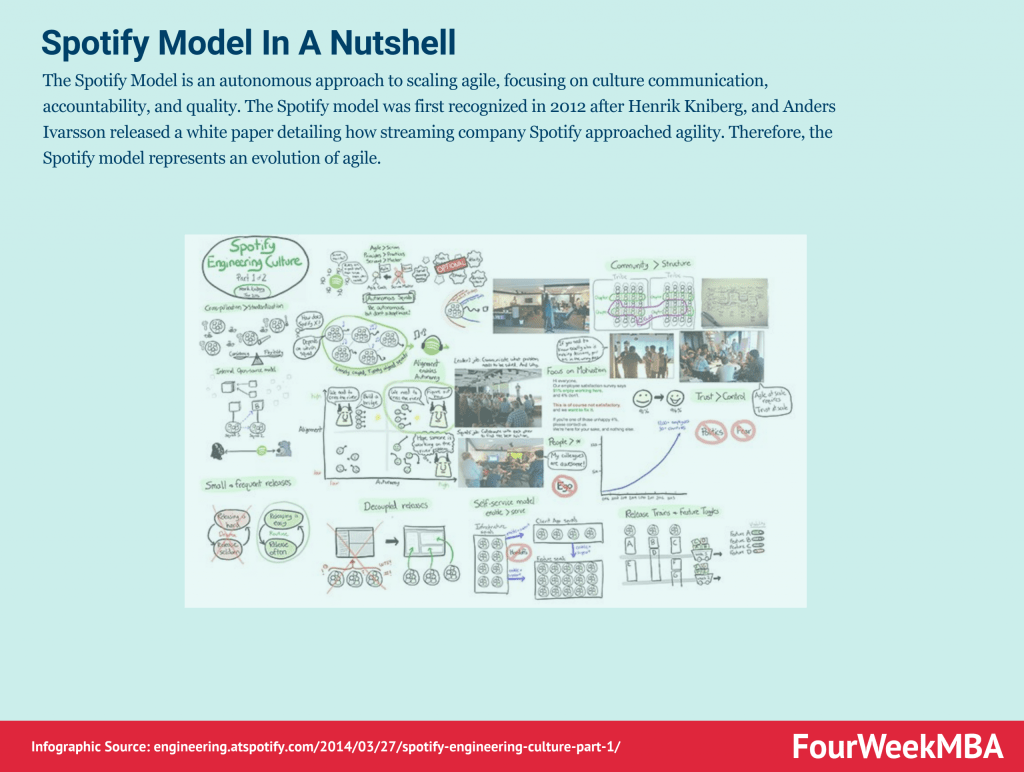
The ad-supported business had a 10% gross margin in 2021, compared to 29% of the subscription-based business. That’s because the more the content gets streamed on the platform, the more that increases royalty costs for Spotify. That is also why the company invested in developing its content. Thus, in part transitioning from platform to brand.The Spotify Model is an autonomous approach to scaling agile, focusing on culture communication, accountability, and quality. The Spotify model was first recognized in 2012 after Henrik Kniberg, and Anders Ivarsson released a white paper detailing how streaming company Spotify approached agility. Therefore, the Spotify model represents an evolution of agile.
Spotify generated €11.56 billion from premium members and €1.68 billion from ad-supported members. The premium membership revenue cost was €8.23 billion and €1.62B billion for the ad-supported segment. Thus, premium members generated a profit of €3.33B billion for Spotify in 2023. Meanwhile, the ad-supported segment generated a €62 million gross profit in 2023. The ad-supported segment, which is run almost at a loss, is critical for Spotify as it enables it to build a sustainable self-serving funnel to convert free users into paid subscribers!
By 2022, most of Tesla’s shares are still owned by Elon Musk, among the company’s co-founders and the CEO. Elon Musk is the top individual investor, with a 23.5% stake in the company. At current rates, this is valued at around $145-50 billion, making Elon Musk one of the wealthiest men on earth. In addition, Musk also holds a significant stake in Twitter and SpaceX, which makes him worth anywhere between $180-90 billion.
Bernard Arnault’s wealth is around $203 billion. Indeed Arnault is the CEO and chairman of the luxury goods conglomerate LVMH Moët Hennessy Louis Vuitton, a massive luxury group that generated over €79 billion in revenue ($83 billion) in 2022, spanning across wines, fashion, cosmetics, and retail. The Arnault family group owns 48.18% of the capital for LVMH with 63.9% voting power, making Bernard Arnault the principal owner and decision-maker. His stake is worth over $203 billion.
Warren Buffett is an American investor, business tycoon, and philanthropist. Known as the “Oracle of Omaha,” Buffett is best known for his strict adherence to value investing and frugality despite his immense wealth. Warren Buffet owns an investment firm, Berkshire Hathaway. He owns 238,624 Class A shares which gives him control over the company. His stake in the company is valued at over $100 billion.
Jeff Bezos’ net worth is primarily based on his ownership stake in Amazon. Indeed, as of 2023, Bezos owned a 12.7% stake in Amazon, worth over $120 billion.
Tim Cook’s net worth is primarily comprised of his Apple stocks. As of 2023, he owned 3,279,898 worth about $480 million at the current rate. However, Tim Cook has sold part of his Apple stocks over the years for hundreds of millions of dollars, making him a billionaire.
Bill Gates was the co-founder and former CEO of Microsoft until 2000, and he was on the board of Microsoft until 2020. However, over the years, Gates sold various stakes in Microsoft and diversified away from it. As of 2019, Gates had a 1.34% stake in Microsoft, which he might still own, valued at about $25 billion.
As of 2022, Satya Nadella had 763,518, valued at $190 million at Microsoft’s current market value. Nadella also got a $2.5 million base salary in 2022, plus $42.27 million in stock awards and over $10 million in non-stock incentives. Nadella sold hundreds of millions of dollars of Microsoft stocks in the last ten years, making him a centi-millionaire. In 2022, 96% of Nadella’s salary was performance-based, whereas only 4% comprised a base salary.
Larry Page co-founded Google (now Alphabet) and Sergey Brin. He controls the company tightly via a dual share ownership structure (made of Class A and B stocks). Alphabet is worth over a trillion dollars, valuing Larry Page’s stake in the company at around $70 billion.
Sergey Brin co-founded Google (now Alphabet) together with Larry Page. He controls the company tightly via a dual share ownership structure (made of Class A and B stocks). Alphabet is worth over a trillion dollars, valuing Sergey Brin’s stake at around $66 billion.
Mark Zuckerberg is the co-founder and principal shareholder of Facebook (now Meta), in which he owns a controlling stake worth over $68 billion. Thus Mark Zucberkerbs’ net worth is around $68 billion in 2023.
Eduardo Luiz Saverin is a billionaire entrepreneur and angel investor. He co-founded Facebook with Mark Zuckerberg; he was later ousted. Yet later on, Facebook settled a lawsuit with Saverin giving him a good chunk of the company’s stock, now worth over ten billion dollars. Thus, Eduardo Saverin’s net worth is around $10.45 billion in 2023.
While Larry Ellison is a shareholder in various tech companies (such as Tesla), his primary wealth comes from his ownership stake in the company he founded, Oracle. He owns almost 43% of the company’s stock, valued at over $100 billion, making him among the wealthiest people on earth.
Howard Schultz’s net worth is over $2.2 billion. Indeed, he is the founder of Starbucks and a major institutional shareholder, with 1.88% ownership of the company, valued at over $2.2 billion at the current market value, making him a billionaire.
Daniel Ek is one of the founders and one of the principal shareholders of Spotify. Indeed, in 2023 with 16.5% of Spotify’s shares, he’s worth around $3.7 billion.
The Pinault family is the main shareholder behind the Kering Group luxury empire, with a stake of 41.7%, valued around €30 billion, thus $32-33 billion. The Kering Group owns iconic brands like Gucci, Yves Saint Laurent and Bottega Veneta.
Pierre Omidyar is a technology entrepreneur andPierre Omidyar is a technology entrepreneur and founder of eBay. As of 2020, before he stepped down from the company’s board of directors, he still owned 4.69% of the company’s stocks, valued at over one billion dollars. Yet, over the years, he sold a good chunk of his stocks, making him a billionaire. founder of eBay. As of 2020, before he stepped down from the company’s board of directors, he still owned 4.69% of the company’s stocks, valued at over one billion dollars. Yet, over the years, he sold a good chunk of his stocks, making him a billionaire.
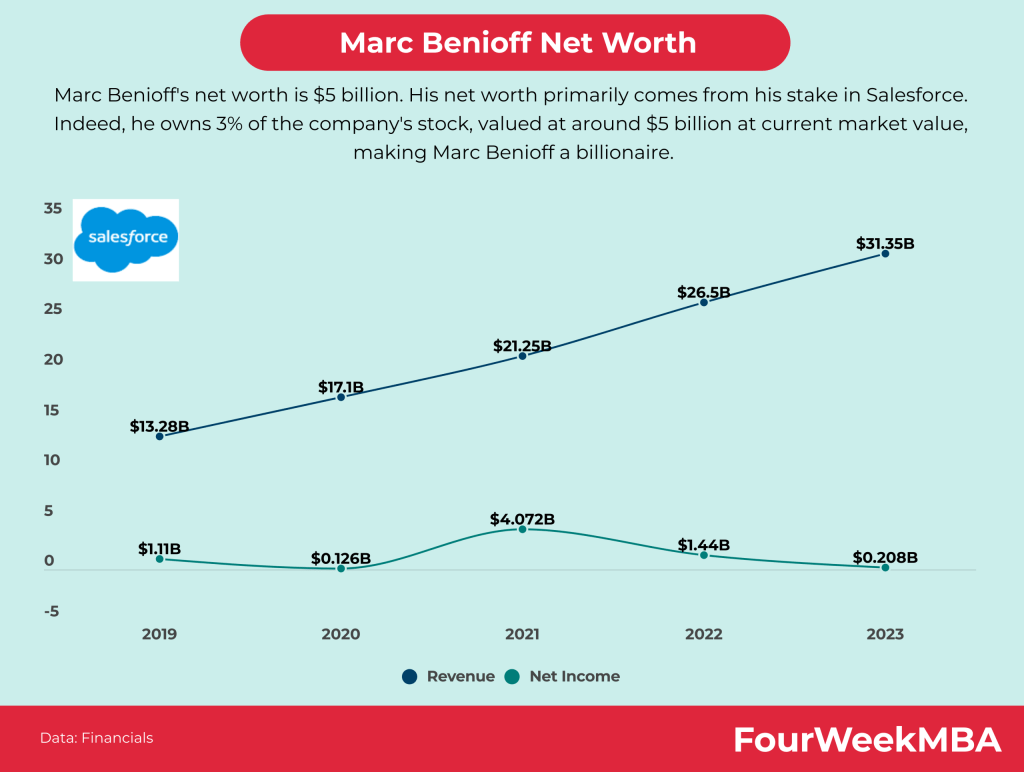
Marc Benioff’s net worth is $5 billion. His net worth primarily comes from his stake in Salesforce. Indeed, he owns 3% of the company’s stock, valued at around $5 billion at current market value, making Marc Benioff a billionaire.
Reed Hastings is the co-founder, former CEO, and now executive chairman of Netflix. He’s also one of the major shareholders, with 1.7% ownership in the company, valued at $2.4 billion at the current rate.
Evan Thomas Spiegel is the co-founder and CEO of Snapchat. He’s also the main shareholder. Indeed, he both owns and controls Snapchat, and his stake in the company is currently valued at around $3 billion.
Brian Chesky is an industrial designer and businessman who is also Airbnb’s co-founder and current CEO. Since the company was founded in 2007, Chesky has been in charge of it, amassing a net worth of about $10 billion, thanks to his shares in the company.
Phil Knight, the founder of Nike, controls the company via a personal stake of shares for 7% ownership, plus the shares held via the family’s owned Swoosh, LLC, in addition to the shares in possession of his son’s Trust. Phil Knight directly controls a significant stake in Nike’s Class A and B shares, valued at over $40 billion.
Michale Jordan is a billionaire but doesn’t own the Jordan brand, which is part of Nike. Yet, he gets 5% royalties on the sales of Jordan. For instance, as of May 31, 2022, Nike had endorsement contract obligations of $7.6 billion, of which over $250 million were to be paid out to Michael Jordan as royalties on the sales of Jordan in 2022 (the company made over 5$ billion in sales in that year). We estimated that between 2018-2022 alone, Nike paid (or is paying) Michael Jordan almost one billion dollars in royalties for Jordan’s brand sales.
Kevin Plank is Under Armour’s primary owner and founder, of which he’s also chairman. His stake in the company is worth over a billion dollars at current market value, making him a billionaire.
Gennaro is the creator of FourWeekMBA, which reached about four million business people, comprising C-level executives, investors, analysts, product managers, and aspiring digital entrepreneurs in 2022 alone | He is also Director of Sales for a high-tech scaleup in the AI Industry | In 2012, Gennaro earned an International MBA with emphasis on Corporate Finance and Business Strategy.
Scroll to Top
Discover more from FourWeekMBA
Subscribe now to keep reading and get access to the full archive.