Spotify’s Premium ARPU, its average monthly subscriptionrevenue per Premium subscriber, was €4.63 in 2025, against €4.69 in 2024 and €6.20 in 2016. ARPU fell as family, student and lower-priced markets grew; Premium subscribers rose 6× to 290 million over the same period.
Sources: Spotify Form 20-F for 2025 and earlier Spotify annual reports (SEC EDGAR). Analysis by The Business Engineer.
How we source: figures on this page come from the company’s own filings (SEC 10-K, 10-Q and earnings releases, or its annual report), with the period stated next to each number. Last refreshed October 2026. Our methodology.
Spotify ARPU: €4.63 a month, falling as it grows. Source: Spotify Form 20-F, 2025 (year to 31 Dec 2025), SEC EDGAR: Premium ARPU definition and values, Premium revenue, Premium Subscribers, plan types (Individual, Family, Duo, Student), local pricing; earlier 20-Fs for ARPU history; Q2 2026 Form 6-K (quarter to 30 Jun 2026): subscribers. ARPU decomposition is illustrative using year-end averages. Columns to scale. Analysis by The Business Engineer.
Earlier analysis and background (pre-2026 figures)
The text below is the earlier version of this page. Its figures refer to earlier periods and some were corrected above; the current, sourced figures are in the sections above.
BUSINESS CONCEPT
Spotify ARPU
When you look at Spotify's ARPU and compare it to other attention-based business models like Facebook's ARPU , you realize how much lower that is. Spotify's businessmodel, contrary to Facebook, is primarily skewed toward premium members who pay a subscription to the platform. Those members are kept on the platform with engaging content, which is released continuously, and it's optimized for a long engagement.
Real-World Examples
FacebookMetaSpotify
Key Insight
Whereas a company like Facebook needs to optimize its ARPU to make it as high as possible in the short term since this is subsidized by advertisers (companies pay to advertise on top of Facebook, which is what makes up its average revenue per user).
Exec Package + Claude OS Master Skill | Business Engineer Founding Plan
FourWeekMBA x Business Engineer | Updated 2026
Year
ARPU
2021
€4.29
2022
€4.52
2023
€4.39
FourWeekMBA BI Intelligence – Source data: Financials
When you look at Spotify’s ARPU and compare it to other attention-based business models like Facebook’s ARPU, you realize how much lower that is.
ARPU, or average revenue per user, is a crucial metric for attention merchants like Facebook. It assesses the ability of the platform to monetize its users. For instance, by the end of 2023, Meta’s ARPU worldwide was $13.12. In the US & Canada, it was $68.44; in Europe, it was $23.14; in Asia-Pacific, $5.52; and in the rest of the world, it was $4.50.
However, there are a few considerations to make here.
Spotify’s businessmodel, contrary to Facebook, is primarily skewed toward premium members who pay a subscription to the platform.
Those members are kept on the platform with engaging content, which is released continuously, and it’s optimized for a long engagement.
Thus, a business model like Spotify fundamentally differs from other attention-based business models, as it’s a mixture of subscription and ad-supported.
Whereas a company like Facebook needs to optimize its ARPU to make it as high as possible in the short term since this is subsidized by advertisers (companies pay to advertise on top of Facebook, which is what makes up its average revenue per user).
On Spotify, the company optimizes for the lifetime of the subscriber.
In short, it will take less today but for a more extended period.
Spotify’s ARPU, over time, might increase substantially if the company strengthens its ad-supported segment.
In fact, for that segment, Spotify can work on increasing the short-term value of ARPU thanks to the advertising network, similar to what Facebook does.
The multi-billion music streaming company Spotify is primarily owned by its founders, Daniel Ek and Martin Lorentzon. As of 2023, Daniel Ek has 15.3% ownership of ordinary shares and 30.5% of the voting power. Martin Lorentzon has 10.9% of ordinary shares and 42.7% of the voting power. Another key shareholder is Baillie Gifford & Co, a Scottish-based money management firm (12% ownership ), followed by Tencent (8.4% ownership).
Spotify is a two-sided marketplace, running a free ad-supported service and a paid membership. Founded in 2008 with the belief that music should be universally accessible, it generated €13.25 billion in 2023. Of these revenues, 87.3%, or €11.56 billion, came from premium memberships, while over 12.6%, or €1.68 billion, came from ad-supported members. By 2023, Spotify had over 600 million users, of which 236 million were premium members and 379 million weread-supported users.
Spotify Audience Network is the underlying advertising infrastructure that supports its ad-supported user base. The Spotify Audience Network was born as the result of the acquisitions of Anchor and Megaphone. By 2023, Spotify had 379 million ad-supported users.
Spotify licensing deals affect its businessmodel. The company runs on both a free service, which is ad-supported and a subscription premium service. They have different economics.
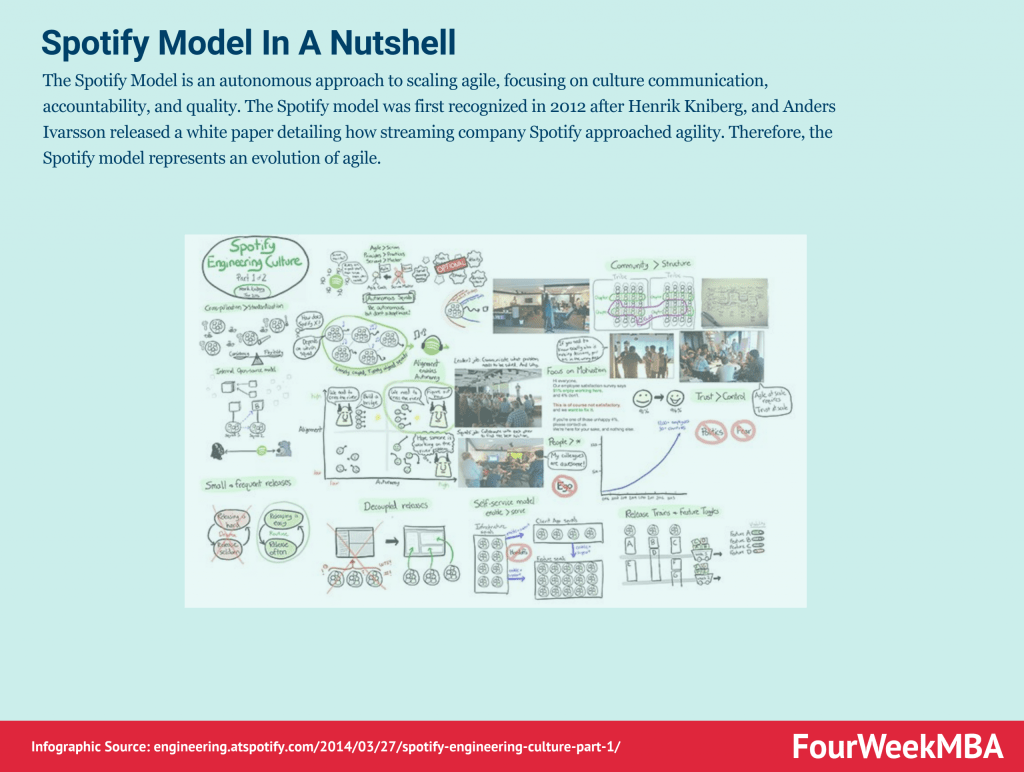
The ad-supported business had a 10% gross margin in 2021, compared to 29% of the subscription-based business. That’s because the more the content gets streamed on the platform, the more that increases royalty costs for Spotify. That is also why the company invested in developing its content. Thus, in part transitioning from platform to brand.The Spotify Model is an autonomous approach to scaling agile, focusing on culture communication, accountability, and quality. The Spotify model was first recognized in 2012 after Henrik Kniberg, and Anders Ivarsson released a white paper detailing how streaming company Spotify approached agility. Therefore, the Spotify model represents an evolution of agile.
Spotify generated €11.56 billion from premium members and €1.68 billion from ad-supported members. The premium membership revenue cost was €8.23 billion and €1.62B billion for the ad-supported segment. Thus, premium members generated a profit of €3.33B billion for Spotify in 2023. Meanwhile, the ad-supported segment generated a €62 million gross profit in 2023. The ad-supported segment, which is run almost at a loss, is critical for Spotify as it enables it to build a sustainable self-serving funnel to convert free users into paid subscribers!
The key components of Spotify ARPU include Year, 2021, 2022, 2023. Year: ARPU
Frequently Asked Questions
What is Spotify ARPU?
When you look at Spotify's ARPU and compare it to other attention-based business models like Facebook's ARPU , you realize how much lower that is. Spotify's businessmodel, contrary to Facebook, is primarily skewed toward premium members who pay a subscription to the platform. Those members are kept on the platform with engaging content, which is released continuously, and it's optimized for a long engagement.
Gennaro Cuofano is a CRO and tech executive who has worked in AI since late 2015, starting with bringing NLP, natural-language generation, voice and chatbot products to the marketing industry. His background is in law and finance: he holds a Master's degree in Law and an International MBA with an emphasis on corporate finance (LUISS Business School and the University of San Diego, 2012), and worked as a financial analyst at a real-estate investment firm in San Diego and as an assistant controller. His work focuses on business model strategy, business engineering and, more broadly, structural analysis: how companies make money, read from their own filings. He created FourWeekMBA and leads research there and at The Business Engineer, his newsletter on AI and business strategy, with over 95,000 subscribers and more than 1,000 published analyses. His writing has also appeared on Entrepreneur, HackerNoon and Search Engine People. Find him on LinkedIn and Substack. See how we source.
Scroll to Top
Discover more from FourWeekMBA
Subscribe now to keep reading and get access to the full archive.