Lean manufacturing seeks to maximize product value while minimizing waste without sacrificing productivity. According to the Lean Enterprise Research Centre (LERC), 60% of a typical manufacturing process is waste. While the removal of waste is perhaps synonymous with lean manufacturing, the goal of the methodology is the sustainable delivery of value to the customer.
Eighteen years later, it was adapted by psychologist Bob Eberle in his book SCAMPER: Games for Imagination Development. The SCAMPER method was first described by advertising executive Alex Osborne in 1953. The SCAMPER method is a form of creative thinking or problem solving based on evaluating ideas or groups of ideas.
Monroe’s motivated sequence was created by American psychologist Alan Monroe, who had an interest in persuasive speech delivery. Monroe’s motivated sequence uses the psychology of persuasion to develop an outline for delivering speeches.
A paired comparison analysis is used to rate or rank options where evaluation criteria are subjective by nature. The analysis is particularly useful when there is a lack of clear priorities or objective data to base decisions on. A paired comparison analysis evaluates a range of options by comparing them against each other.
The scaled agile framework (SAFe) helps larger organizations manage the challenges they face when practicing agile. The scaled agile framework was first introduced in 2011 by software industry guru Dean Leffingwell in his book Agile Software Requirements. The framework details a set of workflow patterns for implementing agile practices at an enterprise scale. This is achieved by guiding roles and responsibilities, planning and managing work, and establishing certain values that large organizations must uphold.
The MVC framework is a predictable software design pattern separated into three main components and suitable for many programming languages. The goal of the MVC framework is to help structure the code-base and separate application concerns into three components: View, Model, and Controller.
Prioritization plays a crucial role in every business. In an ideal world, businesses have enough time and resources to complete every task within a project satisfactorily. The MoSCoW method is a task prioritization framework. It is most effective in situations where many tasks must be prioritized into an actionable to-do list. The framework is based on four main categories that give it the name: Must have (M), Should have (S), Could have (C), and Won’t have (W).
The operating model is a visual representation and mapping of the processes and how the organization delivers value and, therefore, how it executes its businessmodel. Therefore, the operating model is how the whole organization is structured around the value chain to build a viable businessmodel.
The theory was developed by psychologist Edwin Locke who also has a background in motivation and leadership research. Locke’s goal-setting theory of motivation provides a framework for setting effective and motivating goals. Locke was able to demonstrate that goal setting was linked to performance.
The Nadler-Tushman Congruence Model was created by David Nadler and Michael Tushman at Columbia University. The Nadler-Tushman Congruence Model is a diagnostic tool that identifies problem areas within a company. In the context of business, congruence occurs when the goals of different people or interest groups coincide.
Herzberg’s two-factor theory argues that certain workplace factors cause job satisfaction while others cause job dissatisfaction. The theory was developed by American psychologist and business management analyst Frederick Herzberg. Until his death in 2000, Herzberg was widely regarded as a pioneering thinker in motivational theory.
The Kepner-Tregoe matrix was created by management consultants Charles H. Kepner and Benjamin B. Tregoe in the 1960s, developed to help businesses navigate the decisions they make daily, the Kepner-Tregoe matrix is a root cause analysis used in organizational decision making.
The Eisenhower Matrix is a tool that helps businesses prioritize tasks based on their urgency and importance, named after Dwight D. Eisenhower, President of the United States from 1953 to 1961, the matrix helps businesses and individuals differentiate between the urgent and important to prevent urgent things (seemingly useful in the short-term) cannibalize important things (critical for long-term success).
In the FourWeekMBA growth matrix, you can apply growth for existing customers by tackling the same problems (gain mode). Or by tackling existing problems, for new customers (expand mode). Or by tackling new problems for existing customers (extend mode). Or perhaps by tackling whole new problems for new customers (reinvent mode).
You can use the Ansoff Matrix as a strategic framework to understand what growthstrategy is more suited based on the market context. Developed by mathematician and business manager Igor Ansoff, it assumes a growthstrategy can be derived by whether the market is new or existing, and the product is new or existing.
Product management has become a key role within most organizations and startups as it combines product development with experimentation to create a successful product in the market. Product management requires a combination of strategic thinking, problem-solving skills, and a relentless focus on customer needs and delivering the right product at the right time. Top product managers use a customer obsession approach to build and launch successful products.
The Margerison-McCann team management wheel was developed by Dr. Charles Margerison and Dr. Dick McCann. Margerison – an author and psychologist – partnered with scientist and organizational behaviorist McCann to determine why some teams were effective while others with a similar skillset were not.
Belbin’s team roles describe different clusters of behavioral attributes that individuals may exhibit within teams. They were developed by management consultant Dr. R. Meredith Belbin in 1981.
Belbin identified nine roles and categorized them according to whether they were people-oriented, action-oriented, or cerebral. The nine roles include the Shaper, Implementer, Completer, Resource Investigator, Team Worker, Coordinator, Monitor Evaluator, Specialist, and Plant.
Organizations should use Belbin’s work to ensure their teams are balanced and are comprised of an ideal mix of roles.
Disruptive innovation as a term was first described by Clayton M. Christensen, an American academic and business consultant whom The Economist called “the most influential management thinker of his time.” Disruptive innovation describes the process by which a product or service takes hold at the bottom of a market and eventually displaces established competitors, products, firms, or alliances.
Marc Andreessen defined Product/market fit as “being in a good market with a product that can satisfy that market.” According to Andreessen, that is a moment when a product or service has its place in the market, thus enabling traction for the company offering that product or service.
Perceptual mapping is the visual representation of consumer perceptions of brands, products, services, and organizations as a whole. Indeed, perceptual mapping asks consumers to place competing products relative to one another on a graph to assess how they perform with respect to each other in terms of perception.
Value stream mapping uses flowcharts to analyze and then improve on the delivery of products and services. Value stream mapping (VSM) is based on the concept of value streams – which are a series of sequential steps that explain how a product or service is delivered to consumers.
The bullseye framework is a simple method that enables you to prioritize the marketing channels that will make your company gain traction. The main logic of the bullseye framework is to find the marketing channels that work and prioritize them.
A Blockchain Business Model according to the FourWeekMBA framework is made of four main components: Value Model (Core Philosophy, Core Values and Value Propositions for the key stakeholders), Blockchain Model (Protocol Rules, Network Shape and Applications Layer/Ecosystem), Distribution Model (the key channels amplifying the protocol and its communities), and the Economic Model (the dynamics/incentives through which protocol players make money). Those elements coming together can serve as the basis to build and analyze a solid Blockchain Business Model.
In an asymmetric businessmodel, the organization doesn’t monetize the user directly, but it leverages the data users provide coupled with technology, thus have a key customer pay to sustain the core asset. For example, Google makes money by leveraging users’ data, combined with its algorithms sold to advertisers for visibility.
In a business world driven by technology and digitalization, competition is much more fluid, as innovation becomes a bottom-up approach that can come from anywhere. Thus, making it much harder to define the boundaries of existing markets. Therefore, a proper business competition analysis looks at customer, technology, distribution, and financial model overlaps. While at the same time looking at future potential intersections among industries that in the short-term seem unrelated.
Technological modeling is a discipline to provide the basis for companies to sustain innovation, thus developing incremental products. While also looking at breakthrough innovative products that can pave the way for long-term success. In a sort of Barbell Strategy, technological modeling suggests having a two-sided approach, on the one hand, to keep sustaining continuous innovation as a core part of the businessmodel. On the other hand, it places bets on future developments that have the potential to break through and take a leap forward.
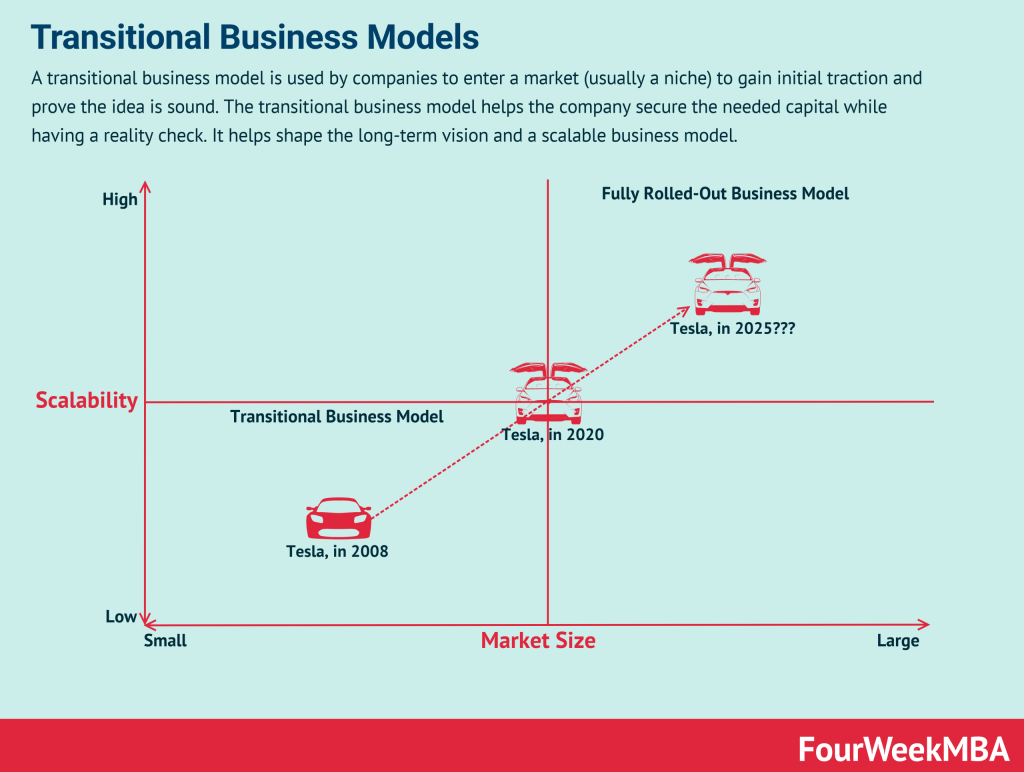
A transitional business model is used by companies to enter a market (usually a niche) to gain initial traction and prove the idea is sound. The transitional business model helps the company secure the needed capital while having a reality check. It helps shape the long-term vision and a scalable businessmodel.
Business scaling is the process of transformation of a business as the product is validated by wider and wider market segments. Business scaling is about creating traction for a product that fits a small market segment. As the product is validated it becomes critical to build a viable businessmodel. And as the product is offered at wider and wider market segments, it’s important to align product, businessmodel, and organizational design, to enable wider and wider scale.
In the FourWeekMBA growth matrix, you can apply growth for existing customers by tackling the same problems (gain mode). Or by tackling existing problems, for new customers (expand mode). Or by tackling new problems for existing customers (extend mode). Or perhaps by tackling whole new problems for new customers (reinvent mode).
In the FourWeekMBA Revenue Streams Matrix, revenue streams are classified according to the kind of interactions the business has with its key customers. The first dimension is the “Frequency” of interaction with the key customer. As the second dimension, there is the “Ownership” of the interaction with the key customer.
Revenue model patterns are a way for companies to monetize their business models. A revenue model pattern is a crucial building block of a business model because it informs how the company will generate short-term financial resources to invest back into the business. Thus, the way a company makes money will also influence its overall businessmodel.
A pricing strategy or model helps companies find the pricing formula in fit with their business models. Thus aligning the customer needs with the product type while trying to enable profitability for the company. A good pricing strategy aligns the customer with the company’s long term financial sustainability to build a solid businessmodel.
Highlights
Concept
Description
When to Use
Advantages
Drawbacks
Lean Manufacturing
Maximizing product value while minimizing waste in manufacturing processes, focusing on sustainable value delivery to customers.
When organizations aim to improve manufacturing efficiency and reduce waste, optimizing processes while delivering value to customers.
Enhances productivity and reduces waste.
Implementation may require significant changes.
SCAMPER Method
A creative thinking and problem-solving method for evaluating and generating ideas by modifying existing ones, developed by Alex Osborne and adapted by Bob Eberle.
When organizations seek creative solutions and idea generation by exploring different dimensions of existing ideas.
Encourages creative thinking and innovation.
May require brainstorming and creativity.
Monroe’s Motivated Sequence
A persuasive speech delivery framework by Alan Monroe, using psychology of persuasion to outline effective speeches.
When delivering persuasive speeches or presentations to engage and influence the audience effectively.
Structured approach to persuasive speech delivery.
May not fit all types of presentations.
Paired Comparison Analysis
A method for subjective evaluation and ranking of options, particularly useful when objective data or clear priorities are lacking.
When making decisions with subjective evaluation criteria or when clear priorities are not evident.
Allows ranking and comparison of options.
Relies on subjective judgments.
Scaled Agile Framework (SAFe)
A framework for implementing agile practices at an enterprise scale, introduced by Dean Leffingwell to help larger organizations manage agile challenges effectively.
When large organizations want to scale agile practices and align their values, roles, and processes to achieve agility.
Supports agile adoption at an enterprise level.
Requires significant organizational changes.
MVC Framework
A software design pattern that separates applications into three components: Model, View, and Controller, providing a structured approach to code organization.
When developing software applications in various programming languages, aiming to improve code structure and organization.
Enhances code modularity and maintainability.
May add complexity for smaller projects.
MoSCoW Method
A task prioritization framework based on four categories: Must have (M), Should have (S), Could have (C), and Won’t have (W), helping prioritize tasks into actionable lists.
When managing tasks and prioritizing them based on their importance and impact, ensuring essential tasks are addressed first.
Offers a clear and structured prioritization system.
Requires clear understanding of task importance.
Operating Model
A visual representation mapping organizational processes and how they deliver value, helping define how an organization executes its business model.
When organizations need to visualize their operations, align them with value delivery, and improve overall business execution.
Provides clarity on organizational processes.
May require comprehensive mapping efforts.
Lightning Decision Jam
A decision-making theory developed by psychologist Edwin Locke, focusing on goal-setting theory of motivation to set effective and motivating goals for individuals.
When setting motivating goals for individuals or teams to improve performance and achieve desired outcomes.
Encourages goal-setting and motivation.
Requires alignment of goals with organizational objectives.
Nadler-Tushman Congruence Model
A diagnostic tool created by David Nadler and Michael Tushman to identify problem areas within organizations, assessing congruence between different elements and interests within a company.
When diagnosing and addressing problem areas within an organization by evaluating the alignment of goals and interests.
Helps identify and address organizational issues.
Requires comprehensive assessment and analysis.
Herzberg’s Two-Factor Theory
A theory by Frederick Herzberg that distinguishes between factors that cause job satisfaction (motivators) and job dissatisfaction (hygiene factors) in the workplace.
When analyzing employee motivation and job satisfaction, aiming to improve workplace conditions and performance.
Provides insights into employee motivation factors.
May require specific interventions for improvement.
Kepner-Tregoe Matrix
A root cause analysis tool created by Charles Kepner and Benjamin Tregoe, helping organizations make informed decisions and navigate complex situations through structured analysis.
When organizations need to analyze complex problems, identify root causes, and make data-driven decisions.
Offers a structured approach to problem-solving.
May require time and data for thorough analysis.
Eisenhower Matrix
A tool for task prioritization based on urgency and importance, named after Dwight D. Eisenhower, assisting individuals and businesses in managing their tasks effectively.
When individuals or businesses need to prioritize tasks to focus on the most important and urgent activities.
Provides a simple method for task prioritization.
May not address complex decision-making needs.
Growth Matrix
A framework for businesses to apply growth strategies based on gaining, expanding, extending, or reinventing solutions for existing and new customers, developed by FourWeekMBA.
When businesses want to strategize and apply growth initiatives based on different customer segments and problems.
Helps align growth strategies with market context.
Requires strategic planning and execution.
Ansoff Matrix
A strategic framework developed by Igor Ansoff, categorizing growth strategies based on existing and new markets and products, helping organizations make informed growth decisions.
When organizations need to assess growth opportunities and determine suitable strategies based on market and product contexts.
Provides a structured approach to growth planning.
Requires market analysis and strategic alignment.
Change Management
A systematic approach to managing organizational change, ensuring successful transitions and alignment with strategic goals.
When organizations undergo significant changes or transformations, managing the transition while maintaining productivity and morale.
Supports smooth transitions and change adoption.
May face resistance and challenges in implementation.
Product Management
A role focused on developing, launching, and managing products that meet customer needs, requiring strategic thinking, problem-solving, and customer-centricity.
When organizations aim to create and launch successful products, manage product lifecycles, and align with customer requirements.
Drives product success through customer focus.
Requires a combination of strategic and tactical skills.
Margerison-McCann Team Management
A model by Charles Margerison and Dick McCann to assess and improve team effectiveness by identifying key roles within a team and their contributions.
When organizations seek to enhance team performance and collaboration by understanding individual roles and contributions.
Provides insights into team dynamics and roles.
May require adjustments in team composition and roles.
Belbin’s Team Roles
A framework by Dr. R. Meredith Belbin categorizing individuals’ roles within teams into nine categories based on behavioral attributes, promoting balanced team composition.
When organizations aim to build effective teams by understanding and optimizing the mix of team roles to improve collaboration.
Helps create balanced and productive team dynamics.
Requires careful consideration of role assignments.
Disruptive Innovation
A concept by Clayton M. Christensen describing how new products or services disrupt established markets and competitors, often starting at the lower end of the market.
When organizations seek to disrupt existing markets, challenge incumbents, and introduce innovative solutions to gain a competitive edge.
Can lead to market disruption and competitive advantage.
May face resistance from established players.
Problem-Solution Fit
An approach to validate market demand and fit for a product by addressing specific customer problems before developing a minimum viable product (MVP).
When organizations want to minimize market risk by ensuring that their product addresses real customer problems effectively.
Reduces the risk of developing products with no market fit.
Requires thorough problem validation efforts.
Product-Market Fit
The alignment of a product with market demand, ensuring that it satisfies customer needs and gains traction in the market, as defined by Marc Andreessen.
When organizations aim to ensure that their product or service resonates with the market, leading to successful customer adoption.
Establishes a strong product-market fit foundation.
Requires ongoing market research and adaptation.
Perceptual Mapping
A visual representation of consumer perceptions of brands, products, or services on a graph, assessing how they compare in terms of consumer perception.
When organizations want to understand consumer perceptions and compare their brand, product, or service with competitors in the market.
Provides insights into market positioning and competition.
Requires accurate data and interpretation.
Value Stream Mapping
A method that uses flowcharts to analyze and improve the delivery of products and services, focusing on value creation and eliminating waste in processes.
When organizations aim to streamline processes, reduce waste, and enhance value delivery to customers by visualizing their value streams.
Enhances process efficiency and customer value.
Requires process analysis and continuous improvement.
Bullseye Framework
A method for prioritizing marketing channels to gain traction, focusing on identifying and prioritizing the most effective marketing channels for a business.
When organizations need to identify and prioritize marketing channels to optimize their marketing strategies and gain traction.
Helps allocate resources effectively for marketing efforts.
Requires analysis and testing of marketing channels.
Speed vs. Reversibility Matrix
A tool for assessing decisions based on the balance between the speed of implementation and the potential for reversibility, helping organizations make informed choices.
When organizations need to make decisions considering the trade-off between speed of implementation and the ability to reverse or modify them.
Provides a structured approach to decision-making.
Requires careful consideration of decision factors.
Tech Business Model Template
A template for tech business models, incorporating components like value model, technological model, distribution model, and financial model, to build a solid tech business model.
When developing or analyzing tech business models, ensuring that all key components are considered to create a viable and sustainable model.
Guides the creation and evaluation of tech business models.
Requires in-depth understanding of tech and business aspects.
Web3 Business Model Template
A framework for analyzing blockchain business models, including components like value model, blockchain model, distribution model, and economic model, to assess their viability and sustainability.
When evaluating or designing blockchain-based business models, considering all critical elements for long-term success.
Supports the analysis and development of blockchain business models.
Requires expertise in blockchain technology and economics.
Asymmetric Business Models
Business models that leverage user data and technology to have one key customer pay for sustaining the core asset, such as Google’s data-driven advertising model.
When organizations want to explore non-traditional business models that rely on data-driven revenue generation and technology exploitation.
Allows monetization through unconventional means.
May raise privacy and ethical concerns.
Business Competition
The analysis of competition in a technology-driven and digitalized business landscape, considering customer, technology, distribution, and financial model overlaps and potential intersections among industries.
When organizations aim to understand and adapt to fluid competition dynamics driven by technology and digitalization, assessing market boundaries.
Provides insights into evolving competition landscapes.
Requires continuous monitoring and adaptation.
Technological Modeling
A discipline that helps companies sustain innovation by developing both incremental and breakthrough products, using a two-sided approach to innovation.
When organizations want to balance continuous innovation with strategic bets on groundbreaking technological developments.
Supports long-term innovation and product diversification.
Requires a strategic approach and resource allocation.
Transitional Business Models
Business models used to enter markets, gain initial traction, and validate ideas while securing capital and shaping long-term scalable business models.
When organizations need to validate market demand, secure initial funding, and transition to scalable business models based on market feedback.
Allows controlled experimentation and validation.
Requires adaptation and scaling after validation.
Business Scaling
The transformation of a business as its product is validated by wider market segments, creating traction, building viable business models, and aligning product, business model, and organizational design for wider scale.
When organizations seek to expand their product offerings to larger market segments, focusing on growth, scalability, and alignment across all aspects of the business.
Enables expansion and market dominance under uncertainty.
Requires strategic alignment and scalability planning.
Growth Matrix
A framework for applying growth strategies based on customer segments and problem domains, including gain, expand, extend, and reinvent modes, to align growth initiatives with specific objectives.
When businesses want to strategize growth efforts based on different customer segments and problem-solving approaches, ensuring alignment with goals.
Helps tailor growth strategies to specific market contexts.
Requires strategic planning and execution.
Revenue Streams Matrix
A classification of revenue streams based on the frequency and ownership of customer interactions, helping organizations understand and optimize revenue generation methods.
When organizations aim to categorize and optimize revenue streams based on customer interactions and ownership to maximize revenue potential.
Provides clarity on revenue sources and interactions.
Requires a deep understanding of customer relationships.
Revenue Modeling
Revenue model patterns that guide how companies generate short-term financial resources to support business operations, influencing the overall business model.
When organizations need to define revenue generation methods that align with their business models, ensuring financial sustainability.
Shapes the financial aspect of the business model.
Requires consideration of long-term financial viability.
Pricing Strategies
Strategies and models for determining product or service pricing to align with business models, customer needs, and profitability goals.
When organizations need to establish pricing strategies that balance customer value, competitiveness, and financial objectives, ensuring profitability and sustainability.
Helps find the right pricing formula for the business model.
Requires continuous pricing analysis and adaptation.
Gennaro is the creator of FourWeekMBA, which reached about four million business people, comprising C-level executives, investors, analysts, product managers, and aspiring digital entrepreneurs in 2022 alone | He is also Director of Sales for a high-tech scaleup in the AI Industry | In 2012, Gennaro earned an International MBA with emphasis on Corporate Finance and Business Strategy.