Howard Schultz’s net worth is over $2.2 billion. Indeed, he is the founder of Starbucks and a major institutional shareholder, with 1.88% ownership of the company, valued at over $2.2 billion at the current market value, making him a billionaire.
Category
Details
Full Name
Howard D. Schultz
Date of Birth
July 19, 1953
Place of Birth
Brooklyn, New York, USA
Nationality
American
Education
Bachelor of Arts in Communications from Northern Michigan University
Early Career
Sales and marketing positions at Xerox Corporation, Director of Retail Operations and Marketing at Hammarplast USA
Major Companies Founded
Starbucks Corporation (responsible for its expansion and success)
Positions
Former Chairman and CEO of Starbucks, Executive Chairman of Starbucks
Net Worth
Estimated at over $2 billion (as of 2024)
Business Milestones
– 1982: Joined Starbucks as Director of Retail Operations and Marketing when the company had only four stores. – 1985: Founded Il Giornale, a coffee company inspired by Italian espresso bars. – 1987: Acquired Starbucks with investors and merged it with Il Giornale, becoming CEO and Chairman. – 1992: Took Starbucks public with an initial public offering (IPO), raising $271 million. – 1996: Opened the first Starbucks location outside North America in Tokyo, Japan. – 2000: Stepped down as CEO but remained Chairman, focusing on global strategy and innovation. – 2008: Returned as CEO to revitalize Starbucks during the financial crisis, leading to significant restructuring and expansion. – 2018: Announced retirement as Executive Chairman of Starbucks, shifting focus to social impact initiatives. – 2020: Published “From the Ground Up: A Journey to Reimagine the Promise of America,” a book about his life and career. – 2022: Returned as interim CEO to guide the company through a transition period.
Howard Schultz: Howard Schultz is an American businessman who gained prominence as the founder of Starbucks, a global coffeehouse chain known for its premium coffee and café culture.
Net Worth: As of the latest available information, Howard Schultz’s net worth is estimated to be over $2.2 billion. His wealth primarily stems from his involvement with Starbucks and his substantial ownership of the company’s shares.
Founder of Starbucks: Howard Schultz is credited with founding Starbucks as we know it today. He joined Starbucks in the early 1980s when it was a small coffee shop chain based in Seattle. Schultz was inspired by the coffee culture he encountered in Italy and saw the potential to turn Starbucks into a premium coffee experience.
Transformation of Starbucks: Under Schultz’s leadership, Starbucks underwent a transformation from a local coffee chain to a global brand. He emphasized high-quality coffee, the ambiance of Starbucks stores, and the concept of the “third place” – a welcoming space between home and work where people could gather and enjoy coffee.
Major Institutional Shareholder: Schultz’s net worth is significantly influenced by his ownership stake in Starbucks. He holds a considerable percentage of the company’s shares, amounting to approximately 1.88% of the total ownership. This sizeable stake has contributed to his billionaire status.
Billionaire Status: Schultz’s ownership of Starbucks shares, combined with the company’s market value, places his net worth well above the billion-dollar mark. His status as a billionaire is attributed to his successful business ventures and contributions to Starbucks’ growth.
Post-Starbucks Ventures: Beyond Starbucks, Schultz has been involved in various philanthropic and business endeavors. He has been vocal about social issues and has explored political interests. Additionally, Schultz has engaged in projects related to education and job creation.
In summary, Howard Schultz’s journey from founding Starbucks to becoming a major institutional shareholder has led to his billionaire net worth.
His impact on the coffee industry and his role in creating a global coffeehouse phenomenon have solidified his position as a significant figure in the business world.
Starbucks’ main individual shareholder is Howard Schultz, the founder of Starbucks. Major institutional shareholders comprise BlackRock, with 7.18%, and The Vanguard Group, with 8.6% ownership. Starbucks follows a heavy-chained businessmodel, where the company-operated stores play a critical role in the company’s long-term strategy, compared to McDonald’s heavy-franchised businessmodel, where the long-term plan is to have over 95% of the stores as franchising.
Starbucks is a retail company that sells beverages (primarily consisting of coffee-related drinks) and food. In 2023, Starbucks had 44% of company-operated stores vs. 56% of licensed stores which might make you think Starbucks is a franchise business, when in reality most of its revenue (nearly 82% in 2023) came from company-operated stores, thus making Starbucks a chain businessmodel.
Starbucks follows a chain business model strategy, where most of its revenue comes from its owned stores. For instance, in 2023, with nearly $36 billion in revenue, most of the revenue came from owned stores ($29.46 billion) compared to franchised stores ($4.51 billion) and other revenue sources ($2 billion). Yet owned stores have higher operational costs compared to franchised stores.
Starbucks follows a chain businessmodel, building its brand through its owned stores. And its owned stores are also where most of the revenue is generated. In addition, the owned stores are a great asset to keep experimenting with new products while maintaining tight control over the customer experience.
In 2023, Starbucks operated 19,592vs. 18,253 licensed stores. Starbucks leverages primarily company-operated stores to keep tight control over product development, branding, distribution, and customer experience. It also leverages licensed stores for better amplification of brand, revenue, and profits.
Starbucks made 60% of its revenue, in 2023, from beverages, followed by other revenue, which accounted for 22% of the total revenue (that comprises packaged and single-serve coffees and teas, plus royalty and licensing revenues, beverage-related ingredients, serve ware, and ready-to-drink beverages, among other items.) and food, which accounted for 18% of the total sales in 2023.
Starbucks’s mission is “to inspire and nurture the human spirit – one person, one cup and one neighborhood at a time.” And its vision is to “treat people like family, and they will be loyal and give their all.”
Starbucks is a multinational coffee chain headquartered in Seattle, Washington. It was founded by Jerry Baldwin, Zev Siegl, and Gordon Bowker in 1971. From a single and very humble bean roasting store in Pike Place Market, the company is now a global giant operating over 37,711 stores around the world. This large global footprint obviously increases the competition for Starbucks in many different markets. The coffee industry itself is also highly competitive, with established players including McDonald’s and Dunkin’ Donuts.
Starbucks follows a matrix organizational structure with a combination of vertical and horizontal structures. It is characterized by multiple overlapping chains of command and divisions.
McDonald’s and Starbucks sit in the opposite spectrum of retail business models. Indeed, whereas McDonald’s follows a heavily franchised businessmodel, Starbucks follows a heavy-chained one.
Starbucks highlights its mission as “to inspire and nurture the human spirit – one person, one cup and one neighborhood at a time.” And its vision is to “treat people like family, and they will be loyal and give their all.”
Starbucks is a global consumer brand with direct distribution, recognized brands, and products that make it a viable business. Its reliance on the Americas as a primary operating segment makes it a weakness. At the same time, Starbucks faces risks related to coffee beans price volatility. Yet the company still has global expansion opportunities.
By 2022, most of Tesla’s shares are still owned by Elon Musk, among the company’s co-founders and the CEO. Elon Musk is the top individual investor, with a 23.5% stake in the company. At current rates, this is valued at around $145-50 billion, making Elon Musk one of the wealthiest men on earth. In addition, Musk also holds a significant stake in Twitter and SpaceX, which makes him worth anywhere between $180-90 billion.
Bernard Arnault’s wealth is around $203 billion. Indeed Arnault is the CEO and chairman of the luxury goods conglomerate LVMH Moët Hennessy Louis Vuitton, a massive luxury group that generated over €79 billion in revenue ($83 billion) in 2022, spanning across wines, fashion, cosmetics, and retail. The Arnault family group owns 48.18% of the capital for LVMH with 63.9% voting power, making Bernard Arnault the principal owner and decision-maker. His stake is worth over $203 billion.
Warren Buffett is an American investor, business tycoon, and philanthropist. Known as the “Oracle of Omaha,” Buffett is best known for his strict adherence to value investing and frugality despite his immense wealth. Warren Buffet owns an investment firm, Berkshire Hathaway. He owns 238,624 Class A shares which gives him control over the company. His stake in the company is valued at over $100 billion.
Jeff Bezos’ net worth is primarily based on his ownership stake in Amazon. Indeed, as of 2023, Bezos owned a 12.7% stake in Amazon, worth over $120 billion.
Tim Cook’s net worth is primarily comprised of his Apple stocks. As of 2023, he owned 3,279,898 worth about $480 million at the current rate. However, Tim Cook has sold part of his Apple stocks over the years for hundreds of millions of dollars, making him a billionaire.
Bill Gates was the co-founder and former CEO of Microsoft until 2000, and he was on the board of Microsoft until 2020. However, over the years, Gates sold various stakes in Microsoft and diversified away from it. As of 2019, Gates had a 1.34% stake in Microsoft, which he might still own, valued at about $25 billion.
As of 2022, Satya Nadella had 763,518, valued at $190 million at Microsoft’s current market value. Nadella also got a $2.5 million base salary in 2022, plus $42.27 million in stock awards and over $10 million in non-stock incentives. Nadella sold hundreds of millions of dollars of Microsoft stocks in the last ten years, making him a centi-millionaire. In 2022, 96% of Nadella’s salary was performance-based, whereas only 4% comprised a base salary.
Larry Page co-founded Google (now Alphabet) and Sergey Brin. He controls the company tightly via a dual share ownership structure (made of Class A and B stocks). Alphabet is worth over a trillion dollars, valuing Larry Page’s stake in the company at around $70 billion.
Sergey Brin co-founded Google (now Alphabet) together with Larry Page. He controls the company tightly via a dual share ownership structure (made of Class A and B stocks). Alphabet is worth over a trillion dollars, valuing Sergey Brin’s stake at around $66 billion.
Mark Zuckerberg is the co-founder and principal shareholder of Facebook (now Meta), in which he owns a controlling stake worth over $68 billion. Thus Mark Zucberkerbs’ net worth is around $68 billion in 2023.
Eduardo Luiz Saverin is a billionaire entrepreneur and angel investor. He co-founded Facebook with Mark Zuckerberg; he was later ousted. Yet later on, Facebook settled a lawsuit with Saverin giving him a good chunk of the company’s stock, now worth over ten billion dollars. Thus, Eduardo Saverin’s net worth is around $10.45 billion in 2023.
While Larry Ellison is a shareholder in various tech companies (such as Tesla), his primary wealth comes from his ownership stake in the company he founded, Oracle. He owns almost 43% of the company’s stock, valued at over $100 billion, making him among the wealthiest people on earth.
Howard Schultz’s net worth is over $2.2 billion. Indeed, he is the founder of Starbucks and a major institutional shareholder, with 1.88% ownership of the company, valued at over $2.2 billion at the current market value, making him a billionaire.
Daniel Ek is one of the founders and one of the principal shareholders of Spotify. Indeed, in 2023 with 16.5% of Spotify’s shares, he’s worth around $3.7 billion.
The Pinault family is the main shareholder behind the Kering Group luxury empire, with a stake of 41.7%, valued around €30 billion, thus $32-33 billion. The Kering Group owns iconic brands like Gucci, Yves Saint Laurent and Bottega Veneta.
Pierre Omidyar is a technology entrepreneur andPierre Omidyar is a technology entrepreneur and founder of eBay. As of 2020, before he stepped down from the company’s board of directors, he still owned 4.69% of the company’s stocks, valued at over one billion dollars. Yet, over the years, he sold a good chunk of his stocks, making him a billionaire. founder of eBay. As of 2020, before he stepped down from the company’s board of directors, he still owned 4.69% of the company’s stocks, valued at over one billion dollars. Yet, over the years, he sold a good chunk of his stocks, making him a billionaire.
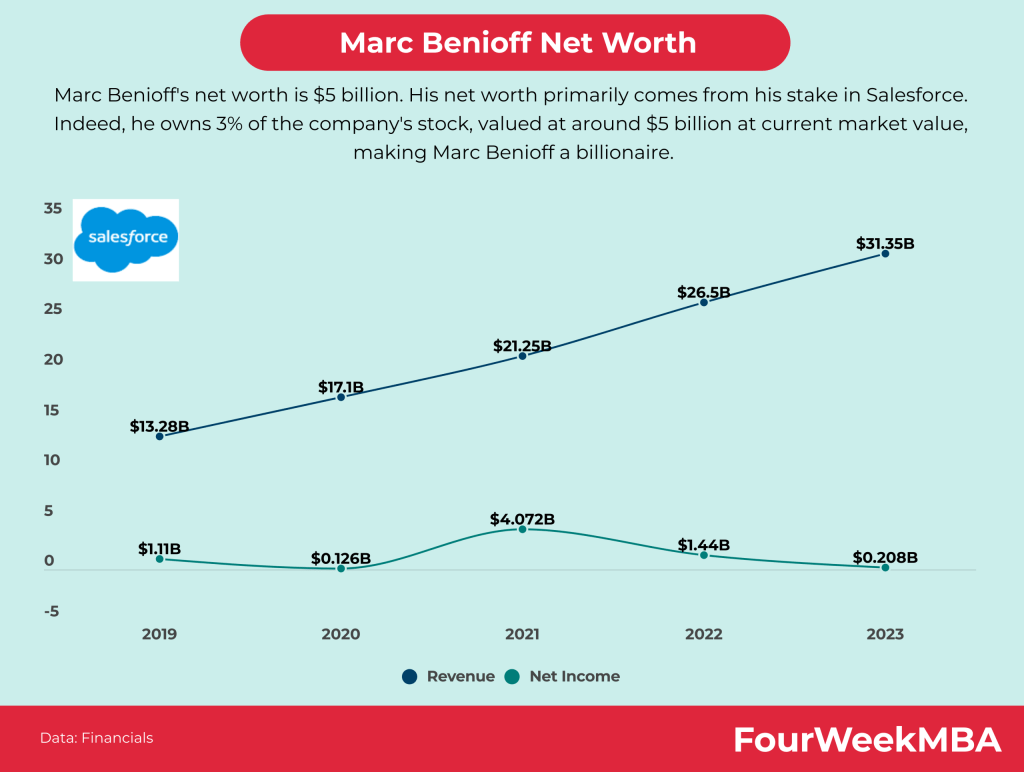
Marc Benioff’s net worth is $5 billion. His net worth primarily comes from his stake in Salesforce. Indeed, he owns 3% of the company’s stock, valued at around $5 billion at current market value, making Marc Benioff a billionaire.
Reed Hastings is the co-founder, former CEO, and now executive chairman of Netflix. He’s also one of the major shareholders, with 1.7% ownership in the company, valued at $2.4 billion at the current rate.
Evan Thomas Spiegel is the co-founder and CEO of Snapchat. He’s also the main shareholder. Indeed, he both owns and controls Snapchat, and his stake in the company is currently valued at around $3 billion.
Brian Chesky is an industrial designer and businessman who is also Airbnb’s co-founder and current CEO. Since the company was founded in 2007, Chesky has been in charge of it, amassing a net worth of about $10 billion, thanks to his shares in the company.
Phil Knight, the founder of Nike, controls the company via a personal stake of shares for 7% ownership, plus the shares held via the family’s owned Swoosh, LLC, in addition to the shares in possession of his son’s Trust. Phil Knight directly controls a significant stake in Nike’s Class A and B shares, valued at over $40 billion.
Michale Jordan is a billionaire but doesn’t own the Jordan brand, which is part of Nike. Yet, he gets 5% royalties on the sales of Jordan. For instance, as of May 31, 2022, Nike had endorsement contract obligations of $7.6 billion, of which over $250 million were to be paid out to Michael Jordan as royalties on the sales of Jordan in 2022 (the company made over 5$ billion in sales in that year). We estimated that between 2018-2022 alone, Nike paid (or is paying) Michael Jordan almost one billion dollars in royalties for Jordan’s brand sales.
Kevin Plank is Under Armour’s primary owner and founder, of which he’s also chairman. His stake in the company is worth over a billion dollars at current market value, making him a billionaire.
Gennaro is the creator of FourWeekMBA, which reached about four million business people, comprising C-level executives, investors, analysts, product managers, and aspiring digital entrepreneurs in 2022 alone | He is also Director of Sales for a high-tech scaleup in the AI Industry | In 2012, Gennaro earned an International MBA with emphasis on Corporate Finance and Business Strategy.