Songtradr is an automated music licensing marketplace founded in 2014 by Paul Wiltshire. Music on the platform is licensed by companies for use in advertisements, movies, social media, and television content
Songtradr makes money by taking a commission from distribution royalties and sync revenue, with the latter experiencing growth due to increased demand for music from amateur filmmakers on YouTube.
Songtradr offers three subscription plans with various perks and commission structures. The company takes a commission from distribution royalties and sync revenue for users on the free plan. However, these commissions are reduced or even removed for users on plans with an annual fee.
Business Model Element
Analysis
Implications
Examples
Value Proposition
Songtradr’s value proposition centers on providing musicians and music creators with a platform to monetize their music and gain exposure. For Musicians and Music Creators, Songtradr offers: – Music Licensing: Opportunities to license music for various projects. – Distribution: Tools to distribute music to streaming platforms. – Royalty Management: Simplified royalty tracking and payments. For Music Seekers (e.g., filmmakers, advertisers), Songtradr provides: – Access to a vast library of music for licensing. – A streamlined process for finding and licensing music. Songtradr empowers musicians to monetize their work and offers music seekers a diverse selection of music for their projects.
Provides musicians opportunities to monetize their music through licensing and distribution. Simplifies royalty tracking and payments for creators. Offers music seekers access to a diverse library of licensed music. Attracts musicians seeking revenue and exposure. Satisfies music seekers’ licensing needs with a streamlined process.
– Licensing opportunities open up new revenue streams for musicians. – Distribution tools help artists reach a broader audience. – Royalty management simplifies financial aspects for creators. – Music seekers benefit from a wide selection of licensed music.
Customer Segments
Songtradr serves various customer segments, including: 1. Musicians and Bands: Independent and emerging artists looking to monetize their music. 2. Music Seekers: Filmmakers, advertisers, and content creators in need of licensed music. 3. Music Publishers and Labels: Entities seeking to manage music rights and licenses. Songtradr caters to a diverse user base, from musicians to music seekers and industry professionals.
Focuses on diverse customer segments, including musicians, music seekers, and industry professionals. Customizes the platform to address the unique needs and preferences of each group. Provides a versatile platform for music licensing and distribution.
– Serving diverse customer segments broadens Songtradr’s user base. – Tailoring the platform enhances customer satisfaction and engagement.
Distribution Strategy
Songtradr’s distribution strategy relies on its website and online platform. Musicians and music creators can sign up, upload their music, and manage their catalog online. Music seekers can search, audition, and license music through the platform. Songtradr also partners with other music platforms and marketplaces to expand its reach.
Primarily utilizes distribution through its website and online platform. Offers online access for user convenience. Focuses on partnerships with other music platforms and marketplaces for integration and service expansion. Ensures easy access to its platform for both musicians and music seekers.
– Website and online platform align with user preferences. – Partnerships extend the service ecosystem and user base. – Ensures accessibility to the platform for all users.
Revenue Streams
Songtradr generates revenue through several streams: 1. Licensing Fees: Earns fees from licensing music to various projects. 2. Distribution Services: Charges fees for distributing music to streaming platforms. 3. Royalty Management: Offers premium royalty management services for a fee. 4. Subscription Model: May explore subscription-based services in the future. Licensing fees and distribution services are the primary revenue sources.
Relies on revenue streams from: 1. Licensing fees for music usage. 2. Distribution services fees for music distribution. 3. Premium royalty management services for creators. Considers potential future revenue streams like subscriptions. Emphasizes licensing and distribution as the primary income sources.
– Licensing fees provide a revenue source from music usage. – Distribution services generate income from artists seeking wider reach. – Premium royalty management services offer added value. – Exploring subscriptions can diversify revenue streams.
Marketing Strategy
Songtradr’s marketing strategy includes digital advertising, content marketing, partnerships, and social media engagement. The platform uses online advertising channels, social media platforms, and targeted content to reach musicians and music seekers. Songtradr also collaborates with music industry partners and participates in industry events to expand its reach.
Utilizes digital advertising, content marketing, partnerships, and social media for marketing. Targets potential users through online advertising channels and social media. Provides educational content to attract and engage users. Collaborates with music industry partners and participates in industry events. Effectively promotes services through digital channels and industry connections.
– Online advertising reaches potential users effectively. – Educational content adds value and attracts users. – Partnerships with industry players extend the user base. – Participation in industry events enhances visibility.
Organization Structure
Songtradr’s organizational structure includes teams dedicated to technology development, customer support, marketing, partnerships, and content moderation. Technology development teams focus on platform enhancements. Customer support teams assist users with inquiries and issues. Marketing teams promote Songtradr’s services, while partnerships and content moderation teams collaborate with music industry partners and ensure a safe environment. This structure supports innovation, user satisfaction, and content quality.
Employs specialized teams for technology development, customer support, marketing, partnerships, and content moderation. Enhances the platform through technology development teams. Assists users with inquiries and issues through customer support teams. Promotes services through marketing teams. Collaborates with industry partners through partnerships. Ensures a safe environment through content moderation teams. Supports innovation, user satisfaction, and content quality.
– Specialized teams drive platform innovation and improvement. – Customer support builds trust and addresses user needs. – Marketing promotes services effectively. – Partnerships extend the service ecosystem. – Content moderation maintains a safe environment for users.
Competitive Advantage
Songtradr’s competitive advantage arises from its vast music library, streamlined licensing process, royalty management tools, and industry partnerships. Vast Music Library: Offers a wide range of music for licensing. Streamlined Licensing: Simplifies the licensing process for music seekers. Royalty Management: Provides tools for simplified royalty management for creators. Industry Partnerships: Collaborates with industry players to expand its music library and reach.
Derives a competitive advantage from: – A vast music library with diverse music options. – A streamlined licensing process for user convenience. – Royalty management tools for creators’ ease. – Industry partnerships that enhance the music selection and user base. Sets itself apart in the music licensing and distribution sector by providing an extensive selection of licensed music and efficient licensing processes.
– Vast music library attracts music seekers with diverse needs. – Streamlined licensing simplifies the user experience. – Royalty management adds value for creators. – Industry partnerships expand the music library and reach.
Songtradr is an automated music licensing marketplace founded in 2014 by Paul Wiltshire. Music on the platform is licensed by companies for use in advertisements, movies, social media, and television content.
Before the idea for Songtradr was conceived, Wiltshire lived in Australia and enjoyed a successful career as a songwriter and producer for major acts such as the Backstreet Boys.
However, Wiltshire was also a musician himself and was frustrated that he wasn’t allowed to license much of his catalog after signing exclusive deals with publishing companies.
What’s more, his location in Australia made it problematic to develop good relationships with music supervisors based in Hollywood, California.
Wiltshire then moved from Australia to Southern California and launched Songtradr thereafter.
The platform was designed to give musicians and rights holders an easy way to license music on their own terms and not be handicapped by their location or industry contacts.
Potential companies can browse Songtradr’s extensive catalog and listen to individual songs before cutting a deal with the musician directly. Importantly, the deal is non-exclusive, which means the musician is free to enter into arrangements with other publishers.
Songtradr is now the largest B2B music licensing marketplace with over 500,000 artists around the world. Revenue is projected to grow to $50.3 million by the end of 2021 with the company also planning to hold an IPO on the Australian Stock Exchange (ASX) at some time in 2022.
Songtradr revenue generation
Songtradr makes money by taking a commission from distribution royalties, which are earned when music is sold or streamed.
In some cases, the company also collects a commission on sync revenue, which describes music that is synchronized or paired with visual media such as movies and television shows.
This volume is due to increased demand from amateur filmmakers on YouTube who require unique music for their video content.
Let’s now take a look at the subscription plans and their respective commission structures.
Subscription plans
The commission varies according to three plans that are offered to the music artist:
Starter ($0/year) – with no hidden fees, intuitive payment splitting, custom artwork editor, and basic analytics and trend reporting. Songtradr collects a 40% commission on sync revenue and a 10% commission on distribution royalties.
Lite ($19/year) – for musicians who want to remain free users but who wish to distribute their music through the Songtradr platform. In this case, the company collects a 40% commission on sync revenue but does not collect a commission on distribution royalties.
Pro ($49/year or $5/month) – with all Lite features and unlimited distribution for up to 100 artists per account. Pro plan musicians are only charged a 20% commission on their sync revenue.
Key Highlights
Songtradr Overview:
Songtradr is an automated music licensing marketplace founded in 2014 by Paul Wiltshire.
It facilitates licensing of music for use in advertisements, movies, social media, and television content.
Spotify is a two-sided marketplace where artists and music fans engage. Spotify has a free ad-supported service and a paid membership. Founded in 2008 with the belief that music should be universally accessible, it generated €9.66 billion in 2021. Of these revenues, 87.5% or €8.46 billion came from premium memberships, while over 12.5% or €1.2 billion came from ad-supported members.
Spotify licensing deals affect its businessmodel. The company runs on both a free service, which is ad-supported, and a subscription premium service. They have different economics. The ad-supported business had a 10% gross margin in 2021, compared to 29% of the subscription-based business. That’s because the more the content gets streamed on the platform, the more that increases royalty costs for Spotify. That is also why the company invested in developing its content. Thus, in part transitioning from platform to brand.
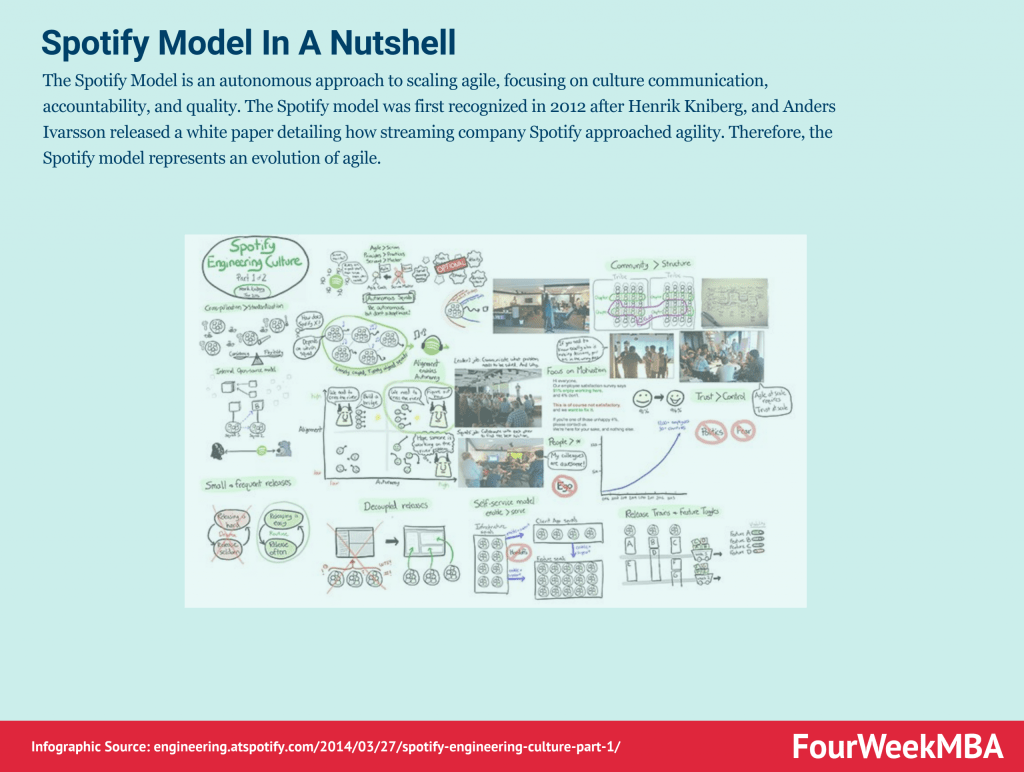
The Spotify Model is an autonomous approach to scaling agile, focusing on cultural communication, accountability, and quality. The Spotify model was first recognized in 2012 after Henrik Kniberg and Anders Ivarsson released a white paper detailing how streaming company Spotify approached agility. Therefore, the Spotify model represents an evolution of agile.
YouTube was acquired for almost $1.7 billion in 2006 by Google. It makes money through advertising and subscription revenues. YouTube advertising network is part of Google Ads, generating more than $28B in revenue by 2021. YouTube also makes money with its paid memberships and premium content.
TikTok is a creative Chinese social media platform driven by short-form video content enabling users to interact and generate content at scale. TikTok primarily makes money through advertising, generating $4.6 billion in advertising revenues in 2021, thus making it among the most popular attention-based business models or attention merchants.
Twitch started in 2007 as Justin.tv, broadcasting the life of Justin Kan, one of its co-founders, used to prove the concept of enabling anyone to broadcast their lives on the web. Once pivoted, Twitch quickly grew, and by 2014 it was acquired by Amazon for almost a billion dollars. Titch now makes money via subscriptions, bits, advertising, and merchandising.
Discord makes money in several ways, from its Discord Store, where users can buy premium games, to the seller shops, which primarily work with a 90/10 revenue share for developers and game sellers. And sellers can get more visibility on the platform by adding features to the game visibility.
Gennaro is the creator of FourWeekMBA, which reached about four million business people, comprising C-level executives, investors, analysts, product managers, and aspiring digital entrepreneurs in 2022 alone | He is also Director of Sales for a high-tech scaleup in the AI Industry | In 2012, Gennaro earned an International MBA with emphasis on Corporate Finance and Business Strategy.