Signal is a non-profit organization founded by Moxie Marlinspike and former WhatsApp co-founder Brian Acton. The organization runs a messaging app that is safe, secure, and private.
Signal revenue generation is dependent on donations and grants. To become a larger player among messaging apps, Signal has also relied on a zero-interest loan from Acton with a long repayment period.
Many Signal donors are undisclosed. However, some of the known donors include Open Technology Fund, Freedom of the Press Foundation, and Elon Musk.
Business Model Element
Analysis
Implications
Examples
Value Proposition
Signal’s value proposition revolves around ensuring private and secure communication for users. For Users, Signal offers: – End-to-End Encryption: Strong encryption ensures only the sender and recipient can access messages. – Privacy-Focused: No ads, trackers, or data sharing. – Open Source: Transparency in code for user trust. Signal prioritizes user privacy and security above all else. Attracts privacy-conscious individuals and organizations.
Provides users with a secure and private messaging platform. Ensures data remains inaccessible to third parties, including Signal itself. Builds trust through open-source code transparency. Attracts users seeking a privacy-focused messaging app. Upholds a commitment to user privacy and data security.
– End-to-End encryption guarantees message privacy. – No ads or trackers enhance user privacy. – Open-source code fosters trust and security. – Appeals to privacy-conscious individuals and organizations.
Customer Segments
Signal primarily targets the following customer segments: 1. Privacy-Conscious Individuals: Users seeking secure and private communication. 2. Activists and Journalists: Individuals requiring secure messaging for sensitive conversations. 3. Businesses and Organizations: Entities looking for confidential communication channels. Signal caters to users and organizations valuing data privacy and security.
Focuses on privacy-conscious individuals, activists, journalists, and organizations prioritizing data security. Tailors features to meet the specific needs of each segment. Provides a trusted platform for secure communication. Offers a versatile messaging solution for various user types.
– Targeting privacy-focused users builds a loyal user base. – Customized features cater to different user needs. – Trust fosters strong user relationships. – Versatility attracts diverse user types and organizations.
Distribution Strategy
Signal’s distribution strategy relies on app stores (Apple App Store, Google Play Store) and its website for users to download and install the app. It also benefits from word-of-mouth recommendations and media coverage highlighting its privacy features. Signal’s focus on user privacy aligns with its distribution strategy of not collecting user data.
Utilizes app stores and its website for user acquisition. Prioritizes user privacy by avoiding data collection. Grows organically through word-of-mouth recommendations and media attention. Ensures accessibility while maintaining a commitment to user data security.
– App stores provide easy access for users. – User privacy is prioritized by avoiding data collection. – Organic growth through word-of-mouth builds trust. – Maintains accessibility and security simultaneously.
Revenue Streams
Signal does not generate revenue through ads or user data monetization. Instead, it relies on donations and grants from supporters and organizations that value user privacy and secure communication. Signal operates as a non-profit organization, ensuring its focus remains on user privacy and security rather than profit.
Does not monetize user data or display ads, prioritizing user privacy. Sustains operations through donations and grants from privacy-conscious supporters and organizations. Maintains a non-profit status to underscore its commitment to user privacy.
– Non-profit status reinforces commitment to privacy. – Reliance on donations aligns with user interests. – Focuses on privacy rather than profit.
Marketing Strategy
Signal’s marketing strategy is based on user advocacy, media coverage, and grassroots promotion. It relies on word-of-mouth recommendations from satisfied users who value privacy. Media coverage highlighting its encryption and privacy features helps attract new users. Signal intentionally refrains from traditional advertising to maintain its privacy-first approach.
Leverages user advocacy and recommendations as a primary marketing tool. Benefits from media coverage that emphasizes its encryption and privacy features. Avoids traditional advertising to align with its privacy-first approach. Grows organically through satisfied users and media exposure.
– Word-of-mouth promotion builds a loyal user base. – Media coverage highlights privacy features. – Avoiding traditional advertising maintains privacy principles.
Organization Structure
Signal’s organizational structure includes teams dedicated to software development, security research, community support, and public relations. Software development teams focus on app improvement and security. Security research teams continuously enhance encryption protocols. Community support teams assist users with inquiries and issues. Public relations teams manage communications and media relations. This structure supports continuous improvement, user satisfaction, and transparent communication.
Employs specialized teams for software development, security research, community support, and public relations. Focuses on improving the app’s security and features through development and research teams. Addresses user inquiries and issues through community support teams. Manages communications and media relations through public relations teams. Ensures user satisfaction and transparent communication.
– Specialized teams drive software improvements and security. – Community support builds trust and addresses user needs. – Public relations manage transparent communication and media relations.
Competitive Advantage
Signal’s competitive advantage arises from its unwavering commitment to user privacy, end-to-end encryption, open-source transparency, and non-profit status. Unwavering Privacy Commitment: Prioritizes user privacy above all else. End-to-End Encryption: Offers robust encryption for secure messaging. Open-Source Transparency: Builds trust through code transparency. Non-Profit Status: Demonstrates commitment to privacy over profit.
Derives a competitive advantage from: – A steadfast focus on user privacy and data security. – Strong end-to-end encryption for secure communication. – Open-source code transparency that fosters trust. – Non-profit status that emphasizes privacy over profit. Sets itself apart in the messaging app space by providing a secure, private, and trustworthy platform.
– User privacy and data security are top priorities. – Encryption ensures secure communication. – Open-source code fosters transparency and trust. – Non-profit status underscores commitment to privacy.
Signal is an American non-profit organization with a focus on developing privacy technology enabling secure global communication and freedom of speech.
In a nutshell, Signal is an end-to-end encryption service that is owned and operated by a non-profit and not by a corporation. It is similar to WhatsApp and iMessage but with broader security protection.
Signal was founded by WhatsApp co-founder Brian Acton and Moxie Marlinspike. Marlinspike developed the platform in response to the pervasive and powerful surveillance capabilities of authorities, noting that “user-friendly technical solutions” would be the best way to counteract it.
In 2014, the Signal app was born. It was a combination of text messaging and phone call apps Marlinspike had developed four years earlier. During this time, however, Signal had a small user base made up of digital security geeks and was not user-friendly.
Marlinspike then reached out to Brian Acton, recently disgruntled after resigning from WhatsApp parent company Facebook in 2017. As a result, Acton provided $50 million in funding to encrypt the entire Signal app and support it as a direct rival to WhatsApp.
Signal has developed a large user base, thanks in part to chaotic world events. The app saw a 400% increase in users after the 2016 U.S. election. It also saw significant rises after protests against systemic racism in the United States and the Chinese occupation of Hong Kong.
The Textsecure Protocol was the precursor to Signal which Marlinspike built so that only the sender and recipient of a message could read its contents. The first apps based on this protocol were launched in 2010 with one intended for texting and the other for phone calls.
The Signal app was born in 2014 after the two apps Marlinspike developed four years earlier were merged. The platform was mostly kept afloat by a $3 million donation from the Open Technology Fund – a non-profit and supporter of projects that work to counter surveillance and censorship.
During this early time, Signal had a small user base comprised of digital security geeks and was not at all user-friendly.
Marlinspike meets Brian Acton
Seeking to influence Signal’s public perception, Marlinspike reached out to WhatsApp co-founder Brian Acton. Marlinspike, Acton, and fellow WhatsApp co-founder Jan Koum shared the same values around user privacy, and, after receiving Facebook’s permission, started to integrate Signal’s protocol into WhatsApp in 2016.
When Signal became a key part of encrypting billions of WhatsApp conversations each day, Marlinspike’s vision of an anti-surveillance internet became that much closer. But after Facebook forced WhatsApp users to make their data available if they wanted to use the app, the trio’s expectations had to be tempered somewhat. Acton was also concerned that Facebook was planning to monetize the platform with ads.
Dismayed at its direction, Acton walked away from WhatsApp and Facebook in 2017. He then teamed up once more with Marlinspike and provided $50 million to encrypt the Signal app and support it as a direct WhatsApp rival.
Growth
Acton’s capital had a profound and immediate impact on Signal’s growth. Funds were used to employ staff to make the app more user-friendly, with reaction emojis added (among other features) to appeal to younger generations of protesters.
Importantly, Acton’s investment in the company came without caveats. Unlike other investors and because of his previous experience at Facebook, he did not require Marlinspike to add trackers that could compromise user privacy.
As the number of users has increased, Signal has had to balance growth with user privacy. While the organization preaches security and non-intrusiveness, it has come under criticism for the way that a new user’s contacts receive a notification whenever they first download the app.
To some extent, Signal’s user base is also due to recent world events. The app saw a 400% increase in users after the 2016 U.S. election. It also saw significant rises after protests against systemic racism in the United States and the Chinese occupation of Hong Kong.
Value Proposition
Privacy-First Messaging: Signal prioritizes user privacy and security by implementing robust encryption protocols and privacy-enhancing features, ensuring that messages, calls, and media shared on the platform remain confidential and inaccessible to unauthorized parties, including hackers, governments, and third-party entities.
End-to-End Encryption: Signal employs end-to-end encryption for all communications, encrypting messages at the sender’s device and decrypting them only at the recipient’s device, preventing intermediaries, service providers, or eavesdroppers from intercepting or accessing the contents of the messages, thereby safeguarding user privacy and confidentiality.
Open Source: Signal is an open-source platform, allowing independent security researchers, developers, and privacy advocates to inspect, audit, and contribute to the source code, fostering transparency, community collaboration, and trust in the security and integrity of the platform, ensuring that potential vulnerabilities are promptly identified and addressed.
Cross-Platform Compatibility: Signal is available across multiple platforms and devices, including smartphones, tablets, desktop computers, and web browsers, enabling seamless communication and synchronization of messages, contacts, and settings across different devices, providing users with flexibility and convenience in their messaging experience.
Non-Profit Foundation: Signal operates as a non-profit organization, the Signal Technology Foundation, dedicated to advancing privacy-preserving technologies and promoting digital rights and civil liberties, ensuring that user interests and privacy rights are prioritized over profit motives or commercial interests, fostering trust and credibility among users.
Signal revenue generation
As a non-profit organization, Signal accepts donations through the tax-exempt Signal Technology Foundation. This helps the organization pay for the development of the app moving forward in addition to ongoing server, bandwidth, and staff costs. Donations can be made in cash or cryptocurrencies such as Bitcoin and Ether.
In December 2021, the company released a feature that enabled users to make in-app donations. Users can make monthly or one-off contributions using Google Pay or Apple Pay with payment information not associated with their Signal account. When shoppers purchase from smile.amazon.com, the eCommerce company will also donate 0.5% of the total amount to Signal.
The company expects to be self-sustaining from a financial point of view after it passes 100 million users. Until that time, the $50 million capital injection from Acton is the largest financial contribution to the company to date. Acton’s contribution has since grown to just over $100 million.
Many consider this a donation, but it is in fact a zero-interest loan that must be re-paid in full by February 2068.
Other donations
In keeping with the company philosophy, Signal does not disclose the identity of the majority of its other donors.
Having said there, here is a list of known Signal donors and donation amounts (if disclosed):
Shuttleworth Foundation.
Knight Foundation.
Open Technology Fund ($3 million).
Freedom of the Press Foundation – which operated crowdfunding efforts in the early days of Signal. Donations here are in the millions of dollars.
Elon Musk – who donated to Signal in 2020 and will reportedly do so again in 2021.
Marketing Strategy
Word-of-Mouth: Signal relies primarily on word-of-mouth marketing and viral growth driven by satisfied users who recommend the app to friends, family members, colleagues, and social networks, leveraging personal recommendations, endorsements, and referrals to expand its user base organically and sustainably.
Media Coverage: Signal garners media attention and press coverage through its advocacy for digital privacy, encryption technology, and civil liberties, participating in interviews, feature articles, opinion pieces, and news segments in mainstream media outlets, tech publications, and digital forums, raising awareness of its platform and mission among broader audiences.
Social Media Engagement: Signal maintains an active presence on social media platforms, including Twitter, Facebook, Instagram, and Reddit, where it shares updates, announcements, security advisories, and educational content related to privacy, security, and digital rights, engaging with users, addressing inquiries, and fostering community participation and feedback.
Educational Outreach: Signal conducts educational outreach and awareness campaigns on digital privacy, encryption, and cybersecurity topics, hosting webinars, workshops, seminars, and online tutorials to empower users with knowledge, skills, and best practices for safeguarding their personal information, digital communications, and online privacy.
Partnerships and Collaborations: Signal collaborates with privacy advocacy groups, non-profit organizations, academic institutions, and industry partners aligned with its mission and values, forming alliances, coalitions, and partnerships to amplify its message, advocate for policy reforms, and advance the adoption of privacy-preserving technologies and practices globally.
Distribution Channels
App Stores: Signal distributes its mobile app through official app stores, including the Apple App Store for iOS devices and the Google Play Store for Android devices, providing a secure and trusted channel for users to download and install the app on their smartphones and tablets, ensuring broad accessibility and compatibility across different platforms.
Website: Signal offers direct downloads of its app installation packages (APK files) through its official website, allowing users to install the app on their Android devices manually or sideload it from third-party sources, providing an alternative distribution channel for users who prefer to download apps outside of official app stores.
Desktop Applications: Signal provides desktop applications for Windows, macOS, and Linux operating systems, available for download directly from its website or through third-party software repositories and package managers, enabling users to use Signal’s messaging platform on their desktop or laptop computers, enhancing accessibility and usability.
Web Client: Signal offers a web-based client that allows users to access their Signal accounts and send/receive messages through a web browser interface, without the need for installing desktop applications or mobile apps, providing additional flexibility and convenience for users who prefer to use Signal on their computers or workstations.
Community Distribution: Signal benefits from community-driven distribution efforts, with privacy-conscious users, developers, and enthusiasts advocating for the platform and sharing installation instructions, download links, and app recommendations through online forums, social media groups, and digital communities, contributing to the platform’s adoption and growth.
Key Highlights
Origin and Founders:
Signal is a non-profit organization focusing on secure global communication and freedom of speech.
Co-founded by Moxie Marlinspike and former WhatsApp co-founder Brian Acton.
Signal offers a messaging app with a strong emphasis on privacy and security.
Growth and User Base:
Signal was developed to counter powerful surveillance capabilities by offering user-friendly privacy solutions.
Founded in 2014, it initially had a small user base of digital security enthusiasts.
Brian Acton provided $50 million to enhance Signal’s encryption and compete directly with WhatsApp.
Signal experienced significant user growth during world events like the 2016 U.S. election and protests against racism and Chinese occupation of Hong Kong.
As of 2021, Signal had an estimated 20 million users.
The Textsecure Protocol and Marlinspike’s Vision:
The precursor to Signal was the Textsecure Protocol, enabling end-to-end encrypted messaging and calls.
Marlinspike’s vision was to create a privacy-focused alternative to mainstream messaging platforms.
Meeting of Minds: Marlinspike and Acton:
Marlinspike approached Brian Acton, a co-founder of WhatsApp, to integrate Signal’s protocol into WhatsApp in 2016.
Acton’s $50 million investment transformed Signal’s growth and user experience.
Acton’s investment was without strings and aimed to uphold user privacy.
Balancing Growth and Privacy:
Acton’s investment enabled Signal to enhance user-friendliness and add features like reaction emojis.
Signal faced criticism for sending notifications to a user’s contacts when they join the app.
Despite challenges, Signal’s user base grew to an estimated 40 million monthly active users in early 2023.
Revenue Generation:
Signal relies on donations and grants for revenue.
Accepts donations through the tax-exempt Signal Technology Foundation in cash or cryptocurrencies like Bitcoin and Ether.
Introduced in-app donations and partnerships for fundraising, like Amazon’s donation scheme.
Aiming to become self-sustaining after reaching 100 million users.
Brian Acton’s $50 million investment is a zero-interest loan repayable by February 2068.
Many donors remain undisclosed, including known supporters like the Shuttleworth Foundation, Knight Foundation, Open Technology Fund, Freedom of the Press Foundation, and Elon Musk.
In an asymmetric businessmodel, the organization doesn’t monetize the user directly. Still, it leverages the data users provide and technology, thus having a key customer pay to sustain the core asset. For example, Google makes money by leveraging users’ data and its algorithms sold to advertisers for visibility. This is how attention merchants make monetize their business models.
In an asymmetric businessmodel, the organization doesn’t monetize the user directly. Still, it leverages the data users provide and technology, thus having a key customer pay to sustain the core asset. For example, Google makes money by leveraging users’ data and its algorithms sold to advertisers for visibility.
Facebook, rebranded as Meta in 2021, is primarily owned by Mark Zuckerberg, founder and CEO. Zuckerberg keeps tight control over the ownership and decision-making of the company. Other large individual shareholders comprise former COO Sheryl Sandberg and co-founder Eduardo Saverin. Large institutional investors include BlackRock, Vanguard, and Fidelity.
Facebook, the main product of Meta is an attention merchant. As such, its algorithms condense the attention of over 2.91 billion monthly active users as of June 2021. Meta generated $117.9 billion in revenues, in 2021, of which $114.9 billion from advertising (97.4% of the total revenues) and over $2.2 billion from Reality Labs (the augmented and virtual reality products arm).
ARPU, or average revenue per user, is a key metric for attention merchants like Facebook. It assesses the ability of the platform to monetize its users. For instance, by the end of 2022, Meta’s ARPU worldwide was $10.86. While in US & Canada, it was $58.77; in Europe, it was $17.29; in Asia, $4.61 and in the rest of the world, it was $3.52.
The ARPU, or average revenue per user, is a key metric to track the success of Facebook – now Meta – family of products. For instance, by the end of 2022, Meta’s ARPU worldwide was $10.86. While in US & Canada, it was $58.77; in Europe, it was $17.29; in Asia, $4.61 and in the rest of the world, it was $3.52.
As of September 2022, Facebook, rebranded as Meta, is a profitable company, generating $18.54B in net profits. Yet, if we look at its Reality Labs segment, which is in charge of building the Metaverse, it recorded a net loss of $9.44 billion in the first nine months of 2022.
Facebook is characterized by a multi-faceted matrix organizational structure. The company utilizes a flat organizational structure in combination with corporate function-based teams and product-based or geographic divisions. The flat organization structure is organized around the leadership of Mark Zuckerberg, and the key executives around him. On the other hand, the function-based teams based on the main corporate functions (like HR, productmanagement, investor relations, and so on).
Instagram makes money via visual advertising. Acquired by Facebook for a billion-dollar in 2012, today, Instagram is integrated into the overall Facebook (now rebranded as Meta) business strategy. In 2018, Instagram founders Kevin Systrom and Mike Krieger left the company as Facebook pushed toward tighter integration of the two platforms. In 2022, Instagram is the most successful product still, in Meta’s portfolio.
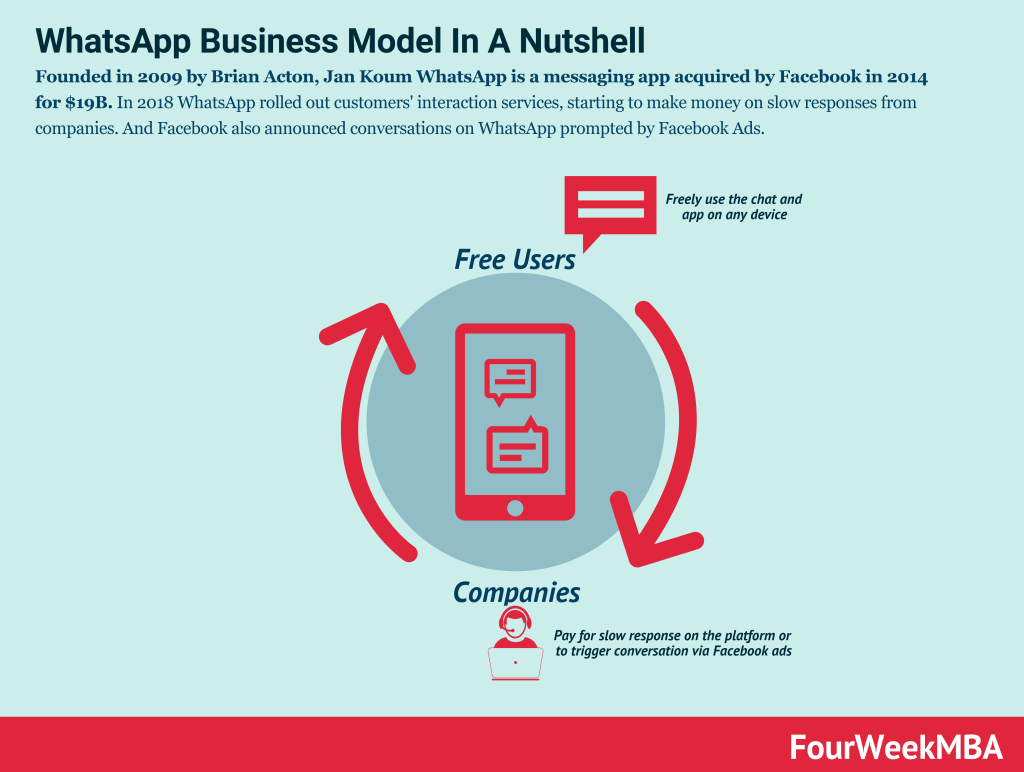
Founded in 2009 by Brian Acton, Jan Koum WhatsApp is a messaging app acquired by Facebook in 2014 for $19B. In 2018 WhatsApp rolled out customers’ interaction services, starting to make money on slow responses from companies. And Facebook also announced conversations on WhatsApp prompted by Facebook Ads.
Gennaro is the creator of FourWeekMBA, which reached about four million business people, comprising C-level executives, investors, analysts, product managers, and aspiring digital entrepreneurs in 2022 alone | He is also Director of Sales for a high-tech scaleup in the AI Industry | In 2012, Gennaro earned an International MBA with emphasis on Corporate Finance and Business Strategy.