Business development comprises a set of strategies and actions to grow a business via a mixture of sales, marketing, and distribution. While marketing usually relies on automation to reach a wider audience, and sales typically leverage a one-to-one approach. The business development’s role is that of generating distribution.
The more you move from consumers to enterprise clients, the more you’ll need a sales force able to manage complex sales. As a rule of thumb, a more expensive product, in B2B or Enterprise, will require an organizational structure around sales. An inexpensive product to be offered to consumers will leverage on marketing.
An effective business model has to focus on two dimensions: the people dimension and the financial dimension. The people dimension will allow you to build a product or service that is 10X better than existing ones and a solid brand. The financial dimension will help you develop proper distribution channels by identifying the people that are willing to pay for your product or service and make it financially sustainable in the long run.
A tech business model is made of four main components: value model (value propositions, mission, vision), technological model (R&D management), distribution model (sales and marketingorganizational structure), and financial model (revenue modeling, cost structure, profitability and cash generation/management). Those elements coming together can serve as the basis to build a solid tech business model.
Digital transformation enables existing businesses to leverage digital technologies for business model innovation. The process of digital transformation is not just about new distribution channels. It starts by better serving key customers, and it completes by developing a new business mindset required to succeed in the digital era.
Business storytelling is a critical part of developing a business model. Indeed, the way you frame the story of your organization will influence its brand in the long-term. That’s because your brand story is tied to your brand identity, and it enables people to identify with a company.
The 3C Analysis Business Model was developed by Japanese business strategist Kenichi Ohmae. The 3C Model is a marketing tool that focuses on customers, competitors, and the company. At the intersection of these three variables lies an effective marketingstrategy to gain a potential competitive advantage and build a lasting company.
The GE McKinsey Matrix was developed in the 1970s after General Electric asked its consultant McKinsey to develop a portfolio management model. This matrix is a strategy tool that provides guidance on how a corporation should prioritize its investments among its business units, leading to three possible scenarios: invest, protect, harvest, and divest.
The McKinsey 7-S Model was developed in the late 1970s by Robert Waterman and Thomas Peters, who were consultants at McKinsey & Company. Waterman and Peters created seven key internal elements that inform a business of how well positioned it is to achieve its goals, based on three hard elements and four soft elements.
AIDA stands for attention, interest, desire, and action. That is a model that is used in marketing to describe the potential journey a customer might go through before purchasing a product or service. The AIDA model helps organizations focus their efforts when optimizing their marketing activities based on the customers’ journeys.
Venture capitalist, Dave McClure, coined the acronym AARRR which is a simplified model that enables to understand what metrics and channels to look at, at each stage for the users’ path toward becoming customers and referrers of a brand.
The freemium – unless the whole organization is aligned around it – is a growth strategy rather than a business model. A free service is provided to a majority of users, while a small percentage of those users convert into paying customers through the sales funnel. Free users will help spread the brand through word of mouth.
A freeterprise is a combination of free and enterprise where free professional accounts are driven into the funnel through the free product. As the opportunity is identified the company assigns the free account to a salesperson within the organization (inside sales or fields sales) to convert that into a B2B/enterprise account.
A go-to-market strategy represents how companies market their new products to reach target customers in a scalable and repeatable way. It starts with how new products/services get developed to how these organizations target potential customers (via sales and marketing models) to enable their value proposition to be delivered to create a competitive advantage.
Customer segmentation is a marketing method that divides the customers in sub-groups, that share similar characteristics. Thus, product, marketing and engineering teams can center the strategy from go-to-market to product development and communication around each sub-group. Customer segments can be broken down is several ways, such as demographics, geography, psychographics and more.
Psychographic segmentation is a form of market segmentation, that looks at consumers into sub-groups that share specific psychological characterizes, that comprise activities, interests, and opinions of customers. The rise of data-driven marketing enabled psychographic segmentation to become a key element of digital marketing activities to personalize those campaigns and reach a micro-audience.
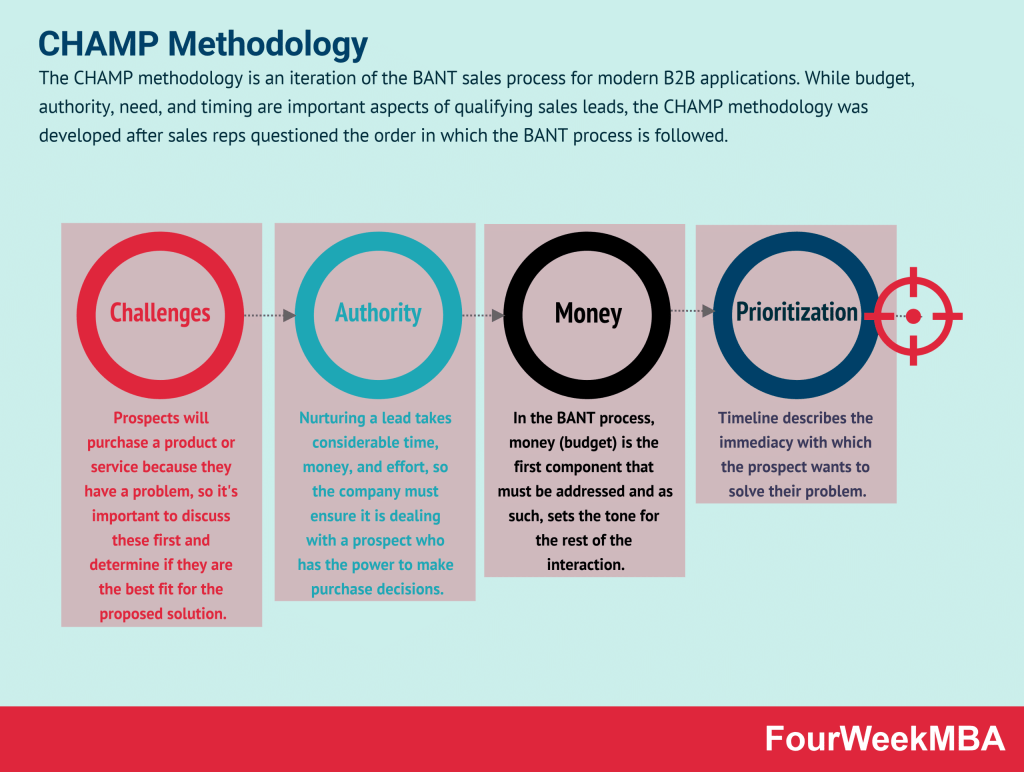
The CHAMP methodology is an iteration of the BANT sales process for modern B2B applications. While budget, authority, need, and timing are important aspects of qualifying sales leads, the CHAMP methodology was developed after sales reps questioned the order in which the BANT process is followed.
The BANT process was conceived at IBM in the 1950s as a way to quickly identify prospects most likely to make a purchase. Despite its introduction around 70 years ago, the BANT process remains relevant today and was formally adopted into IBM’s Business Agility Solution Identification Guide.
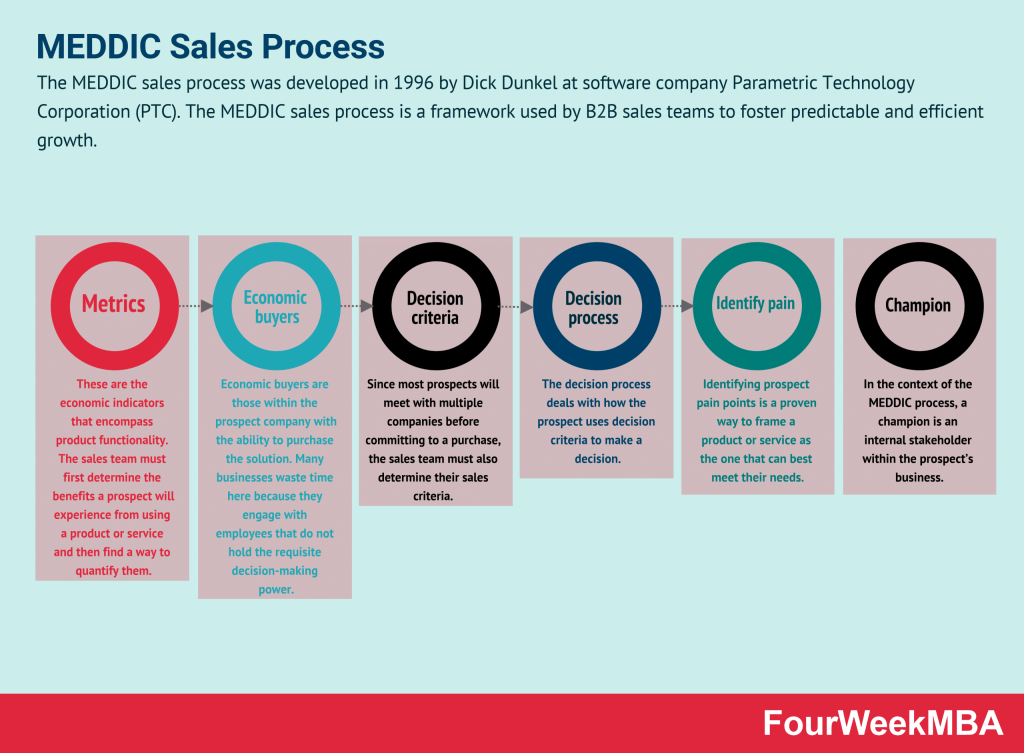
The MEDDIC sales process was developed in 1996 by Dick Dunkel at software company Parametric Technology Corporation (PTC). The MEDDIC sales process is a framework used by B2B sales teams to foster predictable and efficient growth.
Highlights
Concept
Description
When to Use
Advantages
Drawbacks
Business Development
Strategies and actions to grow a business through sales, marketing, and distribution.
When seeking growth and expansion, developing distribution channels, and entering new markets.
Facilitates business growth.
May require resource allocation and planning.
Marketing vs. Sales
Different approaches: marketing for wider audience reach, sales for complex B2B or high-cost products.
When deciding the appropriate approach for selling products or services based on target audience.
Matches approach to product/service type.
Oversimplifies complexities of some markets.
Business Model Framework
Focuses on two dimensions: people (product, brand) and financial (revenue, sustainability) aspects of a business model.
When designing or assessing a business model to ensure it aligns with customer needs and is sustainable.
Balances product and financial considerations.
Requires understanding of both dimensions.
Tech Business Model Template
Comprises four components: value model, technological model, distribution model, and financial model for tech businesses.
When developing a business model for a tech-oriented company and aligning technological and financial aspects.
Addresses key dimensions for tech businesses.
Requires in-depth tech and financial knowledge.
Digital Transformation
Leveraging digital technologies for business model innovation, focusing on better serving key customers and adapting to the digital era.
When transforming an existing business to be more digitally oriented and customer-focused.
Enhances adaptability and customer service.
May involve significant organizational change.
Business Storytelling
Framing the story of an organization to influence its brand identity and enable people to identify with the company.
When developing a brand narrative and communicating the values and mission of the organization.
Creates a strong brand identity.
Requires effective storytelling skills.
3C Analysis Business Model
A marketing tool focusing on customers, competitors, and the company to develop effective marketing strategies.
When crafting marketing strategies to gain a competitive advantage by considering these three variables.
Informs marketing strategy effectively.
May not address external market dynamics.
GE McKinsey Matrix
A portfolio management tool to prioritize investments among business units, categorizing them as invest, protect, harvest, or divest.
When making investment decisions for different business units and assessing their contributions.
Guides resource allocation effectively.
Complexity in implementation and decision-making.
McKinsey 7-S Model
Considers seven internal elements (hard and soft) to assess an organization’s alignment with its goals and overall position.
When evaluating organizational effectiveness and alignment with strategic objectives.
Offers a comprehensive organizational view.
May require substantial data collection.
AIDA Model
Attention, Interest, Desire, Action model describes the customer journey stages to optimize marketing activities.
When optimizing marketing strategies and campaigns by aligning them with customers’ journey stages.
Focuses on key customer journey stages.
Simplifies complex customer behaviors.
Pirate Metrics
AARRR model simplifies metrics and channels at each stage of the user’s path to becoming a customer and brand referrer.
When tracking user conversion and engagement at different stages of the customer journey.
Provides a clear focus on user conversion.
May not cover all nuances of user behavior.
Freemium Business Model
Offers a free service to most users while converting a small percentage into paying customers, primarily a growth strategy.
When aiming to acquire users through a free product and convert them into paying customers.
Attracts a large user base for conversion.
Monetization depends on conversion success.
Freeterprise
Combines free and enterprise approaches, converting free users into enterprise customers through sales efforts.
When transitioning free users to enterprise-level services and aligning sales with conversion efforts.
Targets both free and enterprise customers.
Complexity in managing the transition process.
Go-To-Market Strategy
Defines how new products/services are developed, marketed, and delivered to target customers to gain a competitive advantage.
When launching new products or services and creating a strategic plan for reaching target customers.
Enables effective product introduction.
Requires thorough market analysis and planning.
Customer Segmentation
Divides customers into sub-groups with shared characteristics, enabling tailored marketing and product development strategies.
When personalizing marketing, product development, and communication strategies based on customer groups.
Enhances targeting and customization.
Requires accurate customer data and analysis.
Psychographic Segmentation
Focuses on psychological characteristics, such as activities and opinions, to create customer sub-groups for personalized marketing.
When seeking to personalize marketing campaigns and target customers based on psychological traits.
Tailors marketing to specific psychological traits.
Data collection and analysis can be complex.
CHAMP Methodology
An iteration of the BANT sales process for modern B2B applications, addressing challenges, authority, money, and prioritization.
When qualifying B2B sales leads and adapting the sales process to modern B2B sales dynamics.
Addresses key aspects of B2B sales leads.
May not cover all nuances of buyer behavior.
BANT Sales Process
A sales process focusing on Budget, Authority, Need, and Timing to identify prospects likely to make a purchase.
When identifying and qualifying potential customers based on specific criteria.
Simplifies lead qualification process.
May not consider all buyer readiness factors.
MEDDIC Sales Process
A B2B sales framework emphasizing metrics for predictable and efficient growth, used to improve lead qualification.
When aiming for predictable B2B sales growth and improving lead qualification processes.
What are the key components of 19 Business Development Frameworks For Business Traction?
The key components of 19 Business Development Frameworks For Business Traction include Business Development, Marketing vs. Sales, Business Model Framework, Tech Business Model Template, Digital Transformation. Business Development: Strategies and actions to grow a business through sales, marketing, and distribution.
Gennaro is the creator of FourWeekMBA, which reached about four million business people, comprising C-level executives, investors, analysts, product managers, and aspiring digital entrepreneurs in 2022 alone | He is also Director of Sales for a high-tech scaleup in the AI Industry | In 2012, Gennaro earned an International MBA with emphasis on Corporate Finance and Business Strategy.
Scroll to Top
Discover more from FourWeekMBA
Subscribe now to keep reading and get access to the full archive.