AWS competitors include Microsoft Azure, Google Cloud Platform, and IBM Cloud in the public cloud space. Microsoft Azure, Google Anthos, and IBM Cloud Satellite provide solutions in the hybrid cloud sector. For infrastructure, Microsoft Azure, Google Compute Engine, and IBM Cloud Virtual Servers are prominent. Platform offerings include Microsoft Azure, Google App Engine, and IBM Cloud Foundry. In the SaaS realm, Microsoft 365, Google Workspace, and Salesforce stand out.
Microsoft’s cloud computing platform offering a wide range of cloud services, including infrastructure, AI, analytics, and developer tools. Azure competes directly with AWS in the cloud computing market.
Azure provides cloud services, infrastructure, and developer tools, competing directly with AWS in the cloud computing and enterprise solutions space.
Both compete in the cloud computing market, offering a comprehensive suite of cloud services, but with differences in ecosystem, integration, and technology stacks.
Azure’s integration with Microsoft products and services.
Google Cloud Platform (GCP)
Google’s cloud computing platform known for its data analytics, machine learning, and container orchestration services. GCP competes with AWS in the cloud computing and AI/ML markets.
GCP offers cloud services, data analytics, and machine learning, often overlapping with AWS in the cloud and AI/ML segments.
Both compete in the cloud computing market, focusing on data analytics and AI/ML services, but with different strengths in data management and machine learning.
GCP’s expertise in data analytics and machine learning.
IBM Cloud
IBM’s cloud computing platform providing hybrid cloud, AI, and enterprise solutions. IBM Cloud competes with AWS in the enterprise cloud and hybrid cloud market.
IBM Cloud offers hybrid cloud solutions, AI capabilities, and enterprise services, often competing with AWS in the enterprise and hybrid cloud segments.
Both compete in the enterprise cloud and hybrid cloud market, targeting large enterprises, but with differences in hybrid cloud solutions and AI offerings.
IBM Cloud’s focus on hybrid cloud and enterprise services.
Oracle Cloud
Oracle’s cloud computing platform specializing in database, applications, and enterprise cloud solutions. Oracle Cloud competes with AWS in the enterprise cloud and database markets.
Oracle Cloud offers database services, enterprise applications, and cloud solutions, often overlapping with AWS in the enterprise and database segments.
Both compete in the enterprise cloud and database market, targeting businesses and enterprises, but with differences in database technology and enterprise applications.
Oracle Cloud’s expertise in databases and enterprise applications.
Alibaba Cloud
Alibaba Group’s cloud computing and AI platform known for its strong presence in Asia and a wide range of cloud services. Alibaba Cloud competes with AWS in the cloud computing and Asia-Pacific markets.
Alibaba Cloud provides cloud services, AI capabilities, and a strong Asia-Pacific presence, often competing with AWS in the cloud and AI/ML segments.
Both compete in the cloud computing market, with Alibaba Cloud’s focus on the Asia-Pacific region and expertise in serving businesses in that area.
Alibaba Cloud’s Asia-Pacific presence and localization.
Salesforce
A leading customer relationship management (CRM) platform offering cloud-based solutions for sales, service, marketing, and more. Salesforce competes with AWS in the CRM and cloud applications market.
Salesforce provides cloud-based CRM and business applications, often overlapping with AWS in the cloud and business applications segments.
Both compete in the cloud applications and CRM market, with Salesforce specializing in customer relationship management and business solutions.
Salesforce’s CRM and cloud-based business applications.
SAP
A multinational software corporation specializing in enterprise software solutions, including ERP, CRM, and analytics. SAP competes with AWS in the enterprise software and cloud applications market.
SAP offers enterprise software solutions, cloud applications, and analytics, often overlapping with AWS in the enterprise and cloud applications segments.
Both compete in the enterprise software and cloud applications market, targeting businesses with a focus on ERP, CRM, and analytics solutions.
SAP’s enterprise software and business analytics expertise.
Rackspace Technology
A managed cloud service provider offering cloud management, hosting, and consulting services across various cloud platforms, including AWS. Rackspace competes with AWS in the managed cloud services market.
Rackspace offers managed cloud services, hosting, and consulting for various cloud platforms, including AWS, often serving as a partner and competitor.
Both compete in the managed cloud services market, offering cloud management and hosting services, but with Rackspace specializing in managed services across multiple cloud platforms.
Rackspace’s managed services and multi-cloud expertise.
VMware
A virtualization and cloud infrastructure company providing solutions for hybrid and multi-cloud environments. VMware competes with AWS in the hybrid cloud and virtualization market.
VMware offers virtualization, cloud management, and hybrid cloud solutions, often overlapping with AWS in the hybrid cloud and virtualization segments.
Both compete in the hybrid cloud and virtualization market, focusing on enabling businesses to operate in hybrid and multi-cloud environments.
VMware’s virtualization and hybrid cloud expertise.
NVIDIA
A technology company known for its GPUs and AI hardware, software, and solutions. NVIDIA competes with AWS in the AI/ML and GPU acceleration market.
NVIDIA provides GPUs, AI hardware, and software solutions, often overlapping with AWS in the AI/ML and GPU acceleration segments.
Both compete in the AI/ML and GPU acceleration market, targeting businesses with AI-powered solutions and GPU acceleration capabilities.
NVIDIA’s AI hardware and software offerings.
Public Cloud Providers:
Microsoft Azure: Microsoft’s cloud computing platform, offering a wide range of services and solutions.
Google Cloud Platform: Google’s suite of cloud computing services for infrastructure, storage, and data analytics.
IBM Cloud: IBM’s cloud computing platform, providing infrastructure, AI, and data analytics services.
Hybrid Cloud Providers:
Microsoft Azure: Microsoft’s cloud computing platform, offering hybrid cloud capabilities.
Google Cloud Anthos: Google’s hybrid and multi-cloud platform, enabling workload portability.
IBM Cloud Satellite: IBM’s hybrid cloud platform, extending cloud services to on-premises environments.
Infrastructure as a Service (IaaS) Providers:
Microsoft Azure: Microsoft’s cloud computing platform, providing IaaS capabilities.
Google Compute Engine: Google’s infrastructure as a service offering for virtual machine instances.
IBM Cloud Virtual Servers: IBM’s virtual server instances for scalable compute resources.
Platform as a Service (PaaS) Providers:
Microsoft Azure: Microsoft’s cloud computing platform, providing PaaS capabilities.
Google App Engine: Google’s platform as a service for building and deploying applications.
IBM Cloud Foundry: IBM’s open-source platform as a service for cloud-native applications.
Software as a Service (SaaS) Providers:
Microsoft 365: Microsoft’s suite of cloud-based productivity and collaboration tools.
Google Workspace: Google’s cloud-based productivity and collaboration suite.
Salesforce: A leading cloud-based CRM and enterprise software provider.
Key Highlights:
Public Cloud Providers Competition: AWS faces competition from Microsoft Azure, Google Cloud Platform, and IBM Cloud in the public cloud sector. These providers offer a wide range of cloud services for businesses and developers.
Hybrid Cloud Solutions Rivals: In the hybrid cloud space, Microsoft Azure, Google Anthos, and IBM Cloud Satellite are competitors, offering solutions that bridge on-premises and cloud environments.
Infrastructure and Platform Offerings Challengers: Competitors in the infrastructure and platform sectors include Microsoft Azure, Google Compute Engine, Google App Engine, IBM Cloud Virtual Servers, and IBM Cloud Foundry. These platforms provide various levels of compute resources and development capabilities.
Software as a Service (SaaS) Alternatives: Microsoft 365, Google Workspace, and Salesforce are prominent competitors in the SaaS realm, offering cloud-based productivity and collaboration tools as well as CRM solutions.
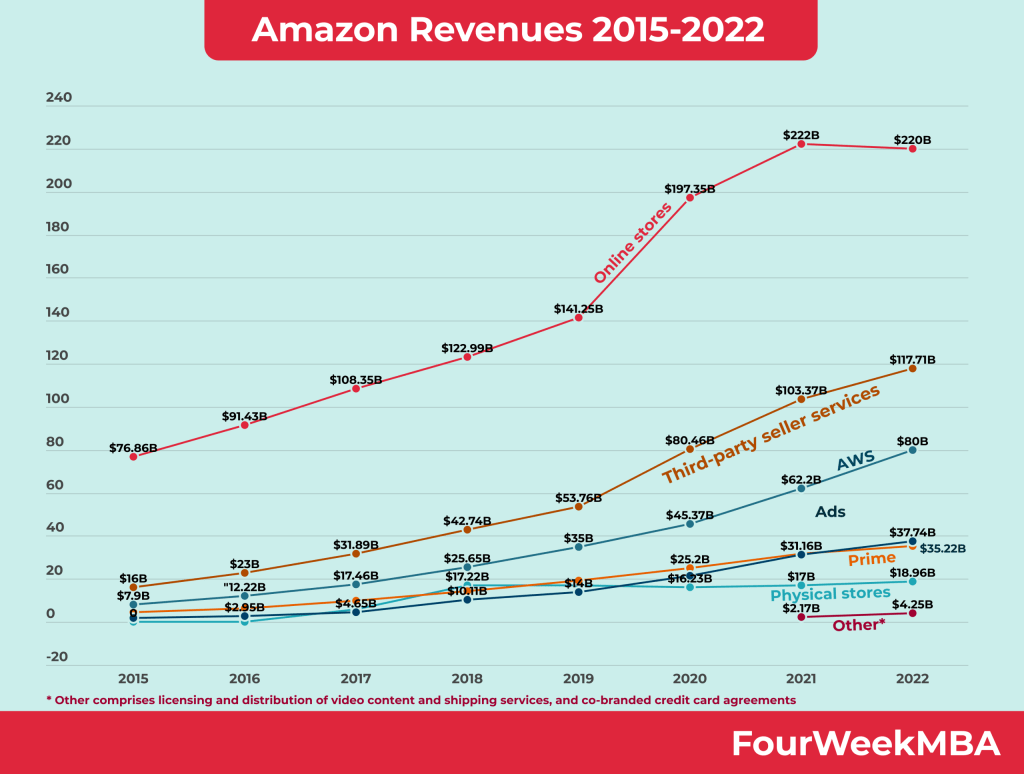
Amazon has a diversified business model. In 2022 Amazon posted over $514 billion in revenues, while it posted a net loss of over $2.7 billion. Online stores contributed almost 43% of Amazon revenues. The remaining was generated by Third-party Seller Services, and Physical Stores. While Amazon AWS, Subscription Services, and Advertising revenues play a significant role within Amazon as fast-growing segments.
In 2022, most of Amazon’s revenue came from the US, with over $356 billion in revenue, followed by Germany with $33.6 billion, the UK with $30 billion, Japan with $24.4 billion, and the rest of the world generated almost $70 billion in net sales.
Both the North American and International segment of Amazon are running at negative margins. Indeed, in 2022, for the North American segments, of almost $316 billion in revenue, Amazon spent almost $319 billion in operating costs to run it, thus it generated $2 billion in operating losses in 2022.
For its International segment, of $118 billion in revenue, Amazon spent almost $126 billion to operate it. Thus, it reported a $7.7 billion operating loss.
While for AWS, with $80 billion in revenue, Amazon spent $57 billion to operate it, thus generating almost $23 billion in operating income.
The high operating costs are primarily due to the high cost of running Amazon’s inventory and fulfillment infrastructure behind its e-commerce operations. Indeed, Amazon is as much as a physical player as a digital one.
Amazon was not profitable once AWS was removed in 2022. In fact, Amazon, without AWS generated $10.6 billion in operating losses. While Amazon, without AWS, generated $12.2. billion operating income.
Amazon is subdivided into three operating profit segments: North America, International, and AWS. Amazon AWS is the most profitable segment, with almost $23 billion in operating profit in 2022. While Both the North American and International segments run at negative operating losses, with $2 billion and $7.74 billion in operating losses, respectively, in 2022.
In 2021, Amazon generated almost $470 billion in revenue, vs. eBay’s over $10.4 billion. In comparison, looking at revenues, Amazon was 45x times larger than eBay.
Amazon’s mission statement is to “serve consumers through online and physical stores and focus on selection, price, and convenience.” Amazon’s vision statement is “to be Earth’s most customer-centric company, where customers can find and discover anything they might want to buy online, and endeavors to offer its customers the lowest possible prices.”
In the Amazon Shareholders’ Letter for 2018, Jeff Bezos analyzed the Amazon business model, and it also focused on a few key lessons that Amazon as a company has learned over the years. These lessons are fundamental for any entrepreneur, of small or large organization to understand the pitfalls to avoid to run a successful company!
Amazon has a business model with many moving parts. The e-commerce platform generated $220 billion in 2022, followed by third-party stores services which generated over $117 billion; Amazon AWS, which generated over $80 billion; Amazon advertising which generated almost $38 billion and Amazon Prime, which generated over $35 billion, and physical stores which generated almost $19 billion.
The Amazon Working Backwards Method is a product development methodology that advocates building a product based on customer needs. The Amazon Working Backwards Method gained traction after notable Amazon employee Ian McAllister shared the company’s product development approach on Quora. McAllister noted that the method seeks “to work backwards from the customer, rather than starting with an idea for a product and trying to bolt customers onto it.”
The Amazon Flywheel or Amazon Virtuous Cycle is a strategy that leverages on customer experience to drive traffic to the platform and third-party sellers. That improves the selections of goods, and Amazon further improves its cost structure so it can decrease prices which spins the flywheel.
In the letter to shareholders in 2016, Jeff Bezos addressed a topic he had been thinking quite profoundly in the last decades as he led Amazon: Day 1. As Jeff Bezos put it “Day 2 is stasis. Followed by irrelevance. Followed by excruciating, painful decline. Followed by death. And that is why it is always Day 1.”
Gennaro is the creator of FourWeekMBA, which reached about four million business people, comprising C-level executives, investors, analysts, product managers, and aspiring digital entrepreneurs in 2022 alone | He is also Director of Sales for a high-tech scaleup in the AI Industry | In 2012, Gennaro earned an International MBA with emphasis on Corporate Finance and Business Strategy.