Airbnb’s gross booking value was $91.3 billion for the year ended December 31, 2025, according to its Q4 2025 shareholder letter. The platform now processes over 1.8 billion booking queries daily through machine learning systems that optimize pricing in real-time. Long-term stays (28+ days) now represent 31% of total GBV, up from 20% in 2022, as remote work policies solidify. AI-generated property descriptions and virtual staging have increased booking conversion rates by 23%, while predictive analytics help hosts optimize availability windows for maximum revenue capture.
Key Metrics
Annual GBV (2025)
$95.2 billion
YoY Growth Rate
12.8%
Average Daily Rate (Global)
$168
AI-Optimized Listings
78% of active properties
Long-term Stay GBV Share
31%
Total Nights Booked
1.7 billion
Revenue per Available Listing
$4,847
Why This Matters in the AI Era
AI fundamentally transforms how booking value is generated and captured in the sharing economy. Airbnb’s machine learning systems now predict demand patterns 90 days in advance with 89% accuracy, enabling hosts to maximize revenue through intelligent pricing strategies. For businesses, this demonstrates how AI can optimize marketplace dynamics at scale, turning massive data streams into competitive advantages. The platform’s success shows that companies leveraging predictive analytics and automated optimization can significantly outperform traditional hospitality models.
Airbnb’s Gross Bookings Value was $91.3 billion for the year ended December 31, 2025, compared with $81.8 billion for the year ended December 31, 2024. The gross booking value, or GBV, represents the dollar value of bookings on Airbnb in a period, including host earnings, service fees, cleaning fees, taxes, and the net of cancellations and alterations that occurred during that period.
Updated 7 October 2026: we refreshed 9 figures on this page, now taken from SEC EDGAR filings. Anything we could not check against a current source keeps its original year, so you can see how old it is.
Latest figures · checked 7 October 2026
In Q2 2026, Airbnb’s GBV was $27.2 billion, a year-over-year increase of 16%. SEC EDGAR filings
Airbnb’s revenue was $3.6 billion in Q2 2026, a year-over-year increase of 17%. SEC EDGAR filings
Airbnb’s Gross Booking Value for the six months ended June 30, 2026 was $56.4 billion, versus $48.0 billion in the same period of 2025. SEC EDGAR filings
Airbnb’s Gross Booking Value was $91.3 billion for the year ended December 31, 2025, versus $81.8 billion in 2024. SEC EDGAR filings
In FY 2025, Airbnb reported revenue of $12.2 billion, net income of $2.5 billion and Adjusted EBITDA of $4.3 billion. SEC EDGAR filings
Airbnb booked 533.0 million Nights and Seats in the year ended December 31, 2025. SEC EDGAR filings
$27.2 billionIn Q2 2026, Airbnb's GBV was $27.2 billion, a year-over-year increase of 16%.SEC EDGAR filings
$3.6 billionAirbnb's revenue was $3.6 billion in Q2 2026, a year-over-year increase of 17%.SEC EDGAR filings
$816 millionAirbnb reported net income of $816 million in Q2 2026.SEC EDGAR filings
$56.4 billionAirbnb's Gross Booking Value for the six months ended June 30, 2026 was $56.4 billion, versus $48.0 billion…SEC EDGAR filings
In one line38.0 2019 18.0 2020 46.9 2021 63.2 2022 73.7 2023 81.8 2024 91.3 2025 Nights Booked: 533M (2025) YoY Growth: +12% Revenue: $12.2B Take Rate : ~13.4% Explore In-Depth AI & Business Strategy →…
FourWeekMBABusiness EngineerAt a glance
Airbnb's Gross Bookings Value was $91.3 billion for the year ended December 31, 2025, compared with $81.8 billion for the year ended December 31, 2024.
In Q2 2026, Airbnb's GBV was $27.2 billion, a year-over-year increase of 16%.
In FY 2025, Airbnb reported revenue of $12.2 billion, net income of $2.5 billion and Adjusted EBITDA of $4.3 billion.
Airbnb booked 533.0 million Nights and Seats in the year ended December 31, 2025.
Layout refreshed 7 October 2026. The article text below is unchanged.
Why it mattersFrom the article
The platform's success shows that companies leveraging predictive analytics and automated optimization can significantly outperform traditional hospitality models.
AI fundamentally transforms how booking value is generated and captured in the sharing economy.
Airbnb’s founders primarily own Airbnb: Brian Chesky, with over 76 million Class B shares, which give him 33..4% of ownership and 30.6% of voting power; Nathan Blecharczyk, with over 64 million Class B shares, which give him 29.4% and 26.9% of voting power; and Joe Gebbia, which has nearly 47 million of Class B shares which give him 21..5% ownership and almost 27% of voting power. Other institutional investors comprise Sequoia Capital, Fidelity, and The Vanguard Group.
Airbnb is a platform business model making money by charging guests a service fee between 5% and 15% of the reservation, while the commission from hosts is generally 3%. For instance, on a $100 booking per night set by a host, Airbnb might make as much as $15, split between host and guest fees.
Airbnb was initially called Airbedandbreakfast, as the main idea behind the starting of the company was to rent air mattresses in their apartment, as San Francisco filled up due to various conferences, to make some money to pay back the rent.
The Aibnb’s founders noticed this as they were designers. And a design conference (IDSA / ICSID) was about to happen in 2007; they launched Airbedandbreakfast as a service offering “Air Bed and Breakfast” to other designers coming to town who could not find available rooms in a hotel.
Thus from there, the initial name.
Yet, as Airbnb joined the Winter 2009 batch of the popular accelerator, YC, Paul Graham, founder of YC, suggested the founders change the name from Airbedandbreakfast to Airbnb – before demo day – as the name sounded better.
Airbnb is a two-sided marketplace where hosts and guests transact via its booking platform. Thus, Airbnb makes money by charging a fee on top of hosts and guests when a transaction goes through. For instance, in 2023, Airbnb generated $ 9.92 billion in transaction rates, with an average take rate of 13.5%.
The Airbnb story began in 2008 when two friends shared their accommodation with three travelers looking for a place to stay. Just over a decade later, it is estimated that the company now accounts for over 20% of the vacation rental industry. As a travel platform, Airbnb competes with other brands like Booking.com, VRBO, FlipKey, and given its massive amount of traffic from Google. Also, platforms like Google Travel can be considered potential competitors able to cannibalize part of Airbnb’s market.
As a peer-to-peer platform, Airbnb will collect a fee from both key players once the transaction between host and guest goes through. For example, from a $100 booking per night set by the host, Airbnb might collect $3 as a hosting fee. At the same time, it might increase the price for the guest to $116 ($16 above the price set by the host) to collect its guest fees of $12 and taxes for the remaining amount.
In 2023, on $73.25 billion in gross bookings, the company reported revenues of $9.92 billion, a record of $4.79 billion in net income, and 13.5%, in take rates.
In 2023, Airbnb reported a 13.5% take rate (analysis by FourWeekMBA). Airbnb reported a 13.3% take rate in 2022 and 12.8% in 2021. The company’s take rate is a critical metric that Airbnb tracks to evaluate the financial health of its platform.
In 2023, Airbnb generated an average value per booking of $163.51, compared to 2022, when Airbnb generated an average value per booking of $161, compared to $156 in 2021 and $124 in 2020.
In 2023, Airbnb had over 5 million hosts on the platform, which generated 7.7 million listings in the same period; Airbnb had 6.6 million active listings, compared to 6 million in 2021.
A storyboard is a linear sequence of illustrations used in animation to develop a broader story. A storyboard process is now used also in business to understand and map customers’ experience and enable the growth of the company using that process.
Airbnb arbitrage is a business model where the renter of a house or apartment sub-lets the property to Airbnb users. This is a model where the Airbnb arbitrageur can transform a long-term rental, with the main property owner, into a short-term rental, with higher rates and margins.
An accessory dwelling unit (ADU) is a term used to describe a secondary house or apartment located on the same plot of land as a larger, primary place of residence. This has become an industry for its own sake, with the potential to become the next trillion-dollar industry.
Samara is a manufacturer of prefab accessory dwelling units (ADUs) that can be installed and operational in a matter of hours. It started as an R&D unit of Airbnb in 2016. And it eventually was spun off and run by Airbnb co-founder Joe Gebbia, who now runs it full-time.
Booking Holdings is the company the controls six main brands that comprise Booking.com, priceline.com, KAYAK, agoda.com, Rentalcars.com, and OpenTable. Over 76% of the company revenues in 2017 came primarily via travel reservations commisions and travel insurance fees. Almost 17% came from merchant fees, and the remaining revenues came from advertising earned via KAYAK. As distributionstrategy, the company spent over $4.5 billion in performance-based and brand advertising.
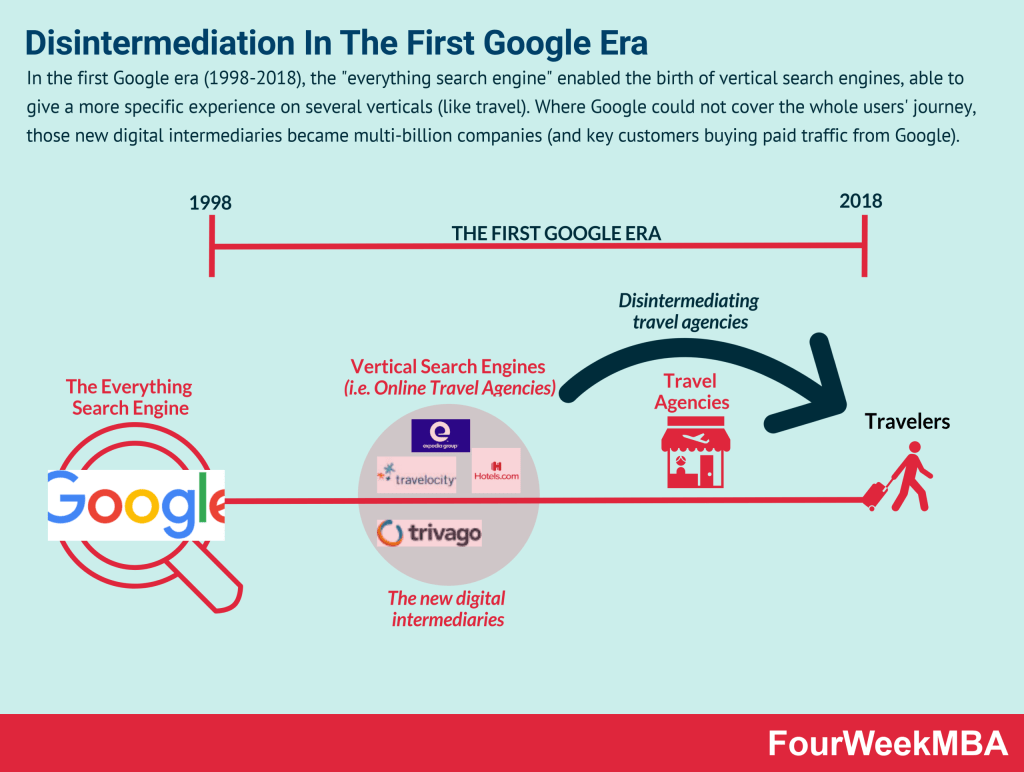
Trivago is a search and discovery travel platform part of Expedia Group. Trivago is widely known as a trusted hotel comparison service. Trivago doesn’t charge based on bookings but rather through a cost-per-click (CPC) model, monetized when a hotel searcher clicks one of its advertiser listings. This referral revenue comprises most of Trivago’s income. Trivago also has another minor revenue stream via subscriptions to its Business Studio, a tool that helps hoteliers track impression and click data associated with their properties.
Born in 1996 as a travel platform of Microsoft, it would be spun off later on. Expedia became among the largest online travel agencies (OTAs) which comprise a set of brands that go from Hotels.com, Vrbo, Orbits, CheapTickets, ebookers, Travelocity, Trivago, and others. The company follows a multi-brandstrategy.
Kayak is an online travel agency and search engine founded in 2004 by Steve Hafner and Paul M. English as a Travel Search Company and acquired by Booking Holdings in 2013 for $2.1 billion. The company makes money via an advertising model based on cost per click, cost per acquisition, and advertising placements.
OpenTable is an American online restaurant reservation system founded by Chuck Templeton. During the late 90s, it provided one of the first automated, real-time reservation systems. The company was acquired by Booking Holding back in 2014, for $2.6 billion. Today OpenTable makes money via subscription plans, referral fees, and in-dining with its first restaurant, as an experiment in Miami, Florida.
OYO’s business model is a mixture of platform and brand, where the company started primarily as an aggregator of homes across India, and it quickly moved to other verticals, from leisure to co-working and corporate travel. In a sort of octopus business strategy of expansion to cover the whole spectrum of short-term real estate.
TripAdvisor’s business model matches the demand for people looking for a travel experience with supply from travel partners around the world providing travel accommodations and experiences. When this match is created TripAdvisor collects commission from partners on a CPC and CPM basis. The non-hotel revenue comprises experiences, restaurants, and rentals.
Trivago is a search and discovery travel platform part of Expedia Group. Trivago is widely known as a trusted hotel comparison service. Trivago doesn’t charge based on bookings but rather through a cost-per-click (CPC) model, monetized when a hotel searcher clicks one of its advertiser listings. This referral revenue comprises most of Trivago’s income. Trivago also has another minor revenue stream via subscriptions to its Business Studio, a tool that helps hoteliers track impression and click data associated with their properties.
Gennaro Cuofano is a business analyst with an International MBA in corporate finance and business strategy (2012). He leads research at FourWeekMBA, which he created, and at The Business Engineer (businessengineer.ai), his newsletter on AI and business strategy, with over 90,000 subscribers and more than 660 published analyses. His work breaks down how companies make money, read from their own filings: revenue and profit structure, capital allocation and ownership. FourWeekMBA reached about four million business people, including C-level executives, investors, analysts and product managers, in 2022 alone. See how we source.
Scroll to Top
Discover more from FourWeekMBA
Subscribe now to keep reading and get access to the full archive.