Zappos primarily generates revenue through e-commerce sales of footwear, clothing, accessories, and related products. The company offers a wide selection of bra
Exceptional Customer Service
Zappos is renowned for its exceptional customer service. The company goes to great lengths to provide top-tier support, including 24/7 customer service availabi
Company Culture and Values
Zappos places a strong emphasis on its company culture and values. The company’s unique approach to corporate culture, centered around core values like "Deliver
Customer Loyalty Programs
Zappos has implemented various customer loyalty programs, such as Zappos Rewards, which offer benefits like early access to sales, expedited shipping, and rewar
Merchandising and Product Recommendations
Zappos employs merchandising and product recommendation strategies to upsell and cross-sell products. By suggesting related items or complementary accessories,
Challenges and Competition
Zappos operates in a highly competitive e-commerce market, facing competition from other online retailers, fashion brands, and marketplace platforms. Maintainin
Future Growth Strategies
Zappos’ future growth strategies may involve: – Expansion of Product Categories: Expanding its product offerings beyond footwear and clothing. – Personalization
The Zappos Business Model revolves around offering a wide selection of shoes and apparel with exceptional customer service and fast delivery. It targets fashion enthusiasts, online shoppers, and service-oriented customers. Revenue is generated through product sales and premium services. Key activities include product sourcing, customer service, and logistics. Key resources involve an extensive product catalog, customer service infrastructure, and efficient logistics network. Key partnerships are formed with brands/suppliers and shipping/delivery providers. The cost structure includes expenses in product sourcing, customer service, and logistics.
Aspect
Description
E-commerce Sales
Zappos primarily generates revenue through e-commerce sales of footwear, clothing, accessories, and related products. The company offers a wide selection of brands and styles, and customers can browse, select, and purchase items through the Zappos website and mobile app. Revenue is generated when customers make purchases online. Zappos provides a seamless and convenient shopping experience to attract and retain customers.
Exceptional Customer Service
Zappos is renowned for its exceptional customer service. The company goes to great lengths to provide top-tier support, including 24/7 customer service availability, free shipping, free returns, and a 365-day return policy. While customer service is a significant expense, it contributes to revenue by fostering customer loyalty and word-of-mouth recommendations, which result in repeat business.
Company Culture and Values
Zappos places a strong emphasis on its company culture and values. The company’s unique approach to corporate culture, centered around core values like “Deliver WOW Through Service,” has garnered attention and media coverage. While not a direct source of revenue, this culture contributes to Zappos’ brand image, customer loyalty, and employee satisfaction, all of which can positively impact the bottom line.
Customer Loyalty Programs
Zappos has implemented various customer loyalty programs, such as Zappos Rewards, which offer benefits like early access to sales, expedited shipping, and rewards points for repeat purchases. These programs encourage repeat business and customer retention, ultimately contributing to revenue.
Merchandising and Product Recommendations
Zappos employs merchandising and product recommendation strategies to upsell and cross-sell products. By suggesting related items or complementary accessories, Zappos can increase the average order value and generate additional revenue from each customer.
Challenges and Competition
Zappos operates in a highly competitive e-commerce market, facing competition from other online retailers, fashion brands, and marketplace platforms. Maintaining a strong brand, offering competitive prices, and providing exceptional customer service are ongoing challenges.
Future Growth Strategies
Zappos’ future growth strategies may involve: – Expansion of Product Categories: Expanding its product offerings beyond footwear and clothing. – Personalization and Recommendation Algorithms: Improving product recommendations and personalizing the shopping experience. – Customer Engagement: Enhancing customer engagement through content, social media, and loyalty programs. – Sustainability Initiatives: Embracing sustainable practices in product sourcing and operations. – International Expansion: Entering new international markets to reach a broader customer base.
Revenue Streams (Financial Model)
Product Sales Zappos generates the majority of its revenue from the sale of shoes, clothing, and accessories. By offering a wide range of products from various brands, Zappos attracts a diverse customer base.
Affiliate Marketing Zappos earns additional revenue through affiliate marketing programs and partnerships. These programs allow affiliates to earn commissions by promoting Zappos’ products on their websites and driving traffic to Zappos.com.
Branded Partnerships Zappos forms partnerships with brands to offer exclusive products and promotions. These partnerships not only enhance the product selection but also create additional revenue streams through special collaborations and limited-edition releases.
Products and Services (Technological Model)
Wide Product Selection Zappos is known for its extensive range of shoes, clothing, and accessories. By offering products from numerous brands, Zappos ensures that customers have access to a wide variety of styles and options.
Customer Service Exceptional customer service is a cornerstone of Zappos’ businessmodel. The company prioritizes customer satisfaction by providing responsive and helpful support, which enhances the overall shopping experience.
Free Shipping and Returns To ensure customer satisfaction, Zappos offers free shipping and returns. This policy reduces the risk for customers and encourages them to shop more confidently on the platform.
Zappos VIP Zappos VIP is a loyalty program that offers benefits such as expedited shipping and early access to sales. This program helps to build customer loyalty and incentivize repeat purchases.
Ecosystem (Distribution Model)
Supply Chain Management Efficient supply chain management is crucial for Zappos to ensure timely delivery of products. By optimizing logistics and inventorymanagement, Zappos maintains high service levels and customer satisfaction.
Partnerships with Brands Zappos collaborates with various brands to offer exclusive products and promotions. These partnerships enhance the product offering and attract customers seeking unique and limited-edition items.
Customer Loyalty Programs Building and maintaining customer loyalty is a key focus for Zappos. Through various loyalty programs and initiatives, Zappos rewards repeat customers and fosters long-term relationships.
Technology Integration Zappos leverages advanced technology to enhance the online shopping experience. From personalized recommendations to seamless navigation, technology plays a vital role in improving customer satisfaction.
User Value (Value Model)
Wide Product Range Zappos provides a wide range of products to meet the diverse needs of its customers. By offering a broad selection of styles and brands, Zappos ensures that there is something for everyone.
Convenience The convenience of online shopping is a significant value proposition for Zappos. With free shipping and returns, customers can shop with confidence and ease, knowing that they can easily return items if needed.
Customer Satisfaction Zappos focuses heavily on customer satisfaction through excellent service and support. This commitment to customer care helps to build trust and loyalty, encouraging repeat business.
Exclusive Offers Zappos VIP members enjoy exclusive offers and promotions. These perks provide additional value to loyal customers and incentivize membership in the VIP program.
Conclusion
The Zappos business model is a well-rounded framework that drives its success in the online retail industry. By leveraging diverse revenue streams, offering a wide range of products and services, fostering a vibrant ecosystem, and providing significant user value, Zappos maintains its competitive edge and continues to grow. This comprehensive understanding of Zappos’ business model highlights the strategic elements that contribute to its position as a leader in online retail.
Key Highlights
Business Model Focus:
The Zappos business model centers around providing a wide range of shoes and apparel, combined with exceptional customer service and speedy delivery.
Target Audience:
Zappos caters to fashion enthusiasts, online shoppers, and customers who value top-notch service.
Revenue Generation:
Zappos generates revenue through product sales and premium services.
Key Activities:
The company engages in activities such as sourcing a diverse range of products, delivering exceptional customer service, and ensuring efficient logistics.
Key Resources:
Zappos relies on key resources including an extensive catalog of products, a robust infrastructure for customer service, and an efficient network for logistics.
Key Partnerships:
Partnerships are established with both brands and suppliers to ensure a varied product range, as well as with shipping and delivery providers to guarantee fast and reliable service.
Cost Structure:
Zappos incurs costs related to sourcing products, maintaining high-quality customer service, and managing the logistics network.
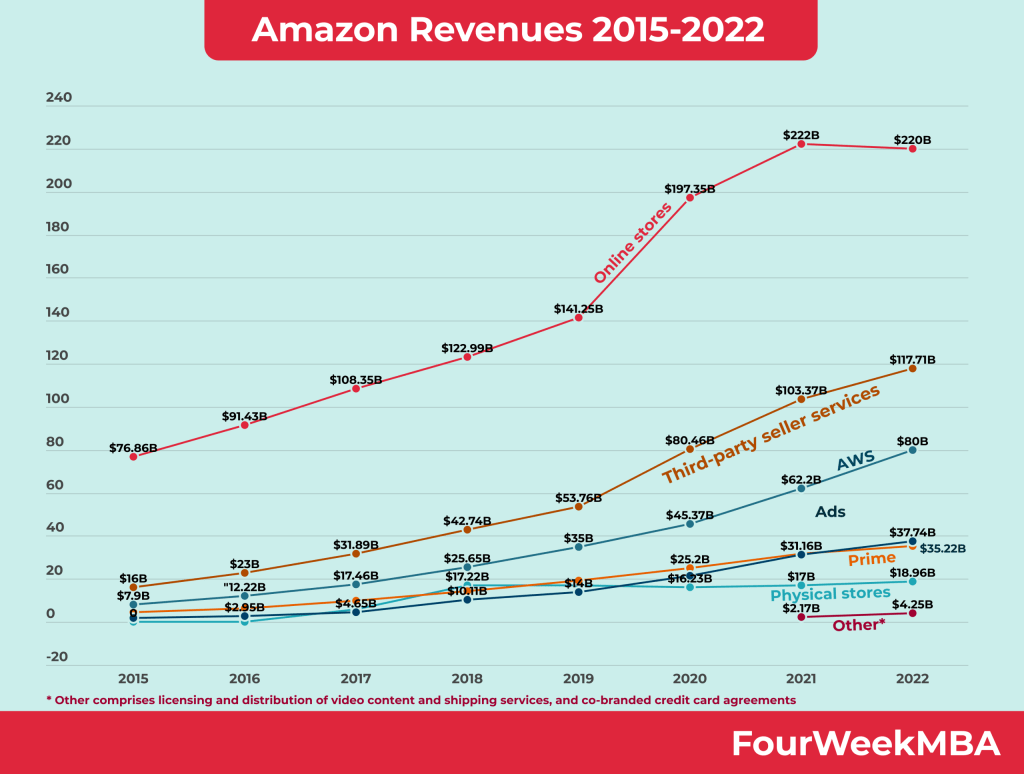
Amazon has a diversified business model. In 2022 Amazon posted over $514 billion in revenues, while it posted a net loss of over $2.7 billion. Online stores contributed almost 43% of Amazon revenues. The remaining was generated by Third-party Seller Services, and Physical Stores. While Amazon AWS, Subscription Services, and Advertising revenues play a significant role within Amazon as fast-growing segments.
In 2022, most of Amazon’s revenue came from the US, with over $356 billion in revenue, followed by Germany with $33.6 billion, the UK with $30 billion, Japan with $24.4 billion, and the rest of the world generated almost $70 billion in net sales.
Both the North American and International segment of Amazon are running at negative margins. Indeed, in 2022, for the North American segments, of almost $316 billion in revenue, Amazon spent almost $319 billion in operating costs to run it, thus it generated $2 billion in operating losses in 2022.
For its International segment, of $118 billion in revenue, Amazon spent almost $126 billion to operate it. Thus, it reported a $7.7 billion operating loss.
While for AWS, with $80 billion in revenue, Amazon spent $57 billion to operate it, thus generating almost $23 billion in operating income.
The high operating costs are primarily due to the high cost of running Amazon’s inventory and fulfillment infrastructure behind its e-commerce operations. Indeed, Amazon is as much as a physical player as a digital one.
Amazon was not profitable once AWS was removed in 2022. In fact, Amazon, without AWS generated $10.6 billion in operating losses. While Amazon, without AWS, generated $12.2. billion operating income.
Amazon is subdivided into three operating profit segments: North America, International, and AWS. Amazon AWS is the most profitable segment, with almost $23 billion in operating profit in 2022. While Both the North American and International segments run at negative operating losses, with $2 billion and $7.74 billion in operating losses, respectively, in 2022.
In 2021, Amazon generated almost $470 billion in revenue, vs. eBay’s over $10.4 billion. In comparison, looking at revenues, Amazon was 45x times larger than eBay.
Amazon’s mission statement is to “serve consumers through online and physical stores and focus on selection, price, and convenience.” Amazon’s vision statement is “to be Earth’s most customer-centric company, where customers can find and discover anything they might want to buy online, and endeavors to offer its customers the lowest possible prices.”
In the Amazon Shareholders’ Letter for 2018, Jeff Bezos analyzed the Amazon business model, and it also focused on a few key lessons that Amazon as a company has learned over the years. These lessons are fundamental for any entrepreneur, of small or large organization to understand the pitfalls to avoid to run a successful company!
Amazon has a business model with many moving parts. The e-commerce platform generated $220 billion in 2022, followed by third-party stores services which generated over $117 billion; Amazon AWS, which generated over $80 billion; Amazon advertising which generated almost $38 billion and Amazon Prime, which generated over $35 billion, and physical stores which generated almost $19 billion.
The Amazon Working Backwards Method is a product development methodology that advocates building a product based on customer needs. The Amazon Working Backwards Method gained traction after notable Amazon employee Ian McAllister shared the company’s product development approach on Quora. McAllister noted that the method seeks “to work backwards from the customer, rather than starting with an idea for a product and trying to bolt customers onto it.”
The Amazon Flywheel or Amazon Virtuous Cycle is a strategy that leverages on customer experience to drive traffic to the platform and third-party sellers. That improves the selections of goods, and Amazon further improves its cost structure so it can decrease prices which spins the flywheel.
In the letter to shareholders in 2016, Jeff Bezos addressed a topic he had been thinking quite profoundly in the last decades as he led Amazon: Day 1. As Jeff Bezos put it “Day 2 is stasis. Followed by irrelevance. Followed by excruciating, painful decline. Followed by death. And that is why it is always Day 1.”
Gennaro is the creator of FourWeekMBA, which reached about four million business people, comprising C-level executives, investors, analysts, product managers, and aspiring digital entrepreneurs in 2022 alone | He is also Director of Sales for a high-tech scaleup in the AI Industry | In 2012, Gennaro earned an International MBA with emphasis on Corporate Finance and Business Strategy.