The Shopify Mafia is the collective term for several former Shopify employees who have founded startups of their own. Similar to the PayPal Mafia who went before them, these individuals have become well-known and sometimes influential in their respective industries.
The Shopify Mafia was likely born out of a tendency for the company to encourage its employees to open their own stores. Here, the idea is that employees who have first-hand experience with running a business are better able to serve Shopify’s entrepreneurial customer base.
Many of these employees simply became so enamored with entrepreneurship that they decided to quit the company to focus on their businesses full time.
Brittany Forsyth is a former Spotify chief product officer who is now a founding partner of investment company Backbone Angels. She co-founded the company with Arati Sharma, a former head of product marketing for Shopify. Some of their notable investments include collaboration platform Wethos and dating app Snack.
Backbone Angels promotes itself as a collective of angel investors who invest in women-led startups in industries that are traditionally overlooked. Since March 2021, Forsyth and Sharma have overseen the deployment of $2.3 million to over 42 companies.
Michael Perry and Mike Taylor
Michael Perry and Mike Taylor joined Shopify after it acquired their startup, Kit, in 2016. Four years later, the pair left the company to start work on Maple.
Maple is a tech company that uses software to simplify parenting and household management. The platform can coordinate chores, plan family trips, track bills and expenses, and organize appointments.
In the future, Perry and Taylor are aiming to grow Maple’s partner ecosystem to feature products and services from various related brands. Two brands the company has already partnered with include pajama company Pika Layers and baby food brand Yumi.
Erin Chan
Together with husband Tomas Ronis, Erin Chan founded Rhenti in 2017. Rhenti is a platform that connects property owners and renters via leasing software and marketing automation. Chan worked as a senior product manager for Shopify, joining the company in 2018 and working on Rhenti as a side hustle for around two years.
In an interview with Business Insider, Chan admitted that her experience at Shopify helped prepare her for the rigors of building a company from the ground up: “They think about product discipline more there than any company I’ve worked with before. It was never lined out for you perfectly. They kind of just forced you to really think about what you were building and who you were building for, and quite intensely.”
Effie Anolik
After experiencing difficulty planning her father’s funeral, Effie Anolik started the end-of-life services startup Afterword in 2018. Anolik spent over four years at Shopify in a variety of internal and customer-facing roles before leaving to start her own company and follow the family tradition of entrepreneurship.
Today, Afterword provides grief and planning support and was also instrumental in helping families live stream memorial services during the COVID-19 pandemic.
Key takeaways:
The Shopify Mafia is the collective term for several former Shopify employees who have founded startups of their own. Similar to the PayPal Mafia, these individuals have become well-known and sometimes influential in their respective industries.
Brittany Forsyth and Arati Sharma founded women-centric startup investment firm Backbone Angels, while Michael Perry and Mike Taylor quit Shopify in 2020 to start their own parenting and household management platform.
Former Shopify senior product manager Erin Chan created a platform to connect renters with landlords, later admitting that the product-focused nature of her former role served as ideal preparation for starting her own business.
The founder and CEO of Shopify, Tobias Lütke, owned or controlled 7,891,852 Class B multiple voting shares and 5,250 Class A subordinate voting shares, representing approximately 33.8% of the aggregate voting power attached to all of the Company’s outstanding voting shares. Another key stakeholder is John H. Phillips, an angel investor who placed an early bet on Shopify.
Shopify is an e-commerce platform that enabled over 2 million merchants by 2021 to commercialize their products. While Shopify works with a subscription-based businessmodel, it makes most of its money via merchant services, which are additional services provided to merchants. In 2023, the company generated over $7 billion in revenue, of which over $1.8 billion (26% of total revenue) was from subscriptions and $5.2 billion (74% of total revenue) from merchant solutions.
While Merchant services drive most of the revenue for Shopify, in reality, subscriptions have a much larger contribution margin. Indeed, in 2023, on $7 billion in revenue, Shopify generated $3.15 billion in gross profits or about 50% gross margins. However, if we drill down its cost structure, we can see how gross margins from merchant services stood at nearly 39%. Meanwhile, gross margins from subscription services (Shopify’s MRR was $149 million in 2023) reported over 80% gross margins, thus making its subscriptionbusiness critical to sustaining the overall Shopify businessmodel.
Shopify was finally profitable in 2023, with $132 million in net profits, while it was not profitable in 2022, generating over $3.4 billion in net losses. In 2021, driven by the massive wave of e-commerce throughout the COVID-19 pandemic, Shopify had turned to profitability in 2021, generating over $2.9 billion in net income, while it became unprofitable again in 2022 and back to profitability in 2023.
The company generated $7.06 billion in revenue in 2023, of which $1.84 billion was from subscription revenue and $5.22B in merchant revenue. In 2022, Shopify generated $5.6 billion in revenue, of which $1.5 billion (almost 27% of total revenue) was from subscriptions and $4.1 billion (more than 73%) from merchant solutions.
In just fifteen short years, Shopify has grown from humble beginnings to become one of the fastest-growing eCommerce platforms online. The Shopify eCommerce solution is perhaps best suited to users who desire an easy, flexible and affordable starter solution for their online store. The provider now has upwards of 820,000 stores accounting for 20% of the total market share. However, the continued success of any company in the dynamic digital market is never guaranteed.
A Blockchain Business Model according to the FourWeekMBA framework is made of four main components: Value Model (Core Philosophy, Core Values and Value Propositions for the key stakeholders), Blockchain Model (Protocol Rules, Network Shape and Applications Layer/Ecosystem), Distribution Model (the key channels amplifying the protocol and its communities), and the Economic Model (the dynamics/incentives through which protocol players make money). Those elements coming together can serve as the basis to build and analyze a solid Blockchain Business Model.
In an asymmetric businessmodel, the organization doesn’t monetize the user directly, but it leverages the data users provide coupled with technology, thus have a key customer pay to sustain the core asset. For example, Google makes money by leveraging users’ data, combined with its algorithms sold to advertisers for visibility.
In a business world driven by technology and digitalization, competition is much more fluid, as innovation becomes a bottom-up approach that can come from anywhere. Thus, making it much harder to define the boundaries of existing markets. Therefore, a proper business competition analysis looks at customer, technology, distribution, and financial model overlaps. While at the same time looking at future potential intersections among industries that in the short-term seem unrelated.
Technological modeling is a discipline to provide the basis for companies to sustain innovation, thus developing incremental products. While also looking at breakthrough innovative products that can pave the way for long-term success. In a sort of Barbell Strategy, technological modeling suggests having a two-sided approach, on the one hand, to keep sustaining continuous innovation as a core part of the businessmodel. On the other hand, it places bets on future developments that have the potential to break through and take a leap forward.
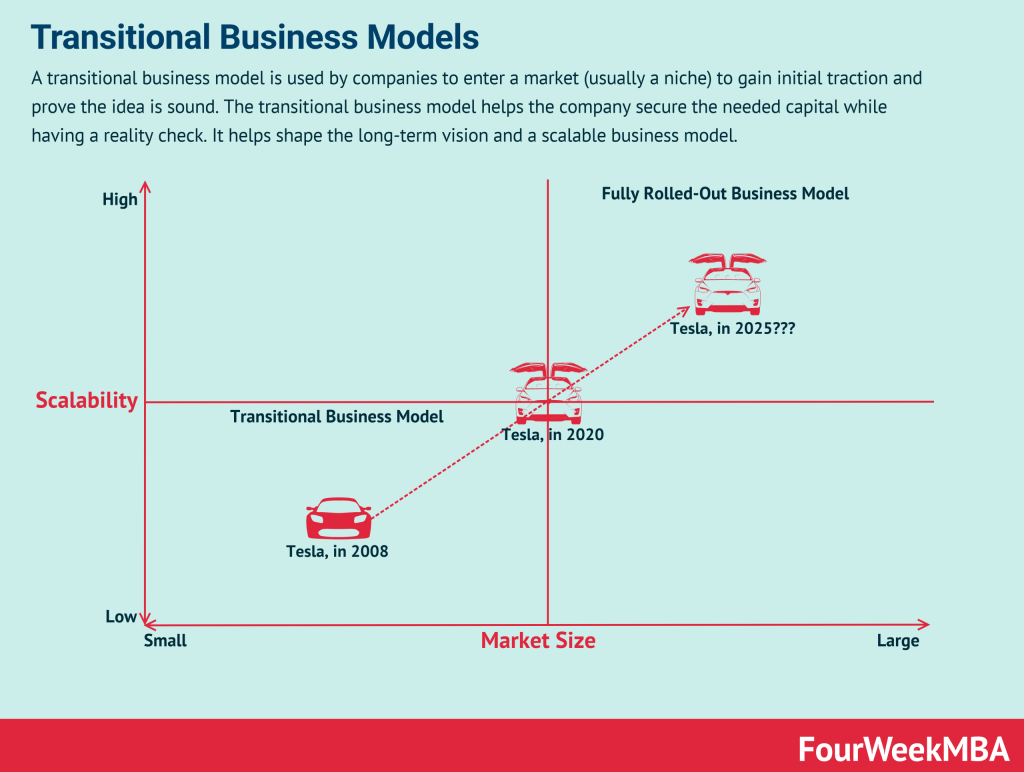
A transitional business model is used by companies to enter a market (usually a niche) to gain initial traction and prove the idea is sound. The transitional business model helps the company secure the needed capital while having a reality check. It helps shape the long-term vision and a scalable businessmodel.
The minimum viable audience (MVA) represents the smallest possible audience that can sustain your business as you get it started from a microniche (the smallest subset of a market). The main aspect of the MVA is to zoom into existing markets to find those people which needs are unmet by existing players.
Business scaling is the process of transformation of a business as the product is validated by wider and wider market segments. Business scaling is about creating traction for a product that fits a small market segment. As the product is validated it becomes critical to build a viable businessmodel. And as the product is offered at wider and wider market segments, it’s important to align product, businessmodel, and organizational design, to enable wider and wider scale.
The market expansion consists in providing a product or service to a broader portion of an existing market or perhaps expanding that market. Or yet, market expansions can be about creating a whole new market. At each step, as a result, a company scales together with the market covered.
In the FourWeekMBA growth matrix, you can apply growth for existing customers by tackling the same problems (gain mode). Or by tackling existing problems, for new customers (expand mode). Or by tackling new problems for existing customers (extend mode). Or perhaps by tackling whole new problems for new customers (reinvent mode).
In the FourWeekMBA Revenue Streams Matrix, revenue streams are classified according to the kind of interactions the business has with its key customers. The first dimension is the “Frequency” of interaction with the key customer. As the second dimension, there is the “Ownership” of the interaction with the key customer.
Revenue model patterns are a way for companies to monetize their business models. A revenue model pattern is a crucial building block of a business model because it informs how the company will generate short-term financial resources to invest back into the business. Thus, the way a company makes money will also influence its overall businessmodel.
A pricingstrategy or model helps companies find the pricing formula in fit with their business models. Thus aligning the customer needs with the product type while trying to enable profitability for the company. A good pricingstrategy aligns the customer with the company’s long term financial sustainability to build a solid businessmodel.
Gennaro is the creator of FourWeekMBA, which reached about four million business people, comprising C-level executives, investors, analysts, product managers, and aspiring digital entrepreneurs in 2022 alone | He is also Director of Sales for a high-tech scaleup in the AI Industry | In 2012, Gennaro earned an International MBA with emphasis on Corporate Finance and Business Strategy.