Exec Package + Claude OS Master Skill | Business Engineer Founding Plan
FourWeekMBA x Business Engineer | Updated 2026
Tech Company
TAM
SAM
SOM
Apple Inc.
Global market for consumer electronics
Consumers and businesses in developed and developing countries
Customers who purchase Apple products and services
Amazon.com Inc.
Global e-commerce and cloud computing
Online shoppers, businesses, and organizations
Amazon Prime subscribers, AWS customers, and marketplace sellers
Google LLC
Global internet search, advertising, and cloud services
Internet users and businesses seeking digital advertising
Google Ads advertisers, G Suite users, and Cloud Platform customers
Microsoft Corporation
Global software, hardware, and cloud services
Enterprises, governments, and individual consumers
Windows OS users, Office 365 subscribers, Azure cloud customers
Facebook, Inc.
Global social media and digital advertising
Social media users, businesses, and advertisers
Facebook, Instagram, WhatsApp, and Messenger users
Alphabet Inc. (Google’s Parent)
Global internet-related services
Internet users, businesses, and advertisers
Google search users, YouTube viewers, and GCP clients
Tesla, Inc.
Global electric vehicle and clean energy markets
Car buyers interested in electric vehicles
Tesla car owners and solar energy customers
Netflix, Inc.
Global streaming entertainment market
Internet users seeking on-demand video content
Netflix subscribers
Uber Technologies, Inc.
Global ride-sharing and food delivery market
Urban and suburban commuters, restaurant-goers
Uber riders and Uber Eats customers
Salesforce.com, Inc.
Global customer relationship management (CRM) market
Businesses and organizations of all sizes
Salesforce CRM and cloud service subscribers
Airbnb, Inc.
Global short-term lodging and vacation rental market
Travelers and property owners
Airbnb hosts and guests
Adobe Inc.
Global software for creativity, marketing, and documents
Creative professionals, marketers, and enterprises
Adobe Creative Cloud and Document Cloud users
PayPal Holdings, Inc.
Global digital payments and financial services
Online shoppers, businesses, and freelancers
PayPal and Venmo users
Twitter, Inc.
Global social media and microblogging market
Individuals, businesses, and advertisers
Twitter users and advertisers
Snap Inc. (Snapchat)
Global multimedia messaging and AR technology
Social media users, advertisers, and AR enthusiasts
Snapchat users and Discover content consumers
Spotify Technology S.A.
Global music streaming and podcast market
Music lovers and podcast enthusiasts
Spotify Premium and Free users
Alibaba Group Holding Limited
Global e-commerce, cloud computing, and fintech
Online shoppers, businesses, and financial services
Alibaba.com, Taobao, and Tmall users
Tencent Holdings Limited
Global internet services, gaming, and social media
Gamers, social media users, and online shoppers
WeChat, QQ, and Honor of Kings players
Square, Inc.
Global financial services, mobile payments, and POS systems
Small businesses, retailers, and service providers
Square payment and hardware users
Zoom Video Communications, Inc.
Global video conferencing and virtual collaboration
Businesses, educational institutions, and remote workers
Zoom Meetings and Webinars participants
Related Frameworks, Models, or Concepts
Description
When to Apply
Total Addressable Market (TAM)
Total Addressable Market (TAM) represents the entire potential market demand for a product or service, assuming ideal market conditions and no competition. While TAM provides a broad estimate of market opportunity, Serviceable Obtainable Market (SOM) refines this by considering factors such as the company’s capabilities, resources, and market penetration potential.
Use TAM analysis to understand the overall market size and potential demand for a product or service. Apply it during market research and strategic planning to assess the scalability and revenue potential of a business opportunity.
Serviceable Addressable Market (SAM)
Serviceable Addressable Market (SAM) represents the portion of the addressable market that a company can realistically serve and capture within a specific timeframe or under current market conditions. While SAM focuses on market segments within the company’s reach, SOM narrows this further by considering the company’s ability to effectively serve and capture market share within those segments.
Utilize SAM analysis to assess the company’s current market penetration and competitive positioning. Apply SOM analysis to set realistic targets and allocate resources effectively to capture market share and drive business growth within specific market segments.
Market Segmentation
Market Segmentation involves dividing the market into distinct groups of customers with similar needs, characteristics, or behaviors. Serviceable Obtainable Market (SOM) analysis leverages market segmentation to identify target customer segments that align with the company’s capabilities and resources.
Utilize Market Segmentation to identify high-potential customer segments that the company can effectively serve and capture within its current capabilities. Apply it to develop targeted marketing campaigns, product features, and customer experiences tailored to the needs and preferences of specific market segments.
Competitive Analysis
Competitive Analysis involves assessing competitors’ strengths, weaknesses, strategies, and market positions to inform strategic decision-making. Serviceable Obtainable Market (SOM) analysis incorporates competitive analysis to understand the competitive landscape within target market segments and identify opportunities for differentiation and competitive advantage.
Conduct Competitive Analysis to benchmark against competitors, identify market gaps, and capitalize on competitive advantages within serviceable obtainable market segments. Apply it to refine value propositions, positioning strategies, and go-to-market plans to outperform competitors and capture market share effectively.
Resource Allocation
Resource Allocation involves allocating financial, human, and other resources to different business activities and initiatives. Serviceable Obtainable Market (SOM) analysis guides resource allocation decisions by identifying high-priority market segments and opportunities with the highest potential for return on investment.
Utilize Resource Allocation to prioritize investments and allocate resources to initiatives that align with the company’s capabilities and offer the greatest opportunity for success within serviceable obtainable market segments. Apply it to optimize resource utilization, minimize risks, and maximize returns on investment in pursuit of market share and business growth.
Go-to-Market Strategy
Go-to-Market Strategy outlines how a company plans to enter and compete in a target market effectively. Serviceable Obtainable Market (SOM) analysis informs go-to-market strategy by identifying target customer segments, positioning strategies, and distribution channels that align with the company’s capabilities and resources.
Develop Go-to-Market Strategy based on insights from SOM analysis to maximize the company’s ability to serve and capture market share within high-priority market segments. Apply it to align marketing, sales, and distribution efforts with target customer needs and preferences to drive adoption and revenue growth effectively.
Customer Acquisition and Retention Tactics
Customer Acquisition and Retention Tactics involve strategies and tactics to attract, convert, and retain customers within target market segments. Serviceable Obtainable Market (SOM) analysis informs customer acquisition and retention efforts by identifying customer needs, preferences, and behavior patterns within serviceable market segments.
Utilize Customer Acquisition and Retention Tactics to tailor marketing campaigns, sales strategies, and customer engagement initiatives to target market segments within the company’s reach. Apply it to optimize customer acquisition costs, improve conversion rates, and increase customer lifetime value within serviceable obtainable market segments.
Operational Efficiency and Scalability
Operational Efficiency and Scalability involve optimizing business processes and systems to increase productivity, reduce costs, and support growth. Serviceable Obtainable Market (SOM) analysis considers operational capabilities and scalability requirements within target market segments to ensure effective resource utilization and operational readiness.
Focus on Operational Efficiency and Scalability to align operational capabilities with the company’s ability to serve and capture market share within serviceable obtainable market segments. Apply it to streamline workflows, improve customer service, and scale operations efficiently to meet growing demand and maintain competitiveness in target markets.
A total addressable market or TAM is the available market for a product or service. That is a metric usually leveraged by startups to understand the business potential of an industry. Typically, a large addressable market is appealing to venture capitalists willing to back startups with extensive growth potential.
A microniche is a subset of potential customers within a niche. In the era of dominating digital super-platforms, identifying a microniche can kick off the strategy of digital businesses to prevent competition against large platforms. As the microniche becomes a niche, then a market, scale becomes an option.
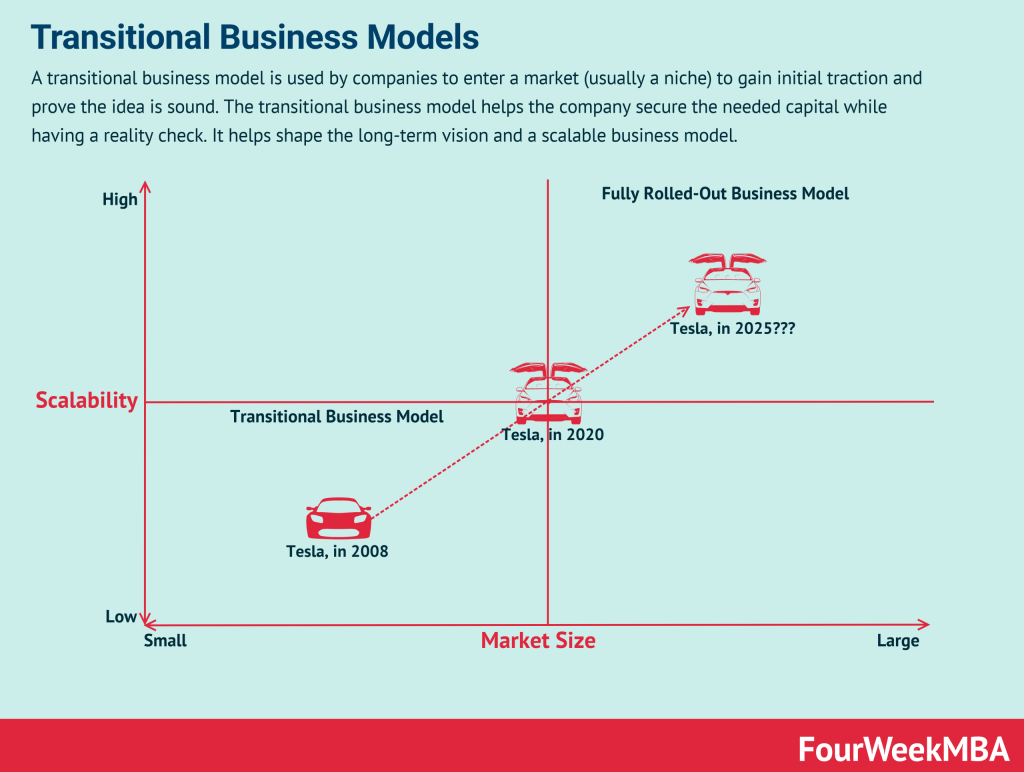
In simple terms, market validation is the process of showing a concept to a prospective buyer and collecting feedback to determine whether it is worth persisting with. To that end, market validation requires the business to conduct multiple customer interviews before it has made a significant investment of time or money. A transitional business model is an example of market validation that helps the company secure the needed capital while having a market reality check. It helps shape the long-term vision and a scalable businessmodel.
Market orientation is an approach to business where the company focuses more on the behaviors, wants, and needs of customers in its market. A company will first target a niche market to prove a commercial use case. And from there, it will create options to scale.
In a tech-driven business world, companies can move toward market expansion by creating options to scale via niches. Thus leveraging transitional business models to scale further and take advantage of non-linear competition, where today’s niches become tomorrow’s legacy players.
Digital and tech business models can be classified according to four levels of transformation into digitally-enabled, digitally-enhanced, tech or platform business models, and business platforms/ecosystems.
A platform business model generates value by enabling interactions between people, groups, and users by leveraging network effects. Platform business models usually comprise two sides: supply and demand. Kicking off the interactions between those two sides is one of the crucial elements for a platform business model success.
Business scaling is the process of transformation of a business as the product is validated by wider and wider market segments. Business scaling is about creating traction for a product that fits a small market segment. As the product is validated it becomes critical to build a viable businessmodel. And as the product is offered at wider and wider market segments, it’s important to align product, businessmodel, and organizational design, to enable wider and wider scale.
Developing a successful business strategy is about finding the proper niche, where to launch an initial version of your product to create a feedback loop and improve fast while making sure not to run out of money. And from there create options to scale to adjacent niches.
A Blockchain Business Model according to the FourWeekMBA framework is made of four main components: Value Model (Core Philosophy, Core Values and Value Propositions for the key stakeholders), Blockchain Model (Protocol Rules, Network Shape and Applications Layer/Ecosystem), Distribution Model (the key channels amplifying the protocol and its communities), and the Economic Model (the dynamics/incentives through which protocol players make money). Those elements coming together can serve as the basis to build and analyze a solid Blockchain Business Model.
In an asymmetric businessmodel, the organization doesn’t monetize the user directly, but it leverages the data users provide coupled with technology, thus have a key customer pay to sustain the core asset. For example, Google makes money by leveraging users’ data, combined with its algorithms sold to advertisers for visibility.
In a business world driven by technology and digitalization, competition is much more fluid, as innovation becomes a bottom-up approach that can come from anywhere. Thus, making it much harder to define the boundaries of existing markets. Therefore, a proper business competition analysis looks at customer, technology, distribution, and financial model overlaps. While at the same time looking at future potential intersections among industries that in the short-term seem unrelated.
Technological modeling is a discipline to provide the basis for companies to sustain innovation, thus developing incremental products. While also looking at breakthrough innovative products that can pave the way for long-term success. In a sort of Barbell Strategy, technological modeling suggests having a two-sided approach, on the one hand, to keep sustaining continuous innovation as a core part of the businessmodel. On the other hand, it places bets on future developments that have the potential to break through and take a leap forward.
A transitional business model is used by companies to enter a market (usually a niche) to gain initial traction and prove the idea is sound. The transitional business model helps the company secure the needed capital while having a reality check. It helps shape the long-term vision and a scalable businessmodel.
The minimum viable audience (MVA) represents the smallest possible audience that can sustain your business as you get it started from a microniche (the smallest subset of a market). The main aspect of the MVA is to zoom into existing markets to find those people which needs are unmet by existing players.
Business scaling is the process of transformation of a business as the product is validated by wider and wider market segments. Business scaling is about creating traction for a product that fits a small market segment. As the product is validated it becomes critical to build a viable businessmodel. And as the product is offered at wider and wider market segments, it’s important to align product, businessmodel, and organizational design, to enable wider and wider scale.
The market expansion consists in providing a product or service to a broader portion of an existing market or perhaps expanding that market. Or yet, market expansions can be about creating a whole new market. At each step, as a result, a company scales together with the market covered.
In the FourWeekMBA growth matrix, you can apply growth for existing customers by tackling the same problems (gain mode). Or by tackling existing problems, for new customers (expand mode). Or by tackling new problems for existing customers (extend mode). Or perhaps by tackling whole new problems for new customers (reinvent mode).
In the FourWeekMBA Revenue Streams Matrix, revenue streams are classified according to the kind of interactions the business has with its key customers. The first dimension is the “Frequency” of interaction with the key customer. As the second dimension, there is the “Ownership” of the interaction with the key customer.
Revenue model patterns are a way for companies to monetize their business models. A revenue model pattern is a crucial building block of a business model because it informs how the company will generate short-term financial resources to invest back into the business. Thus, the way a company makes money will also influence its overall businessmodel.
A pricing strategy or model helps companies find the pricing formula in fit with their business models. Thus aligning the customer needs with the product type while trying to enable profitability for the company. A good pricing strategy aligns the customer with the company’s long term financial sustainability to build a solid businessmodel.
What are the key components of Serviceable Obtainable Market?
The key components of Serviceable Obtainable Market include Apple Inc., Amazon.com Inc., Google LLC, Microsoft Corporation, Facebook, Inc.. Apple Inc.: Global market for consumer electronics Amazon.com Inc.: Global e-commerce and cloud computing
Gennaro is the creator of FourWeekMBA, which reached about four million business people, comprising C-level executives, investors, analysts, product managers, and aspiring digital entrepreneurs in 2022 alone | He is also Director of Sales for a high-tech scaleup in the AI Industry | In 2012, Gennaro earned an International MBA with emphasis on Corporate Finance and Business Strategy.
Scroll to Top
Discover more from FourWeekMBA
Subscribe now to keep reading and get access to the full archive.