Reed Hastings stepped down as Netflix co-CEO in 2023 after 25+ years leading the company from a DVD-by-mail startup to the world’s largest streaming service with 300M+ subscribers. His wealth has grown with Netflix’s continued stock appreciation.
Netflix’s largest individual shareholder is Reed Hastings, co-founder and former CEO of the company, now Chairperson of Netflix. As of July 2024, Hastings had a 1.76% stake, valued at over $4.7 billion.
Category
Details
Full Name
Wilmot Reed Hastings Jr.
Date of Birth
October 8, 1960
Place of Birth
Boston, Massachusetts, USA
Nationality
American
Education
Bachelor of Arts in Mathematics from Bowdoin College, Master of Science in Computer Science from Stanford University
Early Career
Software developer at Adaptive Technology, Founded Pure Software
Major Companies Founded
Pure Software, Netflix
Positions
Co-founder and Executive Chairman of Netflix, Former CEO of Netflix
Net Worth
Estimated around $4.7 billion as of July 2024
Business Milestones
– 1991: Founded Pure Software, a company that produced products to troubleshoot software; the company went public in 1995 and was acquired by Rational Software in 1997. – 1997: Co-founded Netflix with Marc Randolph, initially as a DVD rental-by-mail service. – 2007: Introduced streaming media, revolutionizing the way people consume entertainment and positioning Netflix as a leader in the industry. – 2010: Expanded Netflix’s streaming service internationally, starting with Canada and later to Latin America and Europe. – 2013: Launched original programming with the release of “House of Cards,” marking Netflix’s entry into content production. – 2017: Reached 100 million subscribers worldwide, solidifying Netflix’s position as a global entertainment powerhouse. – 2018: Received the first Academy Award nomination for a Netflix original film, “Mudbound,” highlighting the company’s impact on the film industry. – 2020: Netflix surpassed 200 million subscribers, driven by increased demand for streaming content during the COVID-19 pandemic. – 2021: Stepped down as CEO, transitioning to the role of Executive Chairman, while Ted Sarandos and Greg Peters took over as co-CEOs. – 2022: Continued to focus on strategic growth and innovation, with Netflix expanding into gaming and interactive content.
Wilmot Reed Hastings Jr. is a prominent American entrepreneur and co-founder of the streaming platform Netflix. He served as CEO from 1998 to 2021 and led the company to become a global entertainment powerhouse.
Hastings is a philanthropist and supports various education initiatives through the Hastings Fund. He is also known for his unconventional management style and focus on innovation.
Early career
After earning a Bachelor of Arts in Mathematics from Bowdoin College, Hastings joined the Peace Corps and found himself teaching math to high school students in Swaziland between 1983 and 1985.
In a later interview with Fortune, Hastings noted that his time in the Peace Corps fostered his entrepreneurial spirit: “Once you have hitchhiked across Africa with ten buckets in your pocket, starting a business doesn’t seem too intimidating.”
After he left the Peace Corps, Hastings enrolled at Stanford University and earned a Master’s Degree in Computer Science in 1988.
Adaptive Technology and Pure Software
Post-Stanford, Hastings found himself working on debugging software at Adaptive Technologies. There he met CEO Audrey MacLean and learned the value of doing one product well instead of two products in a mediocre way.
He then left the company to co-found Pure Software in 1991 with his business partner Mark Box. Pure Software was a software development company that focused on software testing and quality assurance services. It grew rapidly in the 1990s and went public in 1995 to become one of the most successful IPOs of that year.
However, the company’s success proved a challenge for Hastings because he lacked managerial experience. At one point he asked the board to replace him, but they refused, and Hastings was forced to learn to become a businessman on the job.
Pure Software merged with Atria Software in 1996. The resultant company, Pure Atria, was acquired by Rational Software in 1997. Hastings served as its CTO for a brief period before leaving after the acquisition.
He spent the next two years determining how he could avoid a similar predicament in his next business endeavor.
Netflix
Netflix is a subscription-based business model making money with three simple plans: basic, standard, and premium, giving access to stream series, movies, and shows. Leveraging on a streaming platform, Netflix generated over $29.6 billion in 2021, with an operating income of over $6 billion and a net income of over $5 billion. Starting in 2013, Netflix started to develop its own content under the Netflix Originals brand, which today represents the most important strategic asset for the company that, in 2022, counted almost 223 million paying members worldwide.
Hastings is best known for starting the DVD rental service Netflix in 1997 with Marc Randolph. The pair become co-workers in 1996 (and later friends) after Pure Atria acquired Integrity QA – a software testing start-up that Randolph had founded.
Before the Rational Software acquisition, both men would carpool to work and discuss business ideas. One day, Hastings was angry over $40 in late fees from Blockbuster at a time when DVDs were being test-marketed in a few cities.
The pair then wondered if the thinner, lighter entertainment format could be sent to consumers by post and enable them to avoid the hassle of dealing with video stores.
Management and culture
According to Randolph, Hastings is not the most empathic person in the world when dealing with staff. In an interview with the Sydney Morning Herald, he noted that “He’s not a bad person – he just doesn’t feel what others feel. The dominant mode for him is, ‘It would be irrational for us to keep someone on, just to keep us from hurting them’”.
Hastings is also known for the Netflix “Keeper Test” where managers are asked to consider which of their employees they would work to retain if they received an offer from another company. By extension, those whom they perceive to be not worth the effort should be let go.
The test was an early iteration of the Netflix culture deck known as Freedom and Responsibility which Hastings wrote with chief talent officer Patty McCord over 10 years. To warn off job applicants who were not a good fit, Hastings even went as far as publishing the 126-slide presentation online.
Among the nine behaviors and skills Hastings looked for include judgment, communication, impact, curiosity, innovation, courage, passion, honesty, and selflessness.
Key takeaways
Reed Hastings is a prominent American entrepreneur and co-founder of the streaming platform Netflix. He served as CEO from 1998 to 2021 and lead the company to become a global entertainment powerhouse.
Post-Stanford, Hastings worked on debugging software at Adaptive Technologies. There he met CEO Audrey MacLean and learned the value of doing one product well and not two products in a mediocre way.
Hastings founded Netflix in 1997 with Marc Randolph. The pair become co-workers in 1996 after Pure Atria acquired Randolph’s software start-up Integrity QA. In the early days of Netflix, Hastings was known for the company’s Keeper Test and the decision to make the company’s culture deck publicly available.
Key highlights:
Reed Hastings: Co-founder, former CEO, and executive chairman of Netflix, with a net worth of $2.4 billion.
Early Career: Hastings joined the Peace Corps after college and taught math in Swaziland. He later earned a Master’s Degree in Computer Science from Stanford University.
Pure Software: Hastings co-founded Pure Software, a successful software development company that went public in 1995.
Netflix: Hastings co-founded Netflix in 1997 with Marc Randolph. The idea for Netflix came from a frustration with late fees from video stores.
Management and Culture: Hastings is known for his unconventional management style, including the Netflix “Keeper Test” and the company’s culture deck known as Freedom and Responsibility. He values skills like judgment, communication, innovation, and passion in employees.
Netflix’s largest individual shareholder is Reed Hastings, co-founder, and former CEO of the company, now Chairperson of Netflix, with a 1.7% stake, valued at over $2.4 billion in February 2023. Other significant individual shareholders comprise Jay C. Hoag, the company’s directors since 1999, and Ted Sarandos, former chief content officer and now Chief Executive Officer of Netflix. Major institutional shareholders comprise The Vanguard Group (7.55% ownership), BlackRock (6.58% ownership), and Capital Research Global Investments (5.84% ownership).
Netflix is a subscription-based business model making money with three simple plans: basic, standard, and premium, giving access to stream series, movies, and shows. Leveraging on a streaming platform, Netflix generated over $29.6 billion in 2021, with an operating income of over $6 billion and a net income of over $5 billion. Starting in 2013, Netflix started to develop its own content under the Netflix Originals brand, which today represents the most important strategic asset for the company that, in 2022, counted almost 223 million paying members worldwide.
Binge-watching is the practice of watching TV series all at once. In a speech at the Edinburgh Television Festival in 2013, Kevin Spacey said: “If they want to binge then we should let them binge.” This new content format would be popularized by Netflix, launching its TV series all at once.
Coopetition describes a recently modern phenomenon where organizations both compete and cooperate, which is also known as cooperative competition. A recent example is how the Netflix streaming platform has been among the major customers of Amazon AWS cloud infrastructure, while Amazon Prime has been among the competitors of the Netflix Prime content platform.
Netflix is among the most popular streaming platforms, with a subscription-based businessmodel. The brand, platform, and content are strengths. The volatility of content licensing and production are weaknesses. The streaming market is a potential blue ocean. The inability to attract and retain premium members and its fixed long-term costs threaten its businessmodel.
Netflix’s largest individual shareholder is Reed Hastings, co-founder, and CEO of the company, with a 1.7% stake, valued at over $1.8 billion in 2022. Netflix runs a subscription-based business model that generated $29.6 billion in revenues, and it had over 221 million global members in 2021. Netflix’s business model runs only premium content on its platform, driven by its Netflix Originals shows. Netflix is also building an ad-supported version.
Netflix generated over $31.6 billion in revenue in 2022, compared to $29.7 billion in 2021. Netflix was profitable in 2022, as it generated almost $4.5 billion in profits.
Netflix had over 74 million paying members in US & Canada, over 76 million in the EMEA region, almost 42 million in the LATAM region, and 38 million in the APAC region.
The most significant geography in terms of average monthly revenue per subscriber in 2022 was US & Canada, with $15.8, compared to $10.99 in the EMEA region and $8.50 in APAC and LATAM.
In 2022, The Walt Disney Company’s total paid subscriber base was larger than Netlfix, with over 235 million paid members, compared with Netflix’s over 230 million members. However, Disney’s offering is fragmented among Disney+, ESPN+, and Hulu, compared with Netflix, which has a single offering.
By 2022, most of Tesla’s shares are still owned by Elon Musk, among the company’s co-founders and the CEO. Elon Musk is the top individual investor, with a 23.5% stake in the company. At current rates, this is valued at around $145-50 billion, making Elon Musk one of the wealthiest men on earth. In addition, Musk also holds a significant stake in Twitter and SpaceX, which makes him worth anywhere between $180-90 billion.
Bernard Arnault’s wealth is around $203 billion. Indeed Arnault is the CEO and chairman of the luxury goods conglomerate LVMH Moët Hennessy Louis Vuitton, a massive luxury group that generated over €79 billion in revenue ($83 billion) in 2022, spanning across wines, fashion, cosmetics, and retail. The Arnault family group owns 48.18% of the capital for LVMH with 63.9% voting power, making Bernard Arnault the principal owner and decision-maker. His stake is worth over $203 billion.
Warren Buffett is an American investor, business tycoon, and philanthropist. Known as the “Oracle of Omaha,” Buffett is best known for his strict adherence to value investing and frugality despite his immense wealth. Warren Buffet owns an investment firm, Berkshire Hathaway. He owns 238,624 Class A shares which gives him control over the company. His stake in the company is valued at over $100 billion.
Jeff Bezos’ net worth is primarily based on his ownership stake in Amazon. Indeed, as of 2023, Bezos owned a 12.7% stake in Amazon, worth over $120 billion.
Tim Cook’s net worth is primarily comprised of his Apple stocks. As of 2023, he owned 3,279,898 worth about $480 million at the current rate. However, Tim Cook has sold part of his Apple stocks over the years for hundreds of millions of dollars, making him a billionaire.
Bill Gates was the co-founder and former CEO of Microsoft until 2000, and he was on the board of Microsoft until 2020. However, over the years, Gates sold various stakes in Microsoft and diversified away from it. As of 2019, Gates had a 1.34% stake in Microsoft, which he might still own, valued at about $25 billion.
As of 2022, Satya Nadella had 763,518, valued at $190 million at Microsoft’s current market value. Nadella also got a $2.5 million base salary in 2022, plus $42.27 million in stock awards and over $10 million in non-stock incentives. Nadella sold hundreds of millions of dollars of Microsoft stocks in the last ten years, making him a centi-millionaire. In 2022, 96% of Nadella’s salary was performance-based, whereas only 4% comprised a base salary.
Larry Page co-founded Google (now Alphabet) and Sergey Brin. He controls the company tightly via a dual share ownership structure (made of Class A and B stocks). Alphabet is worth over a trillion dollars, valuing Larry Page’s stake in the company at around $70 billion.
Sergey Brin co-founded Google (now Alphabet) together with Larry Page. He controls the company tightly via a dual share ownership structure (made of Class A and B stocks). Alphabet is worth over a trillion dollars, valuing Sergey Brin’s stake at around $66 billion.
Mark Zuckerberg is the co-founder and principal shareholder of Facebook (now Meta), in which he owns a controlling stake worth over $68 billion. Thus Mark Zucberkerbs’ net worth is around $68 billion in 2023.
Eduardo Luiz Saverin is a billionaire entrepreneur and angel investor. He co-founded Facebook with Mark Zuckerberg; he was later ousted. Yet later on, Facebook settled a lawsuit with Saverin giving him a good chunk of the company’s stock, now worth over ten billion dollars. Thus, Eduardo Saverin’s net worth is around $10.45 billion in 2023.
While Larry Ellison is a shareholder in various tech companies (such as Tesla), his primary wealth comes from his ownership stake in the company he founded, Oracle. He owns almost 43% of the company’s stock, valued at over $100 billion, making him among the wealthiest people on earth.
Howard Schultz’s net worth is over $2.2 billion. Indeed, he is the founder of Starbucks and a major institutional shareholder, with 1.88% ownership of the company, valued at over $2.2 billion at the current market value, making him a billionaire.
Daniel Ek is one of the founders and one of the principal shareholders of Spotify. Indeed, in 2023 with 16.5% of Spotify’s shares, he’s worth around $3.7 billion.
The Pinault family is the main shareholder behind the Kering Group luxury empire, with a stake of 41.7%, valued around €30 billion, thus $32-33 billion. The Kering Group owns iconic brands like Gucci, Yves Saint Laurent and Bottega Veneta.
Pierre Omidyar is a technology entrepreneur andPierre Omidyar is a technology entrepreneur and founder of eBay. As of 2020, before he stepped down from the company’s board of directors, he still owned 4.69% of the company’s stocks, valued at over one billion dollars. Yet, over the years, he sold a good chunk of his stocks, making him a billionaire. founder of eBay. As of 2020, before he stepped down from the company’s board of directors, he still owned 4.69% of the company’s stocks, valued at over one billion dollars. Yet, over the years, he sold a good chunk of his stocks, making him a billionaire.
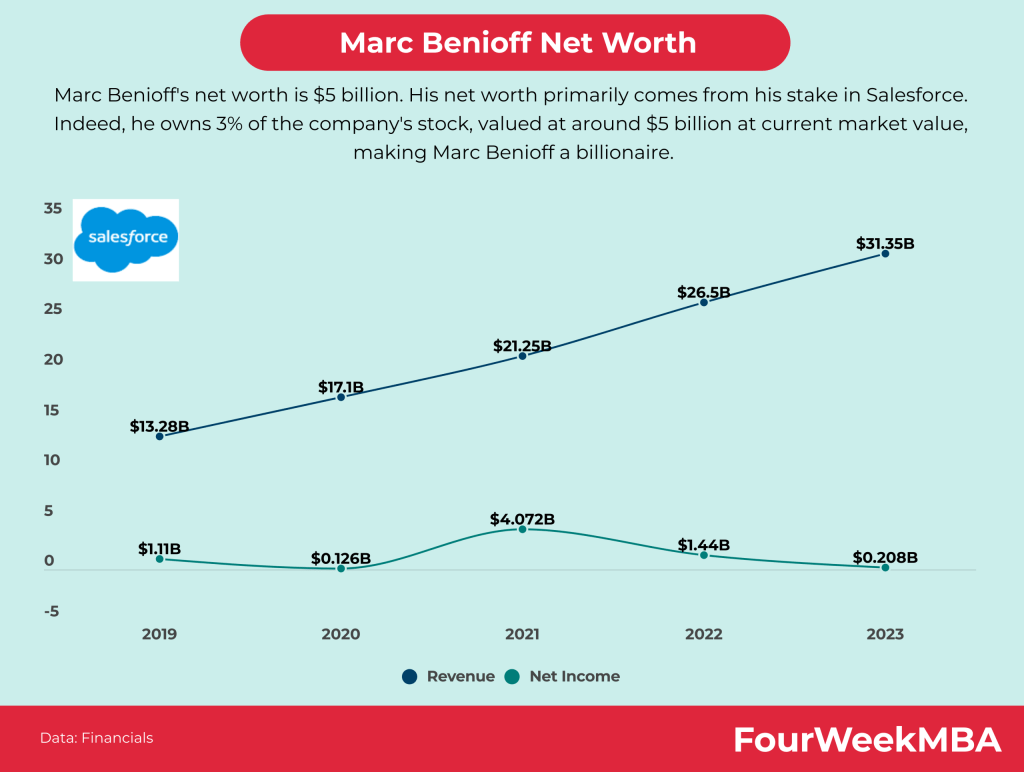
Marc Benioff’s net worth is $5 billion. His net worth primarily comes from his stake in Salesforce. Indeed, he owns 3% of the company’s stock, valued at around $5 billion at current market value, making Marc Benioff a billionaire.
Reed Hastings is the co-founder, former CEO, and now executive chairman of Netflix. He’s also one of the major shareholders, with 1.7% ownership in the company, valued at $2.4 billion at the current rate.
Evan Thomas Spiegel is the co-founder and CEO of Snapchat. He’s also the main shareholder. Indeed, he both owns and controls Snapchat, and his stake in the company is currently valued at around $3 billion.
Brian Chesky is an industrial designer and businessman who is also Airbnb’s co-founder and current CEO. Since the company was founded in 2007, Chesky has been in charge of it, amassing a net worth of about $10 billion, thanks to his shares in the company.
Phil Knight, the founder of Nike, controls the company via a personal stake of shares for 7% ownership, plus the shares held via the family’s owned Swoosh, LLC, in addition to the shares in possession of his son’s Trust. Phil Knight directly controls a significant stake in Nike’s Class A and B shares, valued at over $40 billion.
Michale Jordan is a billionaire but doesn’t own the Jordan brand, which is part of Nike. Yet, he gets 5% royalties on the sales of Jordan. For instance, as of May 31, 2022, Nike had endorsement contract obligations of $7.6 billion, of which over $250 million were to be paid out to Michael Jordan as royalties on the sales of Jordan in 2022 (the company made over 5$ billion in sales in that year). We estimated that between 2018-2022 alone, Nike paid (or is paying) Michael Jordan almost one billion dollars in royalties for Jordan’s brand sales.
Kevin Plank is Under Armour’s primary owner and founder, of which he’s also chairman. His stake in the company is worth over a billion dollars at current market value, making him a billionaire.
Gennaro is the creator of FourWeekMBA, which reached about four million business people, comprising C-level executives, investors, analysts, product managers, and aspiring digital entrepreneurs in 2022 alone | He is also Director of Sales for a high-tech scaleup in the AI Industry | In 2012, Gennaro earned an International MBA with emphasis on Corporate Finance and Business Strategy.