The low-ball technique is a persuasive tactic used in sales and negotiation to secure compliance by initially presenting an attractive offer, then changing the terms or raising the cost after commitment. The low-ball technique capitalizes on these psychological tendencies to influence decision-making and secure compliance from individuals. The low-ball technique relies on the target's desire to maintain consistency and avoid cognitive dissonance by rationalizing their decision to comply with the revised terms.
Step-by-Step Process
1
Initial Attraction : The persuader presents an appealing offer or proposal to the target, enticing…
2
Commitment : Once the target expresses interest or agreement with the initial offer, they make a…
3
Change in Terms : After commitment is secured, the persuader reveals additional terms or conditions…
4
Justification and Compliance : Faced with the discrepancy between the initial commitment and the…
Real-World Examples
AmazonFacebookIbmLinkedinPalantirTarget
Key Insight
The low-ball technique is a persuasive tactic used in sales and negotiation to secure compliance by initially presenting an attractive offer, then changing the terms or raising the cost after commitment.
Exec Package + Claude OS Master Skill | Business Engineer Founding Plan
FourWeekMBA x Business Engineer | Updated 2026
The low-ball technique is a persuasive tactic used in sales and negotiation to secure compliance by initially presenting an attractive offer, then changing the terms or raising the cost after commitment.
Theoretical Underpinnings:
The low-ball technique operates on principles of cognitive dissonance and commitment:
Cognitive Dissonance: When individuals commit to an initial decision or agreement, they experience discomfort if subsequent changes challenge their commitment. This discomfort motivates them to justify and maintain their initial choice, even if conditions change.
Commitment and Consistency: People have a strong desire to appear consistent in their attitudes and behaviors. Once committed to an initial decision, they are more likely to comply with subsequent requests or changes that align with their prior commitment to maintain consistency.
The low-ball technique capitalizes on these psychological tendencies to influence decision-making and secure compliance from individuals.
Mechanisms of the Low-Ball Technique:
The low-ball technique unfolds in several steps:
Initial Attraction: The persuader presents an appealing offer or proposal to the target, enticing them to commit to a decision or course of action. This offer is designed to capture the target’s interest and elicit a positive response.
Commitment: Once the target expresses interest or agreement with the initial offer, they make a commitment, often verbally or through a small action. This commitment establishes a psychological bond between the target and the persuader, making the target more likely to comply with subsequent requests.
Change in Terms: After commitment is secured, the persuader reveals additional terms or conditions that alter the original offer. These changes may include raising the price, adding fees, or imposing constraints that were not initially disclosed to the target.
Justification and Compliance: Faced with the discrepancy between the initial commitment and the revised terms, the target rationalizes their decision to maintain consistency and complies with the changes. This rationalization process may involve justifying the increased cost or accepting the additional conditions as necessary.
The low-ball technique relies on the target’s desire to maintain consistency and avoid cognitive dissonance by rationalizing their decision to comply with the revised terms.
Practical Applications:
The low-ball technique is employed in various contexts, including:
Sales and Marketing: Salespeople use the low-ball technique to secure commitments from customers by initially offering low prices or attractive terms, then revising the offer with add-ons or hidden costs after commitment. This tactic is common in industries such as automotive sales, real estate, and retail.
Negotiation: Negotiators employ the low-ball technique to gain concessions from counterparts during negotiations. By first proposing favorable terms or concessions, then adjusting the terms in their favor once the other party commits to the negotiation process, negotiators can influence the outcome in their favor.
Recruitment and Compliance: Employers and authorities may use the low-ball technique to secure compliance from individuals, such as employees or citizens. By initially offering appealing incentives or benefits, then introducing additional requirements or obligations after commitment, employers and authorities can influence behavior and ensure compliance with their requests.
Ethical Considerations:
The low-ball technique raises ethical concerns regarding:
Transparency: Concealing relevant information or changing terms after commitment violates principles of transparency and honesty. By withholding important details or introducing unexpected changes, persuaders undermine trust and integrity in interpersonal relationships and transactions.
Manipulation: Exploiting cognitive biases and psychological mechanisms to influence decision-making without the target’s full awareness or consent constitutes manipulation. When individuals are influenced to make decisions that are not in their best interest or based on incomplete information, their autonomy and agency are compromised.
Long-term Relationships: Employing deceptive tactics like the low-ball technique can damage long-term relationships and reputations. When targets feel deceived or exploited after discovering the discrepancy between the initial offer and the revised terms, trust and goodwill are eroded, making future interactions more difficult.
Mitigating Ethical Concerns:
To address ethical concerns associated with the low-ball technique, practitioners can:
Maintain Transparency: Be transparent and upfront about all terms, conditions, and potential changes before securing commitment. By providing complete and accurate information upfront, persuaders empower targets to make informed decisions and avoid surprises or misunderstandings later on.
Respect Autonomy: Respect individuals’ autonomy and right to make informed choices by providing them with the freedom to reconsider or withdraw their commitment if circumstances change. Persuaders should avoid pressuring or coercing targets into decisions they may later regret.
Focus on Long-term Relationships: Prioritize building trust and fostering long-term relationships based on honesty, integrity, and mutual respect. By emphasizing open communication, fairness, and accountability in interpersonal interactions, persuaders can establish a foundation of trust that benefits both parties in the long run.
Key Highlights
Theoretical Underpinnings: The low-ball technique leverages cognitive dissonance theory, where individuals strive for internal consistency, and commitment and consistency principles, which highlight the human tendency to stick to initial decisions to maintain this consistency.
Mechanisms of the Low-Ball Technique: It begins with an enticing offer, securing commitment from the target, and then altering the terms or conditions in favor of the persuader. This change prompts the target to justify their commitment to maintain cognitive consistency.
Practical Applications: Widely used in sales, marketing, negotiation, recruitment, and compliance scenarios. For example, in sales, a car dealer might initially offer a low price to entice a buyer, then reveal additional fees or costs after the buyer has mentally committed to the purchase.
Ethical Considerations: The low-ball technique raises ethical concerns due to its deceptive nature and potential manipulation of individuals. By not disclosing all relevant information upfront, it undermines transparency and may lead to feelings of exploitation or mistrust.
Mitigating Ethical Concerns: Practitioners can mitigate ethical issues by prioritizing transparency, respecting individuals’ autonomy to make informed decisions, and fostering long-term relationships built on honesty and mutual respect. This includes disclosing all terms upfront and allowing individuals the freedom to reconsider their commitments if circumstances change.
Related Frameworks
Description
When to Apply
Low-Ball Technique
Low-Ball Technique is a persuasion tactic where an initial commitment is made, followed by the addition of extra costs or requirements after commitment. This makes it difficult for the other party to withdraw.
When you want to secure a commitment or sale, then increase the cost or requirements to make backing out less appealing.
Foot-in-the-Door
Foot-in-the-Door involves getting a person to agree to a small request to increase the likelihood of them agreeing to a larger request later.
When aiming to gain compliance or agreement from someone, start with a small request before presenting a larger one.
Door-in-the-Face
Door-in-the-Face begins with a large request, which is likely to be rejected, followed by a smaller, more reasonable request.
When you want to increase the likelihood of agreement to a smaller request by presenting a larger, less reasonable one first.
Reciprocity
Reciprocity relies on the idea that people are more likely to comply with a request if they feel they owe something to the requester.
When seeking compliance or favors from others, offer something first to trigger a sense of obligation.
Scarcity
Scarcity involves highlighting the limited availability of a product or service to increase its perceived value and desirability.
When marketing a product or service, emphasize its limited availability to drive demand.
Social Proof
Social Proof leverages the influence of peer behavior to persuade individuals to adopt similar behavior.
When trying to persuade individuals, show evidence of others’ similar actions or beliefs to influence their decision-making.
Authority
Authority relies on the credibility and expertise of a person or entity to influence others’ beliefs or behaviors.
When seeking to persuade others, demonstrate your expertise or cite credible sources to bolster your argument.
Contrast Principle
Contrast Principle exploits the tendency of individuals to perceive differences between two presented items more distinctly than if presented separately.
When presenting options or prices, arrange them in a way that accentuates differences to influence decision-making.
Commitment and Consistency
Commitment and Consistency suggests that once a person commits to a position or decision, they are more likely to adhere to it to maintain consistency.
When seeking compliance or agreement, get individuals to commit to a small initial action or belief to increase the likelihood of further agreement.
Fear Appeals
Fear Appeals use the threat of negative consequences to motivate behavior change or compliance.
When aiming to persuade individuals, highlight potential negative outcomes to encourage desired actions or behaviors.
Business development comprises a set of strategies and actions to grow a business via a mixture of sales, marketing, and distribution. While marketing usually relies on automation to reach a wider audience, and sales typically leverage a one-to-one approach. The business development’s role is that of generating distribution.
The more you move from consumers to enterprise clients, the more you’ll need a sales force able to manage complex sales. As a rule of thumb, a more expensive product, in B2B or Enterprise, will require an organizational structure around sales. An inexpensive product to be offered to consumers will leverage on marketing.
A sales cycle is the process that your company takes to sell your services and products. In simple words, it’s a series of steps that your sales reps need to go through with prospects that lead up to a closed sale.
RevOps – short for Revenue Operations – is a framework that aims to maximize the revenue potential of an organization. RevOps seeks to align these departments by giving them access to the same data and tools. With shared information, each then understands their role in the sales funnel and can work collaboratively to increase revenue.
In negotiation theory, BATNA stands for “Best Alternative To a Negotiated Agreement,” and it’s one of the key tenets of negotiation theory. Indeed, it describes the best course of action a party can take if negotiations fail to reach an agreement. This simple strategy can help improve the negotiation as each party is (in theory) willing to take the best course of action, as otherwise, an agreement won’t be reached.
In negotiation, WATNA stands for “worst alternative to a negotiated agreement,” representing one of several alternative options if a resolution cannot be reached. This is a useful technique to help understand what might be a negotiation outcome, that even if negative is still better than a WATNA, making the deal still feasible.
The ZOPA (zone of possible agreement) describes an area in which two negotiation parties may find common ground. Indeed, ZOPA is critical to explore the deals where the parties get a mutually beneficial outcome to prevent the risk of a win-lose, or lose-win scenario. And therefore get to the point of a win-win negotiation outcome.
Revenue modeling is a process of incorporating a sustainable financial model for revenue generation within a business model design. Revenue modeling can help to understand what options make more sense in creating a digital business from scratch; alternatively, it can help in analyzing existing digital businesses and reverse engineer them.
Customer experience maps are visual representations of every encounter a customer has with a brand. On a customer experience map, interactions called touchpoints visually denote each interaction that a business has with its consumers. Typically, these include every interaction from the first contact to marketing, branding, sales, and customer support.
AIDA stands for attention, interest, desire, and action. That is a model that is used in marketing to describe the potential journey a customer might go through before purchasing a product or service. The AIDA model helps organizations focus their efforts when optimizing their marketing activities based on the customers’ journeys.
Social selling is a process of developing trust, rapport, and a relationship with a prospect to enhance the sales cycle. It usually happens through tech platforms (like LinkedIn, Twitter, Facebook, and more), which enable salespeople to engage with potential prospects before closing the sale, thus becoming more effective.
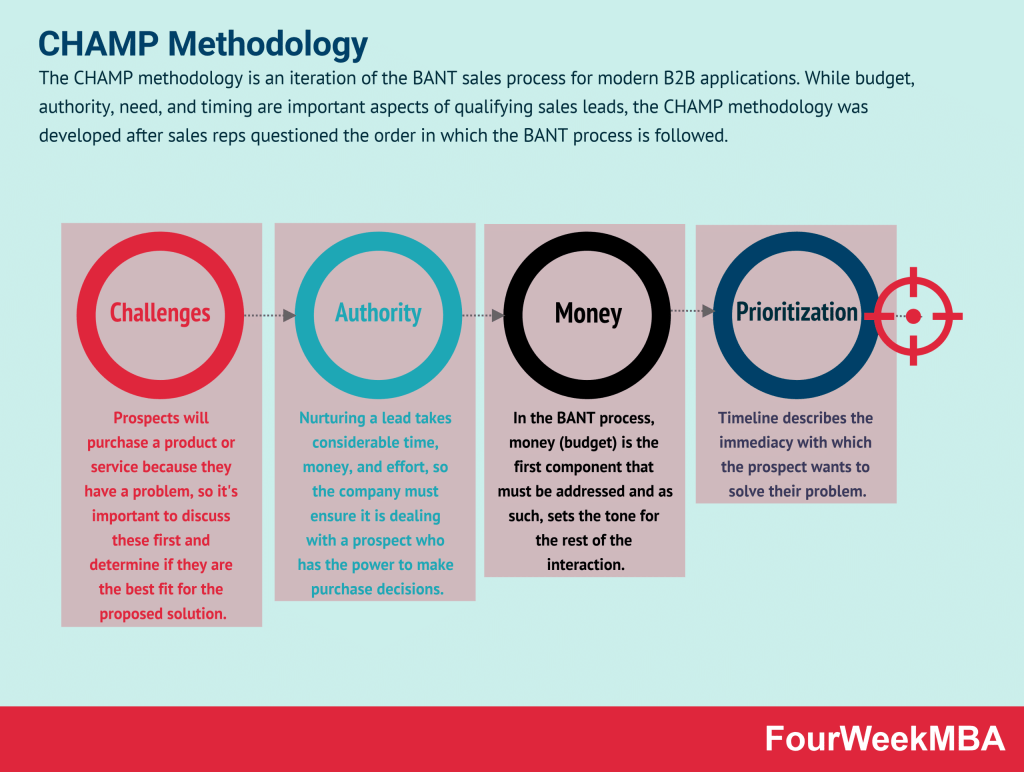
The CHAMP methodology is an iteration of the BANT sales process for modern B2B applications. While budget, authority, need, and timing are important aspects of qualifying sales leads, the CHAMP methodology was developed after sales reps questioned the order in which the BANT process is followed.
The BANT process was conceived at IBM in the 1950s as a way to quickly identify prospects most likely to make a purchase. Despite its introduction around 70 years ago, the BANT process remains relevant today and was formally adopted into IBM’s Business Agility Solution Identification Guide.
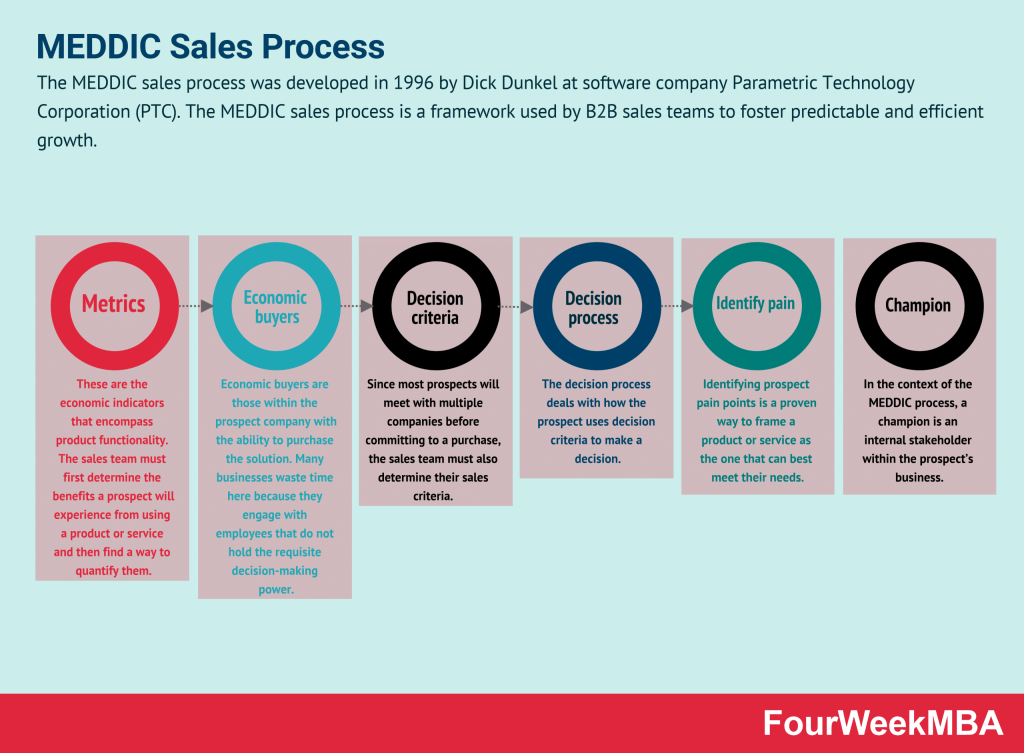
The MEDDIC sales process was developed in 1996 by Dick Dunkel at software company Parametric Technology Corporation (PTC). The MEDDIC sales process is a framework used by B2B sales teams to foster predictable and efficient growth.
STP marketing simplifies the market segmentation process and is one of the most commonly used approaches in modern marketing. The core focus of STP marketing is commercial effectiveness. Marketers use the approach to select the most valuable segments from a target audience and develop a product positioning strategy and marketing mix for each.
The sales funnel is a model used in marketing to represent an ideal, potential journey that potential customers go through before becoming actual customers. As a representation, it is also often an approximation, that helps marketing and sales teams structure their processes at scale, thus building repeatable sales and marketing tactics to convert customers.
Venture capitalist, Dave McClure, coined the acronym AARRR which is a simplified model that enables to understand what metrics and channels to look at, at each stage for the users’ path toward becoming customers and referrers of a brand.
The general concept of Bootstrapping connects to “a self-starting process that is supposed to proceed without external input.” In business, Bootstrapping means financing the growth of the company from the available cash flows produced by a viable businessmodel. Bootstrapping requires the mastery of the key customers driving growth.
The virtuous cycle is a positive loop or a set of positive loops that trigger a non-linear growth. Indeed, in the context of digital platforms, virtuous cycles – also defined as flywheel models – help companies capture more market shares by accelerating growth. The classic example is Amazon’s lower prices driving more consumers, driving more sellers, thus improving variety and convenience, thus accelerating growth.
Business storytelling is a critical part of developing a businessmodel. Indeed, the way you frame the story of your organization will influence its brand in the long-term. That’s because your brand story is tied to your brand identity, and it enables people to identify with a company.
Enterprise sales describes the procurement of large contracts that tend to be characterized by multiple decision-makers, complicated implementation, higher risk levels, or longer sales cycles.
Outside sales occur when a salesperson meets with prospects or customers in the field. This sort of sales function is critical to acquire larger accounts, like enterprise customers, for which the acquisition process is usually longer, more complex and it requires the understanding of the target organization. Thus the outside sales will cut through the noise to acquire a large enterprise account for the organization.
A freeterprise is a combination of free and enterprise where free professional accounts are driven into the funnel through the free product. As the opportunity is identified the company assigns the free account to a salesperson within the organization (inside sales or fields sales) to convert that into a B2B/enterprise account.
Zero to One is a book by Peter Thiel. But it also represents a business mindset, more typical of tech, where building something wholly new is the default mode, rather than building something incrementally better. The core premise of Zero to One then is that it’s much more valuable to create a whole new market/product rather than starting from existing markets.
Palantir is a software company offering intelligence services from governments and institutions to large commercial organizations. The company’s two main platforms Gotham and Foundry, are integrated at enterprise-level. Its business model follows three phases: Acquire, Expand, and Scale. The company bears the pilot costs in the acquire and expand phases, and it runs at a loss. Where in the scale phase, the customers’ contribution margins become positive.
Consultative selling is a sales approach favoring relationship building and open dialogue to adequately meet the needs of a prospective customer. By building trust quickly a consultative selling approach can help the customer better meet her/his expectations and the salesperson hit her/his targets more effectively.
A unique selling proposition (USP) enables a business to differentiate itself from its competitors. Importantly, a USP enables a business to stand for something that they, in turn, become known among consumers. A strong and recognizable USP is crucial to operating successfully in competitive markets.
What are the key components of Low-Ball Technique?
The key components of Low-Ball Technique include Low-Ball Technique, Foot-in-the-Door, Door-in-the-Face, Reciprocity, Scarcity. Low-Ball Technique: Low-Ball Technique is a persuasion tactic where an initial commitment is made, followed by the addition of extra costs… Foot-in-the-Door: Foot-in-the-Door involves getting a person to agree to a small request to increase the likelihood of them agreeing to a…
The low-ball technique capitalizes on these psychological tendencies to influence decision-making and secure compliance from individuals.
How do you apply Low-Ball Technique in practice?
The low-ball technique relies on the target’s desire to maintain consistency and avoid cognitive dissonance by rationalizing their decision to comply with the revised terms.
Frequently Asked Questions
What is Low-Ball Technique?
The low-ball technique is a persuasive tactic used in sales and negotiation to secure compliance by initially presenting an attractive offer, then changing the terms or raising the cost after commitment. The low-ball technique capitalizes on these psychological tendencies to influence decision-making and secure compliance from individuals.
Gennaro is the creator of FourWeekMBA, which reached about four million business people, comprising C-level executives, investors, analysts, product managers, and aspiring digital entrepreneurs in 2022 alone | He is also Director of Sales for a high-tech scaleup in the AI Industry | In 2012, Gennaro earned an International MBA with emphasis on Corporate Finance and Business Strategy.
Scroll to Top
Discover more from FourWeekMBA
Subscribe now to keep reading and get access to the full archive.