facebook-losses

Facebook Losses: The Mounting Costs of Building A Flawed Metaverse

As of 2023, Facebook rebranded as Meta, is a profitable company, generating over $39 billion in profits (recouping from the massive slow-down in 2022). Yet, if we look at its Reality Labs segment, which is in charge of building the Metaverse, it recorded an operating loss of over $16 billion for 2023, with revenues of less than $2 billion, representing less than 1.5% of total revenues for Meta.

For all its life, Facebook has been a printing machine.

Yet, by 2022, as Facebook rebranded into Meta and tried to build a Metaverse relentlessly, it burned billions in the process.

By 2021, Reality Labs, Facebook’s segment tackling the Metaverse, had recorded over $10 billion in losses. And things are getting worse for 2022.

The attempt to build the Metaverse has changed the whole cost structure of Facebook, which moved from being a printing machine to burning billions.

A key note here, in 2021, Facebook (Meta) was still a printing machine, generating over $39 billion in profits.

Yet, in 2022, profits slew down substantially to $23.2B (a massive slowdown compared to $39.37 in net profits in 2021), primarily due to the incredible expenses Meta is carrying for the development of the Reality Labs segment.

In 2023, things are back on track, from a financial standpoint for the overall Meta’s ecosystem, but the reality labs segment is still lagging behind!

In fact, in 2023, Meta focused on efficiency, and it brought back its profitability.

facebook-profitability
Facebook (Meta) revenue in 2023 increased to $134.9B, compared to $116.6B in 2022. Its profitability increased to $39.1B in 2023, compared to $23.2B in 2022 and $39.37B in 2021.

Just a little back than a year ago, on October 28, 2021, Facebook officially announced its rebranding into Meta! 

As I’ve highlighted time and time again. At the same time, Zuckerberg did have a vision of VR as the upcoming business platform since 2014 (when it bought Oculus).

The rebranding of Facebook into Meta was a survival move 

With Apple tightening its mobile pipeline with its iOS update (after the change, users need to explicitly opt-in to track instead of being opted-in by default – and most users don’t opt-in to tracking). 

This created the foundation to kill the whole Facebook advertising machine. Facebook tries to cut costs, pressed by Wall Street, and it does that by sending home 11,000 employees. However…

facebook-layoffs
In March 2023, Facebook (Meta) announced a further round of 10,000 layoffs due to a complete shift in focus for the company and an attempt to bring back a flatter and more efficient organization in what Mark Zuckerberg dubbed as “The Year of Efficiency.” By the end of 2023, Facebook (Meta) had 67,317 employees compared to 86,482 in 2022, thus a reduction in headcount of 19,165 or 22% of the workforce!

This, to me, seems a facade, as the company isn’t planning to cut capital expenditures for the Metaverse, quite the opposite!

In the latest financial releases, Meta projected over $39 billion in capital expenditures by 2023, most of which might be attributable to the expenses to build the Metaverse!

facebook-capital-expenditure

What’s the key issue here? 

I understand that building the Metaverse is not simple and requires a massive amount of resources.

However, it seems that Zuckerberg is falling into the “Bill Gates’ Superhighway trap!”

In other words, instead of building the Metaverse with a bottom-up approach by enabling users’ adoption, Meta is implementing the top-down vision that Zuckerberg has about the Metaverse.

This, to me, seems like the colossal mistake Bill Gates made in the 1990s with the Information Superhighway…

What happened there?

Back in the mid-90s, when the commercial Internet was finally taking over, most luminaries, gurus, and tech experts projected it as a sort of Information Superhighway. 

The vision was about an “interactive entertainment center” (think of it as TV online).

While by 1995, Microsoft had tried to rewrite business history, as if Bill Gates and his company had fully grasped the Internet phenomenon. In reality, things looked quite different!

As explained by Jim Clark (co-founder of Netscape) in his book “Netscape Time: The Making of the Billion-Dollar Start-Up That Took on Microsoft,” in 1994, Netscape was launching the browser which would conquer the whole browser market share, thus, becoming, for a short period, the Internet!

In the same year, Microsoft was still trying to figure things out.

Only in late 1995, a few Internet years later (since one year in the real world seemed like seven years in the Internet early stage) did Microsoft understand that the commercial killer application was the Browser (Microsoft bought the code of Mosaic and built a first, scrappy version, of Internet Explorer).

Microsoft, a native player of the PC era, had risen during the 1970s when Intel had created a whole new industry. Thanks to Intel’s family of chips, with the development of the 8080 – led by Federico Faggin – going forward, the computer industry was born.

The turning point for Microsoft came when IBM, in1980, was about to launch its IBM Personal Computer. The IBM Personal Computer, contrary to what IBM had done in its whole history, followed an open architecture.

In 1980, Microsoft partnered up with IBM to bundle Microsoft’s operating system with IBM computers. The deal was straightforward, IBM would pay Microsoft $430,000 for what would be called MS-DOS.

Microsoft, on the other hand, could license that same operating system to other PC makers beyond IBM. The microcomputer space, which in the late 1970s was dominated by Tandy, Commodore, and Apple, was taken by surprise as the IBM Personal Computer became a huge success.

Yet, by the early 1990s, IBM had lost its leadership and didn’t manage to capture the value of the PC market. Microsoft, instead, built a software platform that would give it a competitive distribution for decades! 

And yet, when the Internet came about, Microsoft managed to keep up, thanks to its massive investments and distribution strength

Read Also: Facebook Business Model

Related Visual Stories

Who Owns Facebook

who-owns-facebook
Mark Zuckerberg is the largest shareholder in the company. Zuckerberg retains ownership and control of the company. Like Google, Facebook has issued two common stocks, Class A and Class B. The holders of Class B common stocks are entitled to ten votes per share, and holders of our Class A common stocks are entitled to one vote per share. Mark Zuckerberg has a voting power of 61.1%; he’s the primary decision-maker. Other individual investors comprise Sheryl Sandberg, Christopher Cox, Marc Andreessen, Peter Thiel, Dustin Moskovitz, and Eduardo Saverin.

Facebook Business Model

facebook-business-model
Facebook, the main product of Meta is an attention merchant. As such, its algorithms condense the attention of over 2.91 billion monthly active users as of June 2021. Meta generated $117.9 billion in revenues, in 2021, of which $114.9 billion from advertising (97.4% of the total revenues) and over $2.2 billion from Reality Labs (the augmented and virtual reality products arm). 

Facebook Revenue Breakdown

facebook-revenue-breakdown

Facebook Revenues

facebook-revenue
Facebook generated most of its revenue from advertising in 2023. Indeed, the company generated $131.95B from advertising, $1.89B billion from its reality labs segment, and over a billion in other revenue.

Facebook Employees

facebook-employees
By September 2022, Facebook’s (Meta) employee count had peaked at 87,314. Yet, as revenue slew down for the first time in years, the company announced a layoff of 13% of its workforce, bringing the headcount to 75,964. By March 2023, Meta announced another round of layoffs, dubbed “The Year of Efficiency,” which brought the headcount down to less than 66 thousand employees. By the end of 2023, Facebook reported 67,317 employees.

Facebook Revenue Per Employee

facebook-revenue-per-employee
In 2022, post layoffs, Facebook generated $1,535,056 per employee, compared to $1,638,586 in 2021. In 2023, as Facebook (now Meta) completed its mass layoffs, the company reported nearly $135 billion in revenue and 67,317 employees, with a $2,003,981 revenue per employee.

Facebook MAU

is-facebook-losing-users
Facebook (Meta) gained users in 2023. In fact, in 2023, Facebook had over three billion users worldwide, of which 272 million were in Canada, 408 million were in Europe, over 1.3 billion were in Asia, and over a billion were in the rest of the world.

Facebook ARPU

facebook-arpu-2023
ARPU, or average revenue per user, is a crucial metric for attention merchants like Facebook. It assesses the ability of the platform to monetize its users. For instance, by the end of 2023, Meta’s ARPU worldwide was $13.12. In the US & Canada, it was $68.44; in Europe, it was $23.14; in Asia-Pacific, $5.52; and in the rest of the world, it was $4.50.

Facebook ARPU 2010-2023

facebook-arpu
ARPU, or average revenue per user, is a crucial metric for attention merchants like Facebook. It assesses the ability of the platform to monetize its users. For instance, by the end of 2023, Meta’s ARPU worldwide was $13.12. In the US & Canada, it was $68.44; in Europe, it was $23.14; in Asia-Pacific, $5.52; and in the rest of the world, it was $4.50.

Facebook Profitability

facebook-profitability
Facebook (Meta) revenue in 2023 increased to $134.9B, compared to $116.6B in 2022. Its profitability increased to $39.1B in 2023, compared to $23.2B in 2022 and $39.37B in 2021.

Facebook Statistics

facebook-statistics

Facebook Organizational Structure

facebook-organizational-structure
Facebook is characterized by a multi-faceted matrix organizational structure. The company utilizes a flat organizational structure in combination with corporate function-based teams and product-based or geographic divisions. The flat organization structure is organized around the leadership of Mark Zuckerberg, and the key executives around him. On the other hand, the function-based teams based on the main corporate functions (like HR, product management, investor relations, and so on).

Instagram Business Model

instagram-business-model
Instagram makes money via visual advertising. Acquired by Facebook for a billion-dollar in 2012, today, Instagram is integrated into the overall Facebook (now rebranded as Meta) business strategy. In 2018, Instagram founders Kevin Systrom and Mike Krieger left the company as Facebook pushed toward tighter integration of the two platforms. In 2022, Instagram is the most successful product still, in Meta’s portfolio.

WhatsApp Business Model

how-does-whatsapp-make-money
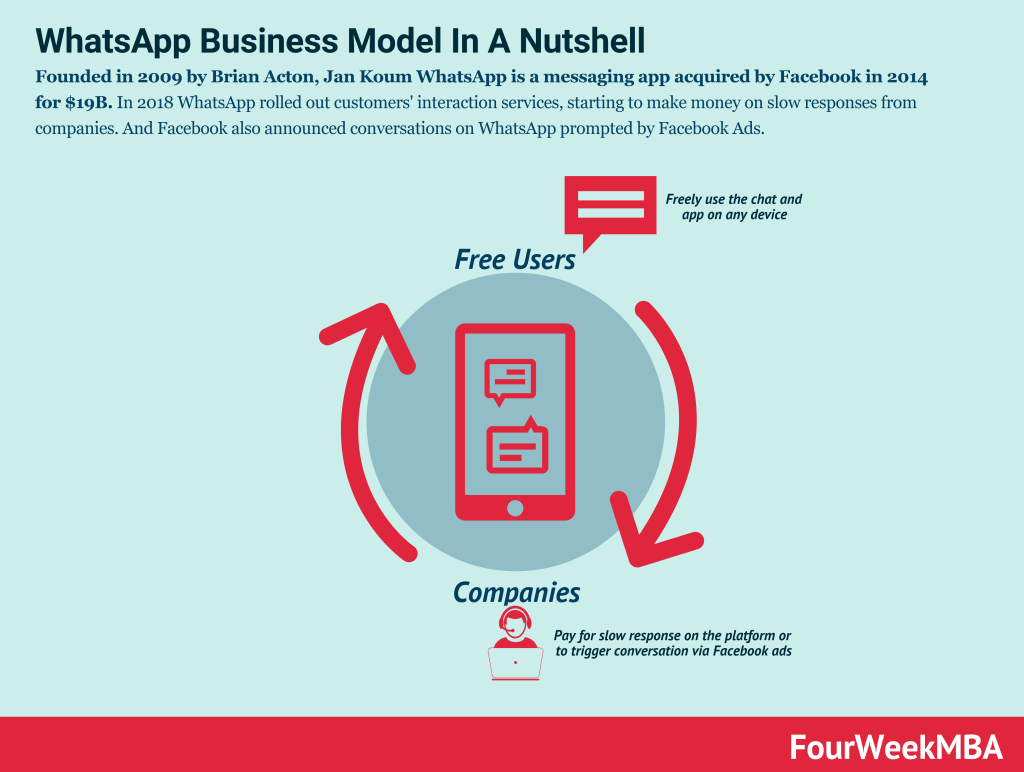
Founded in 2009 by Brian Acton, Jan Koum WhatsApp is a messaging app acquired by Facebook in 2014 for $19B. In 2018 WhatsApp rolled out customers’ interaction services, starting to make money on slow responses from companies. And Facebook also announced conversations on WhatsApp prompted by Facebook Ads.
Scroll to Top

Discover more from FourWeekMBA

Subscribe now to keep reading and get access to the full archive.

Continue reading

FourWeekMBA