Facebook Failures

Failed Project/ProductDescription and PurposeKey Reasons for FailureLessons Learned (if any)
Facebook HomeA launcher app for Android smartphones.Low user adoption and limited device compatibility.The importance of offering value across a wide range of devices and addressing user preferences effectively.
Facebook DealsA location-based deals and discounts platform.Shutdown due to limited user interest and competition.The need for creating compelling value propositions and staying competitive in the deals and discounts space.
Facebook SlingshotA messaging app with ephemeral content sharing.Failed to compete with Snapchat and low user engagement.The challenges of entering competitive markets and providing unique value to users.
Facebook PaperA news aggregation and content curation app.Discontinued due to low user adoption and shifting priorities.Adapting to changing market dynamics and aligning products with company objectives.
Facebook NotifyA mobile news notification app.Discontinued due to low user engagement and competition.The importance of providing valuable and relevant content, as well as addressing user engagement effectively.
Facebook QuestionsA Q&A platform similar to Quora.Phased out due to low usage and competition.Evaluating the sustainability and user engagement potential of Q&A platforms in a competitive landscape.
Facebook GiftsA service for sending physical gifts to friends.Shutdown due to low adoption and competition.Assessing the market viability and demand for services like gift sending within social networks.
Facebook PokeA messaging app for sending ephemeral messages.Failed to compete with Snapchat and lacked user engagement.Recognizing when to pivot or discontinue products in the face of strong competition and changing user preferences.
Facebook MarketplaceAn online classified ads platform for buying and selling.Discontinued due to low user engagement and competition.The need to provide compelling value and address user needs effectively in the online marketplace space.
Facebook Graph SearchA semantic search engine for finding information within Facebook.Restructured and deprioritized due to limited user adoption.Aligning product development with user behavior and evolving user expectations.
Facebook CreditsA virtual currency for in-app purchases on Facebook.Phased out due to limited usage and transition to local currencies.Understanding the evolving payment preferences and regulations in virtual currency markets.
Facebook SpacesA virtual reality social networking platform.Discontinued due to limited adoption and shifting priorities.Adapting to the evolving virtual reality landscape and user preferences, as well as aligning with company objectives.
Facebook TickerA real-time news feed of friends’ activities.Phased out due to low user engagement and redesigns.Recognizing the importance of user engagement and staying attuned to changing user preferences in social networking.
Facebook RiffA collaborative video creation app.Failed to gain widespread adoption and user interest.The challenges of creating unique value propositions and fostering collaboration in the mobile app space.
Facebook CampusA college-focused social networking platform.Shutdown due to limited user engagement and competition.The need to resonate with specific user demographics and adapt to changing preferences among college students.
Facebook LifestageA video-centric social networking app for teens.Discontinued due to limited adoption and low usage.The importance of understanding the target audience and providing features that align with their preferences and behaviors.
Facebook M (Messenger AI)A digital assistant within Messenger for tasks and recommendations.Ceased due to limited scalability and shifting priorities.Evaluating the scalability and practicality of AI-driven digital assistants and aligning them with company goals.
Facebook AquilaA high-altitude, solar-powered drone for internet connectivity.Project canceled due to technical challenges and feasibility concerns.The need to assess the practicality and feasibility of ambitious projects in the context of emerging technologies.
Facebook Portal TVA smart video calling device for TVs.Limited adoption and concerns over privacy and data collection.Addressing privacy concerns effectively and building trust with users in the smart device market.

Read Also: Facebook Business Model

Related Visual Stories

Who Owns Facebook

who-owns-facebook
Mark Zuckerberg is the largest shareholder in the company. Zuckerberg retains ownership and control of the company. Like Google, Facebook has issued two common stocks, Class A and Class B. The holders of Class B common stocks are entitled to ten votes per share, and holders of our Class A common stocks are entitled to one vote per share. Mark Zuckerberg has a voting power of 61.1%; he’s the primary decision-maker. Other individual investors comprise Sheryl Sandberg, Christopher Cox, Marc Andreessen, Peter Thiel, Dustin Moskovitz, and Eduardo Saverin.

Facebook Business Model

facebook-business-model
Facebook, the main product of Meta is an attention merchant. As such, its algorithms condense the attention of over 2.91 billion monthly active users as of June 2021. Meta generated $117.9 billion in revenues, in 2021, of which $114.9 billion from advertising (97.4% of the total revenues) and over $2.2 billion from Reality Labs (the augmented and virtual reality products arm). 

Facebook Revenue Breakdown

facebook-revenue-breakdown

Facebook Revenues

facebook-revenue
Facebook generated most of its revenue from advertising in 2023. Indeed, the company generated $131.95B from advertising, $1.89B billion from its reality labs segment, and over a billion in other revenue.

Facebook Employees

facebook-employees
By September 2022, Facebook’s (Meta) employee count had peaked at 87,314. Yet, as revenue slew down for the first time in years, the company announced a layoff of 13% of its workforce, bringing the headcount to 75,964. By March 2023, Meta announced another round of layoffs, dubbed “The Year of Efficiency,” which brought the headcount down to less than 66 thousand employees. By the end of 2023, Facebook reported 67,317 employees.

Facebook Revenue Per Employee

facebook-revenue-per-employee
In 2022, post layoffs, Facebook generated $1,535,056 per employee, compared to $1,638,586 in 2021. In 2023, as Facebook (now Meta) completed its mass layoffs, the company reported nearly $135 billion in revenue and 67,317 employees, with a $2,003,981 revenue per employee.

Facebook MAU

is-facebook-losing-users
Facebook (Meta) gained users in 2023. In fact, in 2023, Facebook had over three billion users worldwide, of which 272 million were in Canada, 408 million were in Europe, over 1.3 billion were in Asia, and over a billion were in the rest of the world.

Facebook ARPU

facebook-arpu-2023
ARPU, or average revenue per user, is a crucial metric for attention merchants like Facebook. It assesses the ability of the platform to monetize its users. For instance, by the end of 2023, Meta’s ARPU worldwide was $13.12. In the US & Canada, it was $68.44; in Europe, it was $23.14; in Asia-Pacific, $5.52; and in the rest of the world, it was $4.50.

Facebook ARPU 2010-2023

facebook-arpu
ARPU, or average revenue per user, is a crucial metric for attention merchants like Facebook. It assesses the ability of the platform to monetize its users. For instance, by the end of 2023, Meta’s ARPU worldwide was $13.12. In the US & Canada, it was $68.44; in Europe, it was $23.14; in Asia-Pacific, $5.52; and in the rest of the world, it was $4.50.

Facebook Profitability

facebook-profitability
Facebook (Meta) revenue in 2023 increased to $134.9B, compared to $116.6B in 2022. Its profitability increased to $39.1B in 2023, compared to $23.2B in 2022 and $39.37B in 2021.

Facebook Statistics

facebook-statistics

Metaverse Mounting Costs

facebook-losses

Facebook Organizational Structure

facebook-organizational-structure
Facebook is characterized by a multi-faceted matrix organizational structure. The company utilizes a flat organizational structure in combination with corporate function-based teams and product-based or geographic divisions. The flat organization structure is organized around the leadership of Mark Zuckerberg, and the key executives around him. On the other hand, the function-based teams based on the main corporate functions (like HR, product management, investor relations, and so on).

Instagram Business Model

instagram-business-model
Instagram makes money via visual advertising. Acquired by Facebook for a billion-dollar in 2012, today, Instagram is integrated into the overall Facebook (now rebranded as Meta) business strategy. In 2018, Instagram founders Kevin Systrom and Mike Krieger left the company as Facebook pushed toward tighter integration of the two platforms. In 2022, Instagram is the most successful product still, in Meta’s portfolio.

WhatsApp Business Model

how-does-whatsapp-make-money
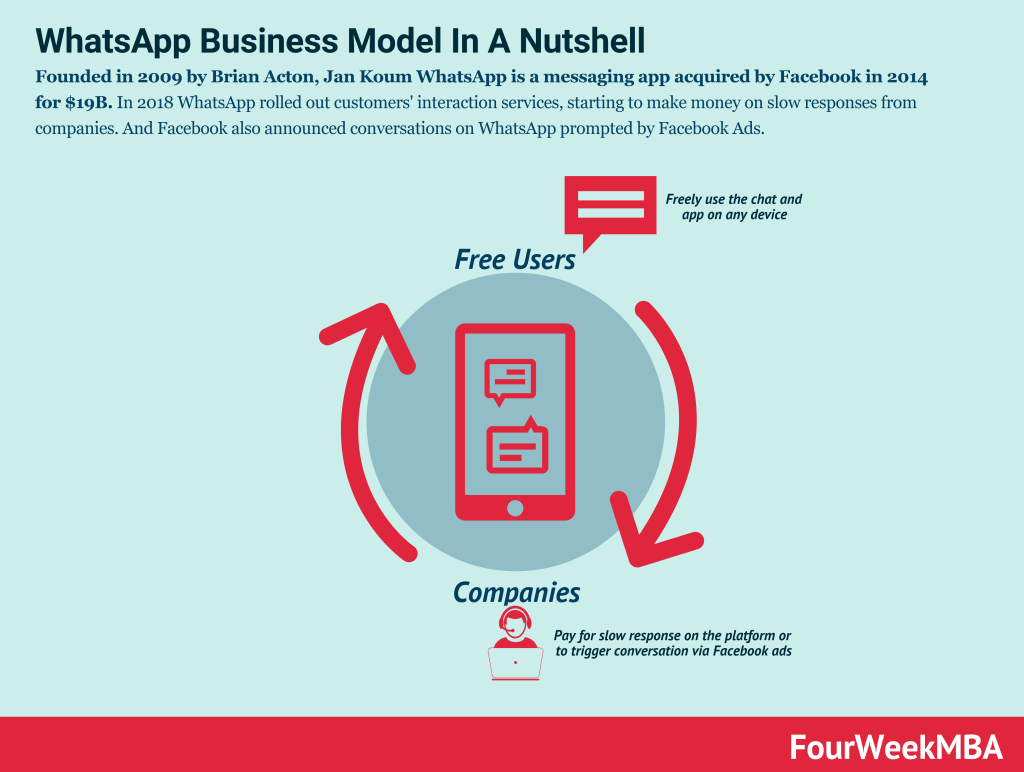
Founded in 2009 by Brian Acton, Jan Koum WhatsApp is a messaging app acquired by Facebook in 2014 for $19B. In 2018 WhatsApp rolled out customers’ interaction services, starting to make money on slow responses from companies. And Facebook also announced conversations on WhatsApp prompted by Facebook Ads.

Google Business Model

hidden-revenue-model-google
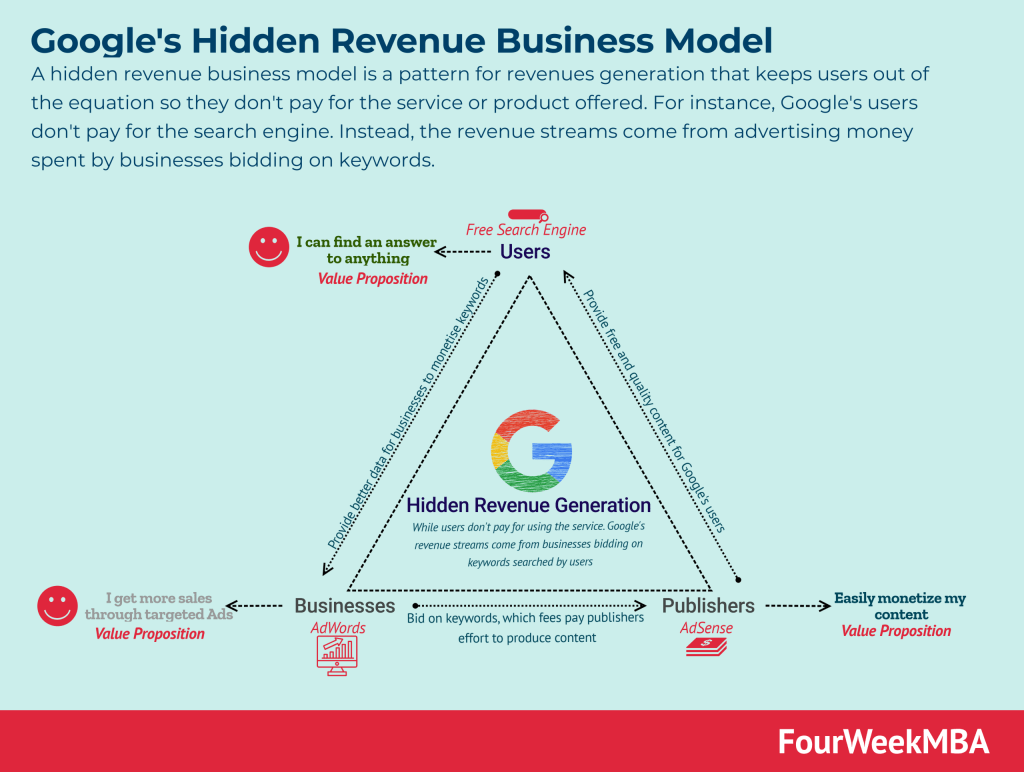
A hidden revenue business model is a pattern for revenue generation that keeps users out of the equation, so they don’t pay for the service or product offered. For instance, Google’s users don’t pay for the search engine. Instead, the revenue streams come from advertising money spent by businesses bidding on keywords.

TikTok Business Model

tiktok-business-model
TikTok is a Chinese creative social media platform driven by short-form video content enabling users to interact and generate content at scale. TikTok primarily makes money through advertising, and it generated $4.6 billion in advertising revenues in 2021, thus making it among the most popular attention-based business models or attention merchants.

Instagram Business Model

instagram-business-model
Instagram makes money via visual advertising. As part of Facebook products, the company generates revenues for Facebook Inc.’s overall business model. Acquired by Facebook for a billion dollars in 2012, today Instagram is integrated into the overall Facebook business strategy. In 2018, Instagram founders, Kevin Systrom and Mike Krieger left the company, as Facebook pushed toward tighter integration of the two platforms.

YouTube Business Model

how-does-youtube-make-money
YouTube was acquired for almost $1.7 billion in 2006 by Google. It makes money through advertising and subscription revenues. YouTube advertising network is part of Google Ads, and it generated more than $28B in revenue by 2021. YouTube also makes money with its paid memberships and premium content.

Twitter Business Model

how-does-twitter-make-money
Twitter makes money in two ways: advertising and data licensing. In 2021, Twitter generated $4.5 billion from advertising and $570 million from data licensing. While Twitter generated $5 billion in total revenues, it lost 221 million.

Scroll to Top

Discover more from FourWeekMBA

Subscribe now to keep reading and get access to the full archive.

Continue reading

FourWeekMBA