By September 2022, Facebook’s (Meta) employee count had peaked at 87,314. Yet, as revenue slew down for the first time in years, the company announced a layoff of 13% of its workforce, bringing the headcount to 75,964. By March 2023, Meta announced another round of layoffs, dubbed “The Year of Efficiency,” which brought the headcount down to less than 66 thousand employees. By the end of 2023, Facebook reported 67,317 employees.
After over-hiring for years, by November 2022, Facebook (rebranded as Meta), which advertising machine had slowed down, had to execute a massive layoff.
The largest layoff for the company to date.
In a leaked internal video, a contrived Mark Zuckerberg shares the news:
Meta laid off 13% of its staff or over eleven thousand employees!
Meta wrote his new manifesto in a new announcement, dubbed “The Year of Efficiency.”
As announced by Meta, the year of efficiency moves along a few key pillars:
Flatter is better
Leaner is better
Keep technology the main thing
Invest in tools to get more efficient
In-person time to build relationships and get more done
Before we get there, let me give you a bit of context on how we got here and what might be coming next.
Also, it is worth noticing that this manifesto that Facebook (Meta) has released is as much a tool to communicate outside the company as a tool to communicate to its employees.
In short, this is a cultural shift that Zuckerberg wants to communicate to its employees before anyone else.
Let me explain why in a bit.
In the meantime, it’s worth remembering that Facebook has undergone three core changes in its history, and one more is happening now.
In this time period, Facebook has acted as a continuous blitzscaler, trying to gain market shares as quickly as possible, killing the competition with an aggressive iterative strategy coupled with aggressive acquisitions and a fight to optimize every single user engagement metric.
In this period, Facebook managed to go from a small startup, in a Harvard dormitory, to a scale-up, able to compete against Google!
Move fast with stable infrastructure (2014-2022)
By 2014-15 Facebook had passed a billion users worldwide, becoming a de facto monopoly in the social media space.
Given the incredible influence of the company, the motto changes from “move fast and break things” to “move fast with a stable infrastructure.”
This was a key change, as it signaled to the world that while Facebook’s priority was still to move fast, it could not afford to do that by risking breaking its own infrastructure.
For a scaled company providing services to billions of users, the underlying infrastructure stability became critical.
From Facebook to Meta (2022-2023)
Zuckerberg had the conviction that VR would have become the next platform in 2014, when Facebook acquired VR maker, Oculus (which still today represents the leading product in the Reality Labs segment).
And yet Zuckerberg’s vision of the Metaverse seemed like Bill Gates’ vision for the Information Highway.
It was correct wholly but directionally missed how it would have evolved in the short term.
The same goes for the Metaverse. Zuckerberg might be right about VR becoming an important businessplatform in the future, but not how he envisioned it in the short term!
Yet, with mounting losses of Reality Labs and slowed down revenue for its VR headsets, Facebook (now rebranded as Meta), had to re-change its strategy.
The company’s cost structure completely collapsed under the weight of a Metaverse that never materialized.
The spiked expenses into the Metaverse also crashed Facebook’s profitability.
Facebook (Meta) revenue in 2023 increased to $134.9B, compared to $116.6B in 2022. Its profitability increased to $39.1B in 2023, compared to $23.2B in 2022 and $39.37B in 2021.
Again, that doesn’t mean the Metaverse is not happening, but not in the way Zuckerberg envisioned, and not on Meta!
Today, the Metaverse is happening on another platform: Roblox.
Roblox it’s so sticky that it has seen its daily active users move from 49.5 million by 2021 to almost 59 million in 2022, collectively spending engaging on the platform 12.8 billion hours!
Facebook, rebranded as Meta in 2021, is primarily owned by Mark Zuckerberg, founder, and CEO. Zuckerberg keeps tight control over the ownership and decision-making of the company. Other large individual shareholders comprise former COO Sheryl Sandberg and co-founder Eduardo Saverin. Large institutional investors include BlackRock, Vanguard, and Fidelity.
Facebook, the main product of Meta is an attention merchant. As such, its algorithms condense the attention of over 2.91 billion monthly active users as of June 2021. Meta generated $117.9 billion in revenues, in 2021, of which $114.9 billion from advertising (97.4% of the total revenues) and over $2.2 billion from Reality Labs (the augmented and virtual reality products arm).
Facebook generated most of its revenue from advertising in 2023. Indeed, the company generated $131.95B from advertising, $1.89B billion from its reality labs segment, and over a billion in other revenue.
By September 2022, Facebook’s (Meta) employee count had peaked at 87,314. Yet, as revenue slew down for the first time in years, the company announced a layoff of 13% of its workforce, bringing the headcount to 75,964. By March 2023, Meta announced another round of layoffs, dubbed “The Year of Efficiency,” which brought the headcount down to less than 66 thousand employees. By the end of 2023, Facebook reported 67,317 employees.
In 2022, post layoffs, Facebook generated $1,535,056 per employee, compared to $1,638,586 in 2021. In 2023, as Facebook (now Meta) completed its mass layoffs, the company reported nearly $135 billion in revenue and 67,317 employees, with a $2,003,981 revenue per employee.
Facebook (Meta) gained users in 2023. In fact, in 2023, Facebook had over three billion users worldwide, of which 272 million were in Canada, 408 million were in Europe, over 1.3 billion were in Asia, and over a billion were in the rest of the world.
ARPU, or average revenue per user, is a crucial metric for attention merchants like Facebook. It assesses the ability of the platform to monetize its users. For instance, by the end of 2023, Meta’s ARPU worldwide was $13.12. In the US & Canada, it was $68.44; in Europe, it was $23.14; in Asia-Pacific, $5.52; and in the rest of the world, it was $4.50.
ARPU, or average revenue per user, is a crucial metric for attention merchants like Facebook. It assesses the ability of the platform to monetize its users. For instance, by the end of 2023, Meta’s ARPU worldwide was $13.12. In the US & Canada, it was $68.44; in Europe, it was $23.14; in Asia-Pacific, $5.52; and in the rest of the world, it was $4.50.
Facebook (Meta) revenue in 2023 increased to $134.9B, compared to $116.6B in 2022. Its profitability increased to $39.1B in 2023, compared to $23.2B in 2022 and $39.37B in 2021.
As of September 2022, Facebook, rebranded as Meta, is a profitable company, generating $18.54B in net profits. Yet, if we look at its Reality Labs segment, which is in charge of building the Metaverse, it recorded a net loss of $9.44 billion in the first nine months of 2022.
Instagram makes money via visual advertising. Acquired by Facebook for a billion-dollar in 2012, today, Instagram is integrated into the overall Facebook (now rebranded as Meta) business strategy. In 2018, Instagram founders Kevin Systrom and Mike Krieger left the company as Facebook pushed toward tighter integration of the two platforms. In 2022, Instagram is the most successful product still, in Meta’s portfolio.
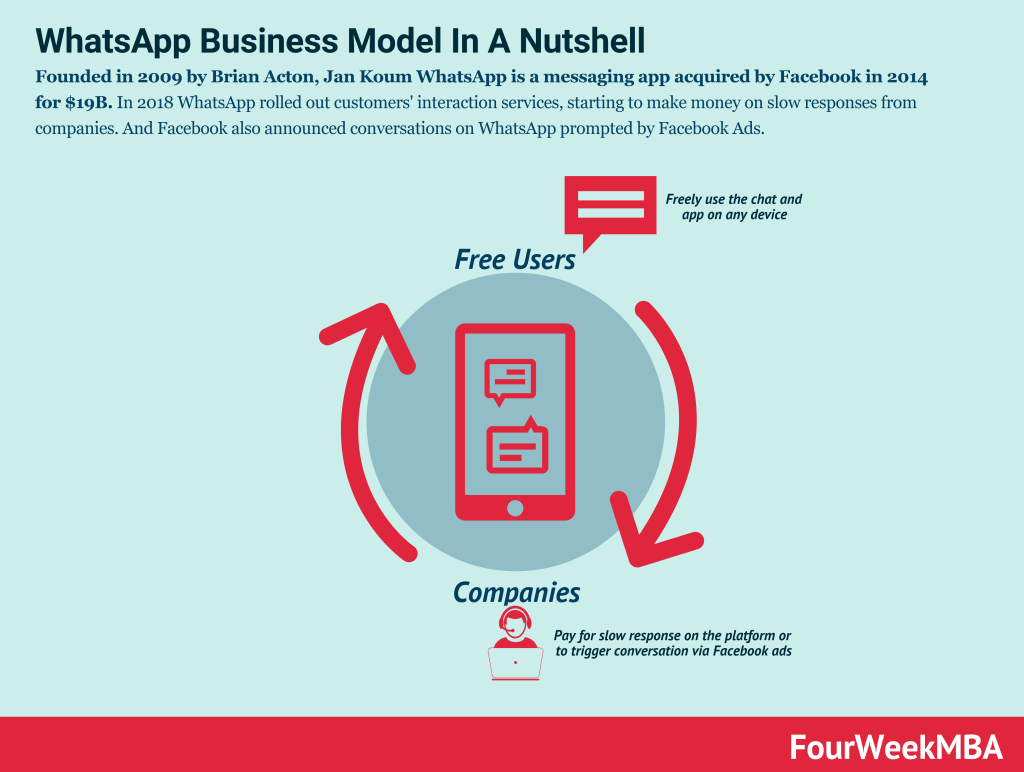
Founded in 2009 by Brian Acton, Jan Koum WhatsApp is a messaging app acquired by Facebook in 2014 for $19B. In 2018 WhatsApp rolled out customers’ interaction services, starting to make money on slow responses from companies. And Facebook also announced conversations on WhatsApp prompted by Facebook Ads.
Facebook is characterized by a multi-faceted matrix organizational structure. The company utilizes a flat organizational structure in combination with corporate function-based teams and product-based or geographic divisions. The flat organizational structure is organized around the leadership of Mark Zuckerberg and the key executives around him. On the other hand, the function-based teams are based on the main corporate functions (like HR, productmanagement, investor relations, and so on).
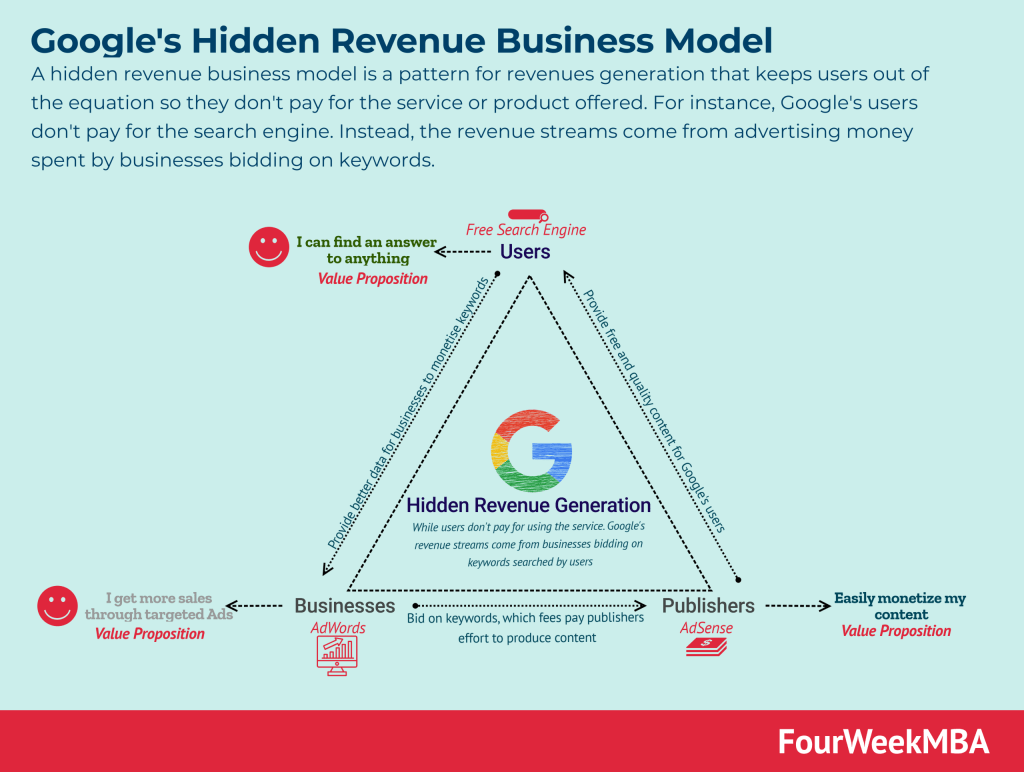
A hidden revenuebusiness model is a pattern for revenue generation that keeps users out of the equation, so they don’t pay for the service or product offered. For instance, Google’s users don’t pay for the search engine. Instead, the revenue streams come from advertising money spent by businesses bidding on keywords.
TikTok is a Chinese creative social media platform driven by short-form video content enabling users to interact and generate content at scale. TikTok primarily makes money through advertising, and it generated $4.6 billion in advertising revenues in 2021, thus making it among the most popular attention-based business models or attention merchants.
Instagram makes money via visual advertising. As part of Facebook products, the company generates revenues for Facebook Inc.’s overall businessmodel. Acquired by Facebook for a billion dollars in 2012, today Instagram is integrated into the overall Facebook business strategy. In 2018, Instagram founders, Kevin Systrom and Mike Krieger left the company, as Facebook pushed toward tighter integration of the two platforms.
YouTube was acquired for almost $1.7 billion in 2006 by Google. It makes money through advertising and subscription revenues. YouTube advertising network is part of Google Ads, and it generated more than $28B in revenue by 2021. YouTube also makes money with its paid memberships and premium content.
Twitter makes money in two ways: advertising and data licensing. In 2021, Twitter generated $4.5 billion from advertising and $570 million from data licensing. While Twitter generated $5 billion in total revenues, it lost 221 million.
Gennaro is the creator of FourWeekMBA, which reached about four million business people, comprising C-level executives, investors, analysts, product managers, and aspiring digital entrepreneurs in 2022 alone | He is also Director of Sales for a high-tech scaleup in the AI Industry | In 2012, Gennaro earned an International MBA with emphasis on Corporate Finance and Business Strategy.