The DMAIC process is a data-driven improvement cycle for optimizing and stabilizing business processes and designs.
Element
Description
Implications
Key Characteristics
Examples
Applications
Define
The first phase focuses on defining the problem or process improvement goal clearly. It involves setting project objectives, scope, and identifying stakeholders.
– Establishes a clear and specific project purpose. – Identifies stakeholders’ expectations and needs. – Defines the scope of the improvement project.
– Problem statement creation. – Project objectives and scope clarification. – Stakeholder identification.
– A manufacturing company defines a project to reduce defects in a production line. – An IT team aims to improve software deployment efficiency. – A healthcare facility defines a project to decrease patient waiting times.
– Initiate improvement projects by defining objectives, scope, and stakeholders. – Ensure alignment between project goals and organizational needs. – Create a detailed problem statement to guide improvement efforts.
Measure
In the measurement phase, relevant data is collected to understand the current state of the process or problem. It involves selecting appropriate metrics and establishing a baseline.
– Gathers data to assess the existing process. – Identifies key performance indicators (KPIs). – Establishes a baseline for measurement.
– Data collection methods and tools utilization. – Identification of relevant metrics and KPIs. – Development of data collection plans.
– Data on defect rates in the manufacturing process is collected and analyzed. – IT project metrics, such as deployment time, are measured to understand the current state. – Patient wait times are tracked and analyzed in a healthcare improvement project.
– Use data-driven approaches to understand the current state of processes. – Collect and analyze data to quantify the problem or process performance. – Establish clear measurement criteria and baselines for comparison.
Analyze
This phase involves data analysis to identify root causes of issues or inefficiencies. Statistical tools and techniques are used to explore data and discover patterns that contribute to the problem.
– Reveals underlying causes contributing to the problem. – Informs decision-making regarding improvement strategies. – Prioritizes root causes based on data-driven insights.
– Data analysis using statistical methods (e.g., regression analysis, Pareto charts). – Identification of contributing factors and root causes. – Prioritization of root causes based on impact and feasibility.
– Statistical analysis identifies specific machine settings causing defects in manufacturing. – Data analysis reveals bottlenecks in an IT process leading to delays. – Root causes of patient wait times are determined through data analysis in a healthcare setting.
– Employ statistical and analytical tools to pinpoint root causes of problems or inefficiencies. – Use data-driven insights to prioritize which issues to address first. – Develop a deep understanding of the factors contributing to the problem.
Improve
In this phase, improvement strategies and solutions are developed and implemented. The goal is to address identified root causes and make necessary process changes for improvement.
– Implements solutions to address root causes. – Measures the impact of process changes. – Iteratively tests and refines improvement strategies.
– Solution ideation and development. – Implementation of process changes. – Continuous testing and refinement of improvement strategies.
– Changes to machine settings are made in the manufacturing process to reduce defects. – Process modifications in IT reduce deployment time. – Healthcare facility implements appointment scheduling improvements to reduce patient wait times.
– Implement and test process changes and solutions to address root causes. – Continuously monitor and assess the impact of implemented improvements. – Be open to iterative adjustments to optimize the effectiveness of changes.
Control
The control phase focuses on sustaining improvements over the long term. It involves developing control plans, setting performance metrics, and implementing monitoring processes.
– Ensures that improvements are maintained and do not regress. – Establishes mechanisms for ongoing performance monitoring. – Defines responsibilities for maintaining the new process.
– Development of control plans and procedures. – Establishment of performance metrics and targets. – Implementation of monitoring and feedback systems.
– A control plan is created to maintain consistent machine settings in manufacturing. – IT implements a monitoring system to track deployment efficiency continuously. – Healthcare facility establishes performance metrics for patient wait times and assigns roles for ongoing monitoring.
– Implement control mechanisms to sustain improvements over time. – Develop clear procedures and responsibilities for maintaining the new process. – Continuously monitor performance to detect and address any deviations from desired outcomes.
Fundamentally, the DMAIC approach exists to bring structure to process improvement and problem-solving.
Indeed, it may be used to implement a new process or improve an existing process.
Every such initiative is underpinned by data collection, which makes it possible to determine whether results have improved and to what degree.
The DMAIC process is often associated with Six Sigma projects, though it is by no means limited to lean manufacturing.
Six Sigma is a data-driven approach and methodology for eliminating errors or defects in a product, service, or process. Six Sigma was developed by Motorola as a management approach based on quality fundamentals in the early 1980s. A decade later, it was popularized by General Electric who estimated that the methodology saved them $12 billion in the first five years of operation.
DMAIC is effective in many quality improvement projects, such as improving employee and customer satisfaction or launching a new product or service.
The five steps of the DMAIC process
DMAIC is an acronym of five interconnected and sequential steps:
Define (D)
Firstly, the problem, improvement activity, project goals, project team, and customer requirements must be identified.
Tools used in the first DMAIC step include stakeholder analysis, voice of the customer matrix, or high-level process map like a SIPOC diagram.
Measure (M)
This step involves data collection to establish the baseline upon which subsequent performance improvements will be measured.
What should be measured and how should it be measured? Useful tools include 6S, value stream maps, and detailed process mapping.
Analyze (A)
Here, potential problem root causes are identified and validated with a root cause analysis.
What is the magnitude of their contribution to the problem? Ideally, the team will have a list of potential root causes to investigate further.
These may be derived by using a failure mode and effects analysis, cause and effect diagrams, or simple brainstorming.
Improve (I)
The purpose of the improve step is to identify, test, and implement a solution that eliminates a root cause.
It’s important to focus on the simplest and easiest answers – there is no need to reinvent the wheel.
The PDCA (Plan-Do-Check-Act) cycle was first proposed by American physicist and engineer Walter A. Shewhart in the 1920s. The PDCA cycle is a continuous process and product improvement method and an essential component of the lean manufacturing philosophy.
Control (C)
In the final step, the project team ensures the solution is a viable long-term fix.
They must ensure the problem does not reoccur by devising a monitoring plan to track the success of the improvement. Initiatives must then be incorporated into standard operating procedures.
Once this has been achieved, the business may find value in implementing the solution in a similar project or process.
Benefits of the DMAIC process
Aside from improving projects and processes, DMAIC has many other benefits:
Discipline and structure
The DMAIC process is a highly structured approach that lets a business think through a problem systematically.
This saves it from implementing a solution before verifying whether it is likely to be successful, which can be financially costly and sometimes exacerbate the problem.
Improvement control
The fifth and final control step is also seen as an important benefit of the methodology.
In some instances, the project team discovers a solution but cannot implement it properly because of inadequate time, money, or buy-in.
DMAIC favors a strict and comprehensive control phase to identify a set of best practices likely to result in long-term success.
Reduced operating costs
Operational costs and associated risks are a major expense for many global companies.
When combined with Six Sigma principles, DMAIC reduces operating costs while minimizing risk.
These savings are instituted by shorter, standardized processes with fewer touchpoints, hand-offs, reworks, failures, and other non-value adding activities.
Drawbacks of the DMAIC Process
Complexity and Time Consumption:
Resource Intensive: Implementing the DMAIC process can be time-consuming and resource-intensive, particularly for small-scale problems.
Steep Learning Curve: Understanding and effectively applying DMAIC requires training and experience, which can be a hurdle for some organizations.
Rigidity and Inflexibility:
Structured Approach: DMAIC’s highly structured approach may not be suitable for problems that require quick, adaptive solutions.
Potential Stifling of Creativity: The emphasis on data and analysis might stifle creative problem-solving approaches that don’t fit within its framework.
Data-Dependence:
Reliance on Quantitative Data: DMAIC relies heavily on quantitative data, which may not always be available or may overlook qualitative insights.
Risk of Data Misinterpretation: Incorrect data collection or analysis can lead to misguided conclusions and actions.
Organizational Challenges:
Change Resistance: Implementing DMAIC can meet resistance in organizations that are accustomed to less structured approaches to problem-solving.
Alignment with Business Goals: Ensuring that DMAIC projects align with broader organizational goals can be challenging.
When to Use the DMAIC Process
Suitable Situations:
Complex Process Improvement: Ideal for complex problems where processes require in-depth analysis and systematic improvement.
Quality Management: Particularly useful in quality management initiatives like Six Sigma.
Strategic Application:
Long-Term Process Optimization: Best utilized for long-term projects aimed at process optimization and waste reduction.
Scalable Projects: Suitable for scalable projects where incremental improvement is desired.
How to Use the DMAIC Process
Implementing Each Phase:
Define: Clearly define the problem, goals, and scope of the project.
Measure: Collect data to establish baselines and measure current performance.
Analyze: Analyze data to identify root causes of the problem.
Improve: Develop and implement solutions to address root causes.
Control: Establish controls to sustain improvements and monitor the process going forward.
Key Considerations:
Stakeholder Engagement: Involve stakeholders throughout the process to ensure alignment and buy-in.
Balanced Approach: While focusing on data, also consider qualitative inputs and employee feedback.
Regular Review and Adaptation:
Monitor Progress: Continuously monitor progress and impact of improvements.
Iterative Improvement: Be prepared to revisit earlier phases based on new insights or changing conditions.
What to Expect from Implementing the DMAIC Process
Enhanced Process Efficiency:
Improved Operational Efficiency: DMAIC can lead to significant improvements in process efficiency and quality.
Reduction in Errors and Defects: Systematic approach helps in reducing errors and defects in processes.
Organizational Impact:
Culture of Continuous Improvement: Promotes a culture of data-driven decision-making and continuous improvement.
Enhanced Problem-Solving Capabilities: Improves organizational capability in systematic problem-solving.
Potential Challenges:
Initial Implementation Barriers: Initial resistance, especially if the approach is new to the organization.
Need for Ongoing Commitment: Successful implementation requires sustained commitment and resources.
Long-Term Benefits:
Sustainable Improvements: DMAIC’s emphasis on control and monitoring helps in sustaining improvements over the long term.
Scalable Methodology: Once established, the methodology can be scaled and applied to various areas within the organization.
Key takeaways
The DMAIC process is a data-driven improvement cycle for optimizing and stabilizing business processes and designs. The process exists to bring structure and clarity to problem-solving.
The DMAIC process is an acronym of five sequential steps: define, measure, analyze, improve, and control.
The DMAIC process encourages businesses to avoid implementing a solution before it has been properly verified. The methodology also ensures the solution is a viable long-term fix and reduces operating costs and risk.
Key Highlights
Structured Problem-Solving: The DMAIC process is a structured approach used for process improvement and problem-solving. It can be applied to both implementing new processes and enhancing existing ones.
Data-Driven Approach: DMAIC is deeply rooted in data collection and analysis. It relies on data to measure improvements and assess the effectiveness of changes made to processes.
Not Limited to Six Sigma: While often associated with Six Sigma projects, DMAIC is not confined to lean manufacturing. It can be applied to various quality improvement initiatives, such as enhancing employee and customer satisfaction or launching new products.
Five Sequential Steps: DMAIC consists of five interconnected and sequential steps: Define, Measure, Analyze, Improve, and Control (DMAIC). Each step has a specific purpose and set of activities.
Define: This initial step involves identifying the problem, setting project goals, assembling a project team, and understanding customer requirements. Tools like stakeholder analysis and process mapping help define the scope.
Measure: Data collection takes place in this step to establish a baseline for measuring performance improvements. Tools such as value stream maps and detailed process mapping aid in defining what and how to measure.
Analyze: In this step, potential root causes of the problem are identified and validated. Techniques like root cause analysis and cause and effect diagrams are employed to pinpoint the underlying issues.
Improve: Solutions to eliminate root causes are identified, tested, and implemented. Simplicity is emphasized, and solutions can be tested using methods like the PDCA (Plan-Do-Check-Act) cycle.
Control: The final step ensures the solution is viable for the long term. A monitoring plan is established to track success, and the solution is integrated into standard operating procedures.
Benefits of DMAIC: DMAIC offers several benefits, including providing discipline and structure to problem-solving, ensuring proper verification of solutions, and reducing operating costs by eliminating non-value-adding activities.
Improvement Control: The control phase in DMAIC ensures that even if a solution is identified, its proper implementation is guaranteed, leading to long-term success.
Reduced Operating Costs: By incorporating Six Sigma principles, DMAIC helps reduce operational costs by streamlining processes, minimizing inefficiencies, and decreasing the risk of errors.
AIOps is the application of artificial intelligence to IT operations. It has become particularly useful for modern IT management in hybridized, distributed, and dynamic environments. AIOps has become a key operational component of modern digital-based organizations, built around software and algorithms.
Agile started as a lightweight development method compared to heavyweight software development, which is the core paradigm of the previous decades of software development. By 2001 the Manifesto for Agile Software Development was born as a set of principles that defined the new paradigm for software development as a continuous iteration. This would also influence the way of doing business.
Agile Program Management is a means of managing, planning, and coordinating interrelated work in such a way that value delivery is emphasized for all key stakeholders. Agile Program Management (AgilePgM) is a disciplined yet flexible agile approach to managing transformational change within an organization.
Agile project management (APM) is a strategy that breaks large projects into smaller, more manageable tasks. In the APM methodology, each project is completed in small sections – often referred to as iterations. Each iteration is completed according to its project life cycle, beginning with the initial design and progressing to testing and then quality assurance.
Agile Modeling (AM) is a methodology for modeling and documenting software-based systems. Agile Modeling is critical to the rapid and continuous delivery of software. It is a collection of values, principles, and practices that guide effective, lightweight software modeling.
Agile Business Analysis (AgileBA) is certification in the form of guidance and training for business analysts seeking to work in agile environments. To support this shift, AgileBA also helps the business analyst relate Agile projects to a wider organizational mission or strategy. To ensure that analysts have the necessary skills and expertise, AgileBA certification was developed.
Agile leadership is the embodiment of agile manifesto principles by a manager or management team. Agile leadership impacts two important levels of a business. The structural level defines the roles, responsibilities, and key performance indicators. The behavioral level describes the actions leaders exhibit to others based on agile principles.
Bimodal Portfolio Management (BimodalPfM) helps an organization manage both agile and traditional portfolios concurrently. Bimodal Portfolio Management – sometimes referred to as bimodal development – was coined by research and advisory company Gartner. The firm argued that many agile organizations still needed to run some aspects of their operations using traditional delivery models.
Business innovation is about creating new opportunities for an organization to reinvent its core offerings, revenue streams, and enhance the value proposition for existing or new customers, thus renewing its whole business model. Business innovation springs by understanding the structure of the market, thus adapting or anticipating those changes.
Business modelinnovation is about increasing the success of an organization with existing products and technologies by crafting a compelling value proposition able to propel a new business model to scale up customers and create a lasting competitive advantage. And it all starts by mastering the key customers.
A consumer brand company like Procter & Gamble (P&G) defines “Constructive Disruption” as: a willingness to change, adapt, and create new trends and technologies that will shape our industry for the future. According to P&G, it moves around four pillars: lean innovation, brand building, supply chain, and digitalization & data analytics.
That is a process that requires a continuous feedback loop to develop a valuable product and build a viable business model. Continuous innovation is a mindset where products and services are designed and delivered to tune them around the customers’ problem and not the technical solution of its founders.
A design sprint is a proven five-day process where critical business questions are answered through speedy design and prototyping, focusing on the end-user. A design sprint starts with a weekly challenge that should finish with a prototype, test at the end, and therefore a lesson learned to be iterated.
Tim Brown, Executive Chair of IDEO, defined design thinking as “a human-centered approach to innovation that draws from the designer’s toolkit to integrate the needs of people, the possibilities of technology, and the requirements for business success.” Therefore, desirability, feasibility, and viability are balanced to solve critical problems.
DevOps refers to a series of practices performed to perform automated software development processes. It is a conjugation of the term “development” and “operations” to emphasize how functions integrate across IT teams. DevOps strategies promote seamless building, testing, and deployment of products. It aims to bridge a gap between development and operations teams to streamline the development altogether.
Product discovery is a critical part of agile methodologies, as its aim is to ensure that products customers love are built. Product discovery involves learning through a raft of methods, including design thinking, lean start-up, and A/B testing to name a few. Dual Track Agile is an agile methodology containing two separate tracks: the “discovery” track and the “delivery” track.
Feature-Driven Development is a pragmatic software process that is client and architecture-centric. Feature-Driven Development (FDD) is an agile software development model that organizes workflow according to which features need to be developed next.
eXtreme Programming was developed in the late 1990s by Ken Beck, Ron Jeffries, and Ward Cunningham. During this time, the trio was working on the Chrysler Comprehensive Compensation System (C3) to help manage the company payroll system. eXtreme Programming (XP) is a software development methodology. It is designed to improve software quality and the ability of software to adapt to changing customer needs.
The ICE Scoring Model is an agile methodology that prioritizes features using data according to three components: impact, confidence, and ease of implementation. The ICE Scoring Model was initially created by author and growth expert Sean Ellis to help companies expand. Today, the model is broadly used to prioritize projects, features, initiatives, and rollouts. It is ideally suited for early-stage product development where there is a continuous flow of ideas and momentum must be maintained.
An innovation funnel is a tool or process ensuring only the best ideas are executed. In a metaphorical sense, the funnel screens innovative ideas for viability so that only the best products, processes, or business models are launched to the market. An innovation funnel provides a framework for the screening and testing of innovative ideas for viability.
According to how well defined is the problem and how well defined the domain, we have four main types of innovations: basic research (problem and domain or not well defined); breakthrough innovation (domain is not well defined, the problem is well defined); sustaining innovation (both problem and domain are well defined); and disruptive innovation (domain is well defined, the problem is not well defined).
The innovation loop is a methodology/framework derived from the Bell Labs, which produced innovation at scale throughout the 20th century. They learned how to leverage a hybrid innovation management model based on science, invention, engineering, and manufacturing at scale. By leveraging individual genius, creativity, and small/large groups.
The Agile methodology has been primarily thought of for software development (and other business disciplines have also adopted it). Lean thinking is a process improvement technique where teams prioritize the value streams to improve it continuously. Both methodologies look at the customer as the key driver to improvement and waste reduction. Both methodologies look at improvement as something continuous.
A startup company is a high-tech business that tries to build a scalable business model in tech-driven industries. A startup company usually follows a lean methodology, where continuous innovation, driven by built-in viral loops is the rule. Thus, driving growth and building network effects as a consequence of this strategy.
Kanban is a lean manufacturing framework first developed by Toyota in the late 1940s. The Kanban framework is a means of visualizing work as it moves through identifying potential bottlenecks. It does that through a process called just-in-time (JIT) manufacturing to optimize engineering processes, speed up manufacturing products, and improve the go-to-market strategy.
RAD was first introduced by author and consultant James Martin in 1991. Martin recognized and then took advantage of the endless malleability of software in designing development models. Rapid Application Development (RAD) is a methodology focusing on delivering rapidly through continuous feedback and frequent iterations.
Scaled Agile Lean Development (ScALeD) helps businesses discover a balanced approach to agile transition and scaling questions. The ScALed approach helps businesses successfully respond to change. Inspired by a combination of lean and agile values, ScALed is practitioner-based and can be completed through various agile frameworks and practices.
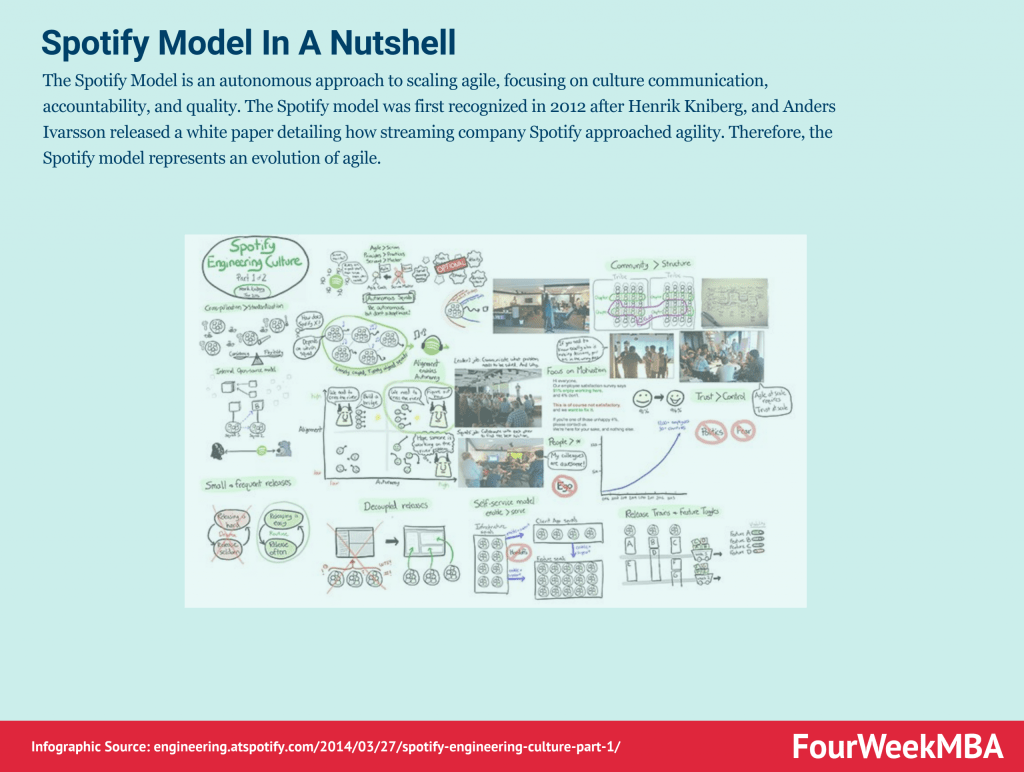
The Spotify Model is an autonomous approach to scaling agile, focusing on culture communication, accountability, and quality. The Spotify model was first recognized in 2012 after Henrik Kniberg, and Anders Ivarsson released a white paper detailing how streaming company Spotify approached agility. Therefore, the Spotify model represents an evolution of agile.
As the name suggests, TDD is a test-driven technique for delivering high-quality software rapidly and sustainably. It is an iterative approach based on the idea that a failing test should be written before any code for a feature or function is written. Test-Driven Development (TDD) is an approach to software development that relies on very short development cycles.
Timeboxing is a simple yet powerful time-management technique for improving productivity. Timeboxing describes the process of proactively scheduling a block of time to spend on a task in the future. It was first described by author James Martin in a book about agile software development.
Scrum is a methodology co-created by Ken Schwaber and Jeff Sutherland for effective team collaboration on complex products. Scrum was primarily thought for software development projects to deliver new software capability every 2-4 weeks. It is a sub-group of agile also used in project management to improve startups’ productivity.
Scrumban is a project management framework that is a hybrid of two popular agile methodologies: Scrum and Kanban. Scrumban is a popular approach to helping businesses focus on the right strategic tasks while simultaneously strengthening their processes.
Scrum anti-patterns describe any attractive, easy-to-implement solution that ultimately makes a problem worse. Therefore, these are the practice not to follow to prevent issues from emerging. Some classic examples of scrum anti-patterns comprise absent product owners, pre-assigned tickets (making individuals work in isolation), and discounting retrospectives (where review meetings are not useful to really make improvements).
Scrum at Scale (Scrum@Scale) is a framework that Scrum teams use to address complex problems and deliver high-value products. Scrum at Scale was created through a joint venture between the Scrum Alliance and Scrum Inc. The joint venture was overseen by Jeff Sutherland, a co-creator of Scrum and one of the principal authors of the Agile Manifesto.
Stretch objectives describe any task an agile team plans to complete without expressly committing to do so. Teams incorporate stretch objectives during a Sprint or Program Increment (PI) as part of Scaled Agile. They are used when the agile team is unsure of its capacity to attain an objective. Therefore, stretch objectives are instead outcomes that, while extremely desirable, are not the difference between the success or failure of each sprint.
The waterfall model was first described by Herbert D. Benington in 1956 during a presentation about the software used in radar imaging during the Cold War. Since there were no knowledge-based, creative software development strategies at the time, the waterfall method became standard practice. The waterfall model is a linear and sequential project management framework.
Gennaro is the creator of FourWeekMBA, which reached about four million business people, comprising C-level executives, investors, analysts, product managers, and aspiring digital entrepreneurs in 2022 alone | He is also Director of Sales for a high-tech scaleup in the AI Industry | In 2012, Gennaro earned an International MBA with emphasis on Corporate Finance and Business Strategy.