The business intelligence models have transitioned to continuous intelligence, where dynamic technology infrastructure is coupled with continuous deployment and delivery to provide continuous intelligence. In short, the software offered in the cloud will integrate with the company’s data, leveraging on AI/ML to provide answers in real-time to current issues the organization might be experiencing.
Aspect
Explanation
Concept Overview
– Continuous Intelligence (CI) is a modern approach to data analysis and decision-making that emphasizes real-time or near-real-time processing of data to enable organizations to make informed, data-driven decisions as events occur. CI integrates various technologies, including streaming analytics, machine learning, and artificial intelligence, to provide actionable insights as new data becomes available. It supports rapid response to changing conditions, enhances operational efficiency, and drives innovation.
Key Characteristics
– Continuous Intelligence is characterized by the following key features: 1. Real-Time Data Processing: Data is processed and analyzed as it is generated, enabling organizations to respond swiftly to events. 2. Predictive Analytics: It leverages machine learning and AI to make predictions and recommendations based on incoming data. 3. Automation: CI often involves automated actions and workflows triggered by predefined conditions. 4. Decision Support: It provides decision-makers with timely, context-aware insights to guide their actions. 5. Scalability: CI systems are designed to handle large volumes of data from diverse sources.
Applications
– Continuous Intelligence is applied in various domains: 1. Financial Services: Banks use CI for real-time fraud detection and credit risk assessment. 2. Healthcare: Hospitals utilize CI for patient monitoring, predicting disease outbreaks, and optimizing resource allocation. 3. E-commerce: Online retailers use CI to personalize recommendations and detect fraudulent transactions. 4. Manufacturing: Continuous monitoring of equipment and processes helps prevent downtime and improve quality. 5. Supply Chain: CI optimizes supply chain logistics and predicts demand fluctuations.
Technology Stack
– CI relies on a technology stack that includes stream processing platforms (e.g., Apache Kafka, Apache Flink), data storage and management systems (e.g., data lakes, databases), machine learning frameworks (e.g., TensorFlow, scikit-learn), and visualization tools for presenting insights to end-users.
Benefits
– Continuous Intelligence offers several benefits: 1. Faster Decision-Making: Real-time insights enable organizations to respond swiftly to opportunities and threats. 2. Improved Efficiency: Automation reduces manual intervention and operational costs. 3. Enhanced Customer Experience: Personalized recommendations and immediate responses improve customer satisfaction. 4. Competitive Advantage: Organizations can gain a competitive edge by leveraging data for innovation and optimization.
Challenges and Risks
– Challenges associated with CI include managing and processing large volumes of data, ensuring data quality and security, and addressing privacy concerns. There is also the risk of overreliance on automated decision-making without human oversight.
Sumo Logic and the rise of continuous intelligence
How Sumo Logic describes the process of continuous intelligence (Image Source: Sumo Logic S-1).
Continuous intelligence gets delivered as a service to enable continuous innovation. Below, some of the features that companies like Sumo Logic, describe it:
The platform of continuous intelligence is always on, scalable and secure. And it needs to have built-in, advanced analytics able to give real-time insights to the client’s firm.
Therefore some of the features of the continuous intelligence business model are:
Always on, current, scaling, elastic, learning (through advanced machine learning algorithms), and secure service.
Built-in, advanced analytics, uncovering patterns, and anomalies across the entire infrastructure and/or application stack.
Delivered via a subscription-based revenue model, coupled in some cases with consumption-based APIs.
Another key element of the Continous Intelligence Business Model is its real-time component:
Speed to value (fast to deploy).
Speed to resolution (fast troubleshooting).
Speed to discipline.
Continuous Intelligence to achieve Continuous Innovation
Continuous Intelligence is tied to the trend of continuous innovation achieved through:
Cloud-based software is integrated within the firm’s data pipelines.
Speed to investigate, solve issues, and fix them in real-time.
Security.
Ability to use the software across various departments within the same organization.
Key Highlights
Transition to Continuous Intelligence: Business intelligence models have evolved into continuous intelligence, where dynamic technology infrastructure is combined with continuous deployment and delivery to offer real-time insights and solutions.
Cloud Integration and AI/ML: Continuous intelligence involves cloud-based software that integrates with a company’s data, utilizing AI and ML to provide real-time answers to current organizational challenges.
Sumo Logic and Continuous Intelligence: Sumo Logic exemplifies continuous intelligence as a service for continuous innovation. It encompasses features like being always on, scalable, and secure, with advanced analytics for real-time insights.
Key Features of Continuous Intelligence:
Always on, scalable, elastic, and secure service.
Incorporates advanced analytics to uncover patterns and anomalies in infrastructure and applications.
Often offered through subscription-based models and consumption-based APIs.
Real-Time Component:
Emphasizes speed to value, resolution, and discipline.
Enables rapid deployment, troubleshooting, and issue resolution.
Offers enhanced security measures.
Continuous Innovation:
Achieved through cloud-based software integration in data pipelines.
Enables quick investigation, real-time issue resolution, and enhanced security.
Can be utilized across various departments within the organization.
Related Frameworks
Description
When to Apply
Real-Time Analytics
– The process of analyzing data and generating insights instantly or near-instantly as data is collected. Real-Time Analytics enables organizations to make immediate decisions based on the latest data, often leveraging streaming data processing technologies.
– When processing data streams or monitoring events in real-time. – Implementing Real-Time Analytics to analyze streaming data, detect anomalies, and trigger automated actions promptly, enabling proactive decision-making and operational responsiveness in Continuous Intelligence environments.
Event-Driven Architecture (EDA)
– An architectural pattern where systems communicate and react to events, such as user actions, system events, or sensor data, asynchronously. Event-Driven Architecture (EDA) enables decoupled, scalable, and resilient systems that can respond to changes and events dynamically.
– When designing scalable and responsive systems or integrating distributed components. – Leveraging Event-Driven Architecture (EDA) to design event-driven workflows, process asynchronous events, and enable reactive and loosely coupled interactions between system components effectively, ensuring agility and scalability in Continuous Intelligence environments.
Complex Event Processing (CEP)
– A technology for analyzing and correlating multiple events or data streams to identify patterns, relationships, and actionable insights in real-time. Complex Event Processing (CEP) platforms apply rules, queries, and algorithms to detect complex patterns and trigger responses automatically.
– When analyzing high-volume, high-velocity data streams or detecting complex patterns. – Employing Complex Event Processing (CEP) techniques to process and correlate events, detect emergent patterns, and trigger automated responses in real-time, enabling situational awareness and proactive decision-making in Continuous Intelligence environments.
Machine Learning (ML) Models
– Algorithms and statistical models that enable systems to learn from data and make predictions or decisions without being explicitly programmed. Machine Learning (ML) models are trained on historical data to identify patterns, trends, and anomalies, and can be deployed to generate insights and predictions in real-time.
– When predicting outcomes, detecting anomalies, or optimizing processes. – Integrating Machine Learning (ML) models into data pipelines to analyze streaming data, predict future events, and automate decision-making based on real-time insights, enabling adaptive and intelligent systems in Continuous Intelligence environments.
Automated Insights
– The process of using algorithms and analytics to generate actionable insights automatically from data, without manual intervention. Automated Insights leverage AI and machine learning to identify trends, anomalies, and opportunities in real-time data streams and deliver relevant insights to stakeholders.
– When monitoring key performance indicators or detecting changes in data patterns. – Implementing Automated Insights solutions to analyze streaming data, detect deviations from normal behavior, and deliver actionable insights to stakeholders promptly, enabling data-driven decision-making and operational efficiency in Continuous Intelligence environments.
Predictive Analytics
– A branch of advanced analytics that uses data, statistical algorithms, and machine learning techniques to make predictions about future events or outcomes. Predictive Analytics enables organizations to anticipate trends, identify risks, and optimize decision-making based on predictive models.
– When forecasting future events, optimizing processes, or mitigating risks. – Leveraging Predictive Analytics models to analyze streaming data, predict future trends, and anticipate potential outcomes in real-time, enabling proactive decision-making and risk management in Continuous Intelligence environments.
Operational Intelligence (OI)
– The ability to monitor, analyze, and act on data in real-time to optimize operational processes and performance. Operational Intelligence (OI) platforms provide real-time visibility into systems, processes, and events, enabling organizations to identify inefficiencies, detect anomalies, and respond promptly.
– When monitoring system health, analyzing operational data, or optimizing processes. – Deploying Operational Intelligence (OI) solutions to monitor infrastructure, analyze operational data, and optimize workflows in real-time, enabling organizations to improve efficiency, reliability, and agility in Continuous Intelligence environments.
Stream Processing
– A computing paradigm for processing and analyzing continuous data streams in real-time. Stream Processing platforms ingest, process, and analyze data as it flows through the system, enabling organizations to derive insights and take actions in real-time.
– When processing high-volume, high-velocity data streams or detecting time-sensitive events. – Utilizing Stream Processing technologies to ingest, process, and analyze streaming data, detect anomalies, and trigger automated responses in real-time, enabling organizations to achieve responsiveness and agility in Continuous Intelligence environments.
Dynamic Dashboards
– Interactive visualizations and dashboards that display real-time data and KPIs, allowing users to monitor performance, track metrics, and gain insights in real-time. Dynamic Dashboards enable stakeholders to visualize and explore data dynamically and make informed decisions based on up-to-date information.
– When monitoring key metrics, tracking performance, or analyzing trends in real-time. – Building Dynamic Dashboards to visualize streaming data, track KPIs, and monitor operational performance in real-time, enabling stakeholders to gain situational awareness and make data-driven decisions in Continuous Intelligence environments.
DataOps Practices
– A set of practices and methodologies that emphasize collaboration, automation, and integration of data processes and workflows across the data lifecycle. DataOps Practices streamline data operations, improve data quality, and accelerate data delivery to support real-time analytics and decision-making.
– When managing data pipelines, automating data processes, or ensuring data quality. – Adopting DataOps Practices to automate data workflows, integrate data sources, and ensure data quality and governance in real-time analytics and decision-making processes in Continuous Intelligence environments.
Business model innovation is about increasing the success of an organization with existing products and technologies by crafting a compelling value proposition able to propel a new business model to scale up customers and create a lasting competitive advantage. And it all starts by mastering the key customers.
The innovation loop is a methodology/framework derived from the Bell Labs, which produced innovation at scale throughout the 20th century. They learned how to leverage a hybrid innovation management model based on science, invention, engineering, and manufacturing at scale. By leveraging individual genius, creativity, and small/large groups.
According to how well defined is the problem and how well defined the domain, we have four main types of innovations: basic research (problem and domain or not well defined); breakthrough innovation (domain is not well defined, the problem is well defined); sustaining innovation (both problem and domain are well defined); and disruptive innovation (domain is well defined, the problem is not well defined).
That is a process that requires a continuous feedback loop to develop a valuable product and build a viable business model. Continuous innovation is a mindset where products and services are designed and delivered to tune them around the customers’ problem and not the technical solution of its founders.
Disruptive innovation as a term was first described by Clayton M. Christensen, an American academic and business consultant whom The Economist called “the most influential management thinker of his time.” Disruptive innovation describes the process by which a product or service takes hold at the bottom of a market and eventually displaces established competitors, products, firms, or alliances.
In a business world driven by technology and digitalization, competition is much more fluid, as innovation becomes a bottom-up approach that can come from anywhere. Thus, making it much harder to define the boundaries of existing markets. Therefore, a proper business competition analysis looks at customer, technology, distribution, and financial model overlaps. While at the same time looking at future potential intersections among industries that in the short-term seem unrelated.
Technological modeling is a discipline to provide the basis for companies to sustain innovation, thus developing incremental products. While also looking at breakthrough innovative products that can pave the way for long-term success. In a sort of Barbell Strategy, technological modeling suggests having a two-sided approach, on the one hand, to keep sustaining continuous innovation as a core part of the business model. On the other hand, it places bets on future developments that have the potential to break through and take a leap forward.
Sociologist E.M Rogers developed the Diffusion of Innovation Theory in 1962 with the premise that with enough time, tech products are adopted by wider society as a whole. People adopting those technologies are divided according to their psychologic profiles in five groups: innovators, early adopters, early majority, late majority, and laggards.
In the TED talk entitled “creative problem-solving in the face of extreme limits” Navi Radjou defined frugal innovation as “the ability to create more economic and social value using fewer resources. Frugal innovation is not about making do; it’s about making things better.” Indian people call it Jugaad, a Hindi word that means finding inexpensive solutions based on existing scarce resources to solve problems smartly.
A consumer brand company like Procter & Gamble (P&G) defines “Constructive Disruption” as: a willingness to change, adapt, and create new trends and technologies that will shape our industry for the future. According to P&G, it moves around four pillars: lean innovation, brand building, supply chain, and digitalization & data analytics.
In the FourWeekMBA growth matrix, you can apply growth for existing customers by tackling the same problems (gain mode). Or by tackling existing problems, for new customers (expand mode). Or by tackling new problems for existing customers (extend mode). Or perhaps by tackling whole new problems for new customers (reinvent mode).
An innovation funnel is a tool or process ensuring only the best ideas are executed. In a metaphorical sense, the funnel screens innovative ideas for viability so that only the best products, processes, or business models are launched to the market. An innovation funnel provides a framework for the screening and testing of innovative ideas for viability.
Tim Brown, Executive Chair of IDEO, defined design thinking as “a human-centered approach to innovation that draws from the designer’s toolkit to integrate the needs of people, the possibilities of technology, and the requirements for business success.” Therefore, desirability, feasibility, and viability are balanced to solve critical problems.
AIOps is the application of artificial intelligence to IT operations. It has become particularly useful for modern IT management in hybridized, distributed, and dynamic environments. AIOps has become a key operational component of modern digital-based organizations, built around software and algorithms.
Agile started as a lightweight development method compared to heavyweight software development, which is the core paradigm of the previous decades of software development. By 2001 the Manifesto for Agile Software Development was born as a set of principles that defined the new paradigm for software development as a continuous iteration. This would also influence the way of doing business.
Agile project management (APM) is a strategy that breaks large projects into smaller, more manageable tasks. In the APM methodology, each project is completed in small sections – often referred to as iterations. Each iteration is completed according to its project life cycle, beginning with the initial design and progressing to testing and then quality assurance.
Agile Modeling (AM) is a methodology for modeling and documenting software-based systems. Agile Modeling is critical to the rapid and continuous delivery of software. It is a collection of values, principles, and practices that guide effective, lightweight software modeling.
Agile Business Analysis (AgileBA) is certification in the form of guidance and training for business analysts seeking to work in agile environments. To support this shift, AgileBA also helps the business analyst relate Agile projects to a wider organizational mission or strategy. To ensure that analysts have the necessary skills and expertise, AgileBA certification was developed.
Business model innovation is about increasing the success of an organization with existing products and technologies by crafting a compelling value proposition able to propel a new business model to scale up customers and create a lasting competitive advantage. And it all starts by mastering the key customers.
That is a process that requires a continuous feedback loop to develop a valuable product and build a viable business model. Continuous innovation is a mindset where products and services are designed and delivered to tune them around the customers’ problem and not the technical solution of its founders.
A design sprint is a proven five-day process where critical business questions are answered through speedy design and prototyping, focusing on the end-user. A design sprint starts with a weekly challenge that should finish with a prototype, test at the end, and therefore a lesson learned to be iterated.
Tim Brown, Executive Chair of IDEO, defined design thinking as “a human-centered approach to innovation that draws from the designer’s toolkit to integrate the needs of people, the possibilities of technology, and the requirements for business success.” Therefore, desirability, feasibility, and viability are balanced to solve critical problems.
DevOps refers to a series of practices performed to perform automated software development processes. It is a conjugation of the term “development” and “operations” to emphasize how functions integrate across IT teams. DevOps strategies promote seamless building, testing, and deployment of products. It aims to bridge a gap between development and operations teams to streamline the development altogether.
Product discovery is a critical part of agile methodologies, as its aim is to ensure that products customers love are built. Product discovery involves learning through a raft of methods, including design thinking, lean start-up, and A/B testing to name a few. Dual Track Agile is an agile methodology containing two separate tracks: the “discovery” track and the “delivery” track.
Feature-Driven Development is a pragmatic software process that is client and architecture-centric. Feature-Driven Development (FDD) is an agile software development model that organizes workflow according to which features need to be developed next.
eXtreme Programming was developed in the late 1990s by Ken Beck, Ron Jeffries, and Ward Cunningham. During this time, the trio was working on the Chrysler Comprehensive Compensation System (C3) to help manage the company payroll system. eXtreme Programming (XP) is a software development methodology. It is designed to improve software quality and the ability of software to adapt to changing customer needs.
The Agile methodology has been primarily thought of for software development (and other business disciplines have also adopted it). Lean thinking is a process improvement technique where teams prioritize the value streams to improve it continuously. Both methodologies look at the customer as the key driver to improvement and waste reduction. Both methodologies look at improvement as something continuous.
A startup company is a high-tech business that tries to build a scalable business model in tech-driven industries. A startup company usually follows a lean methodology, where continuous innovation, driven by built-in viral loops is the rule. Thus, driving growth and building network effects as a consequence of this strategy.
Kanban is a lean manufacturing framework first developed by Toyota in the late 1940s. The Kanban framework is a means of visualizing work as it moves through identifying potential bottlenecks. It does that through a process called just-in-time (JIT) manufacturing to optimize engineering processes, speed up manufacturing products, and improve the go-to-market strategy.
RAD was first introduced by author and consultant James Martin in 1991. Martin recognized and then took advantage of the endless malleability of software in designing development models. Rapid Application Development (RAD) is a methodology focusing on delivering rapidly through continuous feedback and frequent iterations.
Scaled Agile Lean Development (ScALeD) helps businesses discover a balanced approach to agile transition and scaling questions. The ScALed approach helps businesses successfully respond to change. Inspired by a combination of lean and agile values, ScALed is practitioner-based and can be completed through various agile frameworks and practices.
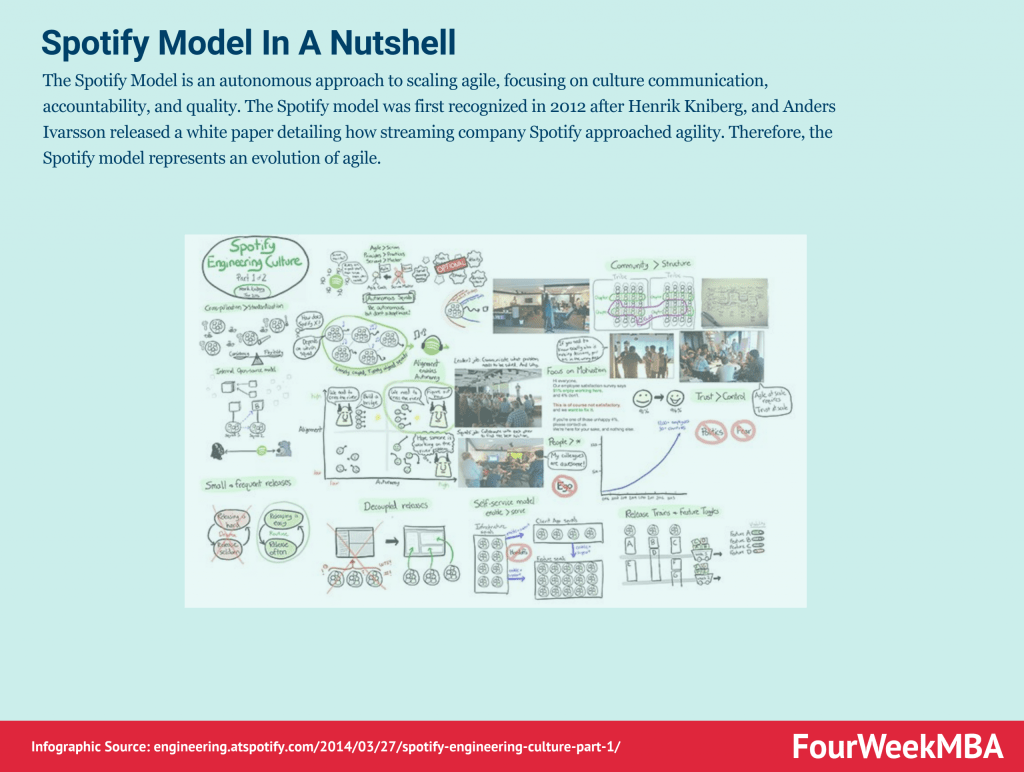
The Spotify Model is an autonomous approach to scaling agile, focusing on culture communication, accountability, and quality. The Spotify model was first recognized in 2012 after Henrik Kniberg, and Anders Ivarsson released a white paper detailing how streaming company Spotify approached agility. Therefore, the Spotify model represents an evolution of agile.
As the name suggests, TDD is a test-driven technique for delivering high-quality software rapidly and sustainably. It is an iterative approach based on the idea that a failing test should be written before any code for a feature or function is written. Test-Driven Development (TDD) is an approach to software development that relies on very short development cycles.
Timeboxing is a simple yet powerful time-management technique for improving productivity. Timeboxing describes the process of proactively scheduling a block of time to spend on a task in the future. It was first described by author James Martin in a book about agile software development.
Scrum is a methodology co-created by Ken Schwaber and Jeff Sutherland for effective team collaboration on complex products. Scrum was primarily thought for software development projects to deliver new software capability every 2-4 weeks. It is a sub-group of agile also used in project management to improve startups’ productivity.
Scrum anti-patterns describe any attractive, easy-to-implement solution that ultimately makes a problem worse. Therefore, these are the practice not to follow to prevent issues from emerging. Some classic examples of scrum anti-patterns comprise absent product owners, pre-assigned tickets (making individuals work in isolation), and discounting retrospectives (where review meetings are not useful to really make improvements).
Scrum at Scale (Scrum@Scale) is a framework that Scrum teams use to address complex problems and deliver high-value products. Scrum at Scale was created through a joint venture between the Scrum Alliance and Scrum Inc. The joint venture was overseen by Jeff Sutherland, a co-creator of Scrum and one of the principal authors of the Agile Manifesto.
Gennaro is the creator of FourWeekMBA, which reached about four million business people, comprising C-level executives, investors, analysts, product managers, and aspiring digital entrepreneurs in 2022 alone | He is also Director of Sales for a high-tech scaleup in the AI Industry | In 2012, Gennaro earned an International MBA with emphasis on Corporate Finance and Business Strategy.