Anthropic’s top five customers accounted for about 25% of its revenue in the nine months to 30 September 2026, according to the risk factors in the Form S-1 it filed with the SEC on 26 October 2026.
The same filing says no single customer passed 10% of revenue, that the company does not expect to pay dividends, and that a single share held by its co-founders will carry 50.1% of the voting power on matters put to stockholders generally.
Business Pill · CONCENTRATION
A short Business Engineer explainer on reading a total that leans on a few large contributors. It teaches the general idea only and says nothing about Anthropic or its filing.
The key insight: As we read it, the S-1 describes two kinds of concentration moving in opposite directions: revenue has spread beyond its five largest customers during 2026, while control after the IPO stays with a single Class F share and a trust that elects the board majority.
The S-1 puts it this way: “While no single customer represented more than 10% of our revenue for the nine months ended September 30, 2026, our top five customers represented approximately 25% of our revenue for the nine months ended September 30, 2026.”
It adds that “Many of our top customers are not subject to long-term contracts with us or have contracts with near-term expiration dates and are able to reduce or in some cases cease spending at any time and for any reason.” The filing does not name the five customers.
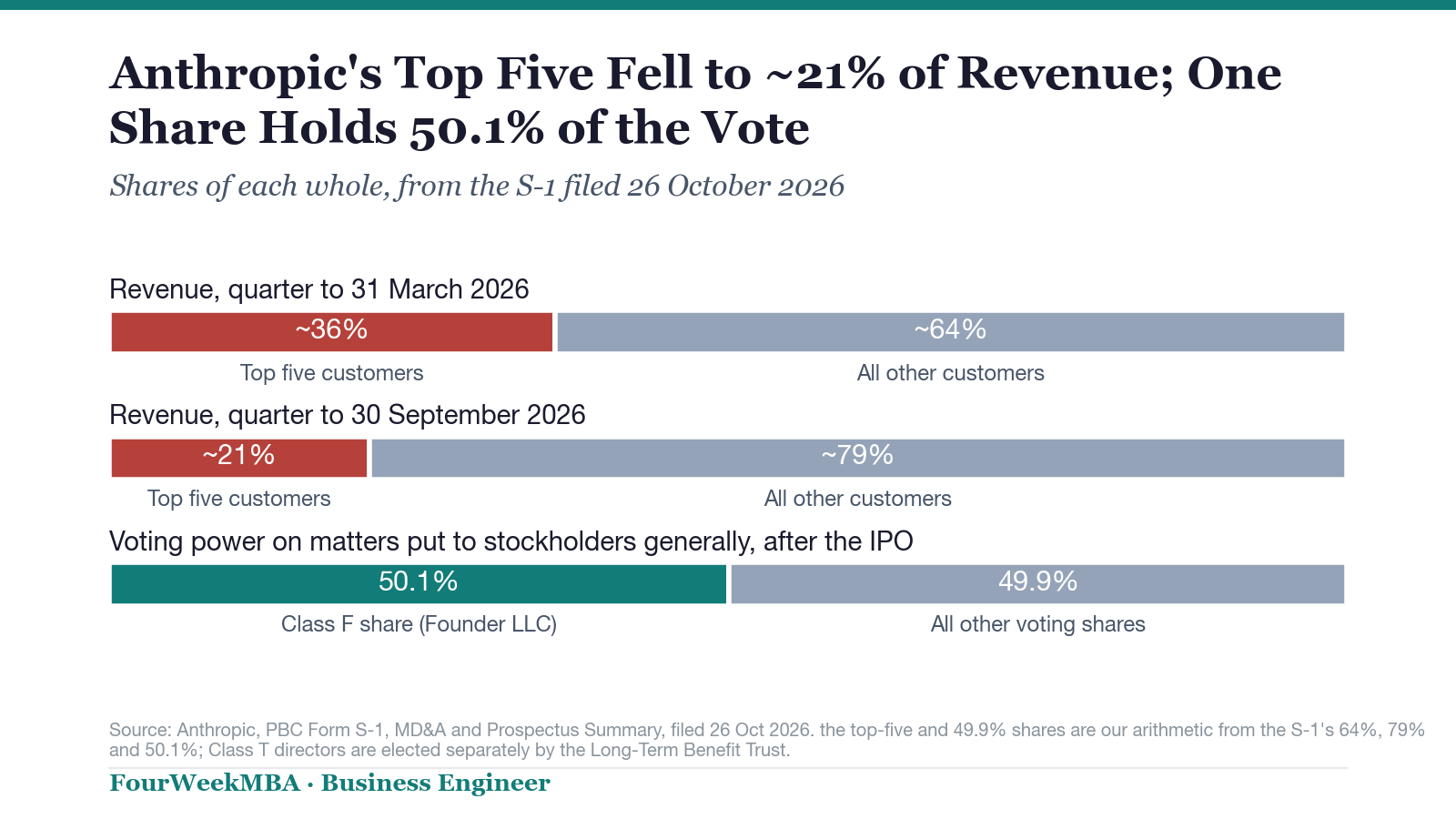
Elsewhere in the S-1, the share fell between the first and third quarters of 2026: “Approximately 79% of our revenue came from customers outside of our top five customers for the three months ended September 30, 2026, up from approximately 64% for the three months ended March 31, 2026.” By our arithmetic, that puts the top five at about 21% of revenue in the third quarter of 2026, down from about 36% in the first.
The same passage says “our largest customers continue to expand,” and that for the three months ended 30 September 2026 “our revenue from each of our top five customers reached a record high.”
From Anthropic’s Form S-1 filed 26 October 2026: about 64% of revenue came from customers outside the top five in the quarter to 31 March 2026 and about 79% in the quarter to 30 September 2026 (MD&A); a single Class F share held by the co-founders’ Founder LLC carries 50.1% of voting power on matters submitted to stockholders generally (Prospectus Summary). The ~36%, ~21% and 49.9% shares are our arithmetic.
Who Supplies the Compute
On the supply side, the S-1 names its dependencies: “We rely on a limited number of CSPs—Amazon.com, Inc. (together with its affiliates, “Amazon”), Google, and Microsoft Corporation (“Microsoft”)—and suppliers, such as Broadcom, for compute and critical components of our compute infrastructure.”
It says that “Migrating workloads to alternative providers would be costly, time-consuming, and operationally complex,” and that pricing, compute commitments and service levels “are subject to negotiation upon renewal.”
Who Controls the Company
Share class
Holder, per the S-1
Rights, per the S-1
Class A
Offered in the IPO; Anthropic has applied to list it on Nasdaq as ANT
One vote per share
Class F
A single share issued to the Founder LLC of the co-founders
50.1% of total voting power on matters submitted to stockholders generally, including directors other than Class T; no economic rights
Class T
Long-Term Benefit Trust
Elects and removes the Class T directors, a majority of the board; no economic rights
Class E
Employees, excluding co-founders
Votes only on certain limited matters; no economic rights
Class N
Primarily strategic business partners
No voting rights except as required by law
Source: Anthropic, PBC Form S-1, cover page and Prospectus Summary, filed 26 October 2026.
The S-1 says Dario Amodei, Daniela Amodei and the five other co-founders “will initially be the sole members of the Founder LLC.” It also says Anthropic is considered a “controlled company” within the meaning of the Nasdaq Global Select Market corporate governance requirements.
The Long-Term Benefit Trust “is intended to operate as an independent body of financially disinterested trustees with expertise in AI safety, national security, public policy, and social enterprise,” according to the filing.
Pay and Protection
The Summary Compensation Table shows 2025 total compensation of $17,958,298 for Dario Amodei, the chief executive, including $2,745,874 “in connection with personal security services that we view as an integral part of our risk management program but may be deemed to be perquisites under current relevant disclosure rules.”
The S-1 says the board approved enhanced personal security for Dario Amodei and Daniela Amodei after a security consulting firm conducted “independent, third-party security studies” in 2025. Daniela Amodei, the president, received total 2025 compensation of $16,408,998, according to the same table.
No Dividends
The dividend policy reads: “We have never declared or paid any cash dividends on our capital stock. We currently intend to retain all available funds and any future earnings to finance the operation and expansion of our business and do not expect to pay any dividends in the foreseeable future.”
Risks the Filing Names
On misuse, the S-1 names a risk from its own products. It says researchers and others have used its models “to identify and exploit vulnerabilities in the systems of other companies, including other AI developers, at times in connection with authorized bug bounty programs.” The filing says this “illustrates that our models can function as a general-purpose tool for gaining unauthorized access to third-party systems.”
On AI risk itself, the filing says that “Misaligned AI systems could corrupt institutional decision- making or cause large-scale harm through autonomous actions that are not visible or understandable to their users and operators.” It also warns that public perception that its models contribute to “job displacement or economic disruption could generate significant negative media coverage.”
On copyright, it says the $1.5 billion Bartz class-action settlement was “approved by the district court in July 2026,” and lists pending song-lyrics suits by music publishers, including Concord Music Group, Inc., et al. v. Anthropic PBC.
Connecting the Coverage
Our S-1 piece reported the headline numbers and the voting structure. Our compute piece covered the cost side of the same filing, with compute and infrastructure falling to 48% of revenue in the second quarter of 2026. Our music suits piece covered the Elvis Presley rightsholders’ suit filed on 23 October. Our Texas piece covered the Texas attorney general’s 23 October suit against OpenAI and Sam Altman. What is new here is how the S-1 itself describes customer concentration, supplier dependence and control.
One Class F share held by the co-founders’ Founder LLC will carry 50.1% of the vote; the Long-Term Benefit Trust elects a board majority. Source: Anthropic S-1, 26 Oct 2026.
The Structural Read
As we read it, the customer figures cut both ways: by our arithmetic from the filing, the top five’s share fell to about 21% of quarterly revenue, yet the S-1 it also says many top customers are not on long-term contracts and can cut spending at any time.
As we read it, the supplier side runs the other way: the S-1 names Amazon, Google, Microsoft and Broadcom and says migrating workloads would be costly, so dependence there is described as structural rather than shrinking.
As we read it, public investors buying Class A shares would get economic rights without control: the filing gives the Founder LLC 50.1% of general voting power and the Long-Term Benefit Trust the right to elect a board majority.
Anthropic, PBC Form S-1, 26 October 2026
“Approximately 79% of our revenue came from customers outside of our top five customers for the three months ended September 30, 2026, up from approximately 64% for the three months ended March 31, 2026.”
Three Implications
FOR IPO INVESTORS The S-1 says Anthropic does not expect to pay dividends in the foreseeable future and that it is a “controlled company” under Nasdaq rules.
FOR CLOUD PROVIDERS The filing names Amazon, Google and Microsoft as the limited number of CSPs it relies on, with Broadcom among its suppliers, and says pricing and commitments are subject to negotiation upon renewal.
FOR ENTERPRISE BUYERS The S-1 says each of its top five customers produced record revenue in the quarter to 30 September 2026, while revenue outside the top five rose to about 79%.
The framework calls it the Embedding Mental Model: “Enterprise SaaS is migrating from “tool you buy” to “infrastructure you’re woven into.””
As we read it, the S-1 shows that model on both sides of Anthropic’s ledger: it describes leaving its cloud providers as costly, and it reports record revenue from each of its top five customers in the quarter to 30 September 2026. The framework was published in December 2025 and does not discuss this filing.
What Is Not Established
The S-1 does not name the top five customers. The 25%, 79% and 64% figures are described as approximate, and the 21% and 36% shares are our arithmetic from them. The S-1 is a preliminary filing that can be amended before any pricing; the price range and share counts are blank, so the economic stake that comes with the Class A shares to be offered is not yet set.
This Week In The AI Supercycle
Execution Fault Lines, Concentrated Demand, and Geopolitical Firewalls
This week’s issue: the AI build is not short of demand for its parts. It is short of cheap money, and its end revenue rests on a narrow base of large, often venture-funded buyers.
Anthropic’s S-1 says its top five customers made up about 25% of revenue in the nine months to 30 September 2026, with no single customer above 10%, and that share fell during the year. It names Amazon, Google, Microsoft and Broadcom as compute dependencies, says it does not expect to pay dividends, and gives a single Class F share held by its co-founders 50.1% of the voting power, while the Long-Term Benefit Trust elects a board majority.
A note on sourcing. All figures and quotations are from Anthropic, PBC’s Form S-1 filed with the SEC on 26 October 2026, a preliminary filing; shares marked as our arithmetic are ours. Earlier reports are as covered in our pieces linked above. This is not investment advice. We did not contact Anthropic.
Gennaro Cuofano is a CRO and tech executive who has worked in AI since late 2015, starting with bringing NLP, natural-language generation, voice and chatbot products to the marketing industry. His background is in law and finance: he holds a Master's degree in Law and an International MBA with an emphasis on corporate finance (LUISS Business School and the University of San Diego, 2012), and worked as a financial analyst at a real-estate investment firm in San Diego and as an assistant controller. His work focuses on business model strategy, business engineering and, more broadly, structural analysis: how companies make money, read from their own filings. He created FourWeekMBA and leads research there and at The Business Engineer, his newsletter on AI and business strategy, with over 95,000 subscribers and more than 1,000 published analyses. His writing has also appeared on Entrepreneur (for example, How to Digitize a Family Business in Europe) and HackerNoon. Find him on LinkedIn and Substack. See how we source.