Anthropic says its Net Revenue Retention was approximately 900% as of 30 September 2026, in the Form S-1 it filed with the SEC on 26 October 2026. By the filing’s definition, revenue from qualifying customers in the three months to 30 September 2026 was about nine times what the same customers paid in the three months a year earlier.
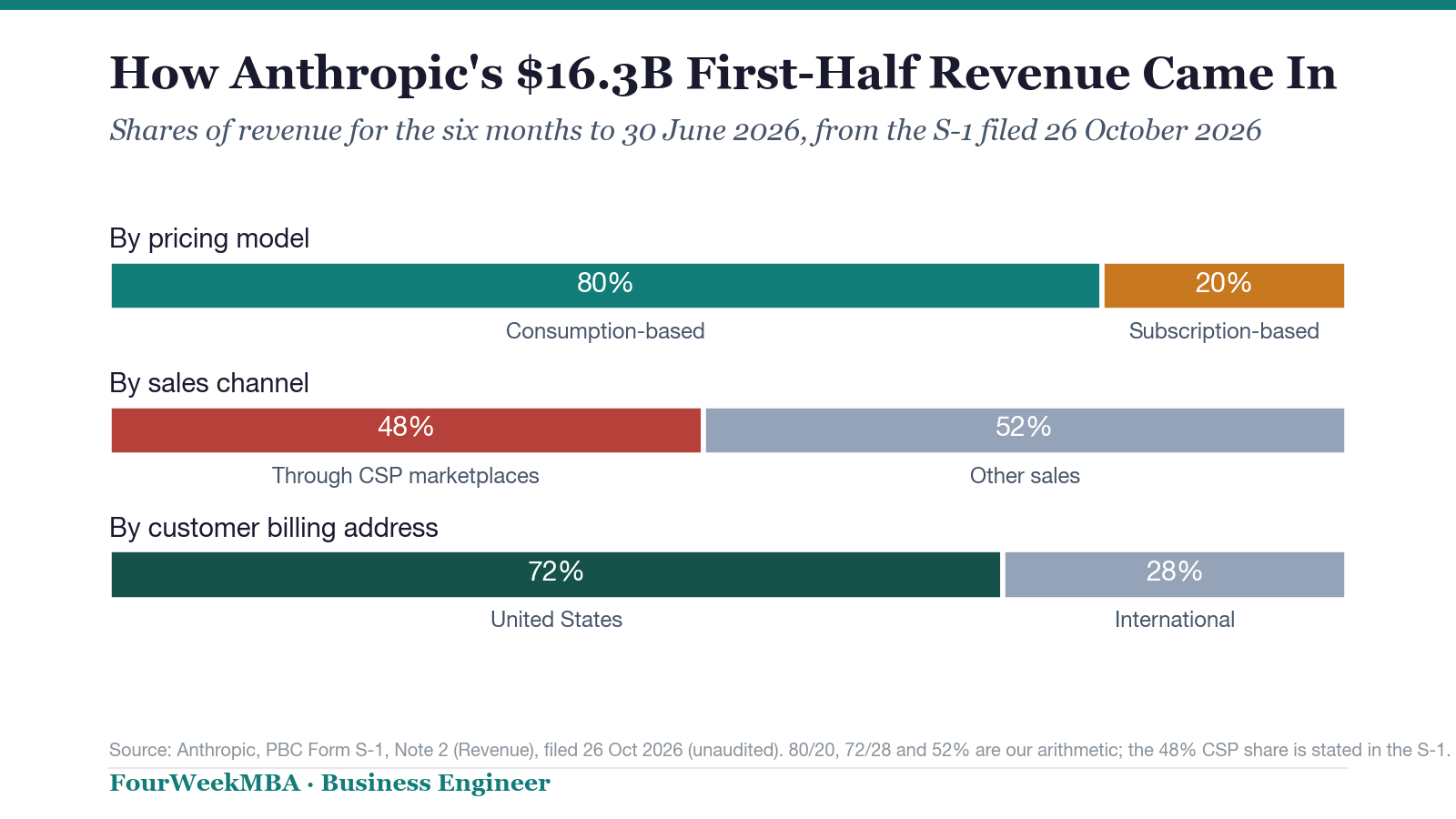
The same filing breaks down how that money arrives: 80% of first-half 2026 revenue was consumption-based and 28% came from customers billed outside the United States, by our arithmetic from its tables, and the S-1 puts the share through cloud marketplaces at approximately 48%.
Business Pill · USAGE-BASED PRICING
A short Business Engineer explainer on how usage-based pricing differs from charging per seat. It teaches the general idea only and says nothing about Anthropic or its filing.
The key insight: As we read it, the S-1 describes a business that grows mostly through existing customers using more: Net Revenue Retention of approximately 900% and 80% consumption-based revenue in the first half of 2026, by our arithmetic for the second figure.
The S-1 defines the metric as follows. “We calculate Net Revenue Retention by dividing the Qualified Customers’ Current Period revenue by their Base Period revenue.” The base period is “the three months ending a year prior to the measurement date” and the current period is “the three months ending as of the measurement date.”
The definition excludes consumer subscribers: a qualified customer has at least $1 of revenue in the base period, “excluding subscribers to our Claude Pro and Max plans, whose fixed-price subscriptions do not reflect the” expansion the metric is meant to capture, the filing says.
The S-1 ties the figure to agentic products. “We see this expansion as customers adopt agentic products like Claude Code,” it says. In the three months to 30 September 2026, “Claude Enterprise users who did not use Claude Code spent less than $75 per month on average, while the top 5% of Claude Enterprise users who used Claude Code spent approximately 20 times that amount.”
From Anthropic’s Form S-1 filed 26 October 2026, Note 2 (Revenue): of $16,286 million of revenue in the six months to 30 June 2026 (unaudited), $13,064 million was consumption-based and $3,222 million subscription-based, and $11,763 million came from customers billed in the United States and $4,523 million from international customers. The S-1 states that approximately 48% came through CSP marketplaces. The 80/20, 72/28 and 52% shares are our arithmetic.
How the Money Comes In
Revenue for the six months to 30 June 2026 was $16.29 billion, the S-1 shows, and its revenue note splits that total two ways. Consumption-based revenue was $13.06 billion and subscription-based revenue $3.22 billion. Customers billed in the United States produced $11.76 billion and international customers $4.52 billion.
Split of revenue
Six months to 30 June 2025
Six months to 30 June 2026
Share of H1 2026 revenue
Consumption-based
$983M
$13,064M
80%
Subscription-based
$180M
$3,222M
20%
United States (billing address)
$820M
$11,763M
72%
International (billing address)
$343M
$4,523M
28%
Through CSP marketplaces
approximately 44%
approximately 48%
48%
Total revenue
$1,163M
$16,286M
100%
Source: Anthropic, PBC Form S-1, Note 2 (Revenue) and its notes on CSP marketplaces, filed 26 October 2026; six-month figures unaudited. Shares of H1 2026 revenue in the last column are our arithmetic, except the CSP marketplace share, which the S-1 states.
Cloud marketplaces have grown as a channel each year. The S-1 puts revenue from sales through CSP marketplaces at approximately 11%, 32% and 47% of total revenue in 2023, 2024 and 2025, and approximately 48% in the first half of 2026, with the CSPs “acting as collection agents” for the company in those transactions.
Customers by Revenue Tier
The filing counts its customers by trailing twelve-month revenue. It reports “more than 11,900 customers with $100,000 or more of revenue on a TTM basis as of September 30, 2026, up from more than 950 as of September 30, 2025.” It also reports more than 1,900 customers at $1 million or more and approximately 250 at $10 million or more.
Those customers increasingly buy more than one product. The S-1 says that in the three months to 30 September 2026, over 50% of its $100,000-plus customers used Claude Platform and at least one first-party application, “up from approximately 30% for the three months ended December 31, 2025.”
Claude Code, Cowork and Cheaper Tasks
The filing calls Claude Code “the product we believe has most concretely defined what autonomous AI work looks like.” Of a newer product, it says that as of 30 September 2026, adoption of Claude Cowork, released as a research preview in January 2026, outpaced the adoption Claude Code reached at the same point after its own preview in February 2025, and that in September 2026 it began merging Claude Cowork and Claude.ai.
The S-1 also describes cutting what customers pay per task. With Claude Fable 5.1 in September 2026, “we reduced the cost of typical workloads by approximately 25% compared to Fable 5, with savings of up to 45% for complex coding and highly agentic tasks,” and with Opus 5.5 “we reduced customers’ cost per task by approximately 40% compared to Opus 5.”
How the S-1 Defines Run-Rate Revenue
The S-1 defines a Run-Rate Revenue metric as consumption-based fees for the trailing 28 days “multiplied by 13” plus monthly subscription fees “multiplied by 12.” This piece does not report a run-rate figure.
Connecting the Coverage
Our S-1 piece reported the headline figures: revenue of $16.29 billion for the first half of 2026 and a net loss of $80.75 billion, most of it a fair-value change on convertible notes. Our compute piece reported compute and infrastructure expense falling to 48% of revenue in the second quarter of 2026. Our customer piece reported that the top five customers made up about 25% of revenue.
Our SpaceXAI piece reported the up-to-$120.5 billion compute arrangement. Earlier, our OpenRouter piece reported Anthropic tokens up 3.6x on that marketplace since Opus 5.5, and our price piece reported OpenAI undercutting Claude on price at Rippling. What is new here is the filing’s own retention, revenue-mix and customer-tier figures.
The Structural Read
As we read it, the pricingmodel and the retention figure point the same way: when 80% of revenue is consumption-based, by our arithmetic, revenue rises with usage, and the S-1 links the 900% figure to customers adopting agentic products such as Claude Code.
As we read it, the cloud marketplaces are both a channel and a dependency: the S-1 puts their share of revenue at approximately 48% in the first half of 2026, up from approximately 11% in 2023, with the CSPs acting as collection agents.
As we read it, the customer tiers show where the revenue sits: more than 1,900 customers above $1 million of trailing revenue and approximately 250 above $10 million, against more than 11,900 above $100,000, as the S-1 reports.
Anthropic, PBC Form S-1, 26 October 2026
“We see this expansion as customers adopt agentic products like Claude Code.”
Three Implications
FOR IPO INVESTORS The S-1 says operating metrics such as Net Revenue Retention and customer counts “have not been independently verified by third parties.”
FOR CLOUD PROVIDERS The S-1 puts revenue through CSP marketplaces at approximately 48% of the first half of 2026, with the CSPs acting as collection agents for Anthropic in those transactions.
FOR ENTERPRISE BUYERS The S-1 says Fable 5.1 cut the cost of typical workloads by approximately 25% compared to Fable 5, and Opus 5.5 cut cost per task by approximately 40% compared to Opus 5.
The framework describes the token as “the unit of cognition the model produces, the unit of compute the data center serves, the unit of price the lab charges, and the unit of value the enterprise extracts.”
As we read it, the S-1 reports Anthropic’s revenue in those units: 80% of first-half 2026 revenue was consumption-based by our arithmetic, so most revenue follows usage. The framework was published in May 2026 and does not discuss this filing.
What Is Not Established
Net Revenue Retention, customer counts and Run-Rate Revenue are operating metrics that, the S-1 says, “have not been independently verified by third parties.” The 900% figure excludes Claude Pro and Max subscribers and compares one three-month period with the same customers’ three months a year earlier. The six-month revenue figures are unaudited. The S-1 does not break revenue down by product, so it gives no separate revenue figure for Claude Code. The shares of revenue are our arithmetic from the filing’s tables, except where stated.
This Week In The AI Supercycle
Execution Fault Lines, Concentrated Demand, and Geopolitical Firewalls
This week’s issue: the AI build is not short of demand for its parts. It is short of cheap money, and its end revenue rests on a narrow base of large, often venture-funded buyers.
Anthropic’s S-1 reports Net Revenue Retention of approximately 900% as of 30 September 2026, more than 11,900 customers above $100,000 of trailing revenue and more than 1,900 above $1 million. Its revenue note shows that most first-half 2026 revenue was consumption-based, that cloud marketplaces carried about 48% of it, and that 28% was billed outside the United States, by our arithmetic.
95,000+ executives read Business Engineer for the AI strategy frameworks cited by ChatGPT, Claude, and Perplexity.
A note on sourcing. All figures and quotations are from Anthropic, PBC’s Form S-1 filed with the SEC on 26 October 2026, a preliminary filing; shares marked as our arithmetic are ours. Earlier reports are as covered in our pieces linked above. This is not investment advice. We did not contact Anthropic.
Gennaro Cuofano is a CRO and tech executive who has worked in AI since late 2015, starting with bringing NLP, natural-language generation, voice and chatbot products to the marketing industry. His background is in law and finance: he holds a Master's degree in Law and an International MBA with an emphasis on corporate finance (LUISS Business School and the University of San Diego, 2012), and worked as a financial analyst at a real-estate investment firm in San Diego and as an assistant controller. His work focuses on business model strategy, business engineering and, more broadly, structural analysis: how companies make money, read from their own filings. He created FourWeekMBA and leads research there and at The Business Engineer, his newsletter on AI and business strategy, with over 95,000 subscribers and more than 1,000 published analyses. His writing has also appeared on Entrepreneur (for example, How to Digitize a Family Business in Europe) and HackerNoon. Find him on LinkedIn and Substack. See how we source.
Scroll to Top
Discover more from FourWeekMBA
Subscribe now to keep reading and get access to the full archive.