The 3×3 Sales Matrix is a strategic framework used in sales management to categorize and prioritize sales opportunities based on two key dimensions: the potential for revenue or profit and the likelihood of closing the deal. By dividing opportunities into nine distinct quadrants, this matrix helps sales teams allocate resources effectively, focus on high-potential prospects, and optimize their sales efforts.
Effective sales processes are contingent on making tough decisions in two key areas:
Determining how to best enter an opportunity. Businesses who enter high can access key decision-makers, but it is difficult to initiate conversations and connect with these individuals. Entering lower gives greater access to constructive dialogue, but this often means the business is not connecting with people who have authority.
Determining when the investigation/diagnosis of a business case is complete. Here, the business must create an impactful business case that can withstand potential inertia. But it must not become so complicated that it passes the point of diminishing returns.
Indeed, the wrong decision in either of these areas has significant implications for the business. Poor decisions can kill the opportunity before it has a chance to flourish. They can also consign the opportunity to a state of purgatory where it slowly atrophies from inaction.
In the next section, we will take a look at how balanced decisions can be made in each of these areas.
Principles of the 3×3 Sales Matrix:
Prioritization: The matrix helps sales teams prioritize opportunities based on their potential revenue and likelihood of success.
Resource Allocation: It guides resource allocation, ensuring that valuable resources are directed toward high-potential opportunities.
Segmentation: The matrix segments opportunities into distinct categories, allowing for tailored sales strategies for each quadrant.
Continuous Review: Opportunities should be regularly reviewed and reassigned within the matrix as circumstances change.
To begin, the business should endeavor to establish three key points of entry. Importantly, there should be variation in the level and responsibility of each point.
The creators of the matrix argue that contact should be made with the following stakeholders:
The role or title that is tasked with managing the relevant problem.
The role or title the above person reports to.
A senior role or title.
A peer role or title to the boss of the first person.
A role below the person identified as managing the problem. This is useful in situations where a senior person is the initial point of entry.
Role players, or those who do not directly manage problems but are nonetheless impacted by them.
Determining whether the investigation has been adequate
It should be noted that determining the right time to end an investigation is highly situational.
Nevertheless, there are a few key questions to keep in mind:
Is the issue worthy of the time, energy, and money invested? Is the level of risk acceptable for both parties?
Does the proposed solution to a problem satisfy budgetary constraints? How can the solution benefit a business directly and indirectly?
How committed are interested parties to the status quo? Many deals fall through because certain individuals would rather live with issues rather than make the effort to address them.
Implementing the 3×3 Sales Matrix
The 3×3 Sales Matrix is a simple but effective tool that can be used by salespeople and managers alike.
Information from each question in the previous section should demonstrate multiple impacts at multiple levels of the organization.
To incorporate this information into the matrix, the business should:
Connect and then engage with three contacts at three different levels (or areas) of the client organization.
Identify three issues that each contact is facing that the business can impact.
This creates a total of nine boxes which, if filled adequately, give the business greater insight into managing sales opportunities and efficient resource allocation. Most importantly, a well-thought-out matrix increases the odds of making the sale.
Advantages of the 3×3 Sales Matrix:
Efficient Resource Allocation: The matrix ensures that resources are allocated efficiently, maximizing ROI.
Focus on High-Potential Deals: Sales teams can prioritize high-potential opportunities, improving win rates.
Strategic Decision-Making: It facilitates data-driven decision-making by categorizing opportunities based on objective criteria.
Sales Pipeline Health: The matrix provides a clear view of the sales pipeline’s health and helps identify gaps or weaknesses.
Challenges of the 3×3 Sales Matrix:
Data Accuracy: The accuracy of the matrix relies on the quality and reliability of data used to assess opportunities.
Changing Dynamics: Market conditions and prospect behavior may change, affecting the placement of opportunities within the matrix.
Resource Constraints: Overemphasis on high-potential opportunities may neglect valuable lower-potential deals with strategic significance.
Complex Sales: In complex B2B sales, accurately assessing revenue potential and likelihood of closing can be challenging.
When to Use the 3×3 Sales Matrix:
Opportunity Assessment: It should be used when assessing and categorizing sales opportunities in the pipeline.
Resource Planning: Sales teams can use the matrix for resource allocation and strategy development.
Pipeline Review: Regular reviews of the sales pipeline should include an evaluation using the matrix.
Goal Setting: When setting sales targets and goals, the matrix can help identify areas of focus.
What to Expect from Using the 3×3 Sales Matrix:
Improved Prioritization: Expect better prioritization of opportunities based on their potential and likelihood of success.
Resource Efficiency: The matrix should lead to more efficient resource allocation and higher ROI.
Strategic Decision-Making: Sales strategies and tactics should become more data-driven and aligned with opportunity characteristics.
Sales Pipeline Health: Monitoring the matrix can help maintain a healthy and balanced sales pipeline.
Long-Term Impact of the 3×3 Sales Matrix:
Increased Win Rates: Over time, the matrix can contribute to increased win rates by focusing efforts on high-potential deals.
Optimized Resource Allocation: It fosters a culture of resource optimization and efficiency within the sales organization.
Data-Driven Culture: A commitment to the 3×3 Sales Matrix encourages a data-driven culture, enhancing overall decision-making.
Strategic Advantage: Effective use of the matrix can provide a strategic advantage in the market by consistently pursuing high-potential opportunities.
Case Studies
Software Sales:
Entry Points: The software sales team decides to contact the IT Manager, the Chief Technology Officer (CTO), and a mid-level manager responsible for the department’s budget.
Timing of Investigation: They assess whether their software solution aligns with the company’s long-term technology goals and budget constraints.
Impact of Decisions: Poor timing or entering at the wrong level could result in the software being deemed too expensive or not aligned with the company’s strategic direction.
Consulting Services:
Entry Points: A consulting firm reaches out to the project manager, the Vice President of Operations, and a peer-level manager from a different department.
Timing of Investigation: They evaluate if their services can address specific operational challenges and fit within the project’s budget.
Impact of Decisions: Failing to connect with the right individuals or misjudging the timing could lead to the project not moving forward or being delayed.
Manufacturing Equipment Sales:
Entry Points: The sales team targets the Production Supervisor, the Plant Manager, and the Chief Financial Officer (CFO).
Timing of Investigation: They assess whether their equipment can improve production efficiency and if it aligns with the company’s financial goals.
Impact of Decisions: Making the wrong entry point choices or failing to address financial concerns could result in the sale being rejected due to budget constraints.
Healthcare Solutions:
Entry Points: A healthcare technology company contacts the Chief Medical Officer, the Director of IT, and a nurse manager.
Timing of Investigation: They evaluate whether their solution can enhance patient care, align with IT infrastructure, and fit within the hospital’s budget.
Impact of Decisions: Choosing the wrong entry points or ignoring budget considerations may lead to the rejection of the healthcare solution.
Financial Services:
Entry Points: A financial services firm connects with the Chief Financial Officer, the HR Director, and an employee in the benefits department.
Timing of Investigation: They assess whether their retirement planning services can meet employee needs, align with the company’s financial goals, and satisfy budget constraints.
Impact of Decisions: Ineffective entry points or overlooking budget concerns may result in the company not adopting their financial services.
Marketing Agency:
Entry Points: A marketing agency reaches out to the Marketing Director, the Chief Marketing Officer (CMO), and a brand manager.
Timing of Investigation: They evaluate whether their marketing strategies can boost brand visibility, align with the company’s marketing goals, and fit within the marketing budget.
Impact of Decisions: Choosing the wrong entry points or not considering budget constraints may lead to the rejection of their marketing services.
Entry Points: In a different scenario, the sales team connects with the CEO, a mid-level manager responsible for production, and a floor supervisor.
Timing of Investigation: They assess whether their equipment can meet production needs, align with the company’s strategic direction, and fit within the budget.
Impact of Decisions: Misjudging the entry points or failing to address budget concerns could result in the equipment purchase being delayed or rejected.
Key takeaways:
The 3×3 Sales Matrix is an investigative and diagnostic tool to shorten the B2B life cycle, helping a business make balanced decisions.
The 3×3 Sales Matrix advocates that a business contacts three roles or titles of varying responsibility. Then, it must determine whether the proposed solution is feasible or viable.
The 3×3 Sales Matrix features nine squares that incorporate valuable information on the problems that individuals are experiencing in the client organization. Importantly, the business must be able to propose a high-impact solution.
Key Highlights of the 3×3 Sales Matrix:
Purpose: The 3×3 Sales Matrix is a tool designed to streamline the B2B sales cycle by aiding in decision-making.
Entry Points: Effective sales strategies involve deciding where and how to enter an opportunity. Going in high provides access to decision-makers but can be challenging to initiate conversations, while entering lower allows for dialogue but may lack authority. This decision is critical to success.
Timing of Investigation: Knowing when to conclude the investigation or diagnosis of a business case is crucial. The business must create a compelling business case without making it overly complex, striking a balance to avoid diminishing returns.
Impact of Decisions: Poor decisions in either entry points or timing can harm the opportunity or leave it stagnant in a state of inaction.
Principles of Implementation: To apply the 3×3 Sales Matrix effectively, businesses should establish three different points of entry, each with varying levels of responsibility and contacts. These may include managers, superiors, peers, or even individuals below the initial point of entry.
Determining Adequate Investigation: Deciding when to end an investigation is situational but should consider factors like the issue’s significance, risk tolerance, budget constraints, and the commitment of parties involved to maintaining the status quo.
Matrix Implementation: The 3×3 Sales Matrix involves connecting with three contacts at three different levels of the client organization, identifying three issues each contact faces, resulting in nine boxes that provide valuable insights for managing sales opportunities and allocating resources efficiently.
Increased Sales Odds: A well-structured 3×3 Sales Matrix increases the likelihood of making a successful sale by offering a comprehensive understanding of client needs and solutions that address those needs.
Aspect
3×3 Sales Matrix
AIDA Model
SPIN Selling
Definition
A framework for categorizing leads based on their likelihood to convert, divided into nine quadrants based on the prospect’s interest level and purchasing urgency.
A classic marketing model that outlines the stages a customer goes through when making a purchase: Attention, Interest, Desire, Action.
A sales technique that focuses on asking Situation, Problem, Implication, and Need-Payoff questions to uncover customer needs and pain points.
Objective
To categorize leads effectively and prioritize sales efforts based on the prospect’s readiness to buy and level of interest.
To guide marketing efforts by capturing the customer’s attention, generating interest, creating desire, and prompting action.
To uncover customer needs, create value, and build trust through effective questioning and problem-solving.
Lead Categorization
Divides leads into nine quadrants based on their level of interest (High, Medium, Low) and purchasing urgency (Immediate, Near-term, Long-term).
Focuses on capturing the customer’s attention (Awareness), generating interest (Interest), creating desire (Desire), and prompting action (Action).
Utilizes a structured set of questions to explore the customer’s situation (Current state), identify problems (Issues), understand implications (Need), and reveal benefits (Payoff).
Sales Approach
Tailors sales efforts and messaging based on the lead’s position in the matrix, focusing on nurturing and converting leads based on their readiness to buy.
Guides marketing strategies to create effective messaging and campaigns that move customers through the stages of attention, interest, desire, and action.
Relies on open-ended questions to uncover customer needs, explore pain points, and present solutions that address the customer’s specific challenges.
Lead Prioritization
Prioritizes leads based on their position in the matrix, with a focus on high-interest, high-urgency leads for immediate action and low-interest, long-term leads for nurturing.
Emphasizes capturing the customer’s attention, maintaining interest, building desire, and facilitating action to move them through the purchase journey.
Prioritizes engaging customers in meaningful conversations, providing immediate value, and aligning solutions with their objectives.
Application
Suitable for sales teams looking to optimize lead management and prioritize sales efforts based on lead readiness and interest level.
Widely used in marketing to design campaigns and messaging that guide customers through the stages of awareness, interest, desire, and action.
Effective for uncovering customer needs and building rapport in consultative sales situations, particularly in industries with complex solutions.
Business development comprises a set of strategies and actions to grow a business via a mixture of sales, marketing, and distribution. While marketing usually relies on automation to reach a wider audience, and sales typically leverage a one-to-one approach. The business development’s role is that of generating distribution.
The more you move from consumers to enterprise clients, the more you’ll need a sales force able to manage complex sales. As a rule of thumb, a more expensive product, in B2B or Enterprise, will require an organizational structure around sales. An inexpensive product to be offered to consumers will leverage on marketing.
A sales cycle is the process that your company takes to sell your services and products. In simple words, it’s a series of steps that your sales reps need to go through with prospects that lead up to a closed sale.
RevOps – short for Revenue Operations – is a framework that aims to maximize the revenue potential of an organization. RevOps seeks to align these departments by giving them access to the same data and tools. With shared information, each then understands their role in the sales funnel and can work collaboratively to increase revenue.
Revenue modeling is a process of incorporating a sustainable financial model for revenue generation within a business model design. Revenue modeling can help to understand what options make more sense in creating a digital business from scratch; alternatively, it can help in analyzing existing digital businesses and reverse engineer them.
Customer experience maps are visual representations of every encounter a customer has with a brand. On a customer experience map, interactions called touchpoints visually denote each interaction that a business has with its consumers. Typically, these include every interaction from the first contact to marketing, branding, sales, and customer support.
AIDA stands for attention, interest, desire, and action. That is a model that is used in marketing to describe the potential journey a customer might go through before purchasing a product or service. The AIDA model helps organizations focus their efforts when optimizing their marketing activities based on the customers’ journeys.
Social selling is a process of developing trust, rapport, and a relationship with a prospect to enhance the sales cycle. It usually happens through tech platforms (like LinkedIn, Twitter, Facebook, and more), which enable salespeople to engage with potential prospects before closing the sale, thus becoming more effective.
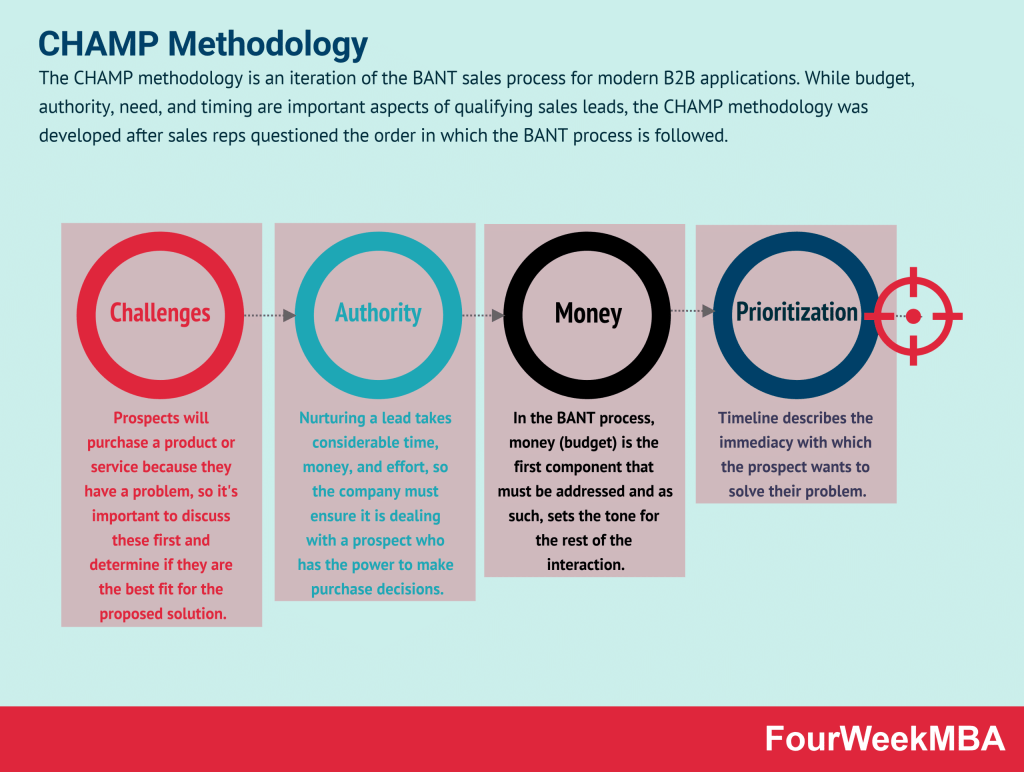
The CHAMP methodology is an iteration of the BANT sales process for modern B2B applications. While budget, authority, need, and timing are important aspects of qualifying sales leads, the CHAMP methodology was developed after sales reps questioned the order in which the BANT process is followed.
The BANT process was conceived at IBM in the 1950s as a way to quickly identify prospects most likely to make a purchase. Despite its introduction around 70 years ago, the BANT process remains relevant today and was formally adopted into IBM’s Business Agility Solution Identification Guide.
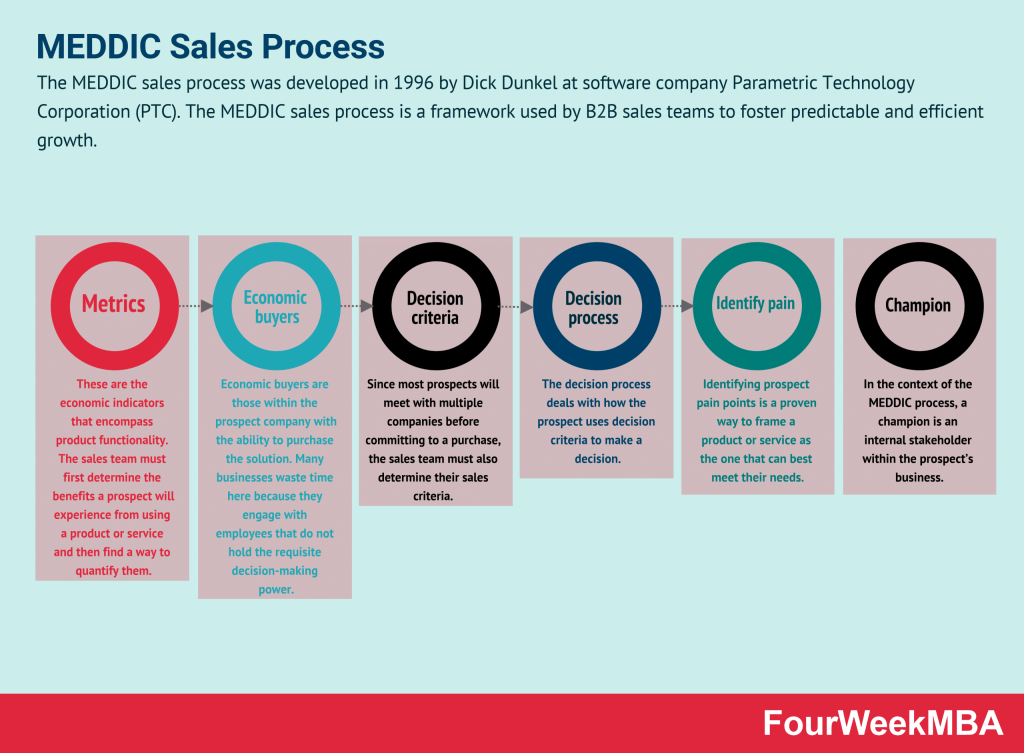
The MEDDIC sales process was developed in 1996 by Dick Dunkel at software company Parametric Technology Corporation (PTC). The MEDDIC sales process is a framework used by B2B sales teams to foster predictable and efficient growth.
STP marketing simplifies the market segmentation process and is one of the most commonly used approaches in modern marketing. The core focus of STP marketing is commercial effectiveness. Marketers use the approach to select the most valuable segments from a target audience and develop a product positioning strategy and marketing mix for each.
The sales funnel is a model used in marketing to represent an ideal, potential journey that potential customers go through before becoming actual customers. As a representation, it is also often an approximation, that helps marketing and sales teams structure their processes at scale, thus building repeatable sales and marketing tactics to convert customers.
Venture capitalist, Dave McClure, coined the acronym AARRR which is a simplified model that enables to understand what metrics and channels to look at, at each stage for the users’ path toward becoming customers and referrers of a brand.
The general concept of Bootstrapping connects to “a self-starting process that is supposed to proceed without external input.” In business, Bootstrapping means financing the growth of the company from the available cash flows produced by a viable business model. Bootstrapping requires the mastery of the key customers driving growth.
The virtuous cycle is a positive loop or a set of positive loops that trigger a non-linear growth. Indeed, in the context of digital platforms, virtuous cycles – also defined as flywheel models – help companies capture more market shares by accelerating growth. The classic example is Amazon’s lower prices driving more consumers, driving more sellers, thus improving variety and convenience, thus accelerating growth.
Business storytelling is a critical part of developing a business model. Indeed, the way you frame the story of your organization will influence its brand in the long-term. That’s because your brand story is tied to your brand identity, and it enables people to identify with a company.
Enterprise sales describes the procurement of large contracts that tend to be characterized by multiple decision-makers, complicated implementation, higher risk levels, or longer sales cycles.
Outside sales occur when a salesperson meets with prospects or customers in the field. This sort of sales function is critical to acquire larger accounts, like enterprise customers, for which the acquisition process is usually longer, more complex and it requires the understanding of the target organization. Thus the outside sales will cut through the noise to acquire a large enterprise account for the organization.
A freeterprise is a combination of free and enterprise where free professional accounts are driven into the funnel through the free product. As the opportunity is identified the company assigns the free account to a salesperson within the organization (inside sales or fields sales) to convert that into a B2B/enterprise account.
Zero to One is a book by Peter Thiel. But it also represents a business mindset, more typical of tech, where building something wholly new is the default mode, rather than building something incrementally better. The core premise of Zero to One then is that it’s much more valuable to create a whole new market/product rather than starting from existing markets.
Palantir is a software company offering intelligence services from governments and institutions to large commercial organizations. The company’s two main platforms Gotham and Foundry, are integrated at enterprise-level. Its business model follows three phases: Acquire, Expand, and Scale. The company bears the pilot costs in the acquire and expand phases, and it runs at a loss. Where in the scale phase, the customers’ contribution margins become positive.
Consultative selling is a sales approach favoring relationship building and open dialogue to adequately meet the needs of a prospective customer. By building trust quickly a consultative selling approach can help the customer better meet her/his expectations and the salesperson hit her/his targets more effectively.
A unique selling proposition (USP) enables a business to differentiate itself from its competitors. Importantly, a USP enables a business to stand for something that they, in turn, become known among consumers. A strong and recognizable USP is crucial to operating successfully in competitive markets.
Gennaro is the creator of FourWeekMBA, which reached about four million business people, comprising C-level executives, investors, analysts, product managers, and aspiring digital entrepreneurs in 2022 alone | He is also Director of Sales for a high-tech scaleup in the AI Industry | In 2012, Gennaro earned an International MBA with emphasis on Corporate Finance and Business Strategy.