In a world driven by tech giants that locked-in the digital distribution pipelines to reach billions of people across the globe, the gatekeeper hypothesis states that small businesses will need to pass through those nodes to reach key customers. Thus, those gatekeepers become the enablers (or perhaps deterrent) for small businesses across the globe.
In a first wave of the Internet, large dominating players (with their walled gardens), were disrupted by once smaller digital players, turned into tech giants.
In this wave, these tech giants (now consolidating their walled gardens) have become the gatekeepers of distribution. Just like Google in the early years, surfed AOL to grow. Today, your small business can reach potential customers by going through those gatekeepers (Google, Amazon, Facebook, Netflix, Apple, and a few others).
As those digital companies turned tech giants, what’s next? Those tech giants are now transitioning into AI companies. That makes them still able to quickly iterate, or perhaps devour those small players trying to grow at their expenses.
However, once this wave is over, and if regulation will act to slow those tech giants, new AI companies, able to leverage on speed, and faster feedback loop might gain traction so quickly that tech giants will not be able to contrast them, nonetheless their distribution power.
Those AI companies will be able to tap on new or existing channels, yet grow so quickly to become massive overnight. A good example is TikTok, for now unstoppable, also by giants like Facebook.
Apple Inc.: Apple’s transformation from a struggling computer company in the 1990s to becoming one of the world’s most valuable tech giants is a classic case study in corporate turnaround and innovation.
Amazon: Amazon’s relentless focus on customer experience and innovation in logistics and e-commerce has allowed it to dominate the online retail industry and expand into cloud computing with Amazon Web Services (AWS).
Netflix: The evolution of Netflix from a DVD rental service to a global streaming powerhouse is a prime example of a company successfully navigating the digital transformation of the entertainment industry.
Tesla:Tesla’s disruption of the automotive industry through electric vehicles and innovations in self-driving technology showcases how a newcomer can challenge well-established players.
Uber: Uber’s rise to prominence as a ride-sharing platform revolutionized the transportation industry and highlighted the potential for disruptive technologies and business models.
Airbnb: Airbnb’s platform for short-term lodging rentals disrupted the hotel industry, empowering individuals to monetize their properties and creating a new sharing economy.
Alibaba Group: Alibaba’s rapid growth in e-commerce and digital payment services has made it a dominant force in China and a global player in the tech industry.
SpaceX: SpaceX’s pioneering efforts in reusable rocket technology and plans for interplanetary travel demonstrate how private companies can disrupt the aerospace sector.
Facebook’s Acquisition of Instagram: Facebook’s acquisition of Instagram in 2012 is a case study in successful M&A strategies, as Instagram has continued to grow and thrive independently.
Key Highlights:
Gatekeeper Hypothesis: In a world dominated by tech giants controlling digital distribution channels, small businesses rely on these gatekeepers to reach key customers, making them enablers (or potential barriers) for global small businessgrowth.
Shifting Dynamics: In the first wave of the internet, smaller digital players disrupted large companies with walled gardens, transforming into tech giants themselves.
Current Gatekeepers: Tech giants like Google, Amazon, Facebook, Netflix, and Apple now serve as gatekeepers of digital distribution, allowing small businesses to access potential customers through their platforms.
Transition to AI Companies: These tech giants are evolving into AI companies, enabling them to maintain their ability to innovate rapidly or potentially stifle smaller competitors.
Future Challenges: If regulatory measures slow down the tech giants, new AI companies with faster feedback loops and adaptability may emerge and grow rapidly, even challenging the established distribution power of tech giants.
Example: TikTok’s rapid growth, despite competition from giants like Facebook, demonstrates how new AI-driven companies can gain significant traction in a short time.
A Blockchain Business Model according to the FourWeekMBA framework is made of four main components: Value Model (Core Philosophy, Core Values and Value Propositions for the key stakeholders), Blockchain Model (Protocol Rules, Network Shape and Applications Layer/Ecosystem), Distribution Model (the key channels amplifying the protocol and its communities), and the Economic Model (the dynamics/incentives through which protocol players make money). Those elements coming together can serve as the basis to build and analyze a solid Blockchain Business Model.
In an asymmetric businessmodel, the organization doesn’t monetize the user directly, but it leverages the data users provide coupled with technology, thus have a key customer pay to sustain the core asset. For example, Google makes money by leveraging users’ data, combined with its algorithms sold to advertisers for visibility.
In a business world driven by technology and digitalization, competition is much more fluid, as innovation becomes a bottom-up approach that can come from anywhere. Thus, making it much harder to define the boundaries of existing markets. Therefore, a proper business competition analysis looks at customer, technology, distribution, and financialmodel overlaps. While at the same time looking at future potential intersections among industries that in the short-term seem unrelated.
Technological modeling is a discipline to provide the basis for companies to sustain innovation, thus developing incremental products. While also looking at breakthrough innovative products that can pave the way for long-term success. In a sort of Barbell Strategy, technological modeling suggests having a two-sided approach, on the one hand, to keep sustaining continuous innovation as a core part of the businessmodel. On the other hand, it places bets on future developments that have the potential to break through and take a leap forward.
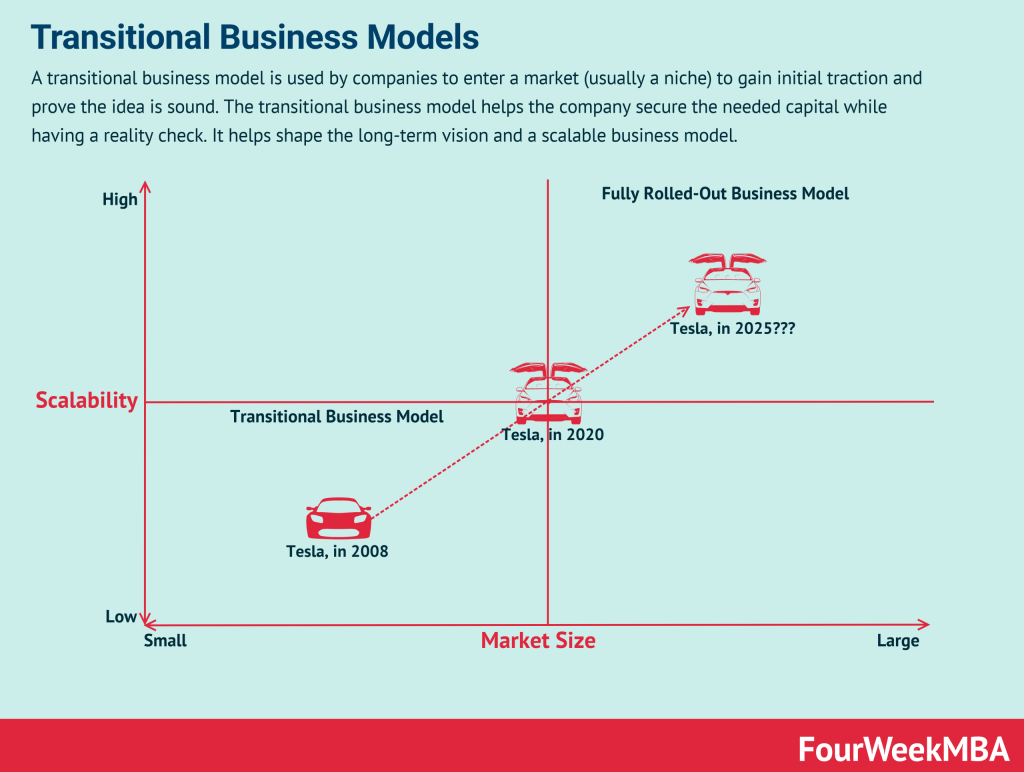
A transitional business model is used by companies to enter a market (usually a niche) to gain initial traction and prove the idea is sound. The transitional business model helps the company secure the needed capital while having a reality check. It helps shape the long-term vision and a scalable businessmodel.
The minimum viable audience (MVA) represents the smallest possible audience that can sustain your business as you get it started from a microniche (the smallest subset of a market). The main aspect of the MVA is to zoom into existing markets to find those people which needs are unmet by existing players.
Business scaling is the process of transformation of a business as the product is validated by wider and wider market segments. Business scaling is about creating traction for a product that fits a small market segment. As the product is validated it becomes critical to build a viable businessmodel. And as the product is offered at wider and wider market segments, it’s important to align product, businessmodel, and organizational design, to enable wider and wider scale.
The market expansion consists in providing a product or service to a broader portion of an existing market or perhaps expanding that market. Or yet, market expansions can be about creating a whole new market. At each step, as a result, a company scales together with the market covered.
In the FourWeekMBA growth matrix, you can apply growth for existing customers by tackling the same problems (gain mode). Or by tackling existing problems, for new customers (expand mode). Or by tackling new problems for existing customers (extend mode). Or perhaps by tackling whole new problems for new customers (reinvent mode).
In the FourWeekMBA Revenue Streams Matrix, revenue streams are classified according to the kind of interactions the business has with its key customers. The first dimension is the “Frequency” of interaction with the key customer. As the second dimension, there is the “Ownership” of the interaction with the key customer.
Revenue model patterns are a way for companies to monetize their business models. A revenue model pattern is a crucial building block of a business model because it informs how the company will generate short-term financial resources to invest back into the business. Thus, the way a company makes money will also influence its overall businessmodel.
A pricingstrategy or model helps companies find the pricing formula in fit with their business models. Thus aligning the customer needs with the product type while trying to enable profitability for the company. A good pricingstrategy aligns the customer with the company’s long term financial sustainability to build a solid businessmodel.
Gennaro is the creator of FourWeekMBA, which reached about four million business people, comprising C-level executives, investors, analysts, product managers, and aspiring digital entrepreneurs in 2022 alone | He is also Director of Sales for a high-tech scaleup in the AI Industry | In 2012, Gennaro earned an International MBA with emphasis on Corporate Finance and Business Strategy.