Post-traumatic growth, also referred to as growth after trauma, describes growth that occurs in response to a traumatic experience. Instead of the individual becoming debilitated by the experience event, they use the associated trauma and adversity to their advantage.
Aspect
Explanation
Definition
Post-Traumatic Growth (PTG) is a psychological phenomenon that refers to positive psychological changes or personal growth that individuals may experience after going through a traumatic or challenging life event. It involves a shift in perception and personal development beyond pre-trauma levels.
Key Concepts
– Adversity as Catalyst: PTG suggests that adversity and trauma can serve as catalysts for personal growth. – Positive Changes: It involves positive changes in various aspects of life, including one’s beliefs, values, relationships, and self-perception. – Resilience: PTG reflects an individual’s resilience in coping with and transcending trauma.
Stages
PTG often follows a series of stages or processes: – Crisis or Trauma: The individual experiences a traumatic event. – Struggle: They undergo emotional turmoil and struggle to make sense of the experience. – Exploration: This phase involves exploring new perspectives and meanings derived from the trauma. – Integration: The individual integrates these newfound insights into their life, resulting in personal growth.
Areas of Growth
PTG can manifest in various areas: – Self-Perception: Enhanced self-esteem, self-acceptance, and personal strength. – Relationships: Improved relationships, increased empathy, and a deeper appreciation of connections. – Life Philosophy: Shifted values, a greater sense of purpose, and a more profound understanding of life’s meaning. – Resilience: Improved coping skills, adaptability, and emotional resilience.
Factors
Several factors contribute to PTG: – Support System: Having a strong support system can facilitate the growth process. – Coping Strategies: Effective coping strategies and resilience play a crucial role. – Perception: The way an individual perceives and makes meaning of the trauma influences PTG.
Benefits
PTG offers several benefits: – Enhanced Resilience: Individuals become more resilient and better equipped to handle future challenges. – Improved Well-Being: It can lead to increased life satisfaction, happiness, and overall well-being. – Deeper Relationships: Greater empathy and improved relationships with others. – New Opportunities: PTG can open up new opportunities and directions in life.
Applications
PTG is often studied in the context of trauma, including experiences such as illness, loss, natural disasters, and combat. It has applications in counseling, therapy, and personal development.
Counseling
Therapists and counselors may use PTG as a framework to help individuals process trauma and find meaning and growth in their experiences.
Resilience Building
PTG highlights the potential for growth in adversity, emphasizing the importance of resilience-building strategies for individuals facing challenging circumstances.
Research
Ongoing research explores the mechanisms and factors that contribute to PTG, shedding light on the potential for growth after trauma.
Inspiration
PTG stories of individuals who have overcome adversity and found new purpose can inspire and motivate others facing difficult circumstances.
Criticism
While PTG is a valuable concept, some criticize it for potentially overlooking the profound and lasting negative effects of trauma in favor of emphasizing growth.
Personal Journey
PTG is a deeply personal and individual journey, and the experience can vary widely from one person to another.
Long-Term Impact
PTG can have a lasting impact on an individual’s life, reshaping their beliefs, values, and goals in significant ways.
Conclusion
Post-Traumatic Growth represents the capacity of individuals to find positive meaning, personal development, and resilience in the aftermath of trauma and adversity. It underscores the human capacity for transformation and growth, even in the face of life’s most challenging experiences.
Some will simply appreciate life more, while others may find religion, start a charity, uncover a hidden talent, or write a book.
The five stages of post-traumatic growth
Psychologists Richard Tedeschi and Lawrence G. Calhoun were responsible for naming the phenomenon in the 1990s and, based on their research, identified five distinct stages of post-traumatic growth.
Each stage occurs with time as the individual deals with adversity:
Personal strength
How does the individual choose to direct the energy and tension associated with stress and anxiety?
Some direct it toward risky or addictive behaviors, while others make the wiser choice of physical exercise or trying something new.
New possibilities
Trauma has a way of redefining one’s worldview and priorities.
Individuals who grow post-trauma explore new and meaningful possibilities instead of defaulting to their previous lives.
Relating to others
Support is vital for post-traumatic growth, whether that be from friends, family, a therapist, or advice from someone who has lived a similar experience.
Appreciation of life
We are all told to cherish the little things in life, but few of us actually do so until we’ve experienced trauma of some kind.
Experiencing post-traumatic growth means the individual sees life as a series of small but joyous events.
Spiritual or existential development
Understandably, many people who experience trauma wonder why it happened to them or what they did to deserve it.
When someone is face-to-face with death, however, they become more spiritual and/or comfortable with their own mortality.
Why do some people grow from trauma while others do not?
Whilst many people develop PTSD after a traumatic experience, not all of them recover or benefit from the experience.
Researchers have found that several factors play a role in determining whether someone grows from trauma:
Personality
Individuals who are extraverted and more open to new experiences are more likely to grow from trauma.
Openness enables them to reconsider their belief systems while their outgoing nature motivates them to seek social connection.
Support
Studies also show that individuals with a strong support network of family and friends have a greater chance of recovery than those who do not.
Integration
When someone can integrate the traumatic experience into their lives, new belief systems are established.
Those who struggle with integration tend to relive the event and suffer from mental illness and flashbacks of the event.
They also find it difficult to maintain relationships.
Eustress vs. Distress
Eustress is a form of positive stress, which might lead to overcoming obstacles and growth instead of leading to burnout and failure.
Indeed, the prefix “eu” in Greek means “good,” thus eustress is classified as good stress or the sort of stress which leads to growth.
To improve at any skill, it’s critical to maintain a state of tension, where you move enough outside your comfort zone to improve, and you’re in a deliberate state, which might lead to the so-called “flow.”
In this stage, you can achieve things, and keep improving, thus making you feel further motivated and energized, which leads to incredible growth.
In the opposite distress scenario, you’re instead moving toward feeling overwhelmed and frustrated and getting stuck.
In a post-traumatic growth scenario, the tension is such that the trauma leads to a growth burst.
Indeed, the trauma was strong enough to induce growth but not as strong to break you.
At that point you experience incredible growth, and you get into an eustress mode of action!
The two mindsets were developed by American psychologist Carol Dweck while studying human motivation. Both mindsets are comprised of conscious and subconscious thought patterns established at a very young age. In adult life, they have profound implications for personal and professional success. Individuals with a growth mindset devote more time and effort to achieving difficult goals and by extension, are less concerned with the opinions or abilities of others. Individuals with a fixed mindset are sensitive to criticism and may be preoccupied with proving their talents to others.
Another critical distinction to understanding post-traumatic growth is a fixed vs. growth mindset.
Indeed, having a growth mindset vs. a fixed mindset can help reframe the trauma into an obstacle to overcome rather than into a personal failure that makes you miserable.
When you can tap into your ability to reframe the trauma into an obstacle to overcome, you kick off an incredible growth and personal evolution process.
Thus, by adding the concepts of eustress and growth mindset in a prost-traumatic scenario, you can achieve much faster growth at personal and business levels!
Key takeaways
Post-traumatic growth (PTG) posits that negative experiences can spur positive, transformational change in an individual.
Psychologists Richard Tedeschi and Lawrence Calhoun were responsible for naming the phenomenon in the 1990s. Based on their research, they identified five stages or qualities of post-traumatic growth: personal strength, new possibilities, relating to others, appreciation of life, and spiritual or existential development.
Not everyone will experience growth after trauma or recover from the experience. One’s level of extraversion and openness can be drivers of post-traumatic growth, as are a strong support network and integration of the trauma into daily life.
Key Highlights of Post-Traumatic Growth (PTG):
Definition:
Post-Traumatic Growth (PTG) refers to the positive psychological changes and personal growth that can occur in individuals following a traumatic experience.
Nature of Growth:
PTG suggests that instead of being debilitated by trauma, individuals can use it as a catalyst for positive transformation and change.
Approximately 50% of trauma survivors with PTSD may experience post-traumatic growth, leading to various forms of personal development.
Five Stages of PTG:
PTG is characterized by five stages:
Personal Strength: Individuals redirect the energy and tension associated with trauma toward constructive activities like physical exercise or new experiences.
New Possibilities: Trauma can reshape one’s worldview and priorities, leading to exploration of new meaningful opportunities.
Relating to Others: Support from friends, family, or professionals is crucial for growth after trauma.
Appreciation of Life: Individuals begin to cherish life’s small joys and experiences.
Spiritual or Existential Development: Some may explore spiritual or existential questions in the face of trauma.
Factors Influencing PTG:
Personality traits, particularly extraversion and openness, can contribute to post-traumatic growth.
Having a strong support network is associated with better outcomes.
The ability to integrate the traumatic experience into one’s life is a key factor.
Eustress vs. Distress:
Eustress, a form of positive stress, can lead to growth and improvement when managed effectively.
In a post-traumatic growth scenario, the tension from trauma can induce growth without overwhelming an individual.
Fixed vs. Growth Mindset:
A growth mindset, which embraces challenges and sees failures as opportunities for growth, can help individuals reframe trauma as an obstacle to overcome.
A Blockchain Business Model according to the FourWeekMBA framework is made of four main components: Value Model (Core Philosophy, Core Values and Value Propositions for the key stakeholders), Blockchain Model (Protocol Rules, Network Shape and Applications Layer/Ecosystem), Distribution Model (the key channels amplifying the protocol and its communities), and the Economic Model (the dynamics/incentives through which protocol players make money). Those elements coming together can serve as the basis to build and analyze a solid Blockchain Business Model.
In an asymmetric businessmodel, the organization doesn’t monetize the user directly, but it leverages the data users provide coupled with technology, thus have a key customer pay to sustain the core asset. For example, Google makes money by leveraging users’ data, combined with its algorithms sold to advertisers for visibility.
In a business world driven by technology and digitalization, competition is much more fluid, as innovation becomes a bottom-up approach that can come from anywhere. Thus, making it much harder to define the boundaries of existing markets. Therefore, a proper business competition analysis looks at customer, technology, distribution, and financial model overlaps. While at the same time looking at future potential intersections among industries that in the short-term seem unrelated.
Technological modeling is a discipline to provide the basis for companies to sustain innovation, thus developing incremental products. While also looking at breakthrough innovative products that can pave the way for long-term success. In a sort of Barbell Strategy, technological modeling suggests having a two-sided approach, on the one hand, to keep sustaining continuous innovation as a core part of the businessmodel. On the other hand, it places bets on future developments that have the potential to break through and take a leap forward.
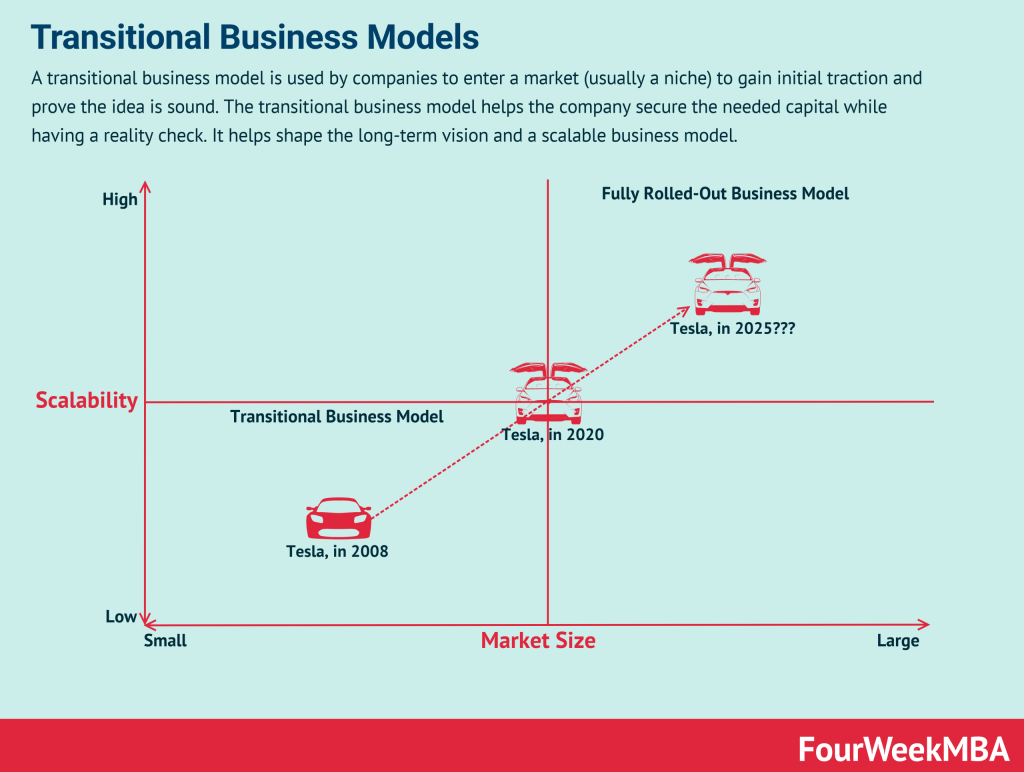
A transitional business model is used by companies to enter a market (usually a niche) to gain initial traction and prove the idea is sound. The transitional business model helps the company secure the needed capital while having a reality check. It helps shape the long-term vision and a scalable businessmodel.
The minimum viable audience (MVA) represents the smallest possible audience that can sustain your business as you get it started from a microniche (the smallest subset of a market). The main aspect of the MVA is to zoom into existing markets to find those people which needs are unmet by existing players.
Business scaling is the process of transformation of a business as the product is validated by wider and wider market segments. Business scaling is about creating traction for a product that fits a small market segment. As the product is validated it becomes critical to build a viable businessmodel. And as the product is offered at wider and wider market segments, it’s important to align product, businessmodel, and organizational design, to enable wider and wider scale.
The market expansion consists in providing a product or service to a broader portion of an existing market or perhaps expanding that market. Or yet, market expansions can be about creating a whole new market. At each step, as a result, a company scales together with the market covered.
In the FourWeekMBA growth matrix, you can apply growth for existing customers by tackling the same problems (gain mode). Or by tackling existing problems, for new customers (expand mode). Or by tackling new problems for existing customers (extend mode). Or perhaps by tackling whole new problems for new customers (reinvent mode).
In the FourWeekMBA Revenue Streams Matrix, revenue streams are classified according to the kind of interactions the business has with its key customers. The first dimension is the “Frequency” of interaction with the key customer. As the second dimension, there is the “Ownership” of the interaction with the key customer.
Revenue model patterns are a way for companies to monetize their business models. A revenue model pattern is a crucial building block of a business model because it informs how the company will generate short-term financial resources to invest back into the business. Thus, the way a company makes money will also influence its overall business model.
A pricing strategy or model helps companies find the pricing formula in fit with their business models. Thus aligning the customer needs with the product type while trying to enable profitability for the company. A good pricing strategy aligns the customer with the company’s long term financial sustainability to build a solid business model.
Gennaro is the creator of FourWeekMBA, which reached about four million business people, comprising C-level executives, investors, analysts, product managers, and aspiring digital entrepreneurs in 2022 alone | He is also Director of Sales for a high-tech scaleup in the AI Industry | In 2012, Gennaro earned an International MBA with emphasis on Corporate Finance and Business Strategy.