Nike has a matrix organizational structure incorporating geographic divisions. Nike’s matrix structure is also present at the regional and sub-regional levels. Managerial responsibility is segmented according to business unit (apparel, footwear, and equipment) and function (human resources, finance, marketing, sales, and operations).
Department
Type
Details
Advantages
Drawbacks
Global Product Divisions
Matrix Structure
– Global product divisions for footwear, apparel, and equipment. Matrix structure combines product divisions with functional departments. Each division has its own leadership and focuses on product innovation and development.
– Specialized product focus and innovation. Expertise in specific product categories.
Potential conflicts between divisions. Complexity.
Functional Departments
Matrix Structure
– Various functional departments like marketing, design, manufacturing, supply chain, and finance. Support product divisions and provide specialized expertise in their respective areas.
– Efficient use of functional expertise. Streamlined processes within departments.
Potential communication challenges. Decision-making delays.
Regional Divisions
Geographic Structure
– Regional divisions manage specific markets, such as North America, EMEA (Europe, Middle East, and Africa), and APLA (Asia-Pacific and Latin America). Each region has its leadership and adapts strategies to local market needs.
– Tailored approach to regional markets. Quick response to market demands. Local market insights.
Coordination challenges between regions. Potential duplication of efforts.
Global Functions
Functional Structure
– Global functions like HR, finance, legal, and IT. Provide centralized support and services to the entire organization. Operate independently from product divisions and regions.
– Efficient resource allocation. Consistency in global operations. Standardized processes.
Potential disconnect from product divisions and regions. Limited specialization.
Direct-to-Consumer (DTC)
Matrix Structure
– DTC division focuses on enhancing the direct-to-consumer retail experience, including online and offline stores. Combines product-focused teams with functional expertise to drive retail and e-commerce strategies.
– Synergy between product innovation and retail strategies. Omnichannel customer engagement.
Complexity in balancing product and retail functions. Potential conflicts.
Nike Brand Divisions
Matrix Structure
– Brand divisions like Jordan Brand and Converse operate under the Nike umbrella. Matrix structure combines brand-specific teams with overall company functions.
– Cultivation of distinct brand identities. Synergy between brand-specific and company-wide strategies.
Potential competition between brand divisions. Brand dilution.
Nike is the world’s most valuable global apparel brand, estimated to be worth dozens of billions.
The company has a matrix organizational structure that combines aspects of a hierarchical and product-based structure.
To support the immense valuation of the Nike brand, teams are divided based on product and must report to project managers. These teams are also accountable to broader department managers who handle policy and regulation. The presence of multiple chains of command with overlapping responsibility is a key feature of the matrix approach.
There are four main components to Nike’s organizational structure. In the following sections, we will look at each of these in more detail.
Global corporate leadership
At the top of the hierarchy is global corporate leadership. This comprises managers who make corporate decisions that have global ramifications for the company. For example, the responsibility for creating a worldwide marketing campaign ultimately rests with a single group at company headquarters.
Each group is headed by a President, Executive Vice President, or Chief Officer:
Each is also based at the global headquarters in Beaverton, Oregon, and is responsible for managing operations in the United States, Americas, and Asia Pacific.
Nike executives note that this structure allows employees to identify with a streamlined company culture that makes consumer needs a priority. They also note that it enables the company to develop a valuable, globalized, and instantly recognizable brand regardless of geographic location.
Regional headquarters
In the case of the EMEA (Europe, Middle East, and Africa) region, operations for 27 countries are managed by a centralized European headquarters in the Netherlands.
EMEA is further segregated into sub-regions including France, Iberia, Italy, Northern Europe, UK & Ireland, AGSS (Austria, Germany, Slovenia, Switzerland), and CEMEA (Central Europe, Middle East, Africa).
Here, the additional level of hierarchy seeks to reduce complexity by managing the number of direct reports for each senior manager. By grouping single markets into regions, fewer direct reports need to be funneled back to regional headquarters.
Sub-regions are semi-autonomous geographic divisions, allowing Nike to build synergies derived from the grouping of countries. For example, AGSS was created to streamline logistics, finance, and marketing operations for each member of the group.
Further streamlining is also seen by examining the way the countries themselves are grouped. They may be clustered according to:
Consumer similarities. For example, consumers in the UK and Ireland are likely to have similar preferences and expectations. This helps Nike adjust marketing strategies accordingly.
Retail similarities, or a likeness of retail structures.
Similarities in market size or market development stage.
Regional matrix structure and subsidiaries
Regional matrix structure
Nike’s matrix structure is also present at the regional and sub-regional levels. Managerial responsibility is segmented according to:
Business unit – apparel, footwear, and equipment.
Function – human resources, finance, marketing, sales, and operations.
Again, the employee must report to two managers. In this case, the functional department manager and the product manager.
Subsidiaries
Nike has 54 wholly-owned subsidiaries, including Umbro, Cole Haan, Converse, and Hurley.
Like sub-regions, these subsidiaries enjoy some level of autonomy. However, projects exceeding limits set by either the regional or global headquarters must obtain approval.
Generally speaking, subsidiaries are free to make operational decisions at the country level. These decisions may encompass the implementation of plans, local initiatives, or adaptation strategies.
Comparison with Top Related Companies
Adidas: Adidas uses a similar matrix structure, integrating both global and regional dimensions, which is segmented by product type (footwear, apparel, and accessories) and market. Like Nike, Adidas focuses on ensuring that its product divisions have a strong functional support system, including marketing and sales. However, Adidas tends to place a greater emphasis on global brand consistency across all markets, whereas Nike often adapts more flexibly to regional market differences.
Under Armour: Under Armour operates with a functionally based structure, emphasizing centralized control over its product development and marketing strategies. This structure allows for strong brand messaging and quick strategic decisions at the corporate level. Compared to Nike’s matrix structure, Under Armour’s approach may result in faster decision-making but can lack the local market adaptability that Nike’s regional divisions provide.
Puma: Puma’s organizational structure is somewhat between Nike’s and Under Armour’s, featuring elements of both functional and geographic structuring. Puma organizes its operations around product lines and major global regions but with less emphasis on the matrix aspect than Nike. This structure supports efficient global operations but may not fully capitalize on the benefits of local responsiveness and cross-functional synergy that Nike’s structure offers.
Similarities and Differences
Similarities: All companies use a mix of product and geographic divisions to some extent, which helps manage their global presence and product diversity effectively. This common approach reflects the industry’s need for balancing global brand presence with local market needs.
Differences: Nike’s matrix structure allows for dual reporting systems within regional and product-based divisions, enhancing flexibility and innovation. In contrast, Under Armour’s more centralized functional structure prioritizes quick decision-making and brand consistency, potentially at the expense of local market nuances. Adidas and Puma, while similar to Nike, vary in the degree of integration and emphasis between their functional and geographic divisions.
Implications
Innovation and Market Responsiveness: Nike’s structure promotes innovation and responsiveness by facilitating close cooperation between product managers and regional managers. This structure can adapt more dynamically to changing market trends and consumer preferences.
Operational Complexity: The matrix structure, while beneficial for flexibility and responsiveness, also adds complexity to Nike’s operations. Managing overlapping responsibilities and dual command structures can lead to challenges in coordination and conflict resolution.
Local vs. Global Balance: Nike’s regional divisions are empowered to adapt strategies to local markets, which can be a competitive advantage in understanding and responding to diverse consumer behaviors. However, this needs to be balanced against maintaining a coherent global brand image.
Scalability and Efficiency: Nike’s approach supports scalability by allowing regional divisions to operate semi-autonomously yet aligned with global strategies. This is crucial for maintaining operational efficiency and leveraging global economies of scale.
Key takeaways:
Nike has a matrix organizational structure with a strong preference for geographic and regional divisions.
At the top of the Nike hierarchy is global corporate leadership headquartered in Beaverton, Oregon. Senior executives head seven functional groups that manage operations in the United States, Americas, and Asia Pacific.
Nike also has regional headquarters in the Netherlands that manages Europe, Middle East, and Africa. Countries in these regions are segregated to streamline operations and group consumers with similar preferences or attributes.
Key Highlights:
Matrix Organizational Structure: Nike employs a matrix organizational structure that combines elements of a hierarchical and product-based structure.
Global Corporate Leadership: Nike’s hierarchy starts with global corporate leadership, including functional groups like Nike brand, finance, global human resources, and more.
Regional Headquarters: For regions like EMEA (Europe, Middle East, and Africa), operations are managed by centralized regional headquarters, which are further divided into sub-regions.
Sub-Regions: Sub-regions, such as AGSS and CEMEA, are semi-autonomous divisions within regions, designed to streamline operations, logistics, and marketing.
Regional Matrix Structure: The matrix structure is also present at regional and sub-regional levels, with managerial responsibility segmented based on business units (apparel, footwear, equipment) and functions (HR, finance, marketing, etc.).
Autonomous Subsidiaries: Nike has multiple subsidiaries like Umbro, Cole Haan, Converse, and Hurley. These subsidiaries have some autonomy in operational decisions but require approval for significant projects.
Adaptability and Efficiency: Nike’s matrix structure allows for adaptability in different markets, consumer segments, and regions while maintaining a unified brand identity and decision-making process.
Consumer-Centric Approach: Nike’s structure enables the company to group consumers with similar preferences or attributes, leading to targeted marketing strategies.
Balancing Autonomy and Approval: The balance between subsidiary autonomy and centralized approval ensures alignment with overall company strategies and objectives.
Streamlined Operations: The matrix structure facilitates efficient operations by enabling cross-functional and cross-regional collaboration.
Globalized Brand Identity: Despite its complex structure, Nike maintains a strong global brand identity and company culture.
The Knight family owns Nike. Indeed, the top individual shareholder is Travis A. Knight, son of Philip Knight, co-founder of Nike, with a 7% stake in Class A stocks and a 2.4% stake in Class B stocks. On the other hand, the Knight family also controls the company tightly through their Trusts and an LLC called Swoosh (the Nike logo’s shape is a “swoosh”). Through individual shares, Swoosh LLC, and Travis Knight’s irrevocable trust, the Knight family controls over 97% of Class A and 21% of Class B stocks.
Nike follows a wholesale strategy combined with a very strong direct distributionstrategy. The company makes money primarily from footwear, which represented over 64% of its total revenues in 2023, followed by apparel (27%). The most successful Nike brand is the Jordan Brand, which in 2023 generated $6.6 billion in revenue. Nike is the master of demand creation and generation through its influencer campaigns, where athletes become an inspiration for everyday people.
Nike leverages both a wholesale and direct distributionstrategy. Indeed, while still in 2023, most sales come from wholesale distribution, in reality, since 2020, Nike has been ramping up its direct distribution through its NIKE stores and e-commerce platform (SNKRS).
Nike generated most of its revenue from footwear. Indeed, in 2023, Nike generated over $33.13 billion in revenue from footwear, $13.84 billion in apparel, $1.73 billion in equipment, and $2.43 billion from the Converse brand.
Nike generated $51.22 billion in revenue in 2023 and over $5 billion in net profits, compared to over $46.71 billion in revenue and $6.05 billion in profits for 2022.
Nike’s vision is “To bring inspiration and innovation to every athlete in the world.” At the same time, its mission statement is to “do everything possible to expand human potential. We do that by creating groundbreaking sports innovations, by making our products more sustainably, by building a creative and diverse global team, and by making a positive impact in communities where we live and work.”
Jordan follows a demand generation business model, where its iconic brand works as a propeller for the sale of its footwear and apparel, that in 2022 generated more than $5 billion in revenue for Nike or more than 10% of its total revenue.
Converse is an independent brand part of Nike’s family of brands. Indeed, Converse generated $2.35 billion in revenue in 2022. And like Nike, it follows an heave Wholesale distributionstrategy, where most of its sales are made, through footwear. However, Converse follows also a direct distribution approach where it sells directly via its monobrand stores.
Michale Jordan is a billionaire but doesn’t own the Jordan brand, which is part of Nike. Yet, he gets 5% royalties on the sales of Jordan. For instance, as of May 31, 2023, Nike had endorsement contract obligations of $7.6 billion, of which over $330 million were to be paid out to Michael Jordan as royalties on the sales of Jordan in 2023 (the company made over 6$ billion in sales in that year). We estimated that between 2018-2023 alone, Nike paid (or is paying) Michael Jordan over one billion dollars in royalties for Jordan’s brand sales.
OpenAI is an artificial intelligence research laboratory that transitioned into a for-profit organization in 2019. The corporate structure is organized around two entities: OpenAI, Inc., which is a single-member Delaware LLC controlled by OpenAI non-profit, And OpenAI LP, which is a capped, for-profit organization. The OpenAI LP is governed by the board of OpenAI, Inc (the foundation), which acts as a General Partner. At the same time, Limited Partners comprise employees of the LP, some of the board members, and other investors like Reid Hoffman’s charitable foundation, Khosla Ventures, and Microsoft, the leading investor in the LP.
Airbnb follows a holacracy model, or a sort of flat organizational structure, where teams are organized for projects, to move quickly and iterate fast, thus keeping a lean and flexible approach. Airbnb also moved to a hybrid model where employees can work from anywhere and meet on a quarterly basis to plan ahead, and connect to each other.
The Amazon organizational structure is predominantly hierarchical with elements of function-based structure and geographic divisions. While Amazon started as a lean, flat organization in its early years, it transitioned into a hierarchical organization with its jobs and functions clearly defined as it scaled.
The Coca-Cola Company has a somewhat complex matrix organizational structure with geographic divisions, product divisions, business-type units, and functional groups.
Costco has a matrix organizational structure, which can simply be defined as any structure that combines two or more different types. In this case, a predominant functional structure exists with a more secondary divisional structure.
Costco’s geographic divisions reflect its strong presence in the United States combined with its expanding global presence. There are six divisions in the country alone to reflect its standing as the source of most company revenue.
Compared to competitor Walmart, for example, Costco takes more a decentralized approach to management, decision-making, and autonomy. This allows the company’s stores and divisions to more flexibly respond to local market conditions.
Dell has a functional organizational structure with some degree of decentralization. This means functional departments share information, contribute ideas to the success of the organization and have some degree of decision-making power.
eBay was until recently a multi-divisional (M-form) organization with semi-autonomous units grouped according to the services they provided. Today, eBay has a single division called Marketplace, which includes eBay and its international iterations.
Facebook is characterized by a multi-faceted matrix organizational structure. The company utilizes a flat organizational structure in combination with corporate function-based teams and product-based or geographic divisions. The flat organization structure is organized around the leadership of Mark Zuckerberg, and the key executives around him. On the other hand, the function-based teams are based on the main corporate functions (like HR, product management, investor relations, and so on).
Goldman Sachs has a hierarchical structure with a clear chain of command and defined career advancement process. The structure is also underpinned by business-type divisions and function-based groups.
Google (Alphabet) has a cross-functional (team-based) organizational structure known as a matrix structure with some degree of flatness. Over the years, as the company scaled and it became a tech giant, its organizational structure is morphing more into a centralized organization.
IBM has an organizational structure characterized by product-based divisions, enabling its strategy to develop innovative and competitive products in multiple markets. IBM is also characterized by function-based segments that support product development and innovation for each product-based division, which include Global Markets, Integrated Supply Chain, Research, Development, and Intellectual Property.
McDonald’s has a divisional organizational structure where each division – based on geographical location – is assigned operational responsibilities and strategic objectives. The main geographical divisions are the US, internationally operated markets, and international developmental licensed markets. And on the other hand, the hierarchical leadership structure is organized around regional and functional divisions.
McKinsey & Company has a decentralized organizational structure with mostly self-managing offices, committees, and employees. There are also functional groups and geographic divisions with proprietary names.
Microsoft has a product-type divisional organizational structure based on functions and engineering groups. As the company scaled over time it also became more hierarchical, however still keeping its hybrid approach between functions, engineering groups, and management.
Nestlé has a geographical divisional structure with operations segmented into five key regions. For many years, Swiss multinational food and drink company Nestlé had a complex and decentralized matrix organizational structure where its numerous brands and subsidiaries were free to operate autonomously.
Nike has a matrix organizational structure incorporating geographic divisions. Nike’s matrix structure is also present at the regional and sub-regional levels. Managerial responsibility is segmented according to business unit (apparel, footwear, and equipment) and function (human resources, finance, marketing, sales, and operations).
Patagonia has a particular organizational structure, where its founder, Chouinard, disposed of the company’s ownership in the hands of two non-profits. The Patagonia Purpose Trust, holding 100% of the voting stocks, is in charge of defining the company’s strategic direction. And the Holdfast Collective, a non-profit, holds 100% of non-voting stocks, aiming to re-invest the brand’s dividends into environmental causes.
Samsung has a product-type divisional organizational structure where products determine how resources and business operations are categorized. The main resources around which Samsung’s corporate structure is organized are consumer electronics, IT, and device solutions. In addition, Samsung leadership functions are organized around a few career levels grades, based on experience (assistant, professional, senior professional, and principal professional).
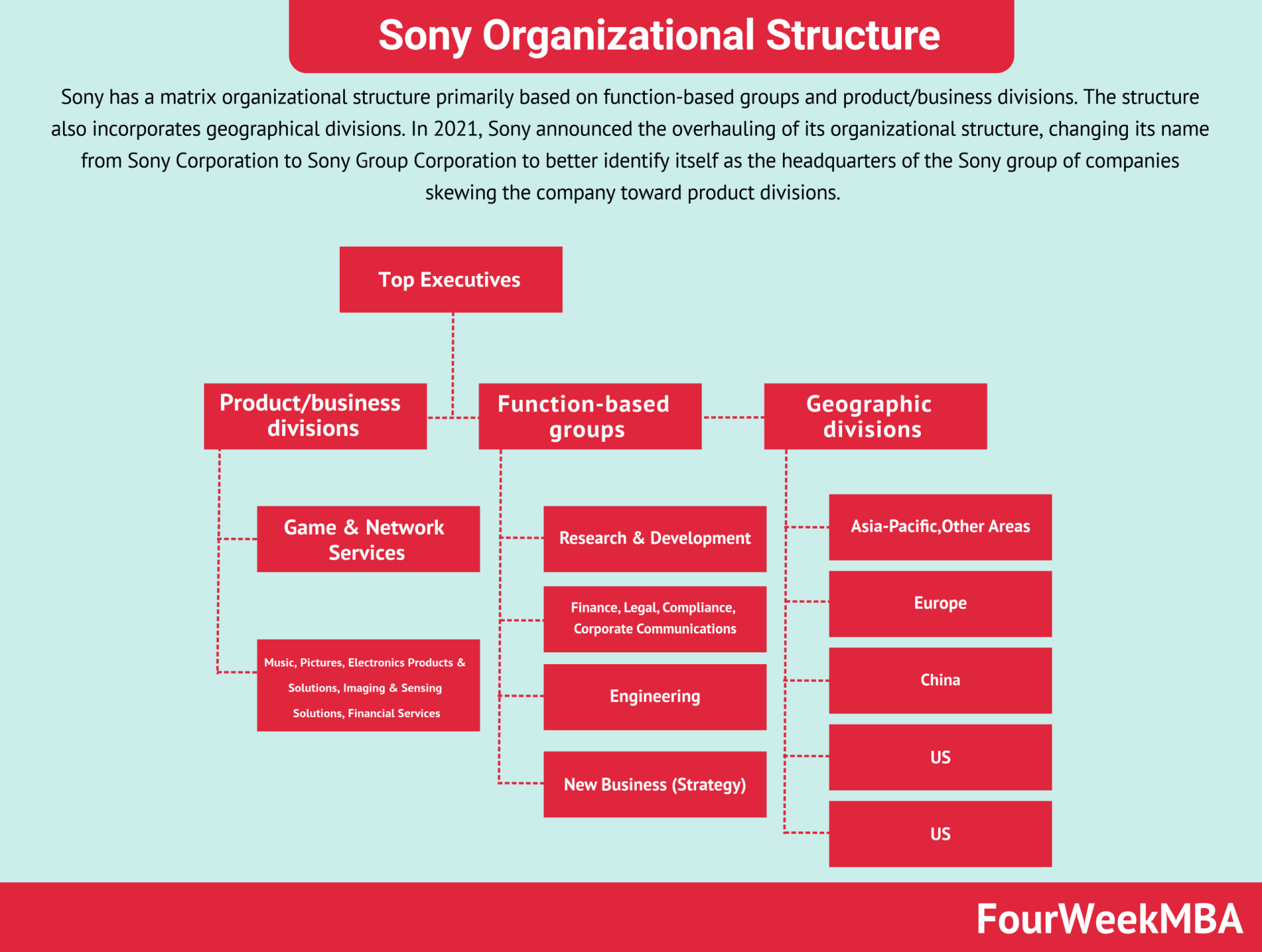
Sony has a matrix organizational structure primarily based on function-based groups and product/business divisions. The structure also incorporates geographical divisions. In 2021, Sony announced the overhauling of its organizational structure, changing its name from Sony Corporation to Sony Group Corporation to better identify itself as the headquarters of the Sony group of companies skewing the company toward product divisions.
Starbucks follows a matrix organizational structure with a combination of vertical and horizontal structures. It is characterized by multiple, overlapping chains of command and divisions.
Tesla is characterized by a functional organizational structure with aspects of a hierarchical structure. Tesla does employ functional centers that cover all business activities, including finance, sales, marketing, technology, engineering, design, and the offices of the CEO and chairperson. Tesla’s headquarters in Austin, Texas, decide the strategic direction of the company, with international operations given little autonomy.
Toyota has a divisional organizational structure where business operations are centered around the market, product, and geographic groups. Therefore, Toyota organizes its corporate structure around global hierarchies (most strategic decisions come from Japan’s headquarter), product-based divisions (where the organization is broken down, based on each product line), and geographical divisions (according to the geographical areas under management).
Walmart has a hybrid hierarchical-functional organizational structure, otherwise referred to as a matrix structure that combines multiple approaches. On the one hand, Walmart follows a hierarchical structure, where the current CEO Doug McMillon is the only employee without a direct superior, and directives are sent from top-level management. On the other hand, the function-based structure of Walmart is used to categorize employees according to their particular skills and experience.
Gennaro is the creator of FourWeekMBA, which reached about four million business people, comprising C-level executives, investors, analysts, product managers, and aspiring digital entrepreneurs in 2022 alone | He is also Director of Sales for a high-tech scaleup in the AI Industry | In 2012, Gennaro earned an International MBA with emphasis on Corporate Finance and Business Strategy.
Scroll to Top
Discover more from FourWeekMBA
Subscribe now to keep reading and get access to the full archive.