Nestlé is a large multinational food and beverage manufacturer with more than 2000 brands spread across 197 countries. Some of Nestlé’s well-known brands include Nescafe, Kit-Kat, Purina, Aero, Butterfinger, Maggi, and Haagen-Dazs. Originally a producer of infant food in 1867, it is now considered to be the world’s largest food manufacturer.
Highly diversified – since Nestlé sells a vast range of products in most of the world’s countries, it does not rely on a select few markets.
Well-established – Nestlé owns some of the food industry’s most recognized brands – some of which consumers have enjoyed for decades or across multiple generations. It also enjoys similarly well-established relationships with other brands such as Coca-Cola, Starbucks, Colgate, and Palmolive.
Unrivaled research and development – Nestlé own a total of 21 research and development centers employing over 5000 personnel. This allows the company to introduce new, innovative products regularly and strengthen its competitive advantage.
Valuable global brand – according to, Nestlé has a market capitalization of $304.1 billion, ranked 13 in the world. It also ranks inside the top 75 globally for sales and profit.
Weaknesses
Controversy – Nestlé has attracted negative press over excessive water usage and forced child labor in developing nations. The company has also been implicated in selling noodles in India contaminated with lead.
Product concentration – although relatively diversified, the company derives much of its revenue from a select few well-recognized brands. Nestlé’s grocery sales are also concentrated among western retail giants such as Walmart and Tesco. This leaves Nestlé vulnerable to changes in consumer behavior and competition from no-name supermarket brands.
Misleading and contradictory advertising – Nestlé has been accused of consumer manipulation in a series of misleading advertisements. For example, the company was accused of using sucrose in infant milk formula in South Africa while promoting the same product in Hong Kong as being sucrose-free and great for infant health.
Opportunities
Online retailing – the surge in popularity of eCommerce could open up a new market for Nestlé – particularly since the beginning of the coronavirus pandemic. This might allow the company to bypass traditional retailers and reach consumers directly.
Emerging markets – second-world countries such as China and India with emerging middle-class populations represent a growth market for Nestlé consumer products.
Emerging consumer trends – the shift toward longer workdays, single-person households and more women in the workplace increases demand for pre-packaged foods which are a mainstay of Nestlé’s product range.
Threats
Water availability and misuse – Nestlé is highly dependent on water to maintain production, but water is a scarce commodity in some countries. They also derive large profits from selling bottled water that is sourced from increasingly depleted aquifers and underground storage.
Competition – the food industry is one of the most saturated in the world. Some of Nestlé’s main competitors include Hershey, Mars, PepsiCo, and Unilever.
Global challenges – Nestlé’s presence in nearly every country means the company is subject to a wide range of global challenges. For example, the rising prices of raw materials and fuel threaten to erode profits. In some third-world countries, Nestlé must also deal with political instability and supply chain issues.
Nestlé is a powerhouse in the consumer space, owning multiple brands. In 2022, most of the company’s revenue came from the powdered and liquid beverages segment, followed by pet care, nutrition & health science, and prepared dishes.
Nestlé’s cost structure is skewed toward marketing and distribution for its consumer brands. Its most substantial segment is the powder and liquid beverages business, which in 2022, for instance, on an over 25 billion Swiss Franc revenue, generated over 5 billion in operating profits.
Nespresso is one of the key brands part of the Nestlé family of consumer brands. Nespresso generated over 6.4 billion Swiss Franc revenue in 2022 (over $7 billion).
Samsung was founded in South Korea in 1938 by Lee Byung-Chul. Originally a trading company, it took Samsung 22 years to become the fully-fledged electronics company that most people recognize today. Indeed, the company is a leader in technological innovation through telecommunications, electronics, and home appliances.
Costco is a large American multinational corporation with a focus on low-cost, membership-only retail warehouse clubs. Costco is the 4th largest retail operator in the world, operating 785 warehouses in 10 different countries. Indeed, it has enjoyed rapid success growing from zero to $3 billion in sales within six years.
From humble beginnings just over 50 years ago, Walmart has grown to become the world’s largest retail company. A single small discount store in Arkansas has now expanded to over 11,000 stores in 28 countries. Some reports suggest that the company now makes $1.8 million of profit every hour.
Headquartered in San Francisco, California, Uber started as a peer-to-peer ridesharing platform. In more recent times, the company has moved into food delivery, rental cars, and bike-sharing. In one form or another, Uber now has a presence in over 900 cities worldwide.
It would be hard to argue the case for a more recognizable entertainment brand than Disney. Disney is of course synonymous with Walt Disney, but it was Walt and his brother Roy who started the company in 1923 in Burbank, California. Disney content is now broadcast on over 100 channels in 34 different languages across the globe.
Coca-Cola is the market leader of the soft drink industry. It is also the most widely recognized brand, with a Business Insider study revealing that a staggering 94% of the world population recognizes the red and white logo. However, Coca-Cola faces significant challenges with increasingly health-conscious consumers and less access to water resources.
Founded in 1903 by Henry Ford and is the fifth-largest family-owned company in the world. Ford is a globally recognized brand in the automotive industry for a couple of reasons. First, Henry Ford is well-known as the inventor of the production line and thus the modern automobile industry. Today, Ford has also maintained relevance as the seventh-largest car manufacturer worldwide, selling a range of passenger cars, trucks, and vans.
Tesco was founded in 1919 by Jack Cohen, as a small group of market stalls. After rapid expansion in the following years, the company became the largest retailer in the UK and is now the second-largest in the world. To put their dominance into perspective, consider that Tesco serves around 66 shoppers per second across 7000 retails stores, delivering approximately $180,000 worth of sales every minute.
Nestlé is a large multinational food and beverage manufacturer with more than 2000 brands spread across 197 countries. Some of Nestlé’s well-known brands include Nescafe, Kit-Kat, Purina, Aero, Butterfinger, Maggi, and Haagen-Dazs. Originally a producer of infant food in 1867, it is now considered to be the world’s largest food manufacturer.
Amazon is among the most diversified business model in the tech industry. The company is well-positioned to dominate e-commerce further. And while its online stores have tight profit margins, Amazon still unlocks cash for growth, while consolidating its dominance in the cloud and grabbing new opportunities like voice.
Facebook, with its products, with its strong appeal, and consumer brand has a solid businessmodel, threatened in the last years by privacy concerns, which open up the way to potential regulation to break up the company. If that will not happen, Facebook will have the chance to expand to define other markets like VR.
Starbucks is a global consumer brand with direct distribution, recognized brands, and products that make it a viable business. Its reliance on the Americas as a primary operating segment makes it a weakness. At the same time, Starbucks faces risks related to coffee beans price volatility. Yet the company still has global expansion opportunities.
Among the most recognized car manufacturers, Tesla is valued more than the combined market capitalization of GM and Ford. While the company’s direct distribution is a strength, its lack of financial viability is a weakness. Competition is a future threat. However, if Tesla defines a new market for car manufacturing its potential growth will be massive.
Netflix is among the most popular streaming platforms, with a subscription-based businessmodel. The brand, platform, and content are strengths. The volatility of content licensing and production are weaknesses. The streaming market is a potential blue ocean. Inability to attract and retain premium members, and its fixed long-term costs are threats to its businessmodel.
Apple can leverage a strong consumer brand and set of successful products as a strength. Yet the company is still too reliant on the iPhone as a primary revenue stream. Though Apple is working to open up new markets as an opportunity, it has to make sure to sustain its stores’ sales.
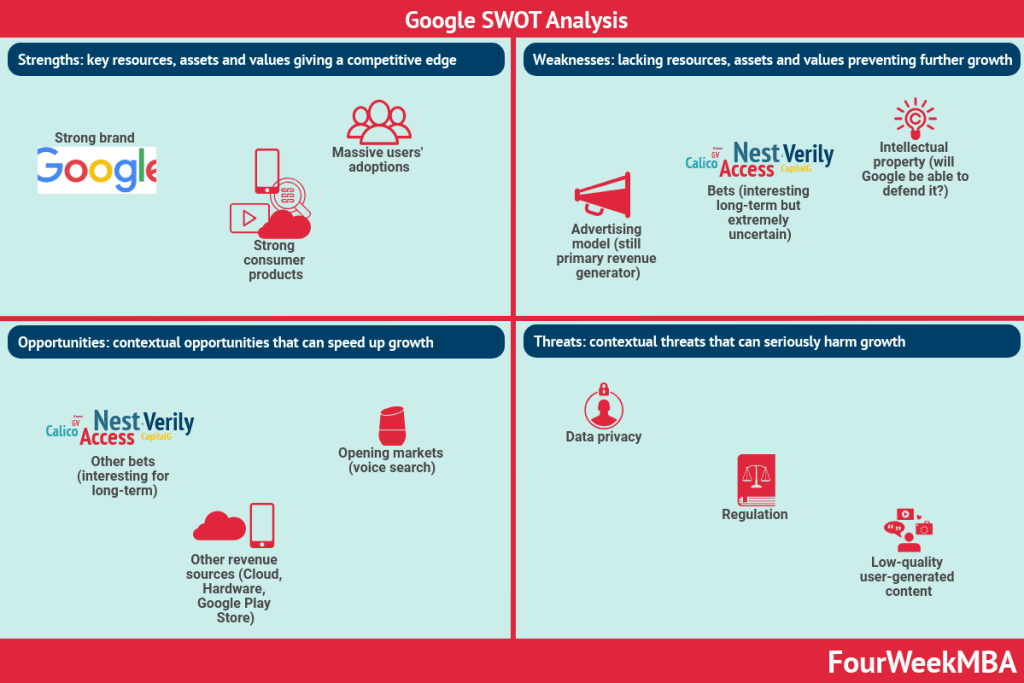
Google’s strength is its strong consumer brand. The company is grabbing new opportunities by opening up industries like voice search and consolidating in industries like the cloud. As a weakness, its revenues primarily come from advertising. A primary threat is the quick change of search and potential intervention by regulators.
Gennaro is the creator of FourWeekMBA, which reached about four million business people, comprising C-level executives, investors, analysts, product managers, and aspiring digital entrepreneurs in 2022 alone | He is also Director of Sales for a high-tech scaleup in the AI Industry | In 2012, Gennaro earned an International MBA with emphasis on Corporate Finance and Business Strategy.