Market fragmentation is most commonly seen in growing markets, which fragment and break away from the parent market to become self-sustaining markets with different products and services. Market fragmentation is a concept suggesting that all markets are diverse and fragment into distinct customer groups over time.
Aspect
Explanation
Market Fragmentation
– Market Fragmentation refers to the division of a market into smaller, more specialized segments characterized by distinct customer preferences, needs, and buying behaviors. It results in the presence of numerous niche markets within an industry.
Causes
– Market fragmentation can be caused by several factors, including diverse consumer preferences, advancements in technology, globalization, and the rise of niche products. It often occurs as markets evolve and mature.
Types
– There are two primary types of market fragmentation: horizontal fragmentation (diversification of product variants within a market) and vertical fragmentation (division of a market along the supply chain, leading to specialized intermediaries or distributors).
Impact
– Market fragmentation can have both positive and negative impacts on businesses. On one hand, it allows companies to target specific niches, which can lead to increased customer loyalty and profit margins. On the other hand, it can increase competition and marketing costs.
Challenges
– Companies operating in fragmented markets often face challenges in resource allocation, branding, and distribution due to the need to cater to diverse customer segments. Marketing strategies must be tailored to each niche.
Examples
– The technology industry is a prime example of market fragmentation, with numerous specialized niches such as smartphones, gaming consoles, and wearable devices. The food industry also exhibits fragmentation with various dietary preference niches.
Strategies
– To thrive in fragmented markets, businesses often adopt strategies such as product differentiation, targeted marketing, and customization. They may also partner with specialized distributors or utilize e-commerce platforms to reach niche audiences.
Market Research
– Conducting thorough market research is essential for understanding the needs and preferences of niche segments. It helps in identifying growth opportunities, crafting tailored marketing messages, and developing products that resonate with specific audiences.
Adaptation
– Successful businesses in fragmented markets continuously adapt and innovate to remain competitive. They are agile in responding to changing consumer trends and preferences, ensuring their products or services meet evolving niche demands.
Conclusion
– Market fragmentation is a phenomenon where a single market divides into smaller, specialized segments. While it presents challenges, it also offers opportunities for businesses to cater to specific customer needs and build strong brand loyalty within niche markets.
The fragmentation process is initiated by a small customer group whose needs are not currently being met.
As the market expands, it becomes economically feasible at some point to develop and sell products to each group.
That is, to meet previously unmet needs.
Fragmentation is both the result of market growth and an avenue for growth for any business looking for a new opportunity.
If the business can identify that a fragment is breaking away from the parent market, it can become that market’s leader by creating a suitable product.
In some cases, market leadership in the fragmented market may increase the company’s brand reputation in the parent market, or vice versa.
Identifying market fragmentation
Identifying market fragmentation is perhaps easier said than done, but the ability to do so can pay off handsomely for a business.
Below are a few characteristics that may help businesses identify fragmented markets or indeed if a market is likely to fragment in the future:
Determine if there are barriers to entry
Various interpretations of what constitutes a barrier to entry have been put forth since the 1950s. For this article, we will use the definition provided by American economist George Stigler in 1968, who stated that a barrier to entry was any “cost of producing that must be borne by a firm which seeks to enter an industry but is not borne by firms already in the industry.” In economics, therefore, barriers to entry prevent or make it difficult for new businesses to enter a specific market.
By their very nature, fragmented markets are characterized by the ease with which a company can gain a competitive position.
Therefore, it stands to reason that markets with existing barriers to entry are not likely to be fragmented.
These barriers can include prohibitive start-up costs, legal or regulatory obligations, or patented technology.
Determine the degree of product innovation
Fragmented markets usually lack innovation or diversification and occur when multiple organizations sell undifferentiated products or services.
Disruptive innovation as a term was first described by Clayton M. Christensen, an American academic and business consultant whom The Economist called “the most influential management thinker of his time.” Disruptive innovation describes the process by which a product or service takes hold at the bottom of a market and eventually displaces established competitors, products, firms, or alliances.
Lack of customization
Are the needs of the market being met? Is demand being fulfilled?
We touched on customer needs in the previous section, but it is worth repeating once more.
Indeed, a lack of custom or personalized products can accurately predict the formation of a new market before it occurs.
Assess economy of scale
In Economics, Economies of Scale is a theory for which, as companies grow, they gain cost advantages. More precisely, companies manage to benefit from these cost advantages as they grow, due to increased efficiency in production. Thus, as companies scale and increase production, a subsequent decrease in the costs associated with it will help the organization scale further.
Or the cost advantage a business enjoys because of the size of its operations.
Fragmented markets have an absence of large and established players that use economies of scale to sell high-volume, low-cost products.
Market fragmentation industry types
Market fragmentation can occur in any industry, including:
Finance and accounting
No single company can dominate the finance and accounting industry because of the sheer number of fragmented markets.
Within the accounting market alone are specialized financial services including retirement planning, tax preparation, forensic accounting, auditing, and fiduciary (property) accounting.
Retail
Fragmented retail markets typically consist of small to medium players that do not have the ability to become market leaders.
This causes further fragmentation as these organizations seek to dominate progressively smaller or niche markets.
Hospitality
One of the best examples of market fragmentation can be seen in the hospitality industry.
Fast food is dominated by a handful of restaurant chains, forcing many smaller establishments to differentiate themselves in sub-markets.
The so-called “Uberification” of this industry has resulted in market fragmentation as restaurants seek to appeal to millennial consumers who value quality, low-cost, and convenience over a diverse menu selection.
Fast-food restaurants are also differentiating themselves from some of the bigger brands by offering fast-casual dining.
This is a high-quality, self-service dining experience where dishes are prepared to order in an informal setting.
Case Studies
Real Estate:
Market Fragmentation: The real estate market can be highly fragmented, with various niches such as residential, commercial, industrial, and agricultural properties. Each niche has its own unique customer base and demands.
Technology and Software:
Market Fragmentation: In the tech sector, there are numerous sub-markets, including software development, hardware manufacturing, cloud computing, and cybersecurity. Each of these segments has specific customer needs and solutions.
Healthcare:
Market Fragmentation: The healthcare industry consists of multiple fragmented markets, such as pharmaceuticals, medical devices, telemedicine, and healthcare IT. Each of these markets caters to different aspects of healthcare delivery.
Education:
Market Fragmentation: Education has a fragmented market with various segments like K-12 education, higher education, online learning, tutoring services, and corporate training. Each segment targets specific learners and learning needs.
Automotive:
Market Fragmentation: The automotive industry includes markets for electric vehicles, luxury cars, budget-friendly vehicles, and specialized vehicles like trucks and vans. Each sub-market caters to distinct customer preferences.
Food and Beverage:
Market Fragmentation: The food and beverage industry encompasses diverse markets, including fast food, fine dining, organic foods, and dietary supplements. Each market targets specific consumer tastes and health concerns.
Fashion and Apparel:
Market Fragmentation: Fashion and apparel comprise fragmented markets with segments like luxury fashion, sportswear, sustainable fashion, and children’s clothing. Each segment appeals to different consumer demographics.
Entertainment:
Market Fragmentation: The entertainment industry has multiple fragmented markets, including film, television, music, gaming, and live events. Each market offers unique content and experiences.
Travel and Tourism:
Market Fragmentation: Travel and tourism involve various markets such as luxury travel, budget travel, adventure tourism, and eco-tourism. Each market caters to different traveler preferences.
Energy and Sustainability:
Market Fragmentation: The energy sector has fragmented markets like renewable energy, fossil fuels, energy-efficient appliances, and sustainable construction. Each market addresses different environmental and energy needs.
Consumer Electronics:
Market Fragmentation: Consumer electronics encompass markets for smartphones, laptops, smart home devices, and wearable technology. Each market targets specific consumer needs and tech preferences.
Beauty and Personal Care:
Market Fragmentation: Beauty and personal care consist of markets for skincare, cosmetics, haircare, and grooming products. Each market offers products tailored to individual beauty routines.
Key takeaways
Market fragmentation is a concept suggesting that all markets are diverse and fragment into distinct customer groups over time.
Market fragmentation is typically initiated by a small customer group whose needs are not being met in the parent market. As the parent market grows and becomes fragmented, it becomes economically viable for a business to meet these needs.
Market fragmentation can occur in any industry, though it is perhaps best exemplified in the finance, accounting, retail, and hospitality industries.
Key Insights
Market Fragmentation: Market fragmentation refers to the concept that all markets are diverse and eventually break into distinct customer groups with specific needs.
Initiation of Fragmentation: Fragmentation is initiated when a small customer group’s needs are not met in the parent market. As the market expands, it becomes feasible for businesses to cater to these specific needs.
Opportunity for Growth: Market fragmentation offers an avenue for growth for businesses seeking new opportunities. Identifying fragmented markets allows businesses to become leaders by creating suitable products.
Characteristics of Fragmented Markets: Fragmented markets are characterized by ease of gaining a competitive position, lack of product innovation or diversification, lack of customization, and an absence of economies of scale.
Identifying Fragmentation: Businesses can identify fragmented markets by assessing barriers to entry, degree of product innovation, lack of customization, and economies of scale in the industry.
Examples of Fragmented Industries: Market fragmentation can occur in various industries, including finance and accounting, retail, and hospitality. These industries have diverse customer groups with specific needs that are not dominated by large players.
Applications
Application
Description
Implications
Audience Segmentation
Use insights to identify and segment target audiences effectively based on similar segmentation strategies observed in case studies.
Better targeting leads to more relevant messaging, increased engagement, and higher conversion rates.
Message Customization
Customize messaging to address the unique needs, preferences, and pain points of different audience segments, following successful examples.
Tailored messages improve resonance with audiences, fostering stronger connections and brand loyalty.
Channel Selection
Determine the most effective communication channels for reaching each audience segment, informed by case study examples of channel usage.
Proper channel selection maximizes reach and engagement, optimizing the overall effectiveness of marketing efforts.
Brand Positioning
Learn how successful companies have positioned their brands to resonate with diverse audience segments and apply similar strategies.
A total addressable market or TAM is the available market for a product or service. That is a metric usually leveraged by startups to understand the business potential of an industry. Typically, a large addressable market is appealing to venture capitalists willing to back startups with extensive growth potential.
A microniche is a subset of potential customers within a niche. In the era of dominating digital super-platforms, identifying a microniche can kick off the strategy of digital businesses to prevent competition against large platforms. As the microniche becomes a niche, then a market, scale becomes an option.
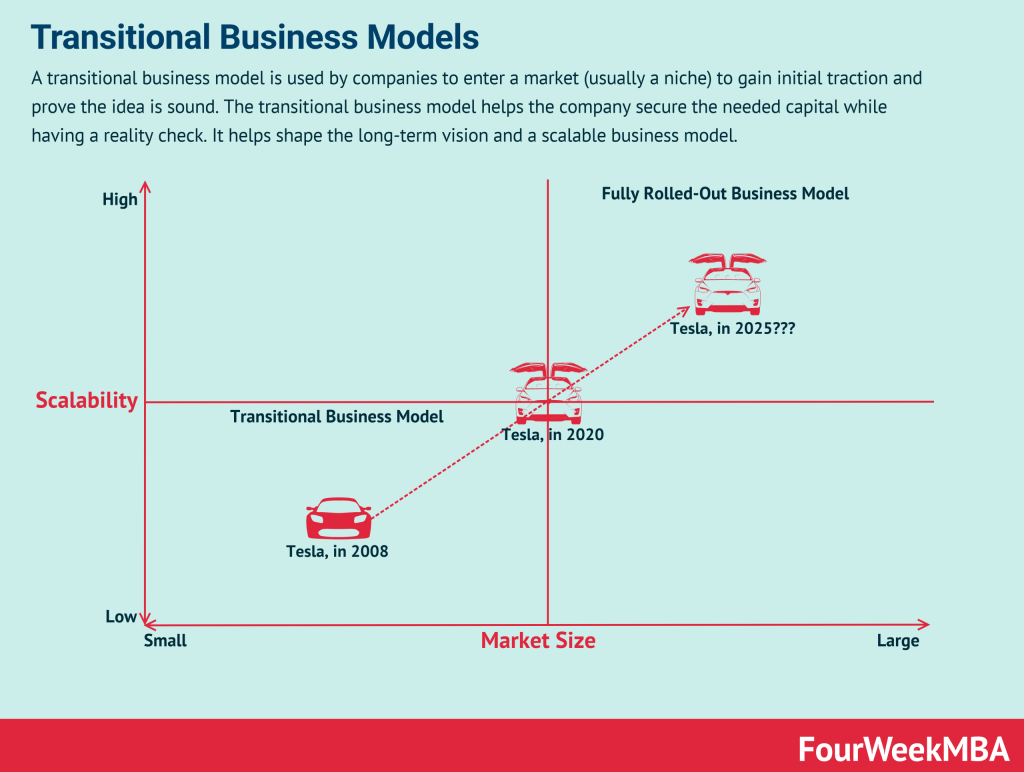
In simple terms, market validation is the process of showing a concept to a prospective buyer and collecting feedback to determine whether it is worth persisting with. To that end, market validation requires the business to conduct multiple customer interviews before it has made a significant investment of time or money. A transitional business model is an example of market validation that helps the company secure the needed capital while having a market reality check. It helps shape the long-term vision and a scalable businessmodel.
Market orientation is an approach to business where the company focuses more on the behaviors, wants, and needs of customers in its market. A company will first target a niche market to prove a commercial use case. And from there, it will create options to scale.
In a tech-driven business world, companies can move toward market expansion by creating options to scale via niches. Thus leveraging transitional business models to scale further and take advantage of non-linear competition, where today’s niches become tomorrow’s legacy players.
Digital and tech business models can be classified according to four levels of transformation into digitally-enabled, digitally-enhanced, tech or platform business models, and business platforms/ecosystems.
A platform business model generates value by enabling interactions between people, groups, and users by leveraging network effects. Platform business models usually comprise two sides: supply and demand. Kicking off the interactions between those two sides is one of the crucial elements for a platform business model success.
Business scaling is the process of transformation of a business as the product is validated by wider and wider market segments. Business scaling is about creating traction for a product that fits a small market segment. As the product is validated it becomes critical to build a viable businessmodel. And as the product is offered at wider and wider market segments, it’s important to align product, businessmodel, and organizational design, to enable wider and wider scale.
Developing a successful business strategy is about finding the proper niche, where to launch an initial version of your product to create a feedback loop and improve fast while making sure not to run out of money. And from there create options to scale to adjacent niches.
A Blockchain Business Model according to the FourWeekMBA framework is made of four main components: Value Model (Core Philosophy, Core Values and Value Propositions for the key stakeholders), Blockchain Model (Protocol Rules, Network Shape and Applications Layer/Ecosystem), Distribution Model (the key channels amplifying the protocol and its communities), and the Economic Model (the dynamics/incentives through which protocol players make money). Those elements coming together can serve as the basis to build and analyze a solid Blockchain Business Model.
In an asymmetric businessmodel, the organization doesn’t monetize the user directly, but it leverages the data users provide coupled with technology, thus have a key customer pay to sustain the core asset. For example, Google makes money by leveraging users’ data, combined with its algorithms sold to advertisers for visibility.
In a business world driven by technology and digitalization, competition is much more fluid, as innovation becomes a bottom-up approach that can come from anywhere. Thus, making it much harder to define the boundaries of existing markets. Therefore, a proper business competition analysis looks at customer, technology, distribution, and financial model overlaps. While at the same time looking at future potential intersections among industries that in the short-term seem unrelated.
Technological modeling is a discipline to provide the basis for companies to sustain innovation, thus developing incremental products. While also looking at breakthrough innovative products that can pave the way for long-term success. In a sort of Barbell Strategy, technological modeling suggests having a two-sided approach, on the one hand, to keep sustaining continuous innovation as a core part of the businessmodel. On the other hand, it places bets on future developments that have the potential to break through and take a leap forward.
A transitional business model is used by companies to enter a market (usually a niche) to gain initial traction and prove the idea is sound. The transitional business model helps the company secure the needed capital while having a reality check. It helps shape the long-term vision and a scalable businessmodel.
The minimum viable audience (MVA) represents the smallest possible audience that can sustain your business as you get it started from a microniche (the smallest subset of a market). The main aspect of the MVA is to zoom into existing markets to find those people which needs are unmet by existing players.
Business scaling is the process of transformation of a business as the product is validated by wider and wider market segments. Business scaling is about creating traction for a product that fits a small market segment. As the product is validated it becomes critical to build a viable business model. And as the product is offered at wider and wider market segments, it’s important to align product, business model, and organizational design, to enable wider and wider scale.
The market expansion consists in providing a product or service to a broader portion of an existing market or perhaps expanding that market. Or yet, market expansions can be about creating a whole new market. At each step, as a result, a company scales together with the market covered.
In the FourWeekMBA growth matrix, you can apply growth for existing customers by tackling the same problems (gain mode). Or by tackling existing problems, for new customers (expand mode). Or by tackling new problems for existing customers (extend mode). Or perhaps by tackling whole new problems for new customers (reinvent mode).
In the FourWeekMBA Revenue Streams Matrix, revenue streams are classified according to the kind of interactions the business has with its key customers. The first dimension is the “Frequency” of interaction with the key customer. As the second dimension, there is the “Ownership” of the interaction with the key customer.
Revenue model patterns are a way for companies to monetize their business models. A revenue model pattern is a crucial building block of a business model because it informs how the company will generate short-term financial resources to invest back into the business. Thus, the way a company makes money will also influence its overall business model.
A pricing strategy or model helps companies find the pricing formula in fit with their business models. Thus aligning the customer needs with the product type while trying to enable profitability for the company. A good pricing strategy aligns the customer with the company’s long term financial sustainability to build a solid business model.
Gennaro is the creator of FourWeekMBA, which reached about four million business people, comprising C-level executives, investors, analysts, product managers, and aspiring digital entrepreneurs in 2022 alone | He is also Director of Sales for a high-tech scaleup in the AI Industry | In 2012, Gennaro earned an International MBA with emphasis on Corporate Finance and Business Strategy.