Lead scoring is a systematic process used by businesses to evaluate and prioritize potential customers (leads) based on their likelihood to convert into paying customers. This method assigns numerical values or scores to individual leads, typically based on various attributes, behaviors, and engagement patterns.
Key Components
Methodologies and Approaches
Implementing lead scoring involves various methodologies and approaches to data collection, analysis, and scoring.
Benefits of Lead Scoring
Lead scoring offers several benefits for businesses looking to optimize their sales and marketing efforts and improve overall efficiency and effectiveness.
Challenges in Implementing Lead Scoring
Despite its benefits, implementing lead scoring can pose several challenges and considerations for businesses.
Strategies for Implementing Lead Scoring
To address challenges and maximize the effectiveness of lead scoring, businesses can employ various strategies and best practices.
Real-World Examples
Lead scoring is widely used across industries and sectors to optimize sales and marketing efforts and drive business growth.
Strengths
✓Improved Sales Productivity: By prioritizing leads with the highest likelihood of conversion, lead scoring enables…
✓Enhanced Lead Quality: Lead scoring helps businesses distinguish between high-quality leads that are more likely to…
✓Increased Conversion Rates: By targeting leads with a higher propensity to buy and tailoring marketing messages and…
✓Better Alignment Between Sales and Marketing: Lead scoring fosters better alignment and collaboration between sales and…
Limitations
✗Data Quality and Consistency: Lead scoring relies on accurate and consistent data from multiple sources, including CRM…
✗Subjectivity and Bias: Lead scoring criteria and weights may be subject to bias or interpretation errors if not…
✗Scalability and Adaptability: As businesses grow and evolve, their lead scoring models may need to be adjusted or…
Real-World Examples
AmazonFacebookIbmLinkedinPalantirTarget
Key Insight
Lead scoring is a valuable tool for businesses looking to optimize their sales and marketing efforts, improve lead quality, and drive revenue growth.
Exec Package + Claude OS Master Skill | Business Engineer Founding Plan
FourWeekMBA x Business Engineer | Updated 2026
Lead scoring is a systematic process used by businesses to evaluate and prioritize potential customers (leads) based on their likelihood to convert into paying customers. This method assigns numerical values or scores to individual leads, typically based on various attributes, behaviors, and engagement patterns. Lead scoring helps sales and marketing teams focus their efforts on leads with the highest probability of conversion, allowing them to allocate resources more efficiently and effectively.
By identifying and prioritizing qualified leads, businesses can streamline their sales funnel, improve conversion rates, and maximize their return on investment (ROI) from marketing and sales activities.
Key Principles
Scoring Criteria: Lead scoring involves defining specific criteria or attributes that indicate a lead’s level of interest, engagement, and fit with the company’s target market. These criteria may include demographic information (e.g., industry, company size), firmographic data (e.g., revenue, location), behavioral data (e.g., website visits, email opens), and engagement metrics (e.g., webinar attendance, content downloads).
Weighted Scoring: In weighted scoring models, each criterion is assigned a numerical weight or value based on its importance or predictive value for conversion. Leads accumulate points based on their alignment with these criteria, with higher scores indicating a stronger likelihood of conversion.
Thresholds and Segmentation: Lead scoring often involves setting thresholds or cutoff points to distinguish between different lead categories, such as hot, warm, and cold leads. Segmentation allows sales and marketing teams to tailor their strategies and messaging to different lead segments based on their readiness to buy and level of engagement.
Methodologies and Approaches
Implementing lead scoring involves various methodologies and approaches to data collection, analysis, and scoring.
Data Integration and Analysis
Integrating data from multiple sources, such as customer relationship management (CRM) systems, marketing automation platforms, and website analytics tools, enables businesses to gather comprehensive insights into lead behavior and engagement. Analyzing this data allows them to identify patterns, trends, and correlations that inform the lead scoring process.
Predictive Modeling
Predictive modeling techniques, such as machine learning algorithms and statistical regression analysis, can be used to develop sophisticated lead scoring models that predict the likelihood of conversion based on historical data and lead attributes. These models continuously learn and refine their predictions over time as new data becomes available.
Behavioral Scoring
Behavioral scoring focuses on tracking and evaluating lead interactions and engagement with digital touchpoints, such as website visits, email opens, clicks, social media interactions, and content downloads. By monitoring these behaviors, businesses can gauge lead interest and intent and adjust their scoring criteria accordingly.
Benefits of Lead Scoring
Lead scoring offers several benefits for businesses looking to optimize their sales and marketing efforts and improve overall efficiency and effectiveness.
Improved Sales Productivity: By prioritizing leads with the highest likelihood of conversion, lead scoring enables sales teams to focus their time and resources on prospects with the greatest potential value. This improves sales productivity and efficiency, allowing reps to prioritize follow-up activities and close deals more effectively.
Enhanced Lead Quality: Lead scoring helps businesses distinguish between high-quality leads that are more likely to convert and low-quality leads that may not be a good fit for their products or services. By focusing on qualified leads, businesses can avoid wasting time and resources on unproductive leads and improve the overall quality of their sales pipeline.
Increased Conversion Rates: By targeting leads with a higher propensity to buy and tailoring marketing messages and sales strategies to their specific needs and preferences, businesses can increase conversion rates and drive more revenue from their sales and marketing efforts.
Better Alignment Between Sales and Marketing: Lead scoring fosters better alignment and collaboration between sales and marketing teams by providing a common framework for evaluating lead quality and prioritizing leads for follow-up. This alignment leads to smoother handoffs between marketing and sales and ensures that both teams are working towards the same goals.
Challenges in Implementing Lead Scoring
Despite its benefits, implementing lead scoring can pose several challenges and considerations for businesses.
Data Quality and Consistency: Lead scoring relies on accurate and consistent data from multiple sources, including CRM systems, marketing platforms, and website analytics tools. Ensuring data quality and integrity is essential for building reliable lead scoring models and making informed decisions.
Subjectivity and Bias: Lead scoring criteria and weights may be subject to bias or interpretation errors if not carefully defined and validated. Businesses must avoid relying on subjective criteria and instead focus on objective, data-driven indicators of lead quality and engagement.
Scalability and Adaptability: As businesses grow and evolve, their lead scoring models may need to be adjusted or refined to reflect changes in market dynamics, customer preferences, and business objectives. Maintaining scalability and adaptability in lead scoring processes is essential for long-term success.
Strategies for Implementing Lead Scoring
To address challenges and maximize the effectiveness of lead scoring, businesses can employ various strategies and best practices.
Define Clear Scoring Criteria: Establish clear and objective criteria for scoring leads based on their demographic attributes, firmographic data, behavioral indicators, and engagement metrics. Collaborate cross-functionally to ensure alignment between sales and marketing teams on scoring criteria and definitions.
Regularly Review and Refine Models: Continuously monitor and evaluate lead scoring models to ensure they remain accurate, relevant, and predictive over time. Regularly review scoring criteria, weights, and thresholds based on feedback from sales and marketing teams and evolving business needs.
Integrate with Sales and Marketing Processes: Integrate lead scoring seamlessly into existing sales and marketing processes and workflows to ensure adoption and alignment across teams. Provide training and support to sales and marketing teams on how to interpret and leverage lead scores effectively in their day-to-day activities.
Iterate and Experiment: Experiment with different scoring models, criteria, and algorithms to identify what works best for your business. Iterate on your approach based on performance feedback and insights gained from ongoing experimentation and analysis.
Real-World Examples
Lead scoring is widely used across industries and sectors to optimize sales and marketing efforts and drive business growth.
Software as a Service (SaaS) Companies: SaaS companies often use lead scoring to prioritize leads based on factors such as company size, industry vertical, website engagement, and trial usage. By focusing on leads with a high likelihood of becoming paying customers, SaaS businesses can accelerate their sales cycles and improve customer acquisition efficiency.
B2B Marketing and Sales Organizations: B2B companies leverage lead scoring to identify and prioritize leads based on factors such as job title, purchase intent, budget, and decision-making authority. By aligning sales and marketing efforts around high-quality leads, B2B organizations can drive higher conversion rates and increase revenue from their target accounts.
E-commerce Retailers: E-commerce retailers use lead scoring to segment and target customers based on their purchase history, browsing behavior, cart abandonment rates, and email engagement. By personalizing marketing campaigns and offers to different customer segments, e-commerce businesses can drive repeat purchases and increase customer lifetime value.
Conclusion
Lead scoring is a valuable tool for businesses looking to optimize their sales and marketing efforts, improve lead quality, and drive revenue growth. By systematically evaluating and prioritizing potential customers based on their likelihood to convert, businesses can focus their resources on the most promising opportunities and maximize their return on investment. Despite challenges such as data quality and scalability, lead scoring offers significant benefits for businesses across industries, from improving sales productivity and conversion rates to fostering better alignment between sales and marketing teams. As businesses continue to evolve and adapt to changing market dynamics, lead scoring will remain a critical component of their growth strategies and customer acquisition efforts.
Business development comprises a set of strategies and actions to grow a business via a mixture of sales, marketing, and distribution. While marketing usually relies on automation to reach a wider audience, and sales typically leverage a one-to-one approach. The business development’s role is that of generating distribution.
The more you move from consumers to enterprise clients, the more you’ll need a sales force able to manage complex sales. As a rule of thumb, a more expensive product, in B2B or Enterprise, will require an organizational structure around sales. An inexpensive product to be offered to consumers will leverage on marketing.
A sales cycle is the process that your company takes to sell your services and products. In simple words, it’s a series of steps that your sales reps need to go through with prospects that lead up to a closed sale.
RevOps – short for Revenue Operations – is a framework that aims to maximize the revenue potential of an organization. RevOps seeks to align these departments by giving them access to the same data and tools. With shared information, each then understands their role in the sales funnel and can work collaboratively to increase revenue.
In negotiation theory, BATNA stands for “Best Alternative To a Negotiated Agreement,” and it’s one of the key tenets of negotiation theory. Indeed, it describes the best course of action a party can take if negotiations fail to reach an agreement. This simple strategy can help improve the negotiation as each party is (in theory) willing to take the best course of action, as otherwise, an agreement won’t be reached.
In negotiation, WATNA stands for “worst alternative to a negotiated agreement,” representing one of several alternative options if a resolution cannot be reached. This is a useful technique to help understand what might be a negotiation outcome, that even if negative is still better than a WATNA, making the deal still feasible.
The ZOPA (zone of possible agreement) describes an area in which two negotiation parties may find common ground. Indeed, ZOPA is critical to explore the deals where the parties get a mutually beneficial outcome to prevent the risk of a win-lose, or lose-win scenario. And therefore get to the point of a win-win negotiation outcome.
Revenue modeling is a process of incorporating a sustainable financial model for revenue generation within a business model design. Revenue modeling can help to understand what options make more sense in creating a digital business from scratch; alternatively, it can help in analyzing existing digital businesses and reverse engineer them.
Customer experience maps are visual representations of every encounter a customer has with a brand. On a customer experience map, interactions called touchpoints visually denote each interaction that a business has with its consumers. Typically, these include every interaction from the first contact to marketing, branding, sales, and customer support.
AIDA stands for attention, interest, desire, and action. That is a model that is used in marketing to describe the potential journey a customer might go through before purchasing a product or service. The AIDA model helps organizations focus their efforts when optimizing their marketing activities based on the customers’ journeys.
Social selling is a process of developing trust, rapport, and a relationship with a prospect to enhance the sales cycle. It usually happens through tech platforms (like LinkedIn, Twitter, Facebook, and more), which enable salespeople to engage with potential prospects before closing the sale, thus becoming more effective.
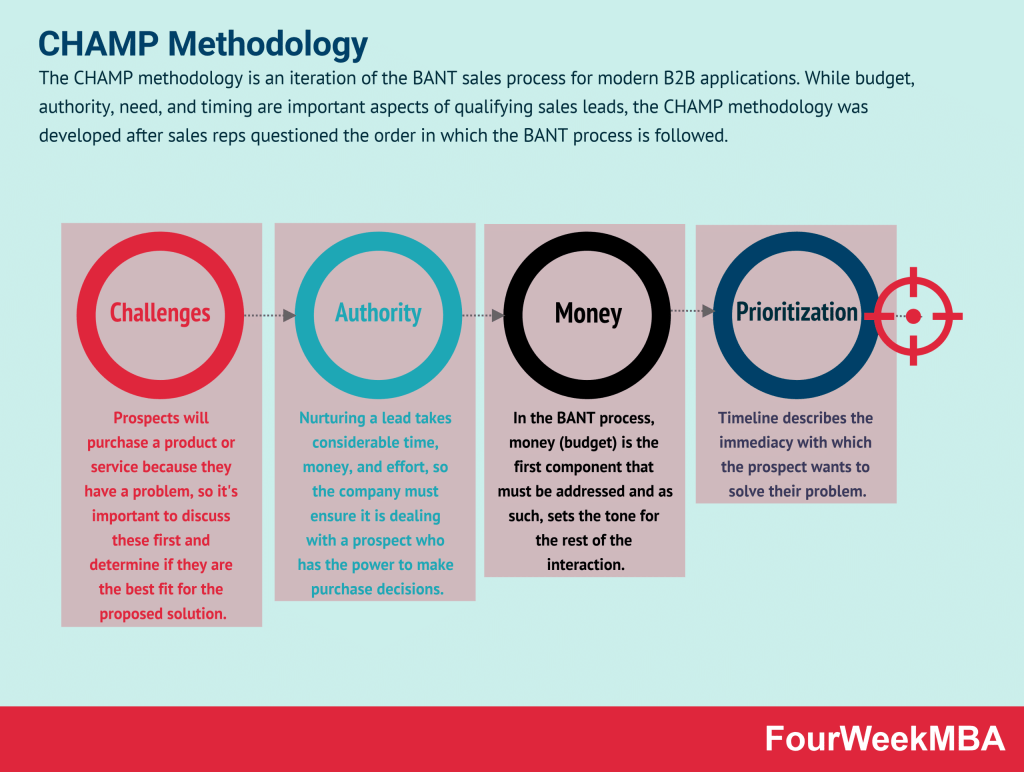
The CHAMP methodology is an iteration of the BANT sales process for modern B2B applications. While budget, authority, need, and timing are important aspects of qualifying sales leads, the CHAMP methodology was developed after sales reps questioned the order in which the BANT process is followed.
The BANT process was conceived at IBM in the 1950s as a way to quickly identify prospects most likely to make a purchase. Despite its introduction around 70 years ago, the BANT process remains relevant today and was formally adopted into IBM’s Business Agility Solution Identification Guide.
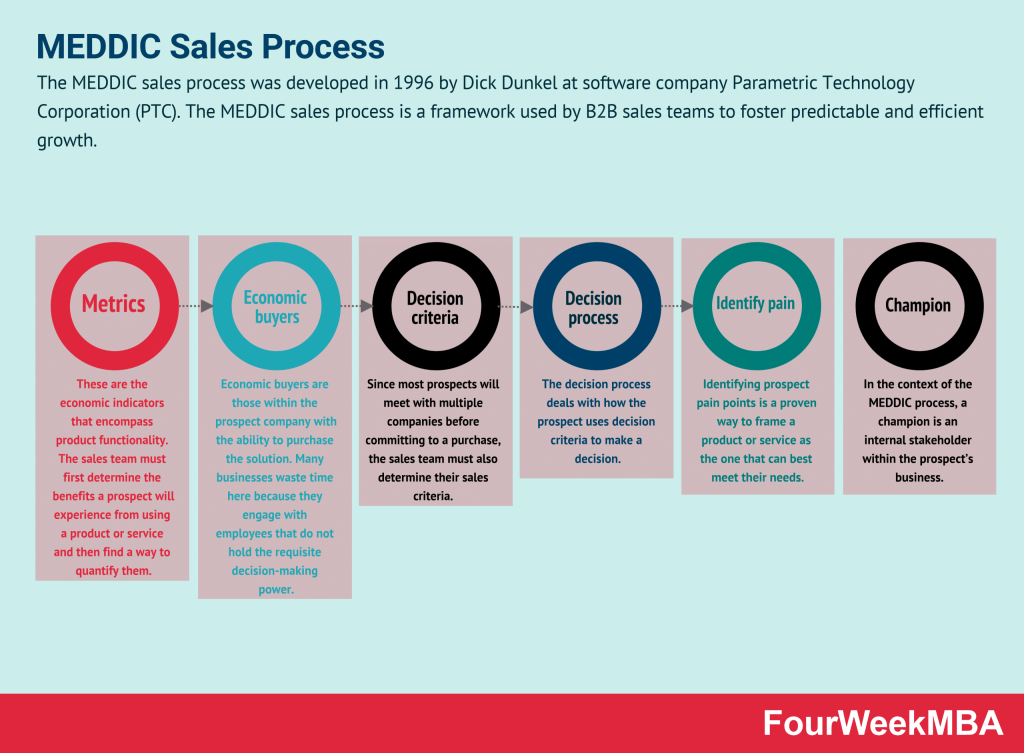
The MEDDIC sales process was developed in 1996 by Dick Dunkel at software company Parametric Technology Corporation (PTC). The MEDDIC sales process is a framework used by B2B sales teams to foster predictable and efficient growth.
STP marketing simplifies the market segmentation process and is one of the most commonly used approaches in modern marketing. The core focus of STP marketing is commercial effectiveness. Marketers use the approach to select the most valuable segments from a target audience and develop a product positioning strategy and marketing mix for each.
The sales funnel is a model used in marketing to represent an ideal, potential journey that potential customers go through before becoming actual customers. As a representation, it is also often an approximation, that helps marketing and sales teams structure their processes at scale, thus building repeatable sales and marketing tactics to convert customers.
Venture capitalist, Dave McClure, coined the acronym AARRR which is a simplified model that enables to understand what metrics and channels to look at, at each stage for the users’ path toward becoming customers and referrers of a brand.
The general concept of Bootstrapping connects to “a self-starting process that is supposed to proceed without external input.” In business, Bootstrapping means financing the growth of the company from the available cash flows produced by a viable business model. Bootstrapping requires the mastery of the key customers driving growth.
The virtuous cycle is a positive loop or a set of positive loops that trigger a non-linear growth. Indeed, in the context of digital platforms, virtuous cycles – also defined as flywheel models – help companies capture more market shares by accelerating growth. The classic example is Amazon’s lower prices driving more consumers, driving more sellers, thus improving variety and convenience, thus accelerating growth.
Business storytelling is a critical part of developing a business model. Indeed, the way you frame the story of your organization will influence its brand in the long-term. That’s because your brand story is tied to your brand identity, and it enables people to identify with a company.
Enterprise sales describes the procurement of large contracts that tend to be characterized by multiple decision-makers, complicated implementation, higher risk levels, or longer sales cycles.
Outside sales occur when a salesperson meets with prospects or customers in the field. This sort of sales function is critical to acquire larger accounts, like enterprise customers, for which the acquisition process is usually longer, more complex and it requires the understanding of the target organization. Thus the outside sales will cut through the noise to acquire a large enterprise account for the organization.
A freeterprise is a combination of free and enterprise where free professional accounts are driven into the funnel through the free product. As the opportunity is identified the company assigns the free account to a salesperson within the organization (inside sales or fields sales) to convert that into a B2B/enterprise account.
Zero to One is a book by Peter Thiel. But it also represents a business mindset, more typical of tech, where building something wholly new is the default mode, rather than building something incrementally better. The core premise of Zero to One then is that it’s much more valuable to create a whole new market/product rather than starting from existing markets.
Palantir is a software company offering intelligence services from governments and institutions to large commercial organizations. The company’s two main platforms Gotham and Foundry, are integrated at enterprise-level. Its business model follows three phases: Acquire, Expand, and Scale. The company bears the pilot costs in the acquire and expand phases, and it runs at a loss. Where in the scale phase, the customers’ contribution margins become positive.
Consultative selling is a sales approach favoring relationship building and open dialogue to adequately meet the needs of a prospective customer. By building trust quickly a consultative selling approach can help the customer better meet her/his expectations and the salesperson hit her/his targets more effectively.
A unique selling proposition (USP) enables a business to differentiate itself from its competitors. Importantly, a USP enables a business to stand for something that they, in turn, become known among consumers. A strong and recognizable USP is crucial to operating successfully in competitive markets.
Lead scoring is a systematic process used by businesses to evaluate and prioritize potential customers (leads) based on their likelihood to convert into paying customers. This method assigns numerical values or scores to individual leads, typically based on various attributes, behaviors, and engagement patterns.
What are the methodologies and approaches?
Implementing lead scoring involves various methodologies and approaches to data collection, analysis, and scoring.
What are the benefits of lead scoring?
Lead scoring offers several benefits for businesses looking to optimize their sales and marketing efforts and improve overall efficiency and effectiveness.
What are the challenges in implementing lead scoring?
Despite its benefits, implementing lead scoring can pose several challenges and considerations for businesses.
What are the real-world examples?
Lead scoring is widely used across industries and sectors to optimize sales and marketing efforts and drive business growth.
Gennaro Cuofano is a CRO and tech executive who has worked in AI since late 2015, starting with bringing NLP, natural-language generation, voice and chatbot products to the marketing industry. His background is in law and finance: he holds a Master's degree in Law and an International MBA with an emphasis on corporate finance (LUISS Business School and the University of San Diego, 2012), and worked as a financial analyst at a real-estate investment firm in San Diego and as an assistant controller. His work focuses on business model strategy, business engineering and, more broadly, structural analysis: how companies make money, read from their own filings. He created FourWeekMBA and leads research there and at The Business Engineer, his newsletter on AI and business strategy, with over 95,000 subscribers and more than 1,000 published analyses. His writing has also appeared on Entrepreneur (for example, How to Digitize a Family Business in Europe) and HackerNoon. Find him on LinkedIn and Substack. See how we source.
Scroll to Top
Discover more from FourWeekMBA
Subscribe now to keep reading and get access to the full archive.