Kevin Systrom is a computer programmer and entrepreneur best known for developing the social photo-based app Burbn and its successor Instagram. When Facebook acquired Instagram, Systrom remained CEO for another six years before quitting in 2018.
Category
Details
Full Name
Kevin Systrom
Date of Birth
December 30, 1983
Place of Birth
Holliston, Massachusetts, USA
Nationality
American
Education
Bachelor of Science in Management Science and Engineering from Stanford University
Early Career
Intern at Odeo (which later became Twitter), Worked at Google on Gmail and other products
Major Companies Founded
Instagram
Positions
Co-founder and former CEO of Instagram
Major Projects
Development and launch of Instagram, Expansion of Instagram into a global social media platform with over a billion users
Notable Achievements
Sold Instagram to Facebook for $1 billion in 2012, Played a key role in shaping visual social media culture
As a management science and engineering student at Stanford University, Systrom was selected to participate in the Mayfield Fellows Program. He was one of 12 students to intern at Odeo, a directory website for RSS-syndicated podcasts that would later become Twitter.
Systrom also turned down a job offer from Mark Zuckerberg around this time. He later recounted the story to Fast Company in 2011: “Unfortunately, I decided I wanted to stay in school, and that’s one of those decisions that I look back at – I would’ve loved to have been part of Facebook’s growth over the years, but it was the first time I met those guys”.
Post-graduation, Systrom joined Google in 2006 where he spent most of his time as an Associate Product Marketing Manager. Before long he moved into the Corporate Development Team but left the company in January 2009.
NextStop and Burbn
With former Google co-workers, Systrom worked as a product manager at the social travel recommendation platform NextStop.
In his spare time, he also learned how to write code and later created Burbn – the location-based social app mentioned earlier.
But the pair realized that the photo-sharing feature was popular and showed potential. They removed all of the non-essential features of Burbn and were left with a bare-bones app where users could share, like, and comment on photos.
Systrom also had an epiphany about the introduction of filters to the app. When he heard that his wife was hesitant to share her photos online, he discovered that she felt they were not as good as those produced by a mutual friend on Burbn who was using filters.
Instagram was released in October 2010 after a short, eight-week build.
Resignation
Systrom resigned from Instagram on September 24, 2018, after six years as CEO – a relatively long period for an entrepreneur to remain involved after selling their company. The move was seen as abrupt and no concrete explanation was ever provided, but some believed there was tension between the pair and Zuckerberg over Instagram’s future direction.
Nevertheless, he served as a visionary over those years and was instrumental in selling the idea of a Metaverse and VR/AR integration.
Since his departure, Systrom has kept a low profile and now devotes time to his family and creative pursuits. He did however partner with Krieger once more to develop a live COVID-19 tracker as the virus took hold in 2020.
Some months later, The New York Times reported that he had been unsuccessfully approached by TikTok for a leadership position.
Key takeaways:
Kevin Systrom is a computer programmer and entrepreneur best known for developing the social photo-based app Burbn and its successor Instagram.
Early on, Systrom held various positions at NextStop, Odeo, and Burbn. All of these equipped him with the knowledge and experience to develop Instagram with programmer and colleague Mike Krieger.
Systrom resigned from Instagram on September 24, 2018, after six years as CEO. He has since devoted himself to other pursuits and kept a relatively low profile.
Key Highlights
Early Career and Education:
Kevin Systrom is a computer programmer and entrepreneur known for creating Instagram.
During his time as a management science and engineering student at Stanford University, he participated in the Mayfield Fellows Program and interned at Odeo, a precursor to Twitter.
Systrom turned down a job offer from Mark Zuckerberg and Facebook during his time at Stanford.
Google and NextStop:
After graduation, Systrom joined Google in 2006, where he worked in various roles, including Associate Product Marketing Manager and the Corporate Development Team.
He later worked as a product manager at NextStop, a social travel recommendation platform, alongside former Google co-workers.
Burbn and Instagram:
In his spare time, Systrom learned to code and created Burbn, a location-based social app.
After securing seed funding, Systrom hired programmer Mike Krieger to refine the app.
Recognizing the popularity of photo-sharing features, Systrom and Krieger stripped down Burbn’s features to focus on photo-sharing, leading to the creation of Instagram in 2010.
Instagram’s Growth and Impact:
Instagram’s release in October 2010 was a success, driven by its simplicity and photo-sharing focus.
Systrom’s insight into adding filters to photos, based on his wife’s hesitations, played a role in enhancing the app’s appeal.
Resignation and Post-Instagram:
Systrom served as Instagram’s CEO for six years after its acquisition by Facebook.
His resignation in September 2018 was seen as abrupt, and while no concrete explanation was provided, there were speculations of tensions with Zuckerberg over Instagram’s future direction.
Systrom remained a visionary during his time at Instagram, advocating for concepts like the Metaverse and VR/AR integration.
Following his departure, Systrom focused on family and creative endeavors. He partnered with Krieger to develop a live COVID-19 tracker during the pandemic.
Later Opportunities:
The New York Times reported that Systrom was approached by TikTok for a leadership position, indicating his continued relevance and influence in the tech industry.
Mark Zuckerberg is the largest shareholder in the company. Zuckerberg retains ownership and control of the company. Like Google, Facebook has issued two common stocks, Class A and Class B. The holders of Class B common stocks are entitled to ten votes per share, and holders of our Class A common stocks are entitled to one vote per share. Mark Zuckerberg has a voting power of 61.1%; he’s the primary decision-maker. Other individual investors comprise Sheryl Sandberg, Christopher Cox, Marc Andreessen, Peter Thiel, Dustin Moskovitz, and Eduardo Saverin.
Facebook, the main product of Meta is an attention merchant. As such, its algorithms condense the attention of over 2.91 billion monthly active users as of June 2021. Meta generated $117.9 billion in revenues, in 2021, of which $114.9 billion from advertising (97.4% of the total revenues) and over $2.2 billion from Reality Labs (the augmented and virtual reality products arm).
Facebook generated most of its revenue from advertising in 2023. Indeed, the company generated $131.95B from advertising, $1.89B billion from its reality labs segment, and over a billion in other revenue.
By September 2022, Facebook’s (Meta) employee count had peaked at 87,314. Yet, as revenue slew down for the first time in years, the company announced a layoff of 13% of its workforce, bringing the headcount to 75,964. By March 2023, Meta announced another round of layoffs, dubbed “The Year of Efficiency,” which brought the headcount down to less than 66 thousand employees. By the end of 2023, Facebook reported 67,317 employees.
In 2022, post layoffs, Facebook generated $1,535,056 per employee, compared to $1,638,586 in 2021. In 2023, as Facebook (now Meta) completed its mass layoffs, the company reported nearly $135 billion in revenue and 67,317 employees, with a $2,003,981 revenue per employee.
Facebook (Meta) gained users in 2023. In fact, in 2023, Facebook had over three billion users worldwide, of which 272 million were in Canada, 408 million were in Europe, over 1.3 billion were in Asia, and over a billion were in the rest of the world.
ARPU, or average revenue per user, is a crucial metric for attention merchants like Facebook. It assesses the ability of the platform to monetize its users. For instance, by the end of 2023, Meta’s ARPU worldwide was $13.12. In the US & Canada, it was $68.44; in Europe, it was $23.14; in Asia-Pacific, $5.52; and in the rest of the world, it was $4.50.
ARPU, or average revenue per user, is a crucial metric for attention merchants like Facebook. It assesses the ability of the platform to monetize its users. For instance, by the end of 2023, Meta’s ARPU worldwide was $13.12. In the US & Canada, it was $68.44; in Europe, it was $23.14; in Asia-Pacific, $5.52; and in the rest of the world, it was $4.50.
Facebook (Meta) revenue in 2023 increased to $134.9B, compared to $116.6B in 2022. Its profitability increased to $39.1B in 2023, compared to $23.2B in 2022 and $39.37B in 2021.
Facebook is characterized by a multi-faceted matrix organizational structure. The company utilizes a flat organizational structure in combination with corporate function-based teams and product-based or geographic divisions. The flat organization structure is organized around the leadership of Mark Zuckerberg, and the key executives around him. On the other hand, the function-based teams based on the main corporate functions (like HR, productmanagement, investor relations, and so on).
Instagram makes money via visual advertising. Acquired by Facebook for a billion-dollar in 2012, today, Instagram is integrated into the overall Facebook (now rebranded as Meta) business strategy. In 2018, Instagram founders Kevin Systrom and Mike Krieger left the company as Facebook pushed toward tighter integration of the two platforms. In 2022, Instagram is the most successful product still, in Meta’s portfolio.
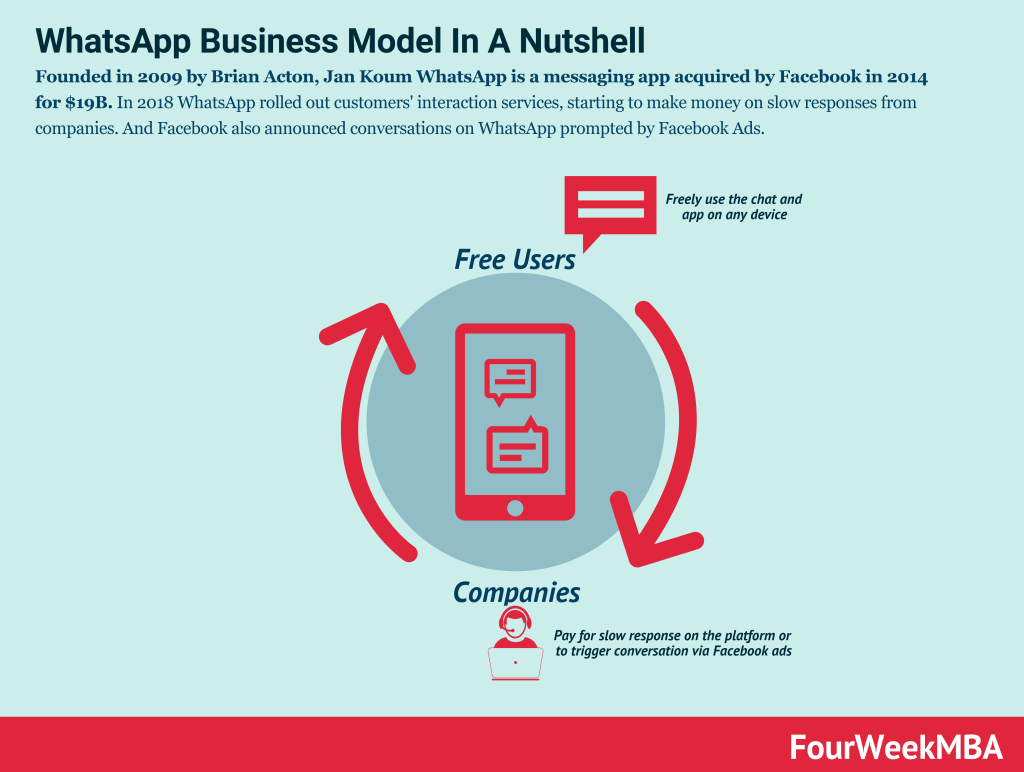
Founded in 2009 by Brian Acton, Jan Koum WhatsApp is a messaging app acquired by Facebook in 2014 for $19B. In 2018 WhatsApp rolled out customers’ interaction services, starting to make money on slow responses from companies. And Facebook also announced conversations on WhatsApp prompted by Facebook Ads.
By 2022, most of Tesla’s shares are still owned by Elon Musk, among the company’s co-founders and the CEO. Elon Musk is the top individual investor, with a 23.5% stake in the company. At current rates, this is valued at around $145-50 billion, making Elon Musk one of the wealthiest men on earth. In addition, Musk also holds a significant stake in Twitter and SpaceX, which makes him worth anywhere between $180-90 billion.
Warren Buffett is an American investor, business tycoon, and philanthropist. Known as the “Oracle of Omaha,” Buffett is best known for his strict adherence to value investing and frugality despite his immense wealth. Warren Buffet owns an investment firm, Berkshire Hathaway. He owns 238,624 Class A shares which gives him control over the company. His stake in the company is valued at over $100 billion.
Jeff Bezos’ net worth is primarily based on his ownership stake in Amazon. Indeed, as of 2023, Bezos owned a 12.7% stake in Amazon, worth over $120 billion.
Tim Cook’s net worth is primarily comprised of his Apple stocks. As of 2023, he owned 3,279,898 worth about $480 million at the current rate. However, Tim Cook has sold part of his Apple stocks over the years for hundreds of millions of dollars, making him a billionaire.
Bill Gates was the co-founder and former CEO of Microsoft until 2000, and he was on the board of Microsoft until 2020. However, over the years, Gates sold various stakes in Microsoft and diversified away from it. As of 2019, Gates had a 1.34% stake in Microsoft, which he might still own, valued at about $25 billion.
As of 2022, Satya Nadella had 763,518, valued at $190 million at Microsoft’s current market value. Nadella also got a $2.5 million base salary in 2022, plus $42.27 million in stock awards and over $10 million in non-stock incentives. Nadella sold hundreds of millions of dollars of Microsoft stocks in the last ten years, making him a centi-millionaire. In 2022, 96% of Nadella’s salary was performance-based, whereas only 4% comprised a base salary.
Larry Page co-founded Google (now Alphabet) and Sergey Brin. He controls the company tightly via a dual share ownership structure (made of Class A and B stocks). Alphabet is worth over a trillion dollars, valuing Larry Page’s stake in the company at around $70 billion.
Sergey Brin co-founded Google (now Alphabet) together with Larry Page. He controls the company tightly via a dual share ownership structure (made of Class A and B stocks). Alphabet is worth over a trillion dollars, valuing Sergey Brin’s stake at around $66 billion.
Mark Zuckerberg is the co-founder and principal shareholder of Facebook (now Meta), in which he owns a controlling stake worth over $68 billion. Thus Mark Zucberkerbs’ net worth is around $68 billion in 2023.
Eduardo Luiz Saverin is a billionaire entrepreneur and angel investor. He co-founded Facebook with Mark Zuckerberg; he was later ousted. Yet later on, Facebook settled a lawsuit with Saverin giving him a good chunk of the company’s stock, now worth over ten billion dollars. Thus, Eduardo Saverin’s net worth is around $10.45 billion in 2023.
While Larry Ellison is a shareholder in various tech companies (such as Tesla), his primary wealth comes from his ownership stake in the company he founded, Oracle. He owns almost 43% of the company’s stock, valued at over $100 billion, making him among the wealthiest people on earth.
Howard Schultz’s net worth is over $2.2 billion. Indeed, he is the founder of Starbucks and a major institutional shareholder, with 1.88% ownership of the company, valued at over $2.2 billion at the current market value, making him a billionaire.
Daniel Ek is one of the founders and one of the principal shareholders of Spotify. Indeed, in 2023 with 16.5% of Spotify’s shares, he’s worth around $3.7 billion.
Gennaro is the creator of FourWeekMBA, which reached about four million business people, comprising C-level executives, investors, analysts, product managers, and aspiring digital entrepreneurs in 2022 alone | He is also Director of Sales for a high-tech scaleup in the AI Industry | In 2012, Gennaro earned an International MBA with emphasis on Corporate Finance and Business Strategy.