Kayak’s value proposition centers around offering users a one-stop platform for planning and booking travel. For Travelers, Kayak provides: – Comprehensive Sear
Customer Segments
Kayak serves various customer segments, including: 1. Individual Travelers: Consumers booking personal trips. 2. Business Travelers: Professionals planning work
Distribution Strategy
Kayak’s distributionstrategy revolves around its website, mobile app, partnerships with airlines and hotels, and affiliate marketing. Users can search and book
Revenue Streams
Kayak generates revenue primarily through online advertising, referral fees, and affiliate marketing. Its primary revenue streams include: 1. Online Advertising
Marketing Strategy
Kayak’s marketingstrategy involves online advertising, search engine optimization (SEO), content marketing, and user-friendly design. The company uses online a
Organization Structure
Kayak’s organizational structure includes teams dedicated to software development, marketing, partnerships, data analytics, and customer support. Software devel
Competitive Advantage
Kayak’s competitive advantage lies in its user-friendly platform, extensive travel options, price comparison tools, and affiliate marketing reach. User-Friendly
Kayak is an online travel agency and search engine founded in 2004 by Steve Hafner and Paul M. English as a Travel Search Company and acquired by Booking Holdings in 2013 for $2.1 billion. The company makes money via an advertising model based on cost per click, cost per acquisition, and advertising placements.
Origin Story
Kayak is an American online travel agency and search engine. The platform was founded in 2004 by Steve Hafner and Paul M. English as Travel Search Company, Inc. Through a mobile app and website, users can search Kayak to compare rates between car rentals, flights, and hotels.
After changing its name to Kayak in 2005, the company received $196 million in financing and went on to make a series of acquisitions. These included German travel search platform Swoodoo and online travel agency SideStep.
Booking Holdings is the company the controls six main brands that comprise Booking.com, priceline.com, KAYAK, agoda.com, Rentalcars.com, and OpenTable. Over 76% of the company revenues in 2017 came primarily via travel reservations commisions and travel insurance fees. Almost 17% came from merchant fees, and the remaining revenues came from advertising earned via KAYAK. As distributionstrategy, the company spent over $4.5 billion in performance-based and brand advertising.
Through a mobile app and website, users can search Kayak to compare rates between car rentals, flights, and hotels. The company also recently launched a corporate travel management platform, allowing business travelers to plan trips more efficiently.
Value Proposition:
Comprehensive Search: Kayak provides users with a comprehensive search platform that aggregates travel information and deals from various sources, allowing travelers to compare prices, routes, and options across multiple airlines, hotels, and car rental companies in one place, simplifying the travel planning process.
Price Comparison: Kayak enables users to compare prices and options for flights, hotels, rental cars, and vacation packages from hundreds of travel websites and providers, helping travelers find the best deals and save money on their bookings by displaying competitive prices and offering real-time updates on fare fluctuations and discounts.
Flexible Filters and Sorting: Kayak offers flexible search filters and sorting options that allow users to refine their search results based on preferences such as price range, airline, departure time, duration, layovers, hotel amenities, location, and more, enabling travelers to find options that match their specific criteria and preferences.
Travel Planning Tools: Kayak provides users with a range of travel planning tools and resources, including price alerts, fare forecasts, flight trackers, destination guides, travel tips, and packing checklists, to help travelers make informed decisions, plan their trips effectively, and navigate the travel process with ease.
User-Friendly Interface: Kayak features a user-friendly interface that is intuitive, easy to navigate, and visually appealing, allowing users to search, compare, and book travel arrangements seamlessly across desktop computers, tablets, and mobile devices, ensuring a hassle-free and enjoyable user experience.
Kayak revenue generation
Kayak operates on a CPC model. Let’s expand on this model below.
Cost-per-click
Popularized by Google, the cost-per-click (CPC) model (invented by goto.com later became Overture) is one of the most widespread online.
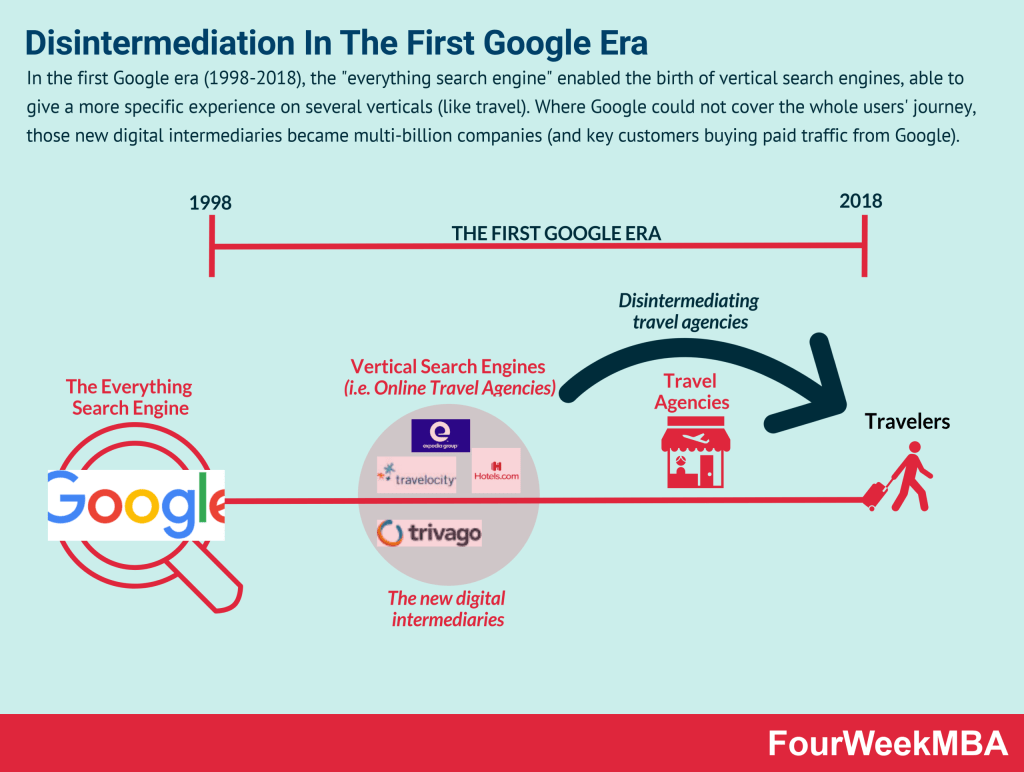
Google (now Alphabet) primarily makes money through advertising. The Google search engine, while free, is monetized with paid advertising. In 2023, Alphabet generated over $175B from Google search, $31.51B billion from the Network members (Adsense and AdMob), $31.31B billion from YouTube Ads, $33B from Google Cloud, and $34.69B billion from other sources (Google Play, Hardware devices, and other services). And $1.53B from its other bets.
Kayak makes money whenever a searcher clicks on an offer on its platform. Here, the advertiser in question pays Kayak a small fee. The exact fee is dependent upon the agreement between each party.
Cost-per-acquisition
When a user both clicks on an advertisement and then makes a purchase, the advertiser must also pay a cost-per-acquisition (CPA) fee. CPA fees typically fall in the range of 10-20%.
This so-called distribution revenue is paid by travel companies, including airlines such as JetBlue and car rental agencies such as Hertz. The airline industry is particularly profitable for Kayak, with estimates suggesting it derives a third of its total revenue from the source.
Advertising placements
Kayak also generates revenue from banner advertisements on its platform. It can charge a premium rate for ad placement because of its proven ability to generate high numbers of leads.
The company receives a fee from the advertiser for every impression its ads receive. Note that an impression is simply an advertisement a searcher views while using the interface. There is no requirement for the user to click on the ad or make a purchase.
Expansion
Kayak now operates in dozens of countries and continues to acquire hotel aggregation businesses in significant European and Asian markets.
This allows it to increase revenue by maintaining its status as a trusted and comprehensive travel service. With more consumers flocking to the platform, travel companies become incentivized to use the platform to remain competitive.
Marketing Strategy:
Search Engine Marketing (SEM): Kayak invests in search engine marketing campaigns to drive traffic to its website and increase visibility in search engine results pages (SERPs), bidding on relevant keywords, phrases, and ad placements to target users searching for travel-related information and services.
Display Advertising: Kayak engages in display advertising campaigns across various online platforms, including social media networks, travel websites, and display ad networks, to promote its brand, products, and special offers, reaching potential customers with targeted display ads and visual content.
Content Marketing: Kayak produces and distributes content marketing materials, including blog posts, articles, guides, and videos, that provide travel tips, destination recommendations, industry insights, and product information to engage and educate users, driving traffic and brand awareness through valuable content.
Affiliate Marketing: Kayak partners with affiliate marketers, travel bloggers, influencers, and online publishers to promote its platform and services to a wider audience, offering affiliate commissions, referral incentives, and co-branded marketing opportunities to affiliates who drive traffic and referrals to Kayak’s website.
Email Marketing: Kayak utilizes email marketing campaigns to communicate with users, deliver personalized recommendations, and promote special deals, discounts, and exclusive offers to subscribers, sending targeted email newsletters, alerts, and notifications to engage users and encourage bookings.
Distribution Channels:
Website and Mobile App: Kayak distributes its travel search engine and booking platform through its official website (www.kayak.com) and mobile applications for iOS and Android devices, allowing users to access and use the platform’s features and functionalities directly through web browsers and mobile apps.
Online Travel Agencies (OTAs): Kayak partners with online travel agencies, booking platforms, and travel intermediaries to distribute its travel search results, deals, and bookings through third-party websites, affiliate networks, and distribution channels, reaching a wider audience and expanding its reach and visibility.
API Integration: Kayak provides application programming interfaces (APIs) and software development kits (SDKs) to third-party developers, travel companies, and travel technology providers, allowing them to integrate Kayak’s travel search and booking capabilities into their own websites, apps, and platforms, leveraging Kayak’s technology and data for enhanced functionality and user experience.
Metasearch Partnerships: Kayak forms partnerships and collaborations with other metasearch engines, travel aggregators, and travel search platforms to distribute its travel search results and listings across partner websites and platforms, sharing traffic, leads, and revenue through reciprocal agreements and syndication partnerships.
Direct Partnerships: Kayak establishes direct partnerships and relationships with airlines, hotels, rental car companies, tour operators, and travel providers to access and display their inventory, availability, and pricing information on its platform, offering users a wide selection of options and choices for their travel bookings.
Key takeaways:
Kayak is an online travel aggregation service. Founded in 2004 by Steve Hafner and Paul M. English, the platform is now available in more than 60 countries.
Kayak operates on a CPC and CPA model to drive the bulk of its revenue. Advertisers pay the company a fee whenever a user clicks on an ad or makes a direct purchase.
Kayak is also able to charge a premium for ad placements. This is because of its popularity with users and aggressive acquisition strategy to corner areas of the travel market.
Key Highlights:
Value Proposition:
Offers a one-stop platform for planning and booking travel.
Comprehensive search and price comparison tools simplify the travel planning process.
Focuses on driving traffic, engaging users, and promoting special offers.
Distribution Channels:
Distributes through website, mobile app, OTAs, API integration, metasearch partnerships, and direct partnerships.
Leverages partnerships and APIs to expand reach and accessibility.
Expansion and Competitive Advantage:
Operates in multiple countries and acquires hotel aggregation businesses.
Competitive advantage lies in user-friendly platform, extensive travel options, price comparison tools, and affiliate marketing reach.
Business Model Element
Analysis
Implications
Examples
Value Proposition
Kayak’s value proposition centers around offering users a one-stop platform for planning and booking travel. For Travelers, Kayak provides: – Comprehensive Search: Access to a wide range of travel options. – Price Comparison: Tools to compare prices from various providers. – Travel Planning: Features for itinerary management. For Suppliers, Kayak offers: – Marketing Platform: A platform to showcase their offerings. – Access to Travelers: Exposure to a large user base. Kayak aims to simplify the travel booking process by providing easy access to travel options and price comparisons.
Simplifies travel planning for users by aggregating travel options and prices from various providers. Allows users to make informed decisions by comparing prices and features. Enhances user convenience through itinerary management tools. Provides suppliers with a marketing platform and access to a large user base. Attracts travelers seeking convenience and value in travel planning. Offers suppliers an avenue to reach a broader audience.
– Comprehensive search options cater to diverse travel needs. – Price comparison tools assist in making cost-effective choices. – Travel planning features enhance convenience. – Suppliers gain exposure to a large user base. – Appeals to travelers seeking convenience and value in travel booking. – Provides suppliers with a broader marketing reach.
Customer Segments
Kayak serves various customer segments, including: 1. Individual Travelers: Consumers booking personal trips. 2. Business Travelers: Professionals planning work-related travel. 3. Vacation Planners: Travelers looking for holiday packages. 4. Travel Agencies: Agents seeking travel options for clients. Kayak caters to a diverse range of travelers and travel professionals.
Focuses on diverse customer segments within the travel industry. Customizes user experiences based on individual preferences and needs. Provides a platform for various customer types, including individual travelers, business travelers, vacation planners, and travel agencies. Offers a versatile range of travel options to meet varying demands.
– Serving diverse customer segments broadens the user base. – Customized experiences cater to individual preferences. – Provides a platform for various customer types. – Offers a versatile product range to meet diverse travel needs.
Distribution Strategy
Kayak’s distribution strategy revolves around its website, mobile app, partnerships with airlines and hotels, and affiliate marketing. Users can search and book travel through Kayak’s website and mobile app. Kayak also partners with airlines, hotels, and other travel providers to offer a wide selection of options. Affiliate marketing programs extend Kayak’s reach through partner websites.
Utilizes its website and mobile app to provide users with convenient access to travel options. Collaborates with airlines, hotels, and other travel providers to expand the selection of choices. Implements affiliate marketing programs to reach a broader audience through partner websites. Maintains a multi-channel distribution strategy for accessibility and convenience.
– Website and mobile app align with user preferences for online booking. – Partnerships expand the range of travel options available to users. – Affiliate marketing extends the platform’s reach through partners. – Multi-channel distribution enhances accessibility and convenience for users.
Revenue Streams
Kayak generates revenue primarily through online advertising, referral fees, and affiliate marketing. Its primary revenue streams include: 1. Online Advertising: Revenue from advertising placements on its website and app. 2. Referral Fees: Fees earned by referring users to third-party travel providers. 3. Affiliate Marketing: Commissions earned from partner websites for bookings made through referrals. Online advertising is a significant source of revenue.
Relies on online advertising as a primary source of income, generating revenue from advertising placements on its platforms. Earns referral fees by directing users to third-party travel providers, such as airlines and hotels. Gains commissions through affiliate marketing programs with partner websites for bookings made through referrals. Prioritizes online advertising to attract users and monetize website traffic. Utilizes referrals and affiliate marketing for additional income.
– Online advertising provides a consistent revenue source. – Referral fees are earned by directing users to third-party providers. – Affiliate marketing generates commissions for bookings through partner websites. – Prioritizes online advertising to attract users. – Utilizes referrals and affiliate marketing for additional income.
Marketing Strategy
Kayak’s marketing strategy involves online advertising, search engine optimization (SEO), content marketing, and user-friendly design. The company uses online advertising to reach a broad audience and attract users to its platform. SEO and content marketing strategies enhance organic visibility on search engines. User-friendly design and features make the platform attractive and easy to use.
Utilizes online advertising to promote its platform and attract users. Implements SEO and content marketing strategies to improve organic visibility on search engines, increasing user traffic. Prioritizes user-friendly design and features to enhance the platform’s appeal and usability. Provides travelers with a seamless experience from search to booking.
– Online advertising reaches a broad online audience. – SEO and content marketing improve organic visibility and user traffic. – User-friendly design enhances the platform’s appeal and usability. – Provides a seamless experience for travelers from search to booking.
Organization Structure
Kayak’s organizational structure includes teams dedicated to software development, marketing, partnerships, data analytics, and customer support. Software development teams focus on platform enhancements. Marketing teams handle promotional efforts. Partnerships teams collaborate with airlines and hotels. Data analytics teams provide insights for personalized recommendations. Customer support teams assist users with inquiries. This structure supports platform excellence, marketing effectiveness, supplier relationships, data-driven strategies, and user satisfaction.
Employs specialized teams for software development, marketing, partnerships, data analytics, and customer support. Prioritizes platform enhancements through development teams. Manages promotional efforts effectively through marketing teams. Collaborates with airlines and hotels through partnerships teams. Utilizes data analytics for data-driven strategies and personalized recommendations. Assists users with inquiries through customer support teams. Ensures platform quality, marketing effectiveness, supplier relationships, data-driven strategies, and user satisfaction.
– Specialized teams drive platform enhancements. – Manages promotional efforts effectively. – Collaborates with suppliers for product expansion. – Leverages data analytics for personalized recommendations. – Assists users with inquiries for enhanced satisfaction. – Ensures platform quality, marketing effectiveness, and data-driven strategies.
Competitive Advantage
Kayak’s competitive advantage lies in its user-friendly platform, extensive travel options, price comparison tools, and affiliate marketing reach. User-Friendly Platform: Offers an easy and convenient platform for travel planning and booking. Extensive Travel Options: Provides users with a wide selection of travel options from various providers. Price Comparison Tools: Allows users to compare prices and make informed decisions. Affiliate Marketing Reach: Extends its reach through partner websites and affiliate marketing programs. Kayak stands out as a user-focused metasearch engine in the online travel industry.
Derives a competitive advantage from: – A user-friendly platform for easy travel planning and booking. – Extensive travel options from various providers. – Price comparison tools that empower users to make cost-effective choices. – Affiliate marketing reach that extends its audience through partners. Stands out as a user-focused platform in the competitive online travel industry.
– Offers a user-friendly platform for convenient travel planning and booking. – Provides extensive travel options for users. – Price comparison tools empower users to make informed choices. – Extends its reach through affiliate marketing and partnerships. – Stands out as a user-focused platform in the competitive online travel industry.
Airbnb is a platform business model making money by charging guests a service fee between 5% and 15% of the reservation, while the commission from hosts is generally 3%. For instance, on a $100 booking per night set by a host, Airbnb might make as much as $15, split between host and guest fees.
Booking Holdings is the company the controls six main brands that comprise Booking.com, priceline.com, KAYAK, agoda.com, Rentalcars.com, and OpenTable. Over 76% of the company revenues in 2017 came primarily via travel reservations commisions and travel insurance fees. Almost 17% came from merchant fees, and the remaining revenues came from advertising earned via KAYAK. As distributionstrategy, the company spent over $4.5 billion in performance-based and brand advertising.
Trivago is a search and discovery travel platform part of Expedia Group. Trivago is widely known as a trusted hotel comparison service. Trivago doesn’t charge based on bookings but rather through a cost-per-click (CPC) model, monetized when a hotel searcher clicks one of its advertiser listings. This referral revenue comprises most of Trivago’s income. Trivago also has another minor revenue stream via subscriptions to its Business Studio, a tool that helps hoteliers track impression and click data associated with their properties.
Born in 1996 as a travel platform of Microsoft, it would be spun off later on. Expedia became among the largest online travel agencies (OTAs) which comprise a set of brands that go from Hotels.com, Vrbo, Orbits, CheapTickets, ebookers, Travelocity, Trivago, and others. The company follows a multi-brandstrategy.
Kayak is an online travel agency and search engine founded in 2004 by Steve Hafner and Paul M. English as a Travel Search Company and acquired by Booking Holdings in 2013 for $2.1 billion. The company makes money via an advertising model based on cost per click, cost per acquisition, and advertising placements.
OpenTable is an American online restaurant reservation system founded by Chuck Templeton. During the late 90s, it provided one of the first automated, real-time reservation systems. The company was acquired by Booking Holding back in 2014, for $2.6 billion. Today OpenTable makes money via subscription plans, referral fees, and in-dining with its first restaurant, as an experiment in Miami, Florida.
OYO’s business model is a mixture of platform and brand, where the company started primarily as an aggregator of homes across India, and it quickly moved to other verticals, from leisure to co-working and corporate travel. In a sort of octopus business strategy of expansion to cover the whole spectrum of short-term real estate.
TripAdvisor’s business model matches the demand for people looking for a travel experience with supply from travel partners around the world providing travel accommodations and experiences. When this match is created TripAdvisor collects commission from partners on a CPC and CPM basis. The non-hotel revenue comprises experiences, restaurants, and rentals.
Trivago is a search and discovery travel platform part of Expedia Group. Trivago is widely known as a trusted hotel comparison service. Trivago doesn’t charge based on bookings but rather through a cost-per-click (CPC) model, monetized when a hotel searcher clicks one of its advertiser listings. This referral revenue comprises most of Trivago’s income. Trivago also has another minor revenue stream via subscriptions to its Business Studio, a tool that helps hoteliers track impression and click data associated with their properties.
Gennaro is the creator of FourWeekMBA, which reached about four million business people, comprising C-level executives, investors, analysts, product managers, and aspiring digital entrepreneurs in 2022 alone | He is also Director of Sales for a high-tech scaleup in the AI Industry | In 2012, Gennaro earned an International MBA with emphasis on Corporate Finance and Business Strategy.