Facebook’s core strategy is to maintain its dominance in the social media space. It achieves this by continuously innovating its platforms, including Facebook,
Data Monetization
Facebook leverages the vast amount of user data it collects to provide targeted advertising services. It uses user data to help advertisers reach specific demog
Acquisitions and Diversification
Facebook actively acquires companies to expand its offerings and diversify its business. This includes acquiring platforms like Instagram and WhatsApp, which ha
Ecosystem Integration
Facebook integrates its platforms and services to create a unified ecosystem. This integration encourages users to spend more time within the Facebook ecosystem
Virtual Reality and Hardware
Facebook invests in virtual reality (VR) and hardware to create new revenue streams and extend its presence beyond social media. Oculus, acquired by Facebook, i
Facebook’s business strategy revolves around its social networking platform, advertising and monetization models, and platform expansion through strategic acquisitions like Instagram, WhatsApp, and Oculus VR. It also focuses on innovation and future technologies such as artificial intelligence, virtual reality, and initiatives like Internet.org to connect the global population.
Business Strategy
Description
Example
Implications
Integration
Social Media Dominance
Facebook’s core strategy is to maintain its dominance in the social media space. It achieves this by continuously innovating its platforms, including Facebook, Instagram, WhatsApp, and Messenger, to engage users and advertisers.
Facebook, the company’s flagship platform, regularly introduces features like News Feed, Stories, and Marketplace to keep users engaged and attract advertisers. Instagram’s addition of Reels and Shopping features is another example.
– Sustains user engagement and retention on its platforms. – Attracts advertisers by offering a large user base for targeting. – Generates significant advertising revenue.
Facebook integrates its various platforms, enabling cross-platform sharing, messaging, and advertising. This integration provides a seamless user experience across Facebook-owned properties.
Data Monetization
Facebook leverages the vast amount of user data it collects to provide targeted advertising services. It uses user data to help advertisers reach specific demographics, interests, and behaviors, maximizing ad effectiveness.
Facebook Ads allows businesses to create highly targeted ad campaigns by specifying demographics, interests, and behaviors. Advertisers can use Facebook Pixel for tracking and optimizing ad performance.
– Drives advertising revenue by offering highly effective ad targeting. – Provides value to advertisers through detailed insights and analytics. – Raises privacy and data security concerns.
Data monetization is integrated into Facebook’s ad platform and business model, enabling businesses to leverage user data for advertising while adhering to privacy regulations.
Acquisitions and Diversification
Facebook actively acquires companies to expand its offerings and diversify its business. This includes acquiring platforms like Instagram and WhatsApp, which have become integral parts of its strategy.
Facebook’s acquisition of Instagram allowed it to tap into the growing visual content and influencer marketing trends. The purchase of WhatsApp expanded its reach in the messaging space.
– Enhances Facebook’s product portfolio and user base. – Mitigates risks associated with a single platform. – Enables cross-platform features and integrations.
Acquired companies are integrated into Facebook’s ecosystem, allowing users to share content seamlessly between platforms and access features like Stories and messaging across Facebook-owned apps.
Ecosystem Integration
Facebook integrates its platforms and services to create a unified ecosystem. This integration encourages users to spend more time within the Facebook ecosystem, increasing engagement and ad exposure.
Users can link their Facebook and Instagram accounts, allowing them to share posts and Stories across both platforms. Integration also extends to Messenger and WhatsApp, offering cross-platform messaging.
– Increases user engagement and interaction across platforms. – Encourages users to stay within the Facebook ecosystem. – Enhances data collection and ad targeting capabilities.
Integration is evident in features like Facebook Login, which allows users to access third-party apps and websites using their Facebook credentials, further expanding the ecosystem’s reach.
Virtual Reality and Hardware
Facebook invests in virtual reality (VR) and hardware to create new revenue streams and extend its presence beyond social media. Oculus, acquired by Facebook, is a key player in the VR space.
Oculus VR headsets like the Oculus Quest offer immersive experiences and access to the Oculus Store. Facebook has also introduced smart glasses, like Ray-Ban Stories, to blend technology with fashion.
– Diversifies Facebook’s business beyond social media. – Positions Facebook as a player in the emerging VR and AR markets. – Creates new opportunities for content creation and engagement.
VR and hardware are integrated into Facebook’s long-term strategy, with plans to connect the metaverse across its platforms, including Oculus and Facebook Horizon. This integration aims to shape the future of social interaction and entertainment.
Facebook, rebranded as Meta in 2021, is primarily owned by Mark Zuckerberg, founder, and CEO. Zuckerberg keeps tight control over the ownership and decision-making of the company. Other large individual shareholders comprise former COO Sheryl Sandberg and co-founder Eduardo Saverin. Large institutional investors include BlackRock, Vanguard, and Fidelity.
Facebook, the main product of Meta is an attention merchant. As such, its algorithms condense the attention of over 2.91 billion monthly active users as of June 2021. Meta generated $117.9 billion in revenues, in 2021, of which $114.9 billion from advertising (97.4% of the total revenues) and over $2.2 billion from Reality Labs (the augmented and virtual reality products arm).
Facebook generated most of its revenue from advertising in 2023. Indeed, the company generated $131.95B from advertising, $1.89B billion from its reality labs segment, and over a billion in other revenue.
By September 2022, Facebook’s (Meta) employee count had peaked at 87,314. Yet, as revenue slew down for the first time in years, the company announced a layoff of 13% of its workforce, bringing the headcount to 75,964. By March 2023, Meta announced another round of layoffs, dubbed “The Year of Efficiency,” which brought the headcount down to less than 66 thousand employees. By the end of 2023, Facebook reported 67,317 employees.
In 2022, post layoffs, Facebook generated $1,535,056 per employee, compared to $1,638,586 in 2021. In 2023, as Facebook (now Meta) completed its mass layoffs, the company reported nearly $135 billion in revenue and 67,317 employees, with a $2,003,981 revenue per employee.
Facebook (Meta) gained users in 2023. In fact, in 2023, Facebook had over three billion users worldwide, of which 272 million were in Canada, 408 million were in Europe, over 1.3 billion were in Asia, and over a billion were in the rest of the world.
ARPU, or average revenue per user, is a crucial metric for attention merchants like Facebook. It assesses the ability of the platform to monetize its users. For instance, by the end of 2023, Meta’s ARPU worldwide was $13.12. In the US & Canada, it was $68.44; in Europe, it was $23.14; in Asia-Pacific, $5.52; and in the rest of the world, it was $4.50.
ARPU, or average revenue per user, is a crucial metric for attention merchants like Facebook. It assesses the ability of the platform to monetize its users. For instance, by the end of 2023, Meta’s ARPU worldwide was $13.12. In the US & Canada, it was $68.44; in Europe, it was $23.14; in Asia-Pacific, $5.52; and in the rest of the world, it was $4.50.
Facebook (Meta) revenue in 2023 increased to $134.9B, compared to $116.6B in 2022. Its profitability increased to $39.1B in 2023, compared to $23.2B in 2022 and $39.37B in 2021.
As of September 2022, Facebook, rebranded as Meta, is a profitable company, generating $18.54B in net profits. Yet, if we look at its Reality Labs segment, which is in charge of building the Metaverse, it recorded a net loss of $9.44 billion in the first nine months of 2022.
Instagram makes money via visual advertising. Acquired by Facebook for a billion-dollar in 2012, today, Instagram is integrated into the overall Facebook (now rebranded as Meta) business strategy. In 2018, Instagram founders Kevin Systrom and Mike Krieger left the company as Facebook pushed toward tighter integration of the two platforms. In 2022, Instagram is the most successful product still, in Meta’s portfolio.
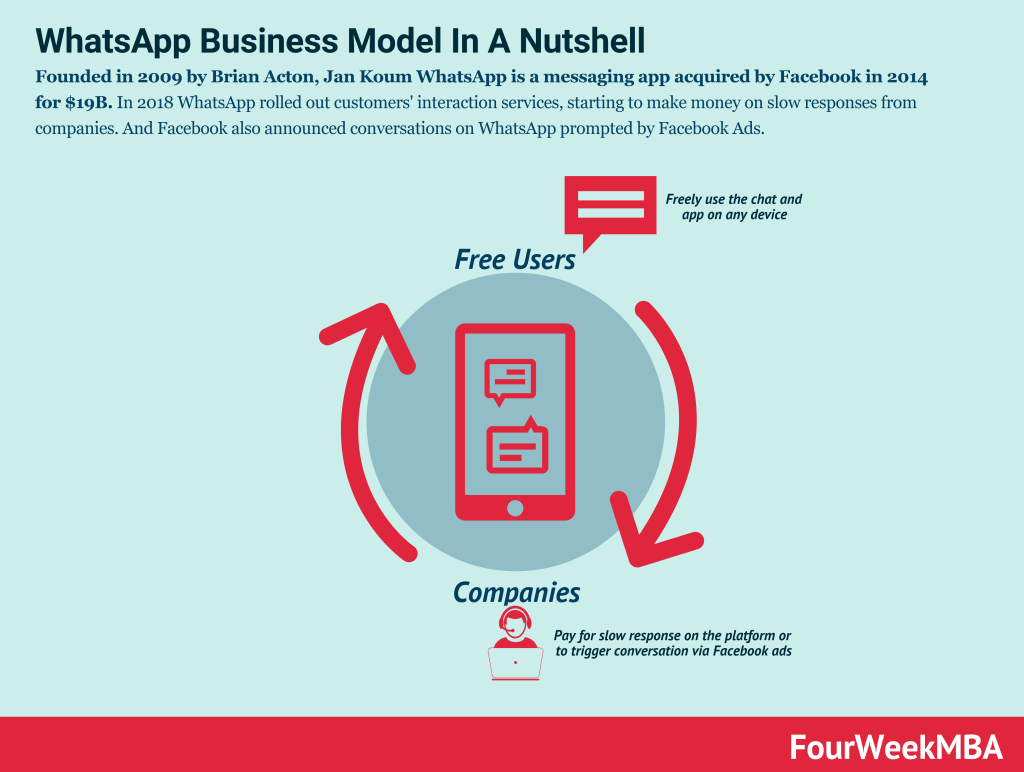
Founded in 2009 by Brian Acton, Jan Koum WhatsApp is a messaging app acquired by Facebook in 2014 for $19B. In 2018 WhatsApp rolled out customers’ interaction services, starting to make money on slow responses from companies. And Facebook also announced conversations on WhatsApp prompted by Facebook Ads.
Facebook is characterized by a multi-faceted matrix organizational structure. The company utilizes a flat organizational structure in combination with corporate function-based teams and product-based or geographic divisions. The flat organizational structure is organized around the leadership of Mark Zuckerberg and the key executives around him. On the other hand, the function-based teams are based on the main corporate functions (like HR, productmanagement, investor relations, and so on).
Gennaro Cuofano is a CRO and tech executive who has worked in AI since late 2015, starting with bringing NLP, natural-language generation, voice and chatbot products to the marketing industry. His background is in law and finance: he holds a Master's degree in Law and an International MBA with an emphasis on corporate finance (LUISS Business School and the University of San Diego, 2012), and worked as a financial analyst at a real-estate investment firm in San Diego and as an assistant controller. His work focuses on business model strategy, business engineering and, more broadly, structural analysis: how companies make money, read from their own filings. He created FourWeekMBA and leads research there and at The Business Engineer, his newsletter on AI and business strategy, with over 95,000 subscribers and more than 1,000 published analyses. His writing has also appeared on Entrepreneur (for example, How to Digitize a Family Business in Europe) and HackerNoon. Find him on LinkedIn and Substack. See how we source.
Scroll to Top
Discover more from FourWeekMBA
Subscribe now to keep reading and get access to the full archive.





![Content Marketing Strategy vs Meta/Facebook Growth Strategy: Key Differences & When to Use Each [2026]](https://i0.wp.com/fourweekmba.com/wp-content/plugins/contextual-related-posts/default.png?resize=150%2C150&ssl=1 "Content Marketing Strategy vs Meta/Facebook Growth Strategy: Key Differences & When to Use Each [2026]")


